
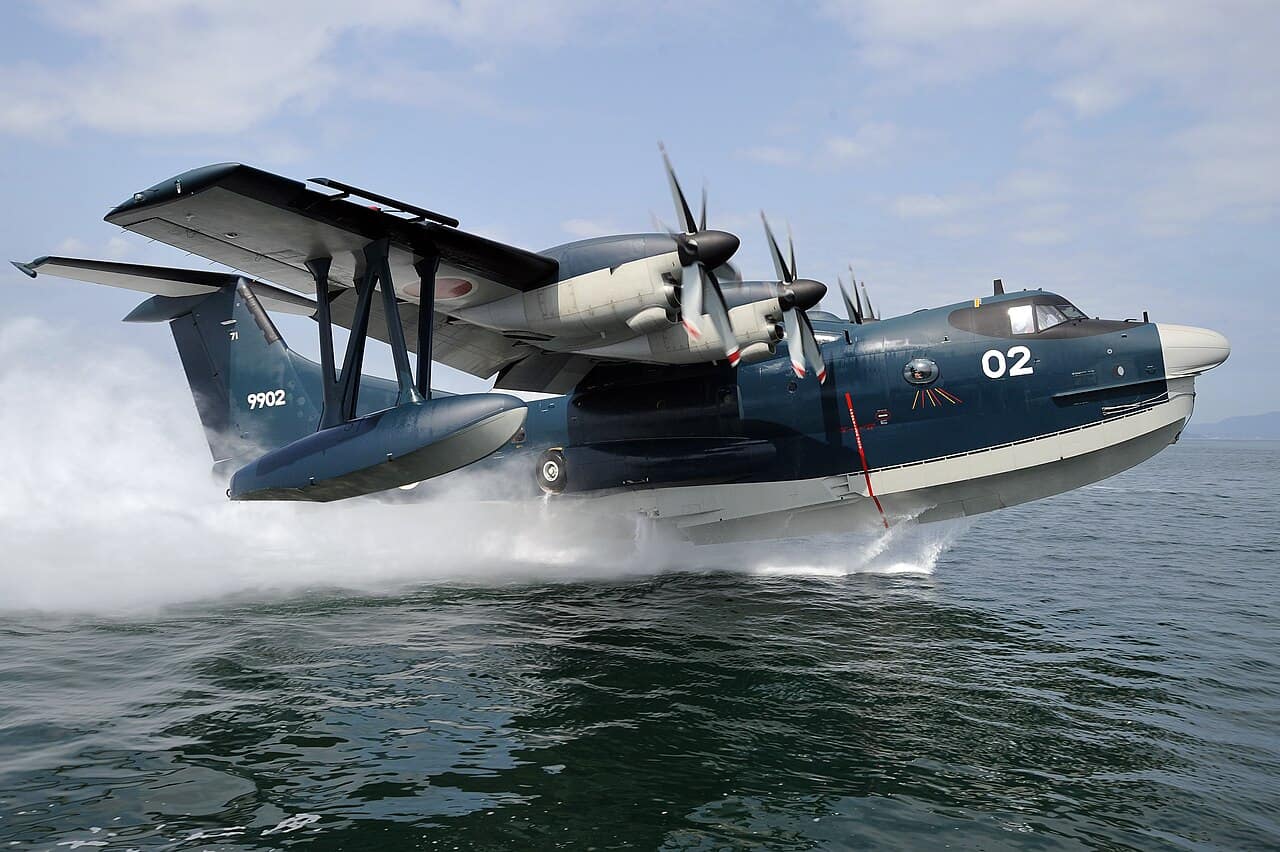
Almost nobody outside Japan knows the ShinMaywa US-2 exists. It does not appear at international air shows. It is not exported. It has never fought in a war. It is not stealth. It does not break sound barriers. What it does do is land a 47-ton four-engined aircraft on three-metre Pacific swells, taxi over them at flight idle, and take off again — and there is no other aircraft in the world capable of doing the same thing.
The US-2 is the last in a direct lineage of large open-ocean flying boats stretching back to the Kawanishi H8K of the Second World War. Japan is, geographically, the country that needs them most. The Japanese exclusive economic zone is about 4.5 million square kilometres of Pacific Ocean. A helicopter cannot reach a fisherman in distress 700 kilometres south-east of Tokyo before his life raft sinks. A conventional fixed-wing aircraft cannot land. The US-2 can do both.
Quick Facts
| Operator | Japan Maritime Self-Defense Force (JMSDF), 71 Air Group |
| Manufacturer | ShinMaywa Industries, Kobe |
| First flight | 18 December 2003 |
| Entered service | 2007 |
| Number built | 9 (one written off in 2015) |
| Engines | Four Rolls-Royce AE 2100J turboprops, 4,591 shp each |
| Maximum take-off weight | 47,700 kg |
| Range | 4,700 km |
| Sea-state capability | Up to Sea State 5 — wave heights of 3 metres |
| Take-off run on water | 280 metres at maximum gross weight |
The aerodynamic conjuring trick
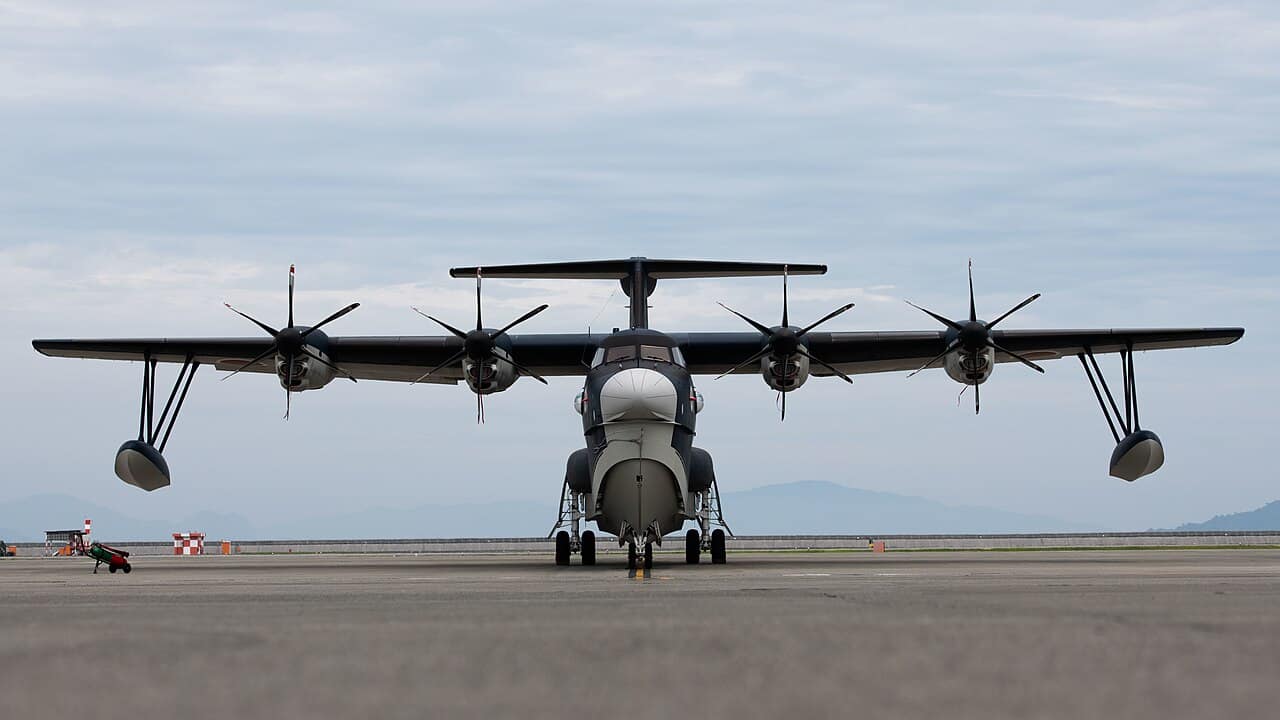
The US-2 looks, from a distance, like a slightly oversized conventional turboprop transport. Up close, the differences become obvious. The wing is mounted very high, like a parasol, leaving the fuselage well clear of the water. The fuselage itself is a true boat hull — sharp keel, planing step, flared chines. The four Rolls-Royce AE 2100J turboprops drive six-bladed Dowty propellers that can be reversed in flight to act as decelerators. And the wing trailing edge is fitted with one of the most aggressive boundary-layer control (BLC) systems ever installed on a production aircraft.
The BLC works like this: a small auxiliary turbine in the fuselage bleeds compressed air from the engines and ducts it through manifolds buried inside the wing. At low airspeed — below 100 knots — high-pressure air is blown out of slots along the leading edge of the flaps. The blown air re-energises the boundary layer of slow-moving air over the wing, keeping the airflow attached at angles of attack that would normally produce a complete stall. The result is that the US-2 can fly stably at speeds as low as 50 knots — slower than a Cessna 172 — in an aircraft weighing over 40 tonnes.
Three-metre seas, three hundred metres of water
The number that matters in any open-ocean rescue aircraft specification is sea-state capability — the height of waves the aircraft can land and take off in. A heavy helicopter cannot land at all in significant seas. The American HC-130 with rescue swimmers can drop equipment but cannot recover survivors. The Russian Be-200 firefighter amphibian is rated to about 1.2-metre waves. The US-2 is rated to 3-metre waves — Sea State 5, which is what you get in a moderately bad day in the open North Pacific.
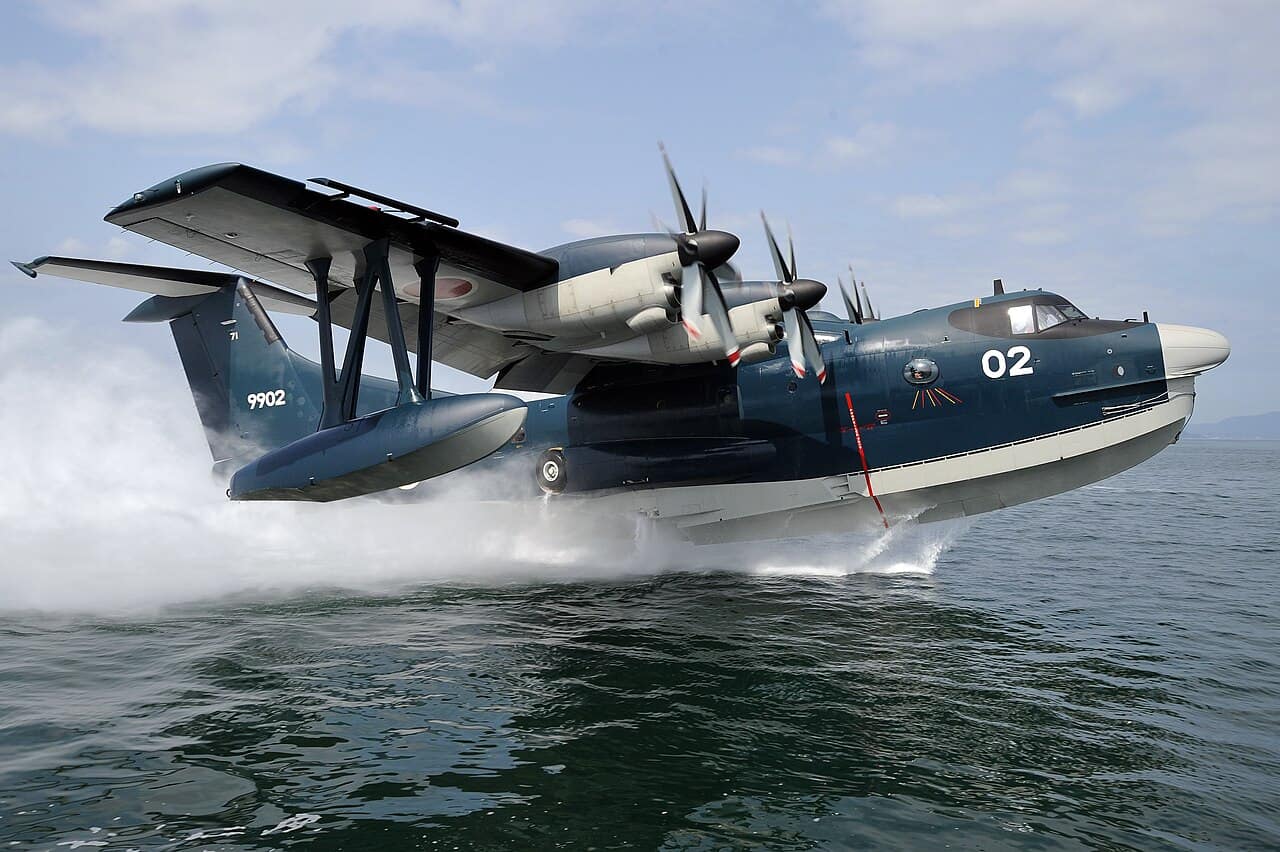
What makes Sea State 5 possible is the combination of the BLC system and the planing hull geometry. The blown wing lets the US-2 approach at 50 knots — slow enough that the impact with a wave crest is survivable rather than catastrophic. The flared chines push water outward and downward, preventing the spray from being ingested by the engines. The four turboprops can be precisely controlled to walk the aircraft through the swells during taxi.
US-2 crews describe a water landing less as a conventional touchdown than as matching the aircraft’s speed to the dominant wave pattern — timing the touchdown for the back of a swell, holding the nose up until the hull settles into the trough, then bringing the throttles back and letting the boat take over.
Real rescues, real distance
The US-2 has performed dozens of open-ocean rescue missions, almost none of which receive any international press. The most famous is the June 2013 rescue of two sailors — blind yachtsman Mitsuhiro Iwamoto and TV newscaster Jirō Shinbō, whose yacht sank after striking a whale roughly 1,200 kilometres offshore — a distance no helicopter in the JMSDF inventory could have reached. A US-2 located the men in their life raft, landed on the swells, recovered them, took off again, and flew home. Both survived.
Other documented missions include rescues from cargo ships in the Philippine Sea, from fishing vessels off Iwo Jima, and from a Singaporean container ship 700 kilometres south-east of Tokyo. In each case the US-2 was the only available aircraft capable of completing the mission. The aircraft has never found an export customer — most notably, an extended Indian effort to acquire a fleet of US-2s, negotiated from the early 2010s onwards, ultimately collapsed over price and technology-transfer disagreements — and the type remains, in some respects, a uniquely Japanese national asset.
A doctrine no other navy maintains
Why does Japan maintain this aircraft, and no other navy does? The answer is partly geography — no other major navy has an exclusive economic zone the size of Japan’s with that few accessible airfields — and partly doctrine. Most maritime rescue agencies have moved to a helicopter-plus-tanker-aircraft model. The JMSDF has decided that the model breaks at distance: a helicopter from a forward-deployed tanker still needs a tanker, and most of Japan’s EEZ is too far for a helicopter operating from anything except a carrier.
The US-2 also has a wartime mission that the JMSDF rarely discusses openly. In the event of a Pacific naval engagement, the US-2 is the only Japanese aircraft capable of recovering shot-down pilots from open water in conditions where a helicopter cannot operate. The Japanese exclusive economic zone is, in defence terms, an enormous body of water in which the survival of a friendly aviator is currently dependent on a fleet of seven aircraft that nobody outside Japan really notices.
Inside Japan’s US-2 — a deep dive into one of the most capable, least-known military aircraft in service today.
Sources: Wikipedia; ShinMaywa Industries technical brochures; JMSDF 71 Air Group public releases; Combat Aircraft.
Related Posts
 English
0 Comments