

On 1 May 1960, the Eisenhower administration told the world that a NASA weather research aircraft had gone missing over Turkey. It was a carefully constructed lie — and it lasted exactly four days. On 5 May, Soviet Premier Nikita Khrushchev revealed that they had shot down an American spy plane deep over Soviet territory, near Sverdlovsk in the Ural Mountains. The pilot, Francis Gary Powers, was alive and in Soviet custody. The Cold War had just acquired its most embarrassing and dangerous incident yet.

The Aircraft That Was Supposed to Be Untouchable
The Lockheed U-2 was the product of the CIA and Lockheed's legendary Skunk Works, developed in the mid-1950s under conditions of extreme secrecy. It was designed around a single premise: fly high enough and no Soviet weapon can reach you. At 70,000 feet — well above the service ceiling of any Soviet interceptor or surface-to-air missile system of the era — a U-2 could photograph Soviet territory with impunity. The cameras it carried could resolve objects six inches across from thirteen miles up.
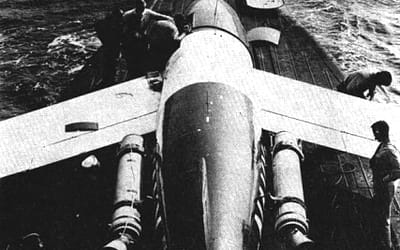
The aircraft itself was extraordinary: a jet-powered glider, built around a massive wing for maximum lift in thin air, with a single Pratt & Whitney J75 engine. It was difficult to fly, unstable at speed, prone to flameout at altitude. The pilots wore full pressure suits — essentially early spacesuits — and breathed pure oxygen for an hour before each mission to purge nitrogen from their blood. A U-2 mission over the Soviet Union typically lasted nine to ten hours.
The Mission That Went Wrong
Francis Gary Powers was a 30-year-old CIA contract pilot from Virginia who had been flying U-2 missions for four years. His mission on 1 May 1960 — designated Operation Grand Slam — was the most ambitious yet: a complete overflight of the Soviet Union from Peshawar, Pakistan, to Bodø, Norway, photographing military and industrial sites including the Sverdlovsk missile production complex.
Near Sverdlovsk, a salvo of Soviet SA-2 Guideline surface-to-air missiles detonated near the aircraft. One of them — possibly the shockwave rather than a direct hit — damaged the U-2, which went into an uncontrolled descent. Powers survived the break-up, parachuted, and was captured by Soviet civilians shortly after landing. He had been given a suicide pin — a needle laced with shellfish toxin — but chose not to use it.
“The CIA told Eisenhower the pilot could not survive. They were wrong. Powers was alive, in Soviet hands, and the cover story was already unravelling.”
— The 1960 U-2 crisisThe Diplomatic Catastrophe

The timing could not have been worse. A major superpower summit was scheduled in Paris for 16 May 1960 — the first such meeting in five years, and one that held real hopes of reducing Cold War tensions. Khrushchev arrived in Paris, demanded a formal apology from Eisenhower, and when none was forthcoming, walked out. The summit collapsed. The brief thaw in Cold War relations froze solid again.
In Moscow, Powers was tried publicly for espionage and sentenced to ten years — three in prison, seven in a labour camp. He served one year and nine months. On 10 February 1962, on the Glienicke Bridge in Berlin — the so-called "Bridge of Spies" — he was exchanged for Rudolf Abel, a senior Soviet intelligence officer who had been arrested in the United States in 1957. The bridge would become famous for exactly these kinds of exchanges.
What It Changed
The U-2 incident forced a fundamental re-evaluation of American intelligence strategy. If a pilot could be captured and a cover story demolished within days, human reconnaissance missions over Soviet territory were too politically risky to continue at scale. The solution was already in development: reconnaissance satellites. The Corona programme, which had been running in parallel with U-2 operations, began returning usable imagery in August 1960 — three months after Powers was shot down. The era of overhead satellite reconnaissance had arrived, and it would never create the kind of diplomatic crisis that a captured pilot could.
Powers returned to the United States to a mixed reception. Some considered him a hero; others were critical of his failure to destroy the aircraft and his survival. He later worked as a test pilot for Lockheed and as a traffic reporter for a Los Angeles radio station, flying a helicopter. He died in a helicopter accident in 1977, aged 47. In 2012, he was posthumously awarded the Silver Star, the Prisoner of War Medal, and the Distinguished Flying Cross. The Cold War took a long time to settle its debts.
Sources: CIA historical records (declassified); Francis Gary Powers Jr. & Curt Kent, Operation Overflight (2004); National Security Archive; National Air and Space Museum.
Related Questions
What was the 1960 U-2 incident?
The 1960 U-2 incident occurred when the Soviet Union shot down an American Lockheed U-2 spy plane deep over its territory near Sverdlovsk on 1 May 1960. The pilot, Francis Gary Powers, survived and was captured. The event exposed a US cover story, wrecked a superpower summit and became a defining Cold War crisis.
Who was Francis Gary Powers?
Francis Gary Powers was a 30-year-old CIA contract pilot who had flown U-2 reconnaissance missions for four years. Shot down over the Soviet Union on 1 May 1960, he parachuted, was captured, and was sentenced to ten years for espionage. He served one year and nine months before being exchanged in 1962.
How was the U-2 spy plane shot down?
Near Sverdlovsk in the Ural Mountains, a salvo of Soviet SA-2 Guideline surface-to-air missiles detonated near the U-2. The blast — possibly a shockwave rather than a direct hit — sent the aircraft into an uncontrolled descent. The U-2 had been considered untouchable at its 70,000-foot cruising altitude until that day.
What made the Lockheed U-2 special?
The Lockheed U-2 Dragon Lady was built by the CIA and Lockheed's Skunk Works to fly above 70,000 feet, beyond the reach of 1950s Soviet interceptors and missiles. Essentially a jet-powered glider with an enormous wing, its cameras could resolve objects six inches across from thirteen miles up. Its successor, the SR-71 Blackbird, flew even higher and faster.
What happened to Gary Powers after he was captured?
Powers was tried publicly in Moscow, convicted of espionage and sentenced to ten years. On 10 February 1962 he was exchanged on Berlin's Glienicke Bridge — the "Bridge of Spies" — for Rudolf Abel, a senior Soviet intelligence officer arrested in the United States in 1957. Powers had served less than two years.
How did the U-2 incident change spying?
The U-2 incident showed that piloted reconnaissance over the Soviet Union was too politically risky, since a captured pilot could demolish a cover story within days. The US accelerated the Corona programme, and reconnaissance satellites soon took over deep-territory spying. Aircraft like the high-flying SR-71 Blackbird continued more limited overflight missions.
Why did the 1960 Paris summit collapse?
A major US–Soviet summit was scheduled in Paris for 16 May 1960, raising hopes of easing Cold War tensions. But after the U-2 shootdown, Soviet Premier Nikita Khrushchev demanded an apology that President Eisenhower would not give, and the Soviet leader walked out. The brief diplomatic thaw froze solid again.
0 Comments