
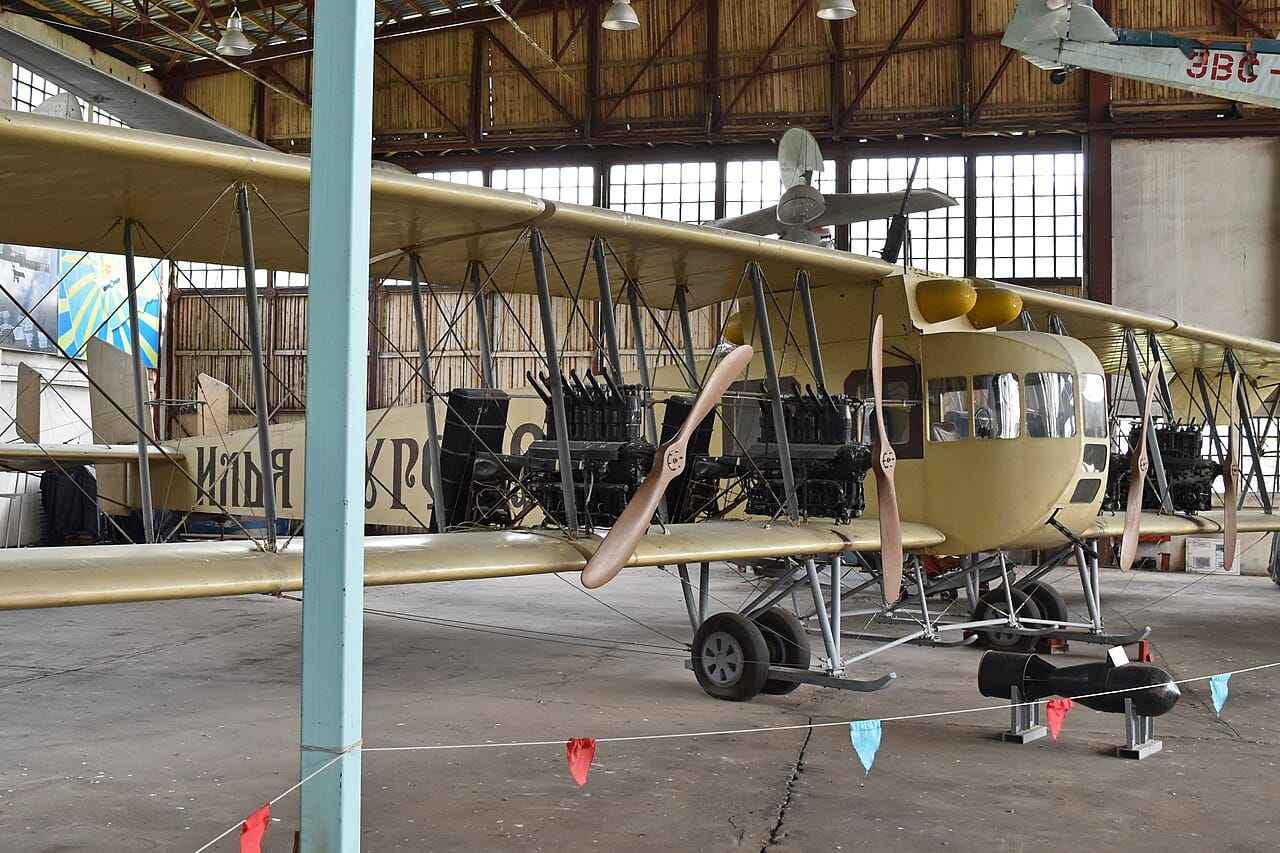
On 11 February 1914, in a freezing Saint Petersburg morning, a 24-year-old aircraft designer named Igor Sikorsky climbed into a giant four-engine biplane he had built, gathered sixteen passengers, and flew them through the air. None of them had any obvious reason to be there. Two were factory workers along for the experience. There was also a dog aboard.
It was the largest passenger flight in history to that date — 16 people aloft simultaneously, in a heated wood-and-fabric cabin furnished with wicker chairs, a small dining table, electric lights powered by a wind generator, and the first onboard lavatory ever installed in an aircraft.
The aircraft was called the Ilya Muromets, named after a hero of medieval Russian folk legend. And by the time the First World War broke out six months later, it would be turned, almost overnight, into history’s first purpose-built strategic bomber.
Quick Facts
Designer: Igor Sikorsky
Manufacturer: Russo-Baltic Carriage Factory (RBVZ), Saint Petersburg
Type: Four-engine heavy biplane, original luxury airliner / WWI bomber
Maiden flight: December 1913
Length × wingspan: 17.5 m × 32 m
Maximum bomb load: 800 kg (1,760 lb)
Crew (military): 4–8, with positions for up to nine machine guns, including the first-ever tail gunner
Combat sorties WWI: Over 400 missions, 65 tons of bombs dropped
Combat losses: 1 to enemy action (the air war’s most lopsided strategic-bomber record)
A Luxury Airliner Before Anyone Wanted One
Sikorsky designed the Muromets to prove something nobody in 1913 believed: that an aircraft could be both large and reliable. The conventional wisdom was that bigger meant heavier, which meant more underpowered, which meant more dangerous. Sikorsky’s response was to add engines until the maths worked. Four 100-horsepower Argus inline engines, mounted on the lower wing, gave the Muromets enough thrust to fly even with one or two engines stopped.
The interior was deliberately, ostentatiously luxurious. Wicker passenger chairs. A heated cabin (revolutionary — most aircraft were open-cockpit). Electric reading lights, powered by a small windmill outside the fuselage. Carpet. A small kitchen for hot food in flight. And — this was the part the press kept talking about — an actual flushing lavatory, the first ever installed in an aircraft.
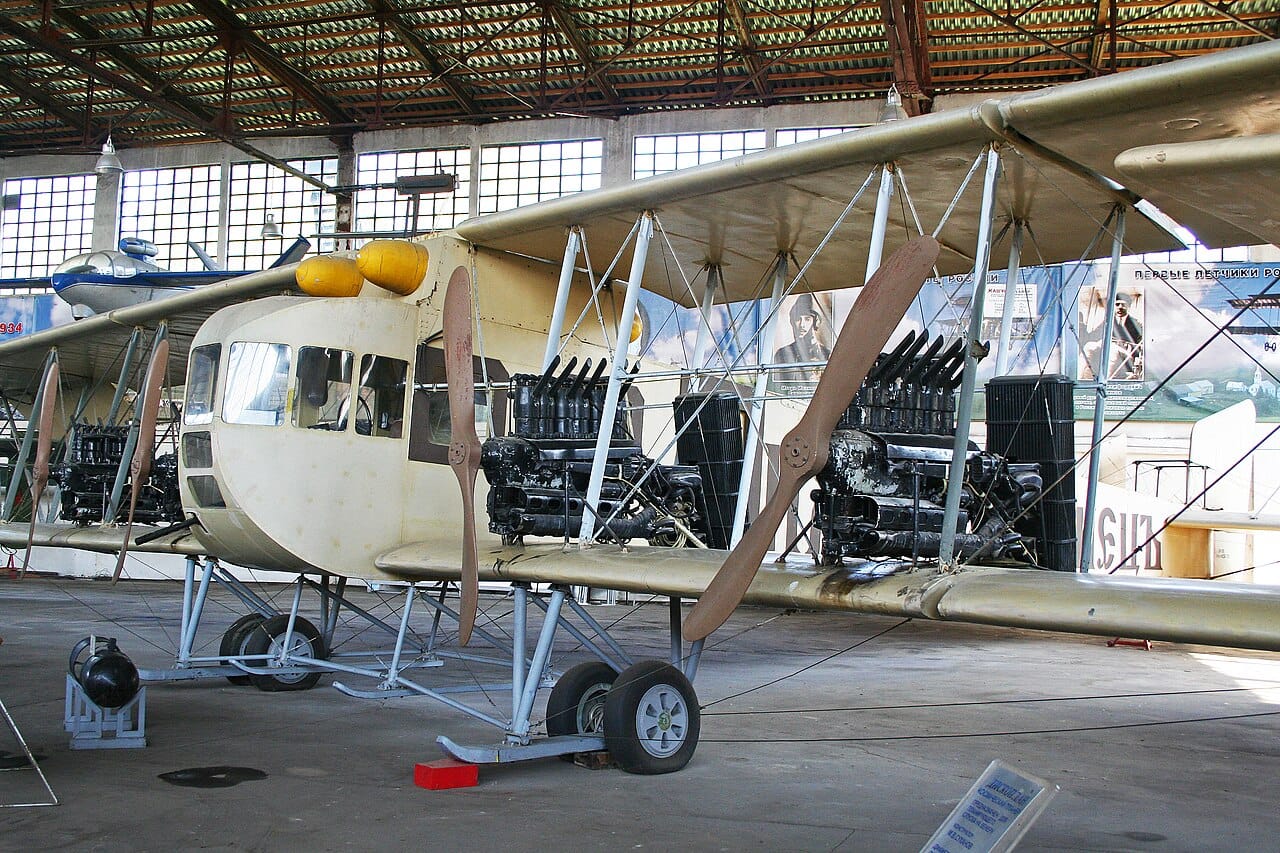
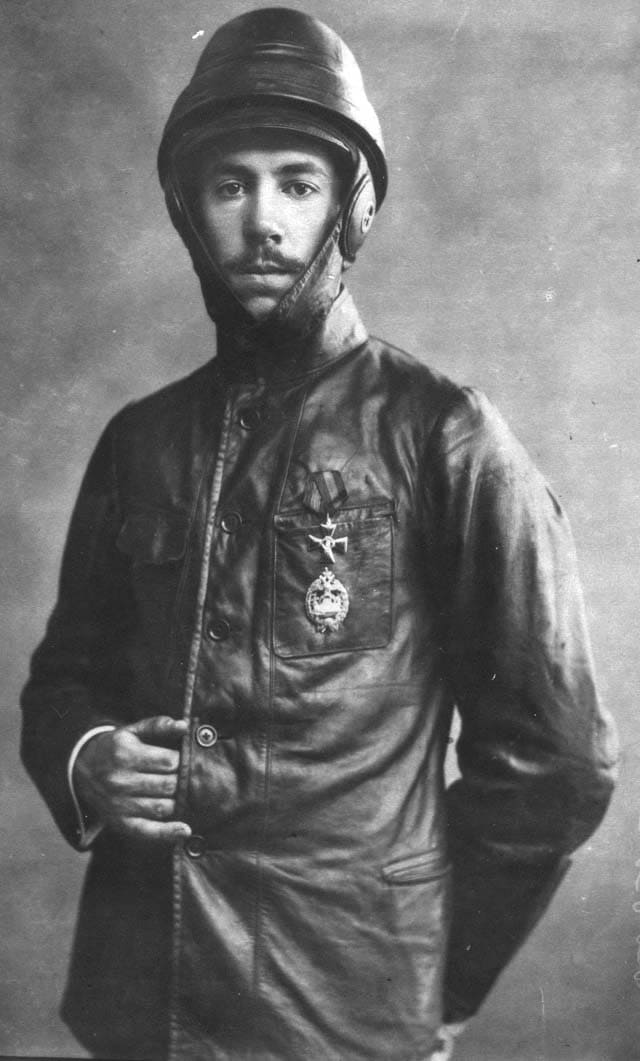
Sikorsky himself piloted the type on most of its demonstration flights. In June–July 1914, he and his crew flew an Ilya Muromets from Saint Petersburg to Kyiv and back — a round trip of about 2,500 km — in around 28 hours’ flying time. The flight included one unscheduled landing in a field, where the crew slept under a hayrick before continuing. It set a world distance record by a margin no other aircraft of the era could approach.
The Day War Turned the Muromets Into a Bomber
On 28 July 1914 the First World War began. The Russian Imperial Air Service had no clear use for a luxury airliner. But it had a desperate, immediate need for an aircraft capable of carrying explosives across enemy lines and dropping them on something useful.
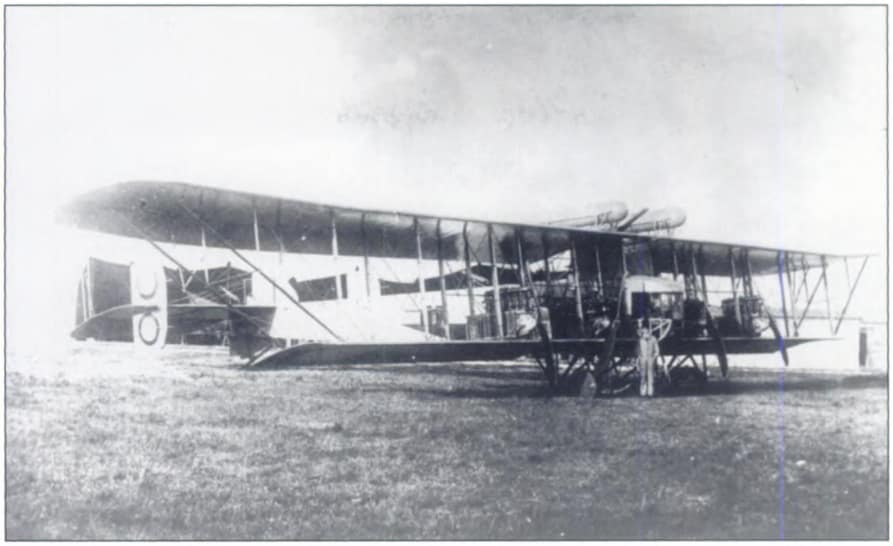
By autumn 1914 the Muromets had been stripped of its wicker chairs and dining table. Bomb racks were fitted in the converted passenger compartment. Internal racks could carry up to 800 kg of bombs — a payload no other aircraft in the world could match. Defensive machine gun positions sprouted from every available angle. In the S-25 Geh-2 variant of March 1916, Sikorsky added something nobody had ever flown before: a position for a tail gunner.
The Combat Record That Should Be Famous
The Squadron of Flying Ships — the Russian unit operating the Muromets in combat — flew over 400 missions across the Eastern Front between 1915 and 1917. They dropped 65 tons of bombs. They struck German railway lines, supply dumps, troop concentrations and airfields, often hundreds of kilometres behind the front line.
And in three years of combat, they lost exactly one Ilya Muromets to enemy action.
That single loss happened on 12 September 1916, when an Ilya Muromets was attacked by four German Albatros fighters during a long-range mission. Before going down, the Muromets’ machine gunners shot down three of the four attackers — quite possibly the largest single defensive engagement of the entire First World War.
Three other Muromets were damaged in air combat but managed to limp home. The aircraft’s combination of multiple machine guns, robust airframe and four-engine redundancy made it almost impossible for contemporary single-engine fighters to bring down. The British, French and Germans were all trying to build something equivalent. None of them succeeded before the war ended.
Why History Forgot the Ilya Muromets
The Muromets is one of the most consequential aircraft ever built, and almost nobody outside Russia has heard of it. The reason is straightforward: the Russian Revolution erased the aircraft from Western aviation memory.
When the Bolsheviks took power in 1917, the Russo-Baltic Carriage Factory was nationalised. Igor Sikorsky himself fled — first to Paris, then to the United States, where he would go on to invent the modern practical helicopter in 1939. The Muromets squadron disbanded. The surviving airframes were used briefly in Soviet civil aviation, then scrapped by the late 1920s.
No original Ilya Muromets survives. The one on display at the Monino Air Force Museum near Moscow is a faithful 1979 replica. Sikorsky’s design papers were either destroyed or scattered in the revolutionary chaos. By the time the Soviet Union got around to writing its own aviation history in the 1930s, the Muromets had become a politically awkward subject — a tsarist-era masterpiece designed by an émigré who had defected to America.
Western aviation history, meanwhile, focused on its own World War I designs: the Sopwith Camel, the Spad XIII, the Gotha bombers. The Russian aircraft that had pioneered heavy strategic bombing years before the twin-engined British Vickers Vimy or German Gotha G.V was essentially ignored.
What the Muromets Made Possible
Every four-engine bomber that followed — the Vickers Virginia, the Boeing B-17 Flying Fortress, the Avro Lancaster, the Boeing B-29 Superfortress, the Boeing B-52 — descends in some real engineering sense from the Ilya Muromets. The configuration (four engines, large internal bomb bay, multiple defensive gun positions including a tail gunner) was Sikorsky’s invention in 1914. The doctrine (long-range, high-payload, formation defence) was developed by the Squadron of Flying Ships in 1915-1917.
By the time the world’s air forces rediscovered strategic bombing in the late 1930s, they were essentially rebuilding what Igor Sikorsky had figured out twenty-five years earlier. The Muromets’s combat record over the Eastern Front was the proof of concept. Every Strategic Air Command bomber pilot, every RAF Bomber Command navigator, every Soviet Long-Range Aviation crew flew aircraft whose lineage runs straight back to a freezing morning in Saint Petersburg in 1914.
The first heavy bomber was, fittingly, also history’s first true airliner. Igor Sikorsky built the future twice, in the same airframe, before anyone else had built it once.
Sources: Wikipedia (Sikorsky Ilya Muromets); Igor Sikorsky Historical Archives; Military Factory; Smithsonian Air & Space Magazine.


 English
0 Comments