
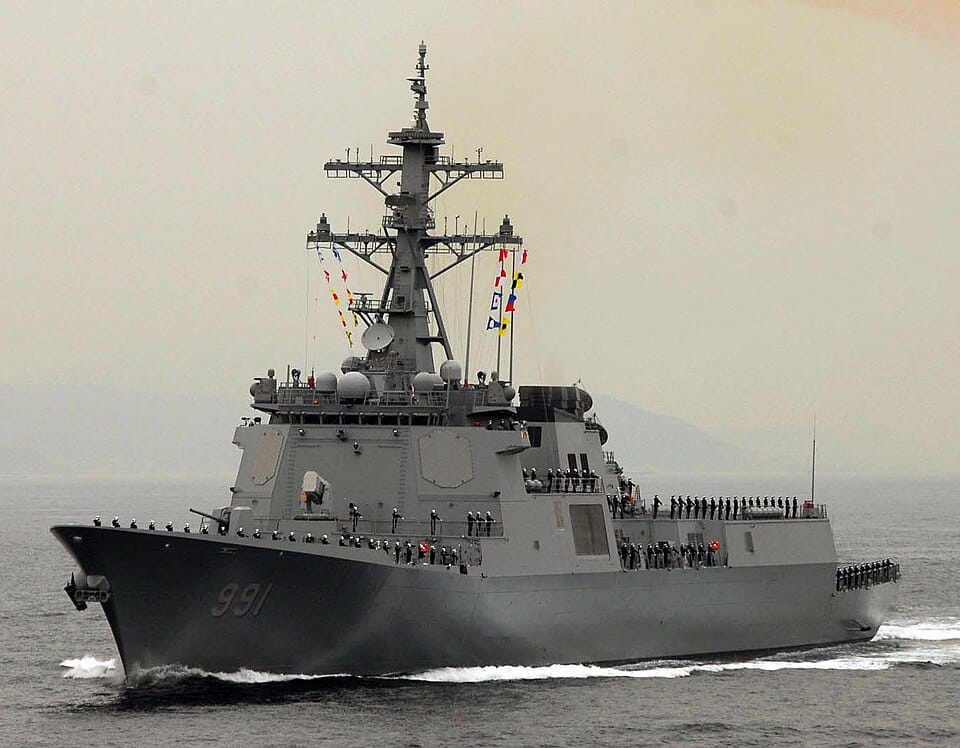
In a conference room in Washington on a Monday morning, two defence ministers sat across a table and began a conversation that could reshape Asia’s role in the Middle East. Pete Hegseth, America’s Secretary of Defense, has made “stand shoulder-to-shoulder” the closest thing his Pentagon has to a foreign policy doctrine. Across from him: Ahn Gyu-back, South Korea’s Defence Minister, who had flown across an ocean carrying a question his government was not yet ready to answer.
Should South Korea join the Hormuz blockade? Ahn told reporters at the Washington press conference that Seoul is reviewing a “phased contribution” to Gulf security operations. The phrasing is diplomatic. The implications are not. An Asian power formally joining a Middle Eastern naval operation would be a significant departure from South Korea’s postwar strategic culture. Seoul has historically kept its military engagements close to home. Hormuz is 7,000 kilometres away.
Then a South Korean-operated vessel was attacked near the Strait last week. That changed the conversation entirely.
Quick Facts
- Meeting: South Korean Defence Minister Ahn Gyu-back met US SecDef Pete Hegseth in Washington on Monday
- Seoul Position: Reviewing “phased contribution” to Hormuz security
- Possible Contributions: Political support, personnel, intelligence-sharing, military assets
- Trigger: South Korean-operated vessel attacked near Hormuz last week
- US Pressure: Hegseth urging allies to stand shoulder-to-shoulder
- Also Discussed: OPCON transfer timeline from US to South Korea
The Attack That Changed the Calculation
For years, South Korea watched the Hormuz crisis from a safe distance. Seoul imports roughly 70% of its crude from the Middle East, but the country had avoided taking sides in a conflict it considered geographically remote. Then a Panama-flagged cargo vessel operated by South Korea’s HMM was struck near the Strait. Suddenly, the crisis was no longer theoretical.
Details of the attack remain limited at time of publication. But the principle is clear: once a country’s ships are being targeted, neutrality becomes progressively harder to defend in cabinet meetings. Maritime insurance implications alone create commercial pressure that compounds the security argument. Ahn flew to Washington carrying both concerns.
The “phased contribution” language Seoul is using is carefully calibrated. It leaves maximum flexibility: Seoul could begin with political solidarity, move to intelligence sharing, then deploy naval assets. Each step is reversible. Each step also moves South Korea further into a conflict that began as somebody else’s war.

Hegseth’s Alliance Pressure Campaign
Pete Hegseth has made burden-sharing the defining theme of his Pentagon tenure. Allies who do not contribute tangibly to US-led operations are, in his telling, free riders on American security. The “stand shoulder-to-shoulder” phrase he deployed in Washington is not diplomatic language — it is a test, publicly administered. Seoul knows this. The Monday meeting was as much a performance review as a consultation.
For South Korea, the complicating factor is North Korea. Deploying naval assets to the Gulf of Oman thins a force structure fundamentally designed to deter Pyongyang. South Korean military planning is built around a specific threat 50 kilometres north of Seoul. Every destroyer in the Persian Gulf is a destroyer not in the Yellow Sea. That trade-off does not disappear because Washington wants coalition unity at Hormuz.
Which is why the OPCON discussion surfaced in the same meeting. Seoul’s willingness to contribute to Hormuz is, in part, leverage in a long-running negotiation about Korean Peninsula command authority. Diplomacy rarely happens on a single track.

What an Asian Power in the Gulf Would Mean
South Korea is not the only Asian democracy watching the Hormuz situation with economic anxiety and strategic caution. Japan, India, Australia — all depend on Gulf energy flows, all have capable navies, and all are being watched by Washington for signs of coalition loyalty. Seoul’s decision will signal something to every government in the Indo-Pacific about the price of alliance in the current era.
If South Korea commits military assets — even a single destroyer on a rotational basis — it would mark the first time an East Asian power has deployed combat-capable naval forces to a Middle Eastern conflict zone under a US-led framework. The precedent is significant regardless of the immediate operational impact. It represents a geographic expansion of what South Korea considers its security perimeter.
The “phased” framing suggests Seoul is thinking carefully. A phase can be entered and exited. But the fact that the question is now being asked publicly, in Washington, by a Defence Minister who flew there to discuss it, tells you something about the direction of travel. The answer, when it comes, will matter well beyond Seoul.
Sources: South Korean Ministry of National Defence, Pentagon press briefing, Reuters, Yonhap News Agency, The Korea Herald

 English
0 Comments