
| Quick Facts | |
| What It Is | A mismatch between what your vestibular system senses and what is actually happening to the aircraft |
| Fatality Rate | ~80% of spatial disorientation accidents are fatal (FAA data) |
| Most Dangerous Scenario | VFR pilot enters clouds or loses the horizon at night |
| Time to Lose Control | As little as 60 seconds without visual reference |
| Who It Affects | Every pilot, regardless of experience — the inner ear cannot be trained out of it |
| Prevention | Trust instruments, maintain instrument proficiency, avoid VFR flight into IMC |

Your body is lying to you. Right now, sitting in a chair, your inner ear is doing a flawless job of telling you which way is up. But put that same body inside an aircraft, take away the horizon, and everything it tells you becomes fiction. Your brain will construct a reality that has nothing to do with what the aircraft is actually doing — and you will believe it completely, right up to the moment of impact.
Spatial disorientation kills more general aviation pilots than almost any other single factor. The FAA estimates it plays a role in approximately 80% of accidents involving loss of control — and those accidents are overwhelmingly fatal. Not sometimes fatal. Not often fatal. Nearly always fatal.
The terrifying part isn’t that it happens. The terrifying part is that pilots who experience it don’t know it’s happening.
The Inner Ear’s Fatal Flaw
The vestibular system — the three fluid-filled semicircular canals in your inner ear — evolved to keep you upright on the ground. It detects angular acceleration: when you turn your head, the fluid shifts, tiny hairs bend, and your brain computes the rotation. It works brilliantly at walking speed.
In an aircraft, it fails. The problem is that the semicircular canals only detect changes in rotation rate, not sustained rotation. Enter a gentle, constant-rate turn, and after about 20 seconds the fluid stabilises. Your inner ear now reports that you are flying straight and level — even though the aircraft is banked 30 degrees and turning. When you roll wings-level to correct, the fluid shifts again, and your brain screams that you are now turning the other way. Every correction feels wrong.
This is the leans — the most common form of spatial disorientation. It’s uncomfortable, confusing, and in instrument conditions it can be deadly. Pilots have been found still gripping the controls in a death spiral, convinced they were flying straight.
The Graveyard Spiral
The deadliest scenario unfolds like this: a VFR pilot flies into clouds or loses the horizon at night. Without visual reference, the aircraft enters a gentle bank. The pilot doesn’t notice — the turn rate is below the vestibular threshold. The bank steepens. The nose drops. Speed builds. The pilot senses the acceleration and pulls back on the yoke, tightening the spiral. Within 60 seconds, the aircraft can be in a near-vertical dive at redline speed.
It happens to experienced pilots as often as it happens to students. John F. Kennedy Jr. was a 300-hour pilot when spatial disorientation killed him, his wife, and her sister over the waters off Martha’s Vineyard in 1999. The night was hazy, the horizon invisible, and his inner ear told him a story that ended in the Atlantic.
Trust the Instruments
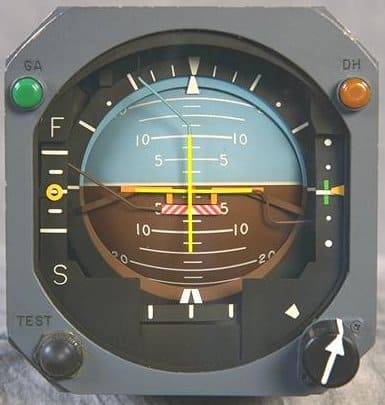
There is no cure for spatial disorientation. You cannot train your inner ear to behave differently. You cannot will yourself to feel the correct attitude of the aircraft. The only defence is the attitude indicator on the instrument panel — the small gyroscopic display that shows your wings’ relation to the horizon, regardless of what your body claims.
Every instrument student learns the mantra: trust the instruments. It sounds simple. In practice, it requires overriding the deepest instincts your body possesses — the same instincts that kept your ancestors alive on the savannah. When every fibre of your being screams that you are turning left, and the attitude indicator says you are wings-level, you must believe the glass.
That’s the paradox at the heart of flying. The human body is an extraordinary machine — until it enters an environment it was never designed for. At that point, the instruments are the only truth you have. Ignore them, and the sky becomes the most convincing liar you’ll ever meet.
Sources: FAA Advisory Circular AC 60-4A, Learn to Fly Blog, Aviation Safety Magazine



 English
0 Comments