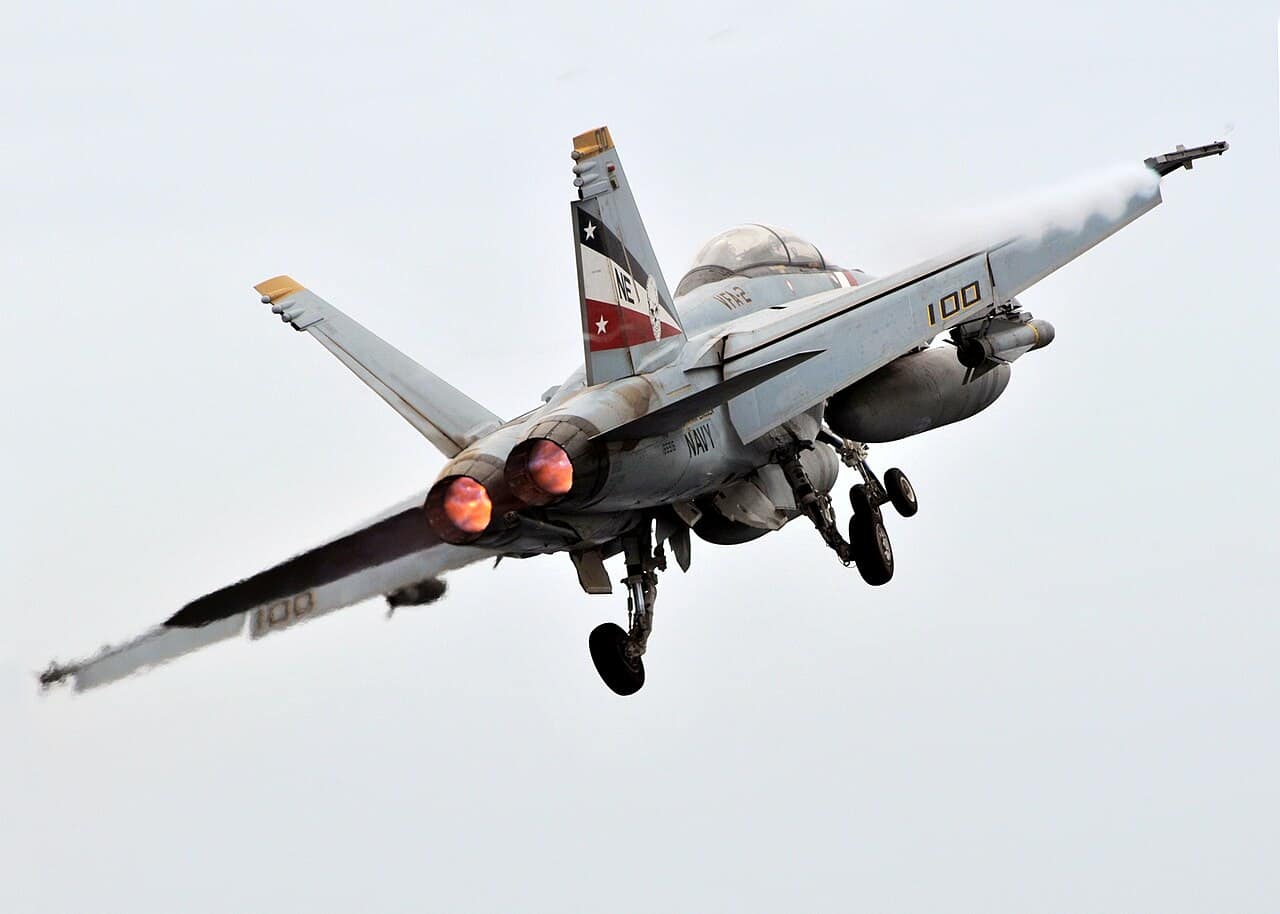
A split-second left-hand turn. A missile detonating just meters behind the canopy. A pilot alive only because chance—or instinct—moved his jet out of a kill zone. On March 25, 2026, a US Navy F/A-18E Super Hornet conducted a low-altitude strafing run near Iran’s Chabahar port and walked away from what should have been a catastrophe.
The incident, captured on video from multiple angles, shows the razor-thin margin between air superiority and disaster. Even the most advanced fighters aren’t invincible below 500 feet.
A Maneuver at the Last Second
The footage tells a stark story. The Super Hornet approaches its target at low altitude, its M61 20mm rotary cannon blazing. The pilot executes his run cleanly—then banks hard left. The turn is sharp, deliberate, the kind of movement that only combat pilots know instinctively.
Frames later, an Iranian MANPADS missile fills the frame behind the departing aircraft. The warhead detonates in a violent bloom of fire and shrapnel, exactly where the jet had been milliseconds before. The pilot is gone. The missile has nothing but empty air.
Whether the pilot saw a threat indicator, heard a warning, or simply made the kind of gut call that separates the living from the dead remains unclear. What matters is this: he moved. And that movement saved his life.
Why the Super Hornet Was Vulnerable
Here’s a detail that should alarm anyone who follows fighter jet design: the F/A-18E/F Super Hornet has no missile launch detection system. None. The jet is equipped with radar warning receivers—crucial for detecting enemy radar—but these systems are essentially useless against infrared-guided MANPADS. An IR missile hunts heat, not radio waves.
At low altitude, flying at high speed over hostile territory, that omission becomes a liability. The pilot has no electronic warning that death is incoming. He flies on faith and situational awareness, relying on eyes, ears, and the accumulated instincts of hundreds of training hours.
This gap in defensive avionics—acceptable perhaps in high-altitude operations where radar coverage and air superiority are guaranteed—becomes lethal below a thousand feet. The Super Hornet is a magnificent aircraft. But it is not designed to absorb punishment from every threat.
The Claims and Denials
The IRGC immediately claimed victory, announcing that the aircraft had been struck and would later crash into the Indian Ocean. It was the kind of declaration that sounds victorious in Tehran and on state media—and sometimes, that’s the only audience that matters.
CENTCOM denied losing any fighter, but the denial carried a notable caveat: they didn’t immediately rule out the near-miss itself. They acknowledged the mission. They acknowledged the threat. What they denied was the kill claim.
The video, however, suggests something in between. The Super Hornet was hit—by proximity, by time, by the narrowest of margins. The jet survived. But survival at 200 knots, fifty feet above a hostile coast, is sometimes just a matter of inches and milliseconds.
What This Tells Us About Modern Air Combat
The incident shatters a comfortable myth: that air superiority equals immunity. The US Navy dominates the skies over Iran. No Iranian fighter would survive a one-on-one engagement with a Super Hornet. But air superiority doesn’t mean you can fly low and slow over enemy territory without risk. It never has.
A man with a MANPADS, crouched in a ditch near Chabahar, changed the equation for one Super Hornet pilot. Tactics matter. Technology matters. But luck—and the instinct honed by years of training—sometimes matter most of all.
This incident won’t change how the Navy flies. The strafing run was necessary. The risk was understood and accepted. But it’s a brutal reminder that even the best pilots, in the best aircraft, operate inside the real world’s margins. And those margins are razor-thin.
Sources: The War Zone; Defense Express; Sandboxx

 English
0 Comments