
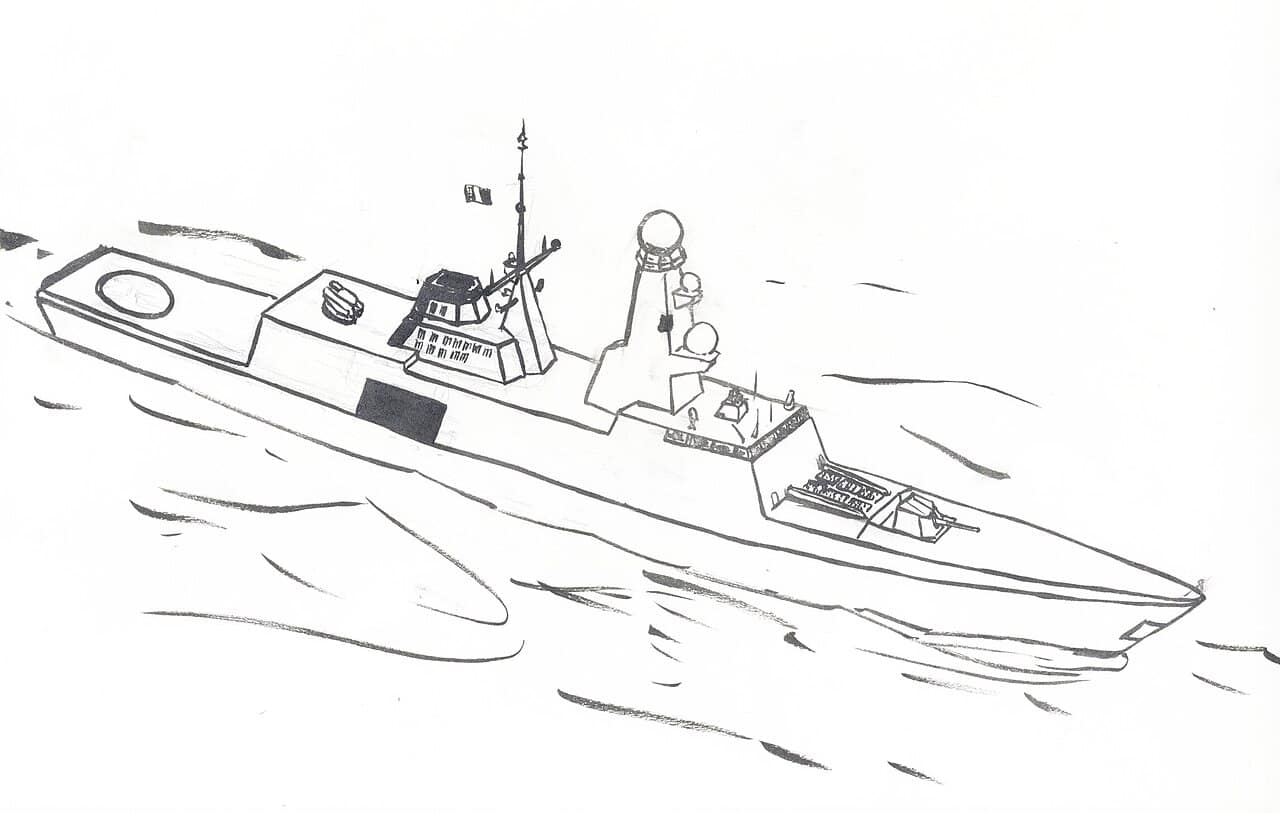
Nobody saw it coming. The Royal Swedish Navy has spent forty years building its surface fleet around shallow-draft, locally-built corvettes optimised for Baltic archipelago warfare — the legendary Visby class, the new Lulea concept, decades of indigenous Saab-Kockums design heritage. The expectation in every defence ministry from Helsinki to Wilhelmshaven was that Sweden’s next major surface combatant would either be built at home or come from the British-Swedish Babcock–Saab team long seen as the favourite.
Instead, Stockholm has picked Paris. Sweden is buying four French Frégates de Défense et d’Intervention (FDI) frigates from Naval Group — a decision that quietly reshapes the European naval shipbuilding map.
Quick Facts
Ships selected: Four frigates (selection decision — contract talks now exclusive to Naval Group)
Class: Frégate de Défense et d’Intervention (FDI)
Builder: Naval Group, Lorient, France
Length: 122 metres
Displacement: 4,500 tonnes
Crew: 125 (plus 28 for embarked helicopter)
Top speed: 27 knots
Primary armament: Aster 15/30 SAMs, Exocet MM40 Block 3 anti-ship missiles, MU90 torpedoes, 76mm gun (French fit — Swedish ships are expected to integrate national weapons such as the RBS 15 missile and Torped 47)
Customer comparison: Also operated by France (Amiral Ronarc’h class) and Greece (Kimon class)
Why this matters
The FDI was designed around a specific hole in the European frigate market: bigger than a corvette, smaller than the FREMM, packed with first-rate combat systems, and offered at a price point closer to €600 million per hull than the €1+ billion typical of a fully kitted Type 26 or FREMM. Naval Group built the class hoping Greece would buy three. Greece did. Then the export pitch went quiet.
Sweden picking the FDI is something different. The Royal Swedish Navy has no recent history of buying French military hardware. It has a long history of buying German, Italian, and American equipment. Switching to French is a deliberate political and industrial signal — Stockholm is hedging against Berlin and tying itself more closely to Paris on continental defence.

What Sweden is actually getting
The FDI is a thoroughly modern combat ship designed for the post-2020 threat picture. The radar is the Thales Sea Fire 500 AESA — a four-fixed-face active electronically scanned array that gives the ship simultaneous 360-degree tracking on every emitter. The vertical launch system fires Aster 15 and Aster 30 surface-to-air missiles, the same family used on French and Italian air defence cruisers. The anti-ship punch comes from Exocet MM40 Block 3 — the same Exocet that crippled HMS Sheffield in the Falklands, updated for the 2020s with land-attack capability.
Critically, the FDI is also one of the first surface combatants in the world designed from the keel up with cyber defence and electronic warfare as primary mission systems, not bolt-on additions. Sweden’s navy has spent the past decade getting jammed, spoofed, and probed in the Baltic by Russian electronic warfare units. The FDI gives them a platform built for that fight.

Swedish content — and what gets left behind
As with every modern European warship order, the FDI deal will be hollowed out for Swedish industrial participation. Swedish systems — including the RBS 15 anti-ship missile and the Torped 47 lightweight torpedo — are expected to be integrated on board. Hägglunds and BAE Systems Sweden will likely supply armour and structural components. Kockums in Karlskrona — Sweden’s flagship shipyard — is expected to stay focused on the submarine programme, with the four frigate hulls built at Naval Group’s Lorient yard.
What gets quietly abandoned is the long-running effort to develop an indigenous Swedish replacement for the Visby corvettes. That programme — sometimes called the next-generation surface combatant — has been on Stockholm’s drawing board for over a decade without producing a hull. Picking the FDI ends the suspense.

The Baltic strategic picture
Sweden joined NATO in 2024 after two centuries of formal non-alignment. With Finland having joined in 2023, the Baltic Sea is now effectively a NATO lake — with the exception of the Russian enclave at Kaliningrad and the Russian Baltic Fleet at St. Petersburg. The Swedish navy’s new strategic role is therefore considerably bigger than it was a decade ago: not just coastal defence of the archipelago, but contribution to NATO-wide sea control across the Baltic, the GIUK gap, and the North Atlantic.
The FDI is a blue-water-capable frigate, not a coastal patrol vessel. Sweden buying four of them signals that Stockholm intends to deploy beyond the Baltic — and to do so in close cooperation with the French Marine Nationale, which has steadily built up its own Baltic and North Sea presence since 2022.
Sources: Naval Group press releases; The War Zone; Defense News; Swedish Defence Materiel Administration (FMV); French Ministère des Armées.


 English
0 Comments