
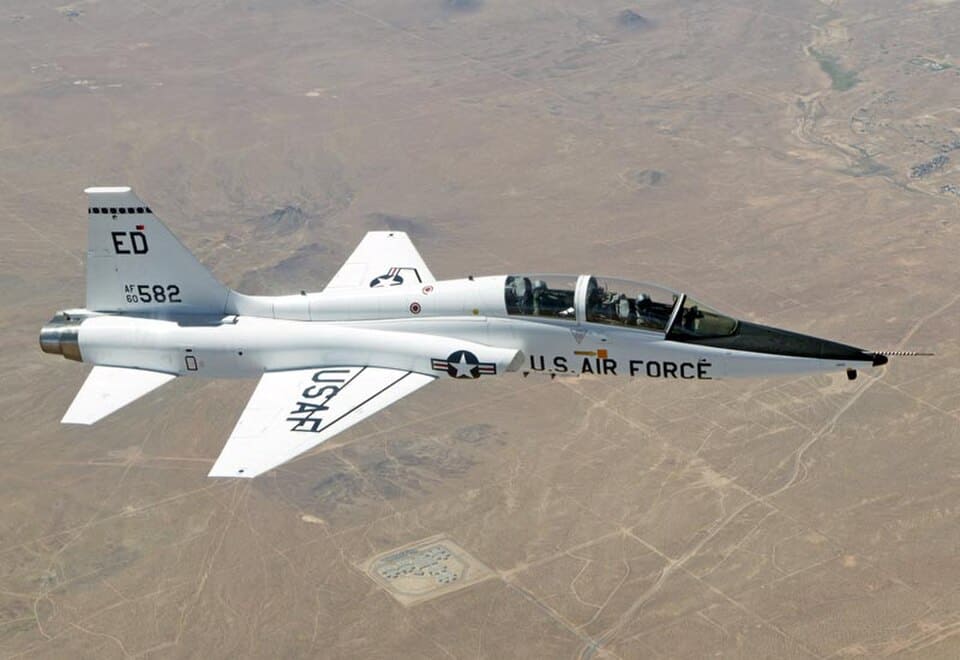
The entire U.S. Air Force T-38 Talon fleet has been grounded. Every single one of the venerable white-and-blue trainers — the jet that has taught virtually every American fighter pilot since the Kennedy administration how to fly fast — is sitting silently on ramps across the country, parked after an operational pause was ordered on May 19 after a T-38 from Columbus Air Force Base, Mississippi, crashed in rural Lamar County, Alabama, on May 12. Both pilots ejected safely, which is the good news. The bad news is that the Air Force’s most ancient jet just reminded everyone, loudly, that it is overdue for retirement.
The operational pause — military speak for “grounded until we figure out what went wrong” — affects every major command that operates the T-38: Air Education and Training Command, Air Combat Command, Air Force Materiel Command, and Air Force Global Strike Command. That is a sprawling footprint for a trainer, and it underscores just how deeply embedded the Talon remains in the Air Force’s daily operations, more than sixty years after it first flew.
🚨 Status: Entire T-38 Talon fleet under operational pause
📅 Crash date: May 12, 2026 — Columbus AFB jet, down in Lamar County, Alabama
📅 Pause announced: May 19, 2026
✅ Crew status: Both pilots ejected safely
🏗 Commands affected: AETC, ACC, AFMC, AFGSC
🕓 Aircraft age: 60+ years in service (first flight: April 10, 1959)
🔄 Replacement: Boeing T-7A Red Hawk nearing production
Sixty Years and Counting
The T-38 Talon first flew on April 10, 1959 — the same year Alaska and Hawaii became states, Fidel Castro took power in Cuba, and the average price of a new house was $12,400. To say it has had a long career is an understatement of almost comic proportions. The Talon has trained more military pilots than any other supersonic trainer in history, churning out generations of aviators who went on to fly everything from F-4 Phantoms in Vietnam to F-22 Raptors over Syria. NASA used it as a chase plane and astronaut proficiency aircraft. The Thunderbirds flew it in the 1970s and early 1980s. It is, without exaggeration, one of the most consequential aircraft in American military history.
Columbus AFB is home to the 14th Flying Training Wing, one of the Air Force’s primary undergraduate pilot training bases. Student pilots there fly a progression from the T-6A Texan II to the T-38C, learning the fundamentals of high-performance jet flying before moving on to their operational aircraft. With the T-38 fleet parked, those students are being redirected to simulators — which are good, but not the same as feeling the kick of two General Electric J85 engines pushing you through 500 knots at 30,000 feet.
The tension is one that Air Education and Training Command leaders have acknowledged for years: the T-38 has more than earned its place in history, but every grounding is another reminder that a 1960s airframe is being asked to carry a modern training mission — and that its replacement cannot arrive soon enough.
Enter the T-7A Red Hawk
The T-38’s designated successor, the Boeing T-7A Red Hawk, has been in development since Boeing won the contract in 2018. Named after the Tuskegee Airmen and their iconic red-tailed P-51 Mustangs, the T-7A is a clean-sheet design built with digital engineering and advanced manufacturing techniques. It features a modern glass cockpit, a single General Electric F404 engine, and the ability to simulate the flight characteristics of multiple frontline fighters — something the analog T-38 could never do.

But the T-7A program has been plagued by its own delays. An ejection seat deficiency identified in 2022 required a redesign, pushing the production timeline to the right. Boeing has been working to resolve the issues, and the program is now nearing engineering and manufacturing development completion, but the first operational T-7As are still likely a couple of years away from entering the training pipeline. Until then, the T-38 — grounded or not — remains the Air Force’s only advanced jet trainer.
The current operational pause will eventually be lifted, likely after the investigation identifies the cause and any necessary fleet-wide inspections or fixes are implemented. But each grounding chips away at the already shrinking pool of available T-38 flying hours, and each incident adds urgency to the T-7A timeline. The Air Force’s pilot production pipeline — already strained by years of pilot shortages — cannot afford to have its primary advanced trainer sitting on the ground indefinitely.
Sources: Air Education and Training Command Public Affairs (May 19, 2026); Columbus Air Force Base 14th Flying Training Wing; Air Force Safety Center; Boeing T-7A Program Office.


 English
0 Comments