
✈ Quick Facts
- Exercise: Tianma (天馬操演) — Taiwan’s first live-fire anti-ship drone exercise
- Date: Early June 2026 (reported by USNI News, June 10)
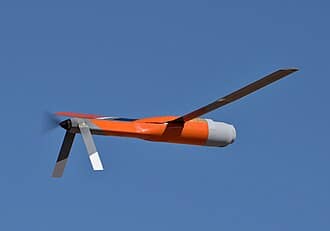
- Weapon: Anduril Altius-600M loitering munition (“kamikaze drone”)
- Result: 100% hit rate against all offshore maritime targets
- Unit: UAV Battalion, 21st Artillery Command, Third Combat Zone
- Inventory: ~2,000 Altius-600 variants delivered or on order ($1.46B+ total)
- Cost per unit: ~$1M (vs. $1.4–2.25M for a Harpoon anti-ship missile)
The Tianma Exercise
The drill was carried out by the UAV Battalion of the 21st Artillery Command under Taiwan’s Third Combat Zone. At least three towed flatbed launchers, each loaded with four Altius drones, deployed to Taiwan’s west coast — the side facing China. The Altius-600M is a tube-launched loitering munition weighing just 27 lb (12 kg). It flies at roughly 90 km/h, can loiter for up to two hours searching for targets, and carries a 6.6 lb (3 kg) modular warhead — a shaped charge or thermobaric option depending on the mission. Its range with warhead is approximately 160 km; in ISR configuration, it reaches 440 km. Against the offshore targets simulating approaching naval vessels, the drones achieved a clean sweep. The Military News Agency confirmed success across every phase of the engagement: autonomous target search, positive identification, human-in-the-loop authorization, and terminal strike.The Porcupine Strategy in Action
Taiwan has been buying these drones in enormous quantities. A first batch of 291 Altius-600M units arrived under a $300 million Foreign Military Sales package approved in June 2024 (a separate $60 million case covered 720 Switchblade 300s), with all deliveries complete by March 2026. In January 2026, Taiwan disclosed a second, much larger order: 1,554 Altius-700M strike variants (with heavier 35 lb warheads) and 478 Altius-600ISR surveillance drones, worth an estimated $1.1 billion. Across all orders, Taiwan has approximately 2,000 Altius loitering munitions delivered or on the way. This is asymmetric warfare by design. A single Altius-600M costs roughly $1 million — cheaper than a Harpoon anti-ship missile ($1.4–2.25M) and a fraction of the cost of the ships it targets. The strategy draws directly from Ukraine’s success against the Russian Black Sea Fleet: overwhelm an invasion force with cheap, expendable, precision-guided drones rather than fighting ship-to-ship.“I want to turn the Taiwan Strait into an unmanned hellscape using a number of classified capabilities.”
— Adm. Samuel Paparo, Commander, U.S. Indo-Pacific Command

 English
0 Comments