

There is an aircraft that first flew when Harry Truman was president, that dropped conventional bombs over Vietnam and precision-guided munitions over Afghanistan, that practiced nuclear deterrence through the Cuban Missile Crisis and Desert Storm and every anxious decade in between, and that is now scheduled to keep flying into the 2050s. The Boeing B-52 Stratofortress is, by any reasonable measure, the most successful military aircraft ever built. And on May 4, 2026, it took another step toward immortality.
That was the day Boeing announced that the B-52H Commercial Engine Replacement Program (CERP) had cleared its Critical Design Review — the formal engineering milestone that confirms the design is mature enough to begin production and modification of actual aircraft. The first two B-52Hs will enter the modification line this year to receive their new Rolls-Royce F130 engines, emerging as B-52J Stratofortresses. It is the most significant upgrade in the bomber's seven-decade history, and it is the reason the B-52 will almost certainly outlive every person reading this sentence.
✈️ Programme: B-52 Commercial Engine Replacement Program (CERP)
📅 CDR cleared: May 4, 2026
🔧 Old engines: Pratt & Whitney TF33-P-3/103 (1960s era, 8 per aircraft)
⚡ New engines: Rolls-Royce F130 (commercial BR725 derivative)
🛫 New designation: B-52J Stratofortress
📅 In service since: 1955 (71 years and counting)
📈 Expected service life: Into the 2050s (nearly 100 years)
Why the B-52 Needed New Engines Yesterday
The Pratt & Whitney TF33 engines currently hanging from the B-52H's wings are, to put it charitably, antiques. They are descendants of the JT3D commercial turbofan that powered the first generation of Boeing 707 airliners. They were designed in the late 1950s. They entered service on the B-52H in 1961. They have been maintained, overhauled, and coaxed along for more than six decades, and they are tired.

The numbers tell the story. The TF33 produces approximately 17,000 pounds of thrust and has a specific fuel consumption that would make a modern engine designer weep. The F130, by contrast, is derived from the Rolls-Royce BR725, a modern high-bypass turbofan that powers the Gulfstream G650 business jet. It produces comparable thrust with roughly 30% better fuel efficiency, dramatically reduced maintenance requirements, and the kind of reliability that comes from 21st-century materials science and manufacturing processes.
For the B-52 fleet, this translates to an estimated 40% increase in range on internal fuel alone. It means fewer tanker rendezvous on long-range strike missions. It means lower operating costs per flight hour. And it means that the airframe — which, remarkably, has considerable structural life remaining — will not be limited by engines that are literally older than most of the people maintaining them.
The Engineering Challenge: Eight Engines, Zero Margin for Error
Re-engining the B-52 sounds straightforward until you consider the details. Each B-52H carries eight engines in four twin-engine pods. The CERP replaces all eight TF33s with eight F130s, but the new engines are physically different in dimensions, weight distribution, and accessory drive locations. The engine pylons, nacelles, and associated systems must be redesigned. The fuel system plumbing changes. The electrical generation system changes. The fire detection and suppression systems change. The engine instrumentation in the cockpit changes.
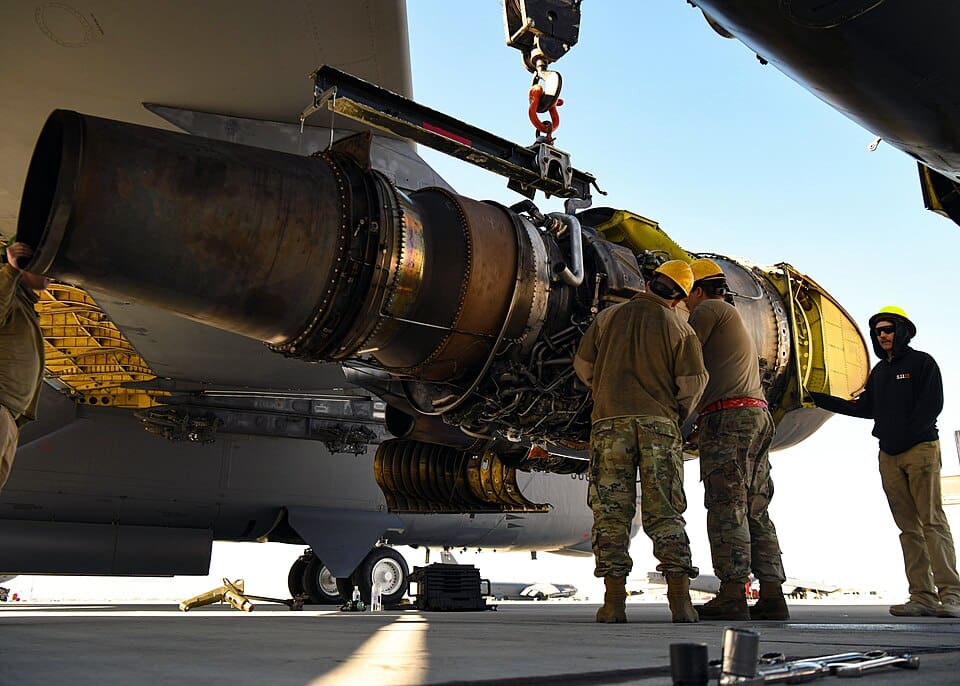
Boeing is the prime contractor for the modification, which will be performed at the company's facility in San Antonio, Texas. The work on each aircraft is expected to take several months in the depot, during which the bomber is essentially rebuilt from the engine pylons outward. The entire fleet of 76 operational B-52Hs is scheduled for modification, a process that will take years to complete.

A Century Bomber: The Absurdity and the Logic
When the B-52 first flew on April 15, 1952, the idea that it would still be in frontline service a century later would have seemed like science fiction. Yet here we are. The B-52J, with its new F130 engines, is expected to remain operational into the 2050s. That means an aircraft designed during the Truman administration will be flying combat missions — or at least standing nuclear alert — during a presidential administration that has not yet been born.

The logic behind this apparent absurdity is actually quite sound. The B-52's airframe was massively overbuilt for its original mission of high-altitude nuclear penetration. When surface-to-air missiles made that mission suicidal, the B-52 adapted to low-level penetration, then to conventional bombing, then to cruise missile carrier, then to precision strike platform. With each evolution, the airframe proved it had capacity to spare. The wings are good. The fuselage is good. The landing gear is good. What was not good, for the last twenty years, was the engines. The F130 fixes that.
The B-52J: What Changes Beyond the Engines
The engine replacement is the centerpiece of the B-52J upgrade, but it is not the only change. The aircraft is also receiving a new radar — the Raytheon AN/APQ-188 AESA (Active Electronically Scanned Array), a derivative of the fighter-proven AN/APG-79 — replacing the aging AN/APQ-166. The new radar provides dramatically improved ground mapping, weather avoidance, and targeting capabilities. The communications suite is being upgraded. The electronic warfare systems are being modernized. By the time the modifications are complete, the B-52J will be, in many respects, a new aircraft wearing an old airframe.

There is something both magnificent and slightly absurd about spending billions of dollars to keep a 1950s airframe in service until the 2050s. But the alternatives — designing and building a new large bomber from scratch, or doing without the B-52's unique capabilities — are either more expensive or strategically unacceptable. The B-21 Raider will handle the penetrating bomber mission. The B-52J will handle everything else, from standoff cruise missile delivery to maritime strike to close air support with JDAMs. It is the Swiss Army knife of the bomber fleet, and it just got a new set of blades.
The Immortal BUFF
The B-52 has survived everything the Air Force, the Pentagon, and the world have thrown at it: budget cuts, nuclear treaties, the rise and fall of the Soviet Union, the War on Terror, and six decades of attempts to replace it with something newer. It has outlasted the B-58 Hustler, the FB-111, and soon enough it will outlast the B-1B Lancer. The only aircraft in the current inventory that might match its longevity is the KC-135 Stratotanker, which is a Boeing design of almost exactly the same vintage.
With the F130 engines and the B-52J designation, the BUFF is not just being kept alive. It is being given a new lease on a life that already defies all reasonable expectations. Boeing will begin modifying the first two aircraft this year. The rest of the fleet will follow. And somewhere in the 2050s, a young pilot who has not yet been born will climb into a cockpit that first saw service before their grandparents were married, light eight Rolls-Royce engines, and taxi out to do the same job that the B-52 has been doing since before anyone alive can remember.
The B-52 will outlive us all. The CDR clearance on May 4 just made it official.
Sources: Boeing Defense press release, May 2026; Rolls-Royce Defence; Air Force Magazine; USAF Global Strike Command; Wikimedia Commons (USAF public domain).
Related Questions
Why is the B-52 getting new engines?
The B-52 is being re-engined because its eight Pratt & Whitney TF33 turbofans date to the late 1950s and entered service in 1961, making them costly and hard to maintain. The Commercial Engine Replacement Program (CERP) swaps them for modern Rolls-Royce F130 engines, improving fuel efficiency, range, and reliability to keep the bomber flying for decades.
What engines will the new B-52 use?
The re-engined B-52 will use the Rolls-Royce F130, a commercial BR725-derivative turbofan. It replaces the bomber's original Pratt & Whitney TF33 engines one-for-one, preserving the eight-engine layout. The upgrade cleared its Critical Design Review on 4 May 2026, allowing modification of actual aircraft to begin that year.
What is the B-52J?
The B-52J is the designation for B-52H bombers upgraded under the Commercial Engine Replacement Program with new Rolls-Royce F130 engines and other modernised systems. The change is the most significant update in the aircraft's history and is intended to keep the Stratofortress in service into the 2050s, approaching a century of operation.
How long has the B-52 been in service?
The Boeing B-52 Stratofortress first flew in 1952 and entered US Air Force service in 1955, giving it more than 70 years of operation. With the F130 engine upgrade it is expected to keep flying into the 2050s, potentially serving nearly 100 years. The B-52 at 70 details this remarkable longevity.
What other bombers has the US Air Force flown?
The US Air Force has fielded many bombers alongside the B-52, from radical experiments like the Northrop YB-49 flying wing, an ancestor of today's stealth bombers, to the supersonic B-1B Lancer and the stealthy B-2 Spirit. The B-52's planned service into the 2050s means it will fly beside the new B-21 Raider.
Related Posts
The Boeing B-52 Stratofortress: A Complete Guide
The B-21 Raider: America's Next Stealth Bomber
Rolls-Royce Aircraft Engines: A History of Power
0 Comments