
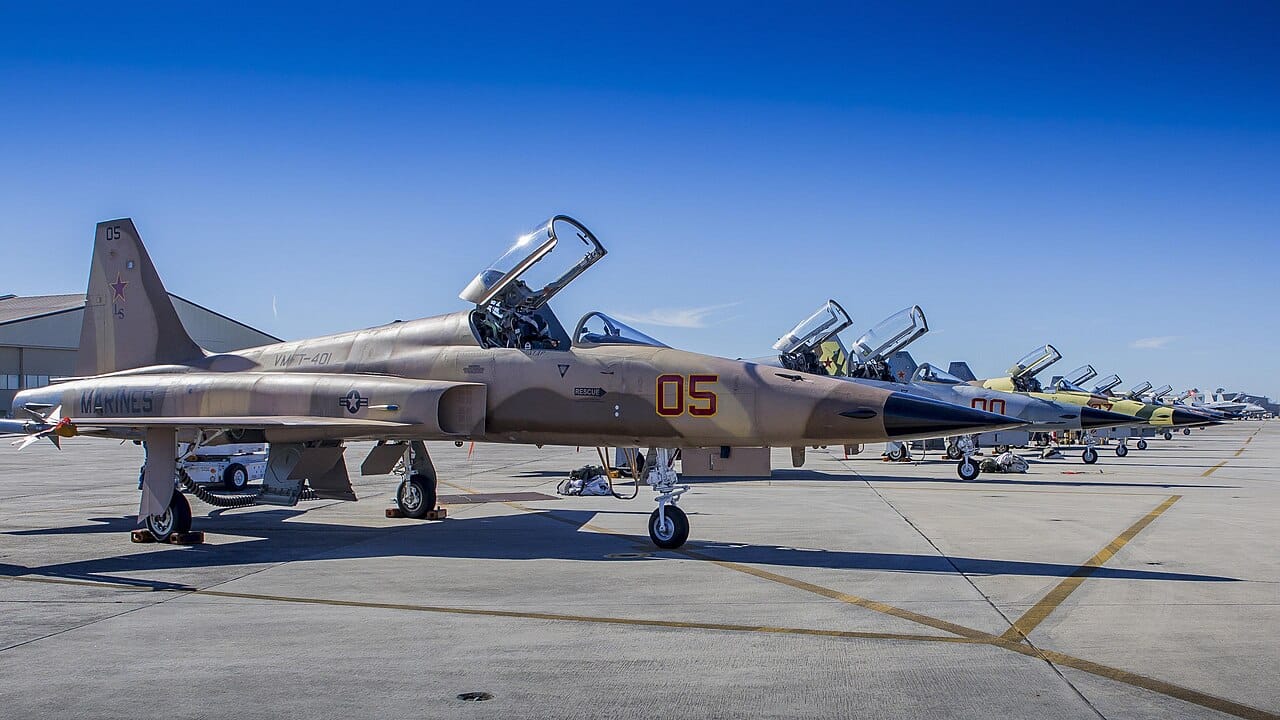
The fighter jets rolling onto the runway at NAS Fallon in Nevada are not U.S. Navy aircraft. They are operated by TacAir — a private company based in Reno. The pilots in the cockpits are civilians, many of them former military. Their job is to fly aggressively against the Navy’s best aviators, simulate the manoeuvres of enemy fighters, and, if possible, win.
Welcome to the booming business of “Red Air” — and the increasingly sophisticated private industry that feeds one of the most demanding training pipelines in military aviation.
Not Your Father’s Aggressor Jet
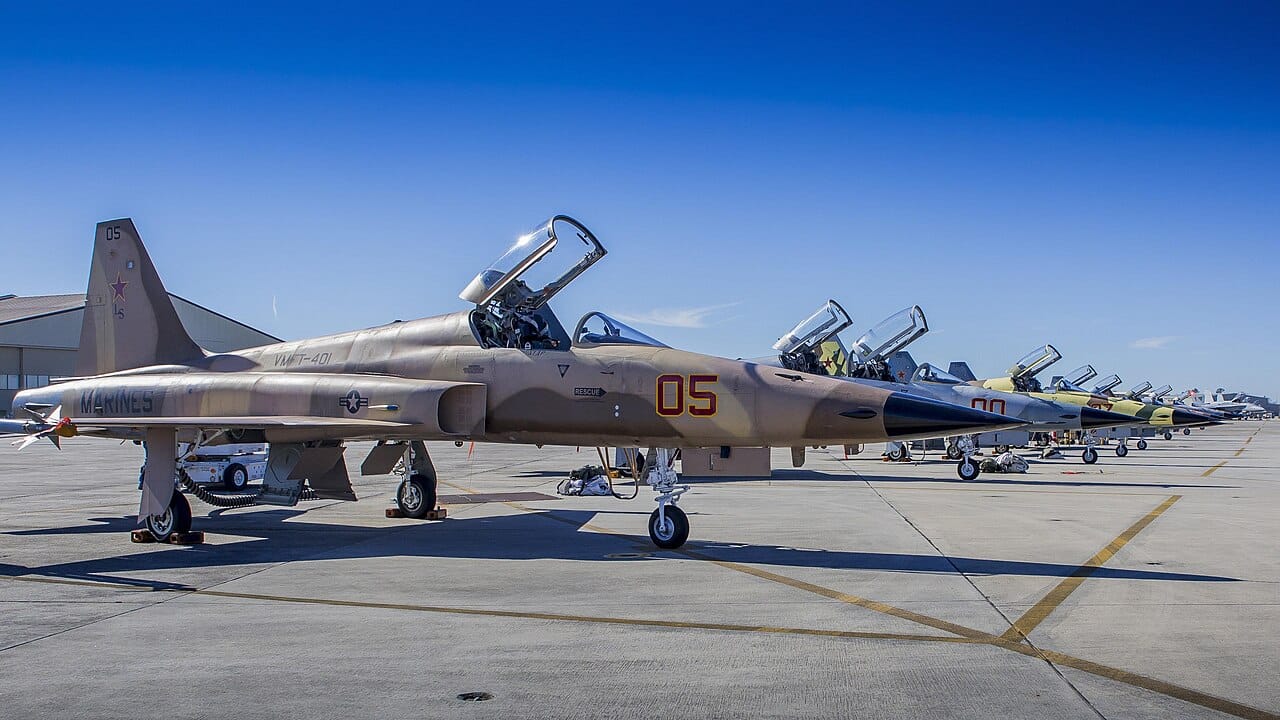
TacAir’s aircraft are ex-Jordanian and Saudi F-5E/F airframes — originally designed in the 1960s, now comprehensively modernised. The current configuration includes an AESA radar, datalink, Garmin wide-area display avionics, Scorpion helmet-mounted display, and internal infrared search and track. The result is what TacAir calls “a 4th generation adversary platform with 3rd generation economy” — an aircraft that can replicate the tactics of a modern adversary fighter at a fraction of the cost of operating a real one.
This matters. Training against a competent, aggressive adversary is the single most important factor in preparing fighter pilots for actual combat. The U.S. military learned this the hard way in Vietnam — where American pilots entered the war with a kill ratio of roughly 2:1, and left with lessons that led directly to the creation of TOPGUN. Today, TOPGUN graduates and air wing pilots at NAS Fallon routinely fly against TacAir’s upgraded F-5s as part of their workup for deployment.
Beating ATAC After 30 Years
TacAir recently won a five-year, $106.8 million contract to fly Red Air for the U.S. Navy — displacing ATAC, which had held that contract since 1996. More recently, TacAir was selected for Adversary Air Fighter Jet Services at the Naval Aviation Warfighting Development Center: TOPGUN itself, and the Air Wing Fallon exercises where entire carrier air wings sharpen up before deployment.
The contract is a remarkable endorsement of the private adversary model. The Navy trusts a civilian company to simulate its most dangerous opponents — Chinese J-20s, Russian Su-35s, Iranian F-14s — in the skies over Nevada, year after year, against its most valuable human assets.
The Enemy Gets Better Too
The key driver behind the F-5’s longevity in adversary roles is economics: the airframe is cheap to operate, relatively simple to maintain, and — critically — upgradeable. As real-world adversary capabilities improve, TacAir can add systems to the F-5 that make it a more credible simulator. The AESA radar on today’s aircraft would have been unthinkable on this airframe twenty years ago.
It’s a strange loop: the better enemies get, the better the fake enemies have to be — and the more valuable the private companies that build and fly them become.
Sources: The War Zone; Air & Space Forces Magazine; Tactical Air Support
 English