
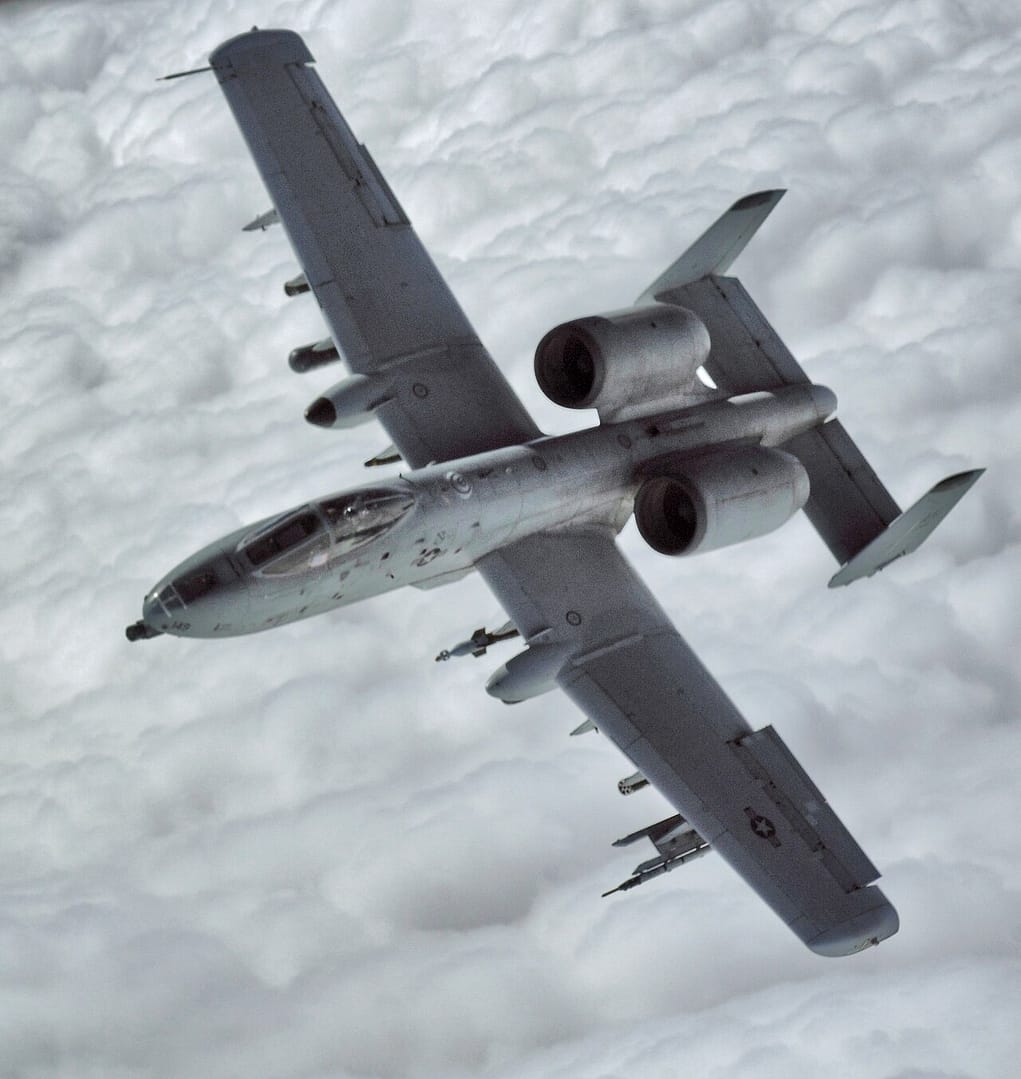
It came home to Portsmouth on October 11, 2025, callsign TABOR61, nose adorned with two small silhouettes of Shahed-type drones alongside the figure of Ares. The Idaho Air National Guard A-10C had just finished six months in the CENTCOM area of responsibility. It had been hunting drones — and it had found them.
The A-10 Thunderbolt II, designed in the 1970s to kill Soviet tanks on the plains of Central Europe, had become a drone killer over the Middle East. Nobody planned it that way. It just works.
The Weapon That Changes the Maths
The standard way to shoot down an Iranian Shahed drone is to fire a missile at it — a Patriot interceptor, an AIM-9, a NASAMS round. The problem is cost. A Shahed costs Iran roughly $20,000 to build. The missiles used to stop them cost anywhere from $500,000 to over $3 million each. Iran has been deliberately exploiting this ratio, launching swarms of cheap drones to drain expensive Western air defence inventories.
Enter the A-10, loaded with AGM-20F FALCO laser-guided rockets — Advanced Precision Kill Weapon System rounds that cost a fraction of a full air-to-air missile. One APKWS costs around $28,000. That’s still more than the drone, but it’s a ratio the West can sustain. The A-10 gives commanders a reusable, mobile platform that hunts and kills drones without burning through premium interceptor stocks.
An Aircraft the Air Force Wanted to Retire
The irony is rich. The U.S. Air Force has been trying to retire the A-10 for years — arguing that it is too slow, too vulnerable, and too specialised to survive on the modern battlefield. Congress has repeatedly blocked the effort, often citing the plane’s close air support capabilities. Now the Warthog is doing something nobody anticipated: demonstrating that in an era of drone warfare, a slow, cheap, heavily armed platform that can loiter and hunt is exactly what the battlefield needs.
Two kill marks on one aircraft from one deployment might seem modest. Multiply it across a fleet and a sustained campaign, and the A-10’s new role starts to look like a strategic argument. The Cold War’s most unloved survivor may have just earned another stay of execution.
Sources: The Aviationist; The War Zone; Army Recognition; United 24 Media

 English