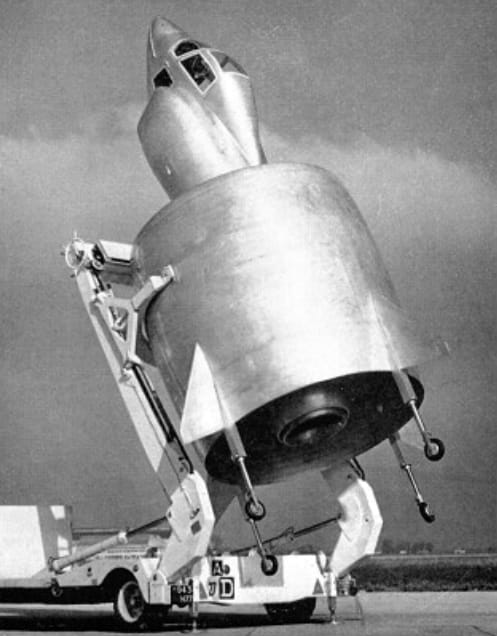
Picture a jet engine standing on its tail. Now wrap an annular wing around it — a hollow doughnut of aluminium and steel. Put a man in a tilting seat at the top, light the afterburner, and launch the whole thing straight up like a Roman candle. That, in essence, was the SNECMA C.450 Coléoptère.
It is, without exaggeration, one of the most audacious aircraft ever built. The French engineers behind it were not insane — they were trying to solve a real problem, and their solution was so radical that even today, looking at photographs of the Coléoptère sitting on its launch platform, you have to pause and ask: did they really fly that?
They did. Nine times. And on the ninth, it all went wrong.
Quick Facts
Aircraft: SNECMA C.450-01 Coléoptère (“Beetle”)
Type: Tail-sitting VTOL research aircraft with annular wing
Test pilot: Auguste Morel (survived with injuries)
Concept origin: Austrian engineer Helmut von Zborowski
The Dream of the Annular Wing
The Coléoptère’s story begins not in France but in Austria, with engineer Helmut von Zborowski. In the early 1950s, von Zborowski proposed a revolutionary idea: an annular wing — a hollow cylindrical surface wrapped around a jet engine — that could serve simultaneously as airframe, wing, and engine housing. The geometry would reduce drag, the internal engine would provide both thrust and lift, and the whole assembly could take off and land vertically without a runway.
For NATO planners terrified of Soviet nuclear strikes destroying European airfields in the first hours of a war, the concept was irresistible. An interceptor that needed no runway could be dispersed to forest clearings, parking lots, or mountain roads. SNECMA, the French engine manufacturer, picked up von Zborowski’s concept and ran with it.
The SNECMA Atar Volant — the Coléoptère’s predecessor. This bare turbojet on legs proved that a jet engine alone could hover and land vertically, paving the way for the annular-wing concept. Wikimedia Commons
But before wrapping an annular wing around a turbojet, SNECMA needed to prove the basic principle: could a jet engine, standing on its tail, hover, transition to horizontal flight, and land vertically? They built the Atar Volant — literally “flying Atar” — a stripped-down SNECMA Atar turbojet mounted vertically on four legs with a pilot perched on top.
It looked like a science fiction prop. It sounded like the end of the world. And incredibly, it worked. Between 1956 and 1958, the Atar Volant completed over 200 tethered hovers and more than a hundred free flights, proving that a single turbojet could sustain controlled vertical flight.
Building the Beetle
With the Atar Volant’s success in hand, SNECMA moved to the next step: the C.450 Coléoptère itself. Nord Aviation built the airframe — a sleek fuselage enclosed within a barrel-shaped annular wing roughly 3.2 metres in diameter. Four small triangular fins at the base served as landing gear and provided limited control during hover. The Atar 101E.V turbojet produced 3,700 kilograms of thrust — enough to lift the 3,000-kilogram aircraft with margin to spare.
The pilot sat in a tilting ejection seat at the top of the fuselage. During vertical flight, the seat rotated so the pilot looked roughly upward. During the planned transition to horizontal flight, the seat would tilt forward to a conventional position. In theory, the transition from vertical to horizontal would be smooth and controlled, the annular wing generating lift as airspeed increased.
The Atar Volant preserved at the Musée de l’Air et de l’Espace, Le Bourget. The naked simplicity of the design — a turbojet with four legs and a seat — is both audacious and slightly terrifying. Wikimedia Commons
In practice, the transition was the most dangerous part of the flight envelope — the phase where the aircraft was too slow for aerodynamic control but too committed to hover safely. Every tailsitter design in history has struggled with this moment. The Coléoptère would be no exception.
Nine Flights and a Catastrophe
Test pilot Auguste Morel made the first tethered hover on April 17, 1959. The Coléoptère rose on a column of fire and noise, held in place by cables, and settled back down. It worked. On May 3, Morel made the first free hover, keeping the aircraft airborne for three and a half minutes.
Over the following weeks, Morel made seven more flights, gradually extending the envelope — climbing higher, moving laterally, testing the control responses. The aircraft reached 800 metres altitude. Each flight revealed the same challenge: the Coléoptère was stable in pure hover, but the instrumentation was primitive and the pilot had almost no visual references to judge attitude or drift. There was no horizon line when you were sitting on top of a vertical rocket.
The ninth flight, on July 25, 1959, was supposed to begin the transition toward horizontal flight — a gentle tilt, a slow buildup of forward speed, the first step toward proving the concept could work as a real aircraft.
It went wrong almost immediately. The Coléoptère tilted past its controllable angle. Without adequate instruments or visual cues, Morel could not judge how far the aircraft had pitched. The annular wing, which provided stability in pure hover, offered almost no aerodynamic authority at the low speeds of the transition phase. The aircraft began oscillating — pitching nose-up, then overcorrecting nose-down — in wild swings that Morel could not damp out.
At 150 metres altitude, with the aircraft tumbling, Morel fired the ejection seat. He was badly injured but survived. The Coléoptère hit the ground and was destroyed.
Why It Could Never Have Worked
The crash ended the programme. A second prototype had been planned, but funding never materialised. By the early 1960s, the entire tailsitter concept was falling out of favour worldwide — the American Convair XFY Pogo and Lockheed XFV had encountered similar control problems years earlier, and neither had progressed beyond experimental flight.
The fundamental issue was not the annular wing itself, which provided reasonable performance in hover. The problem was the transition. Moving from vertical to horizontal flight demanded precise attitude control at very low airspeeds — exactly the regime where conventional control surfaces are least effective. Modern fly-by-wire systems and digital flight controls could potentially solve this problem, but in 1959, with analog instruments and a pilot’s eyeballs as the primary reference, the transition was an invitation to disaster.
The Coléoptère was not a failure of courage or imagination. It was a machine that arrived fifty years too early for the technology it needed to succeed. Auguste Morel, who risked his life nine times atop a vertical jet engine, later said he believed the concept was sound — just beyond the capabilities of 1959 engineering.
The wreckage was cleared. The programme was closed. And one of the strangest, bravest chapters in French aviation history quietly disappeared into the archives.
Sources: Musée de l’Air et de l’Espace, Military Factory, National Interest, Vertipedia (VTOL.org)
It reads like the plot of a heist film. Smuggle swarms of attack drones thousands of kilometres into the enemy’s heartland, hidden inside ordinary cargo trucks. Park them, unremarked, beside the most valuable aircraft in the arsenal. Then, at a chosen moment,...
You step onto a parked airliner and everything just works. The cabin lights are on, the air is cool, screens are glowing — and yet the two great engines on the wings are stone-cold silent. Somewhere behind you, a faint high-pitched whine is the only clue to what...
Launching a torpedo is the easy part. The hard part is what happens next: keeping a one-tonne self-propelled bomb running dead straight and at exactly the right depth, through the chaos of the sea, toward a ship that is moving and may be more than a mile away. There...




 English
0 Comments