Here is a story about building a better mousetrap and watching the world buy the old one anyway.
In the early 1980s, Northrop spent $1.2 billion of its own money — not government money, its own — to develop the F-20 Tigershark. It was lighter than the F-16. It was cheaper than the F-16. It could scramble from cold start to Mach 1 faster than any fighter in Western inventory. Its radar was excellent. Its maintenance requirements were a fraction of its competitors. Two test pilots loved it so much they died flying it at airshows, pushing the aircraft to its limits to impress the crowds.
Nobody bought it. Not one.
The F-20 Tigershark is the fighter that politics killed — a textbook case of what happens when a brilliant aircraft meets the wrong moment in geopolitical history.
Role: Lightweight export fighter / air defence interceptor
Engine: 1x General Electric F404-GE-100 (17,000 lbf with afterburner)
First flight: August 30, 1982 (went supersonic on maiden flight)
Max speed: Mach 2.1
Scramble time: Cold start to Mach 1 in under 2.5 minutes
Radar: AN/APG-67 multimode (the same family later used on KF-16 upgrades)
Development cost: $1.2 billion (Northrop private funds)
Built: 3 prototypes
Orders: Zero
Fatal crashes: 2 (both G-LOC during demo flights — aircraft cleared of fault)
Programme cancelled: Late 1986
Born From an Export Policy
The F-20’s origin lies in a Carter administration policy that made perfect sense at the time and then stopped making sense almost immediately.
In 1977, President Jimmy Carter established the FX (Fighter Export) programme, which prohibited the sale of America’s top-tier fighters — the F-15 Eagle and F-16 Fighting Falcon — to countries that were not close NATO allies or major strategic partners. The policy was meant to prevent advanced American weapons from spreading to unstable regions or ending up in hostile hands.
But allied nations still needed fighters. The policy created a market gap: countries like Taiwan, South Korea, and various Middle Eastern states needed modern aircraft but were barred from buying the best America had. Carter essentially told the US defence industry: build something good enough for export, but not as good as the F-16.
Northrop, which had built the hugely successful F-5 Tiger II — the most widely exported American fighter of the Cold War — saw an opportunity. Take the proven F-5 airframe, replace its twin underpowered engines with a single General Electric F404 (the same engine that powered the F/A-18 Hornet), add a modern radar and avionics suite, and create a fighter that was far superior to the F-5 but positioned below the F-16 in capability and price.
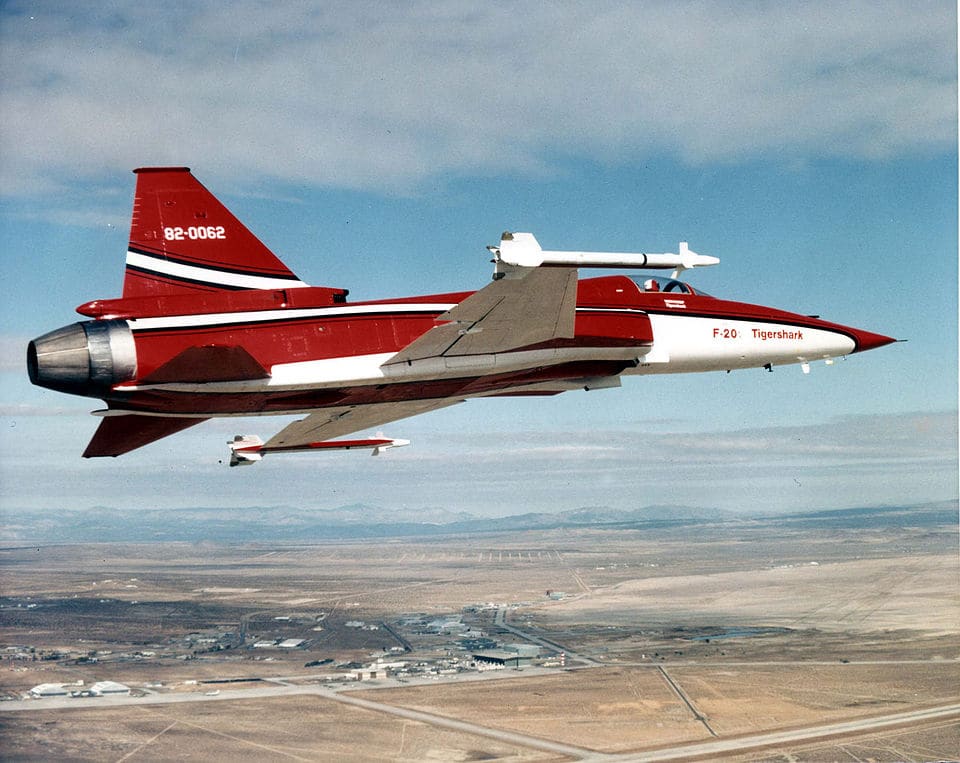
An F-20 Tigershark in aggressor colours — the paint scheme it wore for the USAF evaluation that was supposed to secure domestic orders. It never did. US Air Force / Wikimedia Commons
The result was the F-5G — later redesignated F-20 Tigershark. And it was, by every technical measure, a superb aircraft.
A Fighter That Did Everything Right
The F-20 went supersonic on its very first flight on August 30, 1982 — a rare achievement for any new fighter design. Test pilot Russ Scott took it to Mach 1.04 straight out of the factory. The aircraft was immediately impressive.
The GE F404 engine transformed the airframe. Where the F-5E Tiger II had been pleasant but underpowered, the F-20 was a rocket. It could scramble from a cold, unpowered state to Mach 1 in under two and a half minutes — faster than any Western fighter of the era, including the F-16. For nations defending against surprise air attacks, that scramble time was worth more than any specification on paper.
The AN/APG-67 radar gave the F-20 genuine beyond-visual-range capability — something the F-5 had never had. The avionics were modern and reliable. Maintenance hours per flight hour were dramatically lower than the F-16, which mattered enormously for air forces with limited ground crew and tight budgets.
And the price was right. Northrop offered the F-20 at roughly $15 million per copy in early-1980s dollars — substantially less than the F-16, which was climbing toward $20 million. For cash-strapped allies, the math was compelling.
The Rug Gets Pulled
Then Ronald Reagan won the presidency, and the entire foundation of the F-20 programme collapsed overnight.
Reagan’s team had a fundamentally different view of arms exports. Where Carter had restricted sales, Reagan opened them up. In 1981, a presidential directive allowed first-line American fighters to be sold on a case-by-case basis. Suddenly, the F-16 was available to nearly everyone who wanted it.
Pakistan got F-16s. Venezuela got F-16s. South Korea — which Northrop had been courting intensely for the F-20 — got F-16s. One by one, the export customers that the F-20 was designed to serve were offered the real thing instead of the alternative.
The surviving F-20 Tigershark on display at the California Science Center in Los Angeles — a billion-dollar fighter that nobody was allowed to buy. Wikimedia Commons
Northrop was caught in a brutal trap. The company had bet $1.2 billion on a policy that no longer existed. The F-20 was a better value than the F-16 on paper, but no air force in the world wanted to explain to its parliament why it had bought the second-best American fighter when the first-best was available. The F-16 had the one thing the F-20 lacked: a US Air Force roundel. If America’s own air force flew the F-16, foreign customers concluded it must be the right choice.
Two Pilots, Two Crashes, One Cleared Aircraft
The F-20 programme suffered two fatal crashes that further damaged its commercial prospects — even though both investigations cleared the aircraft of any mechanical or design fault.
On October 10, 1984, Northrop demonstration pilot Darrell Cornell was killed when his F-20 crashed during a demonstration flight in South Korea — one of the most important potential export customers. The investigation concluded that Cornell had lost consciousness due to G-induced loss of consciousness (G-LOC) during an aggressive manoeuvre. The aircraft was in perfect working order.
Seven months later, on May 14, 1985, Northrop pilot Dave Barnes died in an identical manner at Goose Bay, Labrador, while practising his routine for the Paris Air Show. Again, G-LOC was the cause. Again, the aircraft was blameless.
Two dead pilots in seven months. The F-20 was technically vindicated, but the optics were devastating. A fighter that had killed two of its own demonstration pilots — regardless of the cause — was a difficult sell to foreign air chiefs who answered to politicians and press.
The Quiet Death
By 1986, Northrop had spent six years and $1.2 billion without a single order. Negotiations with Morocco for 20 aircraft and a small order from Bahrain were the last realistic prospects, but both fell through. Northrop quietly cancelled the programme in late 1986.
The company did not make noise about it. Northrop was simultaneously developing the B-2 Spirit stealth bomber — a far larger programme that depended on good relations with the Pentagon and the Air Force. Protesting that the USAF had unfairly favoured the F-16 over the F-20 would have poisoned those relationships. So Northrop absorbed the loss and moved on.
The surviving F-20 prototype now sits at the California Science Center in Los Angeles, its shark-nosed profile and compact frame a physical reminder of what might have been. It is, by any reasonable assessment, one of the best fighters ever built that nobody was allowed to buy — a machine that did everything right in a world where doing everything right was not enough.
Sources: Vintage Aviation News, National Security Journal, The Armory Life, National Interest
Every fighter pilot trains for it. Most pray they'll never experience it. The moment a jet engine — the machine that keeps you flying at 500 knots and 30,000 feet — stops working. Whether it's a compressor stall that sounds like a cannon going off behind your seat, a...
Luca Parmitano has lived two lives that most people only dream about. In the first, he was a fighter pilot — flying AMX Ghibli attack jets for the Italian Air Force, deployed to Afghanistan, trained to fly low and fast into hostile territory. In the second, he became...
Before the Rafale, before the Mirage 2000, before the Mirage F1 — there was the Mirage III. Dassault's first supersonic fighter was a revelation when it entered service in 1961: a sleek, tailless delta that could break Mach 2, carry a nuclear bomb, and outfight...



 English
0 Comments