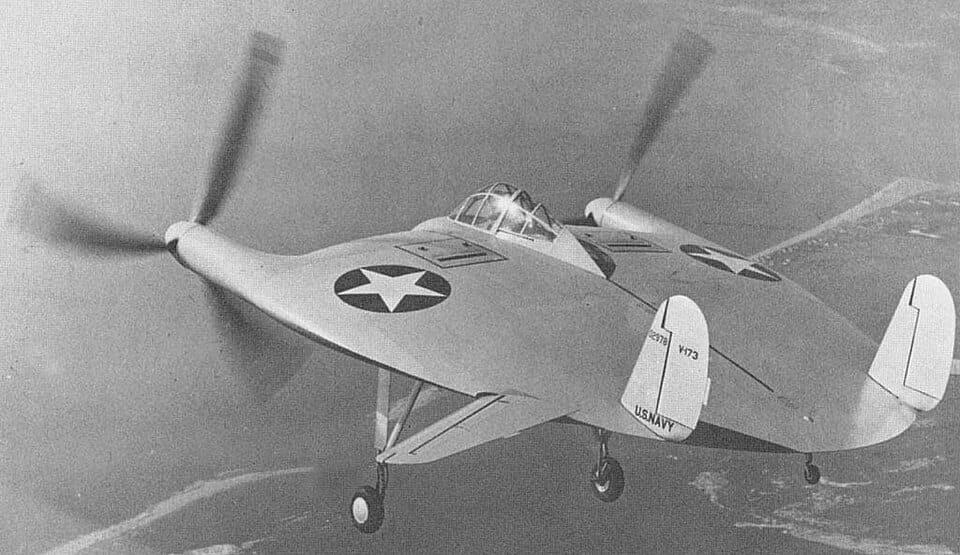
In the autumn of 1942, residents of Stratford, Connecticut, began calling the police to report a flying saucer over the Housatonic River. The callers were not delusional. There was, in fact, a flat, disc-shaped object circling lazily above the Vought-Sikorsky factory at Bridgeport — cream-coloured, about 23 feet across, and making a distinctive thrumming sound that carried for miles.
It was not from another planet. It was the Vought V-173, and it was the strangest aircraft the United States Navy had ever funded. The engineers called it the “Zimmer Skimmer,” after its designer. The test pilots called it something else. History remembers it as the Flying Pancake.
It should not have worked. A flat disc is not an obvious shape for an aircraft. But the V-173 flew 190 times over five years, impressed Charles Lindbergh, nearly became a Navy fighter, and proved a principle of aerodynamics so counterintuitive that most engineers refused to believe it until they saw the data.
Designer: Charles H. Zimmerman, NACA / Vought-Sikorsky
Configuration: Disc-shaped “all-wing” with twin propellers at leading edge
V-173 first flight: November 23, 1942
V-173 total flights: 190 (131.8 flight hours)
V-173 stall speed: As low as 25 mph
XF5U design speed: 460+ mph (estimated)
Notable pilot: Charles Lindbergh flew the V-173 during testing
Programme cancelled: March 17, 1947
Surviving aircraft: V-173 preserved at Smithsonian NASM
The Man Who Believed in Discs
Charles H. Zimmerman was not a crank. He was a respected NACA engineer who had spent years studying an aerodynamic puzzle: why do flat, disc-shaped objects generate so much lift relative to their size? Frisbees, autumn leaves, spinning coins — nature and physics were full of examples of flat objects that flew surprisingly well. Zimmerman wanted to know if the same principle could produce a practical aircraft.
His insight was that a very low aspect ratio wing — essentially a disc — could generate enormous amounts of lift at high angles of attack without stalling in the conventional sense. Normal wings stall when the airflow separates from the upper surface at steep angles. A disc-shaped wing, Zimmerman discovered, behaved differently: vortices that formed at the edges actually energised the airflow over the upper surface, delaying or preventing stall entirely.
The practical implication was remarkable. A disc-winged aircraft could fly at extremely slow speeds — slow enough to hover or nearly hover — while also being capable of high-speed flight with enough engine power. It could take off in very short distances and land at walking pace. For the Navy, which needed fighters that could operate from small escort carriers with short flight decks, this was irresistible.
The V-173 during its maiden flight in November 1942. The disc-shaped aircraft — with its twin propellers on the leading edge — prompted UFO reports from startled Connecticut residents. US Navy / Wikimedia Commons
The Pancake Takes Flight
Vought-Sikorsky agreed to build Zimmerman’s concept as a proof-of-concept demonstrator. The V-173 was constructed largely of wood and fabric — lightweight, inexpensive, and quick to modify. Two Continental A-80 piston engines, producing just 80 horsepower each, drove large propellers mounted at the leading edge of the disc. The propellers served a dual purpose: they provided thrust and their slipstream over the disc surface augmented lift dramatically.
On November 23, 1942, test pilot Boone T. Guyton made the first flight. The V-173 lifted off at a speed that seemed impossibly low — witnesses later described it as barely above a brisk jog. The aircraft climbed, turned, and landed without incident. Guyton’s verdict: it flew.
Over the next five years, the V-173 accumulated 190 flights and 131.8 hours of test time — an extraordinary amount for an experimental aircraft. It was slow (top speed around 138 mph with its tiny engines), it vibrated badly at certain speeds, and the propeller gear boxes needed constant maintenance. But it proved Zimmerman’s core prediction: the disc wing generated phenomenal lift at low speeds. The V-173 could fly at just 25 mph without stalling — a speed at which any conventional aircraft of the period would have fallen out of the sky.
Detail of the V-173 showing the all-flying tail surfaces with anti-servo tabs — advanced control technology for 1942. Wikimedia Commons
The aircraft’s unusual shape triggered regular UFO sightings over Connecticut. Local police reportedly fielded dozens of calls from citizens reporting a flying saucer. The calls were entirely understandable — the V-173, seen from below, looked like nothing that belonged in the sky.
Lindbergh in the Cockpit
The V-173’s most famous test pilot was not a Vought employee. Charles Lindbergh — by then serving as a consultant to the aircraft industry — flew the Flying Pancake during the test programme. His assessment carried enormous weight: Lindbergh found the aircraft easy to handle and was particularly impressed by its low-speed characteristics. The endorsement from America’s most famous aviator helped maintain Navy interest in the programme.
Other pilots who flew the V-173 reported a similar experience. The disc was stable, predictable, and forgiving — qualities not always found in experimental aircraft. The unusual appearance was quickly forgotten once the pilot was airborne; the controls responded normally, and the aircraft’s ability to fly slowly without stalling gave it an enormous safety margin during approach and landing.
From Pancake to Flapjack
Encouraged by the V-173’s success, the Navy contracted Vought to build a combat version: the XF5U-1, nicknamed the “Flying Flapjack.” This would be a full-size, all-metal fighter with Pratt & Whitney R-2000 engines producing 1,350 horsepower each — nearly seventeen times the power of the V-173’s little Continentals.
The XF5U was designed to reach speeds above 460 mph while retaining the V-173’s extraordinary low-speed capability. If the concept worked, the Navy would have a carrier fighter that could take off in a fraction of the deck run required by conventional aircraft, fight at high speed, and then land at speeds low enough to eliminate the most dangerous moments of carrier operations.
But the XF5U arrived too late. By 1947, when the prototype was finally ready for flight testing, the jet age had arrived. The Navy was transitioning to jet-powered fighters that were faster, simpler, and backed by enormous government investment. A propeller-driven disc, no matter how clever, was not going to compete with the FH Phantom or the F9F Panther.
The Navy cancelled the programme on March 17, 1947. The XF5U prototype — which had made only brief taxi hops and never achieved sustained flight — was ordered scrapped. The demolition crew reportedly had enormous difficulty cutting through the aircraft’s robust metallic structure, a final ironic testament to how well it was built.
What Remains
The V-173 survived. It was preserved and eventually transferred to the Smithsonian’s National Air and Space Museum, where it resides today — a cream-coloured disc that looks more like a prop from a 1950s science fiction film than a serious piece of aeronautical engineering.
Charles Zimmerman’s disc-wing concept never became a production aircraft, but his work influenced decades of research into low-aspect-ratio wings, VTOL designs, and unconventional lift-generating configurations. The V-173 proved that aerodynamics does not care about aesthetics: a flying pancake, given the right engineering, can fly just as well as a sleek fighter. Sometimes, the weird idea is the right one.
Sources: Smithsonian National Air and Space Museum, War History Online, US Naval Institute, Pacific Paratrooper
From the fjords of northern Norway to the sun-baked runways of southern Spain, NATO is conducting the largest air exercise in Alliance history. Ramstein Flag 2026, which began on 8 June and runs through 19 June, has assembled more than 200 aircraft from 18 nations...
The numbers arrived in Brussels like a cold shower. US fighter jets allocated to NATO: cut from 150 to 100. KC-46 aerial refuelling tankers: all eight withdrawn. Maritime patrol aircraft: slashed from 26 to 15. One carrier strike group, one cruise-missile submarine,...
Forget everything you think you know about how military drones get made. Lockheed Martin's legendary Skunk Works division — the outfit that gave us the U-2, the SR-71 Blackbird, and the F-117 Nighthawk — just showed off an unmanned aircraft that was designed,...




 English
0 Comments