
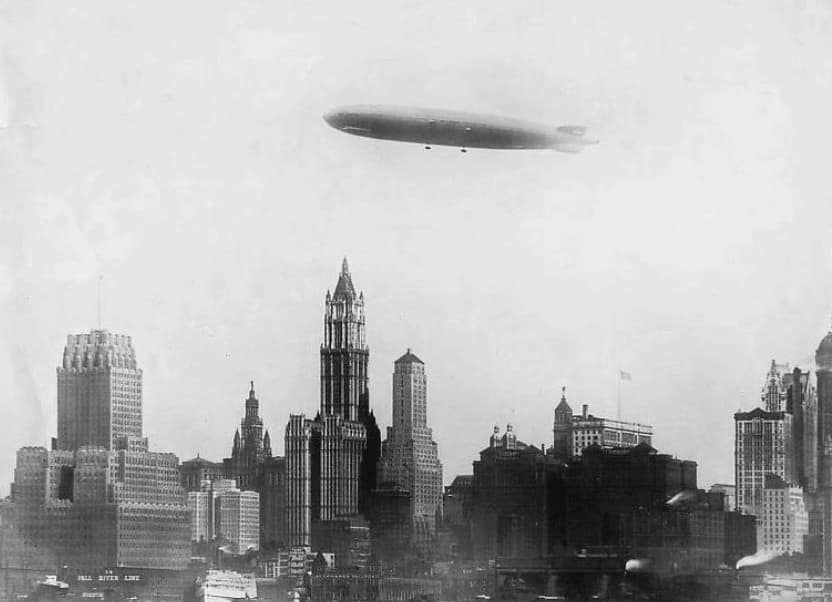
The wind is tearing at your overalls. Below you, there is nothing — just the grey expanse of the South Atlantic, thousands of feet down, where whitecaps trace the restless surface of an ocean that has never heard of mercy. You are standing on the outer framework of the Graf Zeppelin, clinging to the airship’s internal girders with your bare hands, while the storm-damaged fabric covering flaps and snaps around you like a living thing trying to shake you off.
There is no safety net. No harness. No parachute that would help at this altitude above open ocean. And the engines have been shut down to keep the slipstream from sweeping you into the void — which means the airship is slowly losing altitude with every passing minute. Work fast, or everyone dies.
This actually happened. In 1934, during a routine transatlantic flight to South America, crew members of the LZ 127 Graf Zeppelin climbed outside the hull in mid-flight to repair storm damage over the Atlantic. Photographer Alfred Eisenstaedt was on board — and he captured the moment with his Leica camera, creating one of the most extraordinary photographs in aviation history.
Quick Facts: LZ 127 Graf Zeppelin
- Type: Rigid airship (hydrogen-filled)
- Length: 236.6 m (776 ft) — longer than three Boeing 747s
- First flight: September 18, 1928
- Total flights: 590
- Total distance: ~1.7 million km (over 1 million miles)
- Ocean crossings: 144
- Passengers carried: More than 13,000
- Passenger/crew fatalities: Zero
- Commander: Dr. Hugo Eckener
- Retired: June 1937 (decommissioned after the Hindenburg disaster)
The World’s Most Successful Airship
To understand why men would risk their lives climbing outside a flying airship, you need to understand what the Graf Zeppelin meant. Launched in 1928 and named after Count Ferdinand von Zeppelin, the LZ 127 was the crown jewel of Germany’s airship program — and the most successful rigid airship ever built. Over its nine-year career, it made 590 flights covering nearly 1.7 million kilometers, carried more than 13,000 passengers, completed 144 ocean crossings, circumnavigated the globe, and flew to the Arctic — all without a single passenger or crew fatality.
Under the command of Dr. Hugo Eckener — a charismatic, supremely confident aviator who had studied under Count Zeppelin himself — the Graf Zeppelin operated a regular scheduled service to South America, departing Germany almost every other Saturday for Brazil. By 1934, transatlantic airship travel had become almost routine. Almost.
Storm Over the South Atlantic
In 1934, during one of its regular flights to Rio de Janeiro, the Graf Zeppelin encountered a severe Atlantic storm. The turbulence and wind shear tore sections of the outer fabric covering — the skin that gave the airship its aerodynamic shape and protected the hydrogen gas cells within. If left unrepaired, the damage would worsen with every mile, the torn fabric acting like a sail, catching the wind and ripping further until structural integrity was compromised.
The ship was Eckener’s. Every decision, every risk, was his to take. When the fabric tore over the Atlantic, he did not hesitate to send men outside — because the alternative was to let the damage spread until the airship became uncontrollable.
The decision was made: a repair team would climb outside the hull, in flight, over the open Atlantic, and patch the damage by hand. This was not the first time such a repair had been attempted on the Graf Zeppelin — and that precedent is part of what makes the airship’s story so remarkable.
A Tradition of Terrifying Repairs
The first — and most famous — mid-air repair had occurred six years earlier, during the Graf Zeppelin’s very first transatlantic crossing in October 1928. On October 13, while passing through a squall line, the lower covering of the port tail fin was torn away. Commander Eckener faced an impossible choice: turn back (with uncertain fuel reserves) or send men outside to fix it.
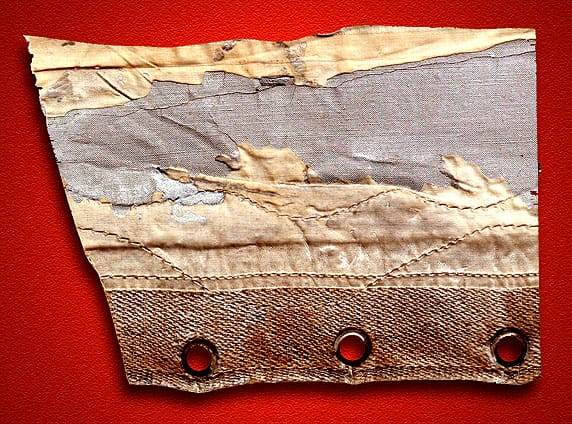
He chose the repair. A four-man team was assembled: Eckener’s own son, Knut Eckener; senior elevatorman Albert Sammt (who would later command the Graf Zeppelin II); Ludwig Knorr (who became chief rigger on the Hindenburg); and a fourth crewman. The procedure was agonizing. The engines had to be throttled back to reduce the slipstream, but without forward speed, the airship lost aerodynamic lift and began sinking. The crew would work on the exposed fin until altitude dropped dangerously low, then scramble back inside so the engines could be brought up to regain height — then climb back out again when the ship rose high enough.
For four and a half hours, they repeated this cycle. Climbing out. Working. Retreating. Climbing out again. Finally, the repair held, and the four men crawled back inside, exhausted but alive. The Graf Zeppelin completed its crossing and landed at Lakehurst, New Jersey, to a hero’s welcome.
Eisenstaedt’s Immortal Photograph
By 1934, the Graf Zeppelin’s crew had developed the mid-air repair into something approaching — though never reaching — routine. When storm damage struck during the South America service, the crew knew what to do. But this time, there was a witness with a camera.
Alfred Eisenstaedt — who would go on to become one of LIFE magazine’s founding photographers and one of the most celebrated photojournalists of the 20th century — was aboard the Graf Zeppelin as a passenger. Using his handheld 35mm Leica, he captured the crew members clambering across the exterior framework of the airship while the South Atlantic stretched to the horizon below them. The resulting photographs are among the most viscerally terrifying images in aviation history: men in work clothes, standing on the skeletal aluminum girders of a flying machine, patching canvas over open sky.
Eisenstaedt emigrated to the United States the following year and joined LIFE magazine at its 1936 launch. His Graf Zeppelin photographs became icons of an era — and of a form of courage that seems almost incomprehensible today.
Zero Fatalities, Infinite Courage
The Graf Zeppelin flew until June 1937, when it was retired after the Hindenburg disaster ended the era of hydrogen airships. Its safety record remains staggering: 590 flights, 1.7 million kilometers, 144 ocean crossings, 13,000 passengers — and not a single fatality. Not one. In an era when aviation regularly killed its practitioners, the Graf Zeppelin’s perfect record stands as a monument to meticulous engineering, skilled seamanship, and the raw bravery of men willing to climb outside a flying machine over the open ocean to keep it flying.
Sources
- LZ 127 Graf Zeppelin — Wikipedia
- LZ 127 Graf Zeppelin Operational History — Wikipedia
- Graf Zeppelin History — Airships.net
- Fearless Men Repair the Graf Zeppelin in Mid-Flight — Gizmodo
- Anniversary of Graf Zeppelin’s First Transatlantic Flight — Airships.net
- Captain Albert Sammt — Faces of the Hindenburg
- By Zeppelin to Rio — Zeppelin Museum


 English
0 Comments