

Legend says the Japanese soldiers in Burma had a name for it: the Whispering Death — supposedly because by the time the engines were audible, the aircraft was already in firing position with its quartet of 20mm Hispano cannon and six 7.7mm Brownings tearing the convoy apart. The pilots had landed, climbed back out of the cockpit, and lit cigarettes before the Japanese realised what had just happened to them. No Japanese source for the nickname has ever been found — historians suspect it was coined by the Beaufighter crews themselves — but the name stuck.
The aircraft in question was a Bristol Beaufighter — a 12-tonne RAF heavy fighter with a fifty-eight-foot wingspan, two Bristol Hercules sleeve-valve radial engines, and — at the time of its introduction — the heaviest forward-firing armament of any fighter in the world. Almost nobody remembers it. The Mosquito gets the postage stamps. The Spitfire gets the films. The Beaufighter, which won the night-fighter war over Britain, flew some of the deadliest anti-shipping strikes of the RAF’s war, and turned Burma's coastline into a graveyard of Japanese coastal vessels, is the forgotten brutalist of British aviation.
Quick Facts
Designer: Bristol Aeroplane Company
First flight: 17 July 1939
In service: 1940–1960 (Australia)
Crew: Pilot + radar/observer
Engines: 2× Bristol Hercules 14-cylinder sleeve-valve radials (1,600 hp each)
Armament: 4× 20mm Hispano cannon + 6× .303 Brownings + torpedo/rocket payload
Built: 5,928 aircraft
A heavy fighter built from spare parts
The Beaufighter was, in design terms, a parts-bin aircraft. In 1938 the Royal Air Force needed a heavy long-range fighter capable of carrying airborne intercept radar — and capable of being built fast. Bristol's chief designer, Leslie Frise, looked at the Beaufort torpedo bomber the company was already producing, kept the wings, kept the rear fuselage, kept the tail, and grafted on a new front section with two Hercules engines and a heavily armed nose. The first prototype flew nine months after it was sketched.
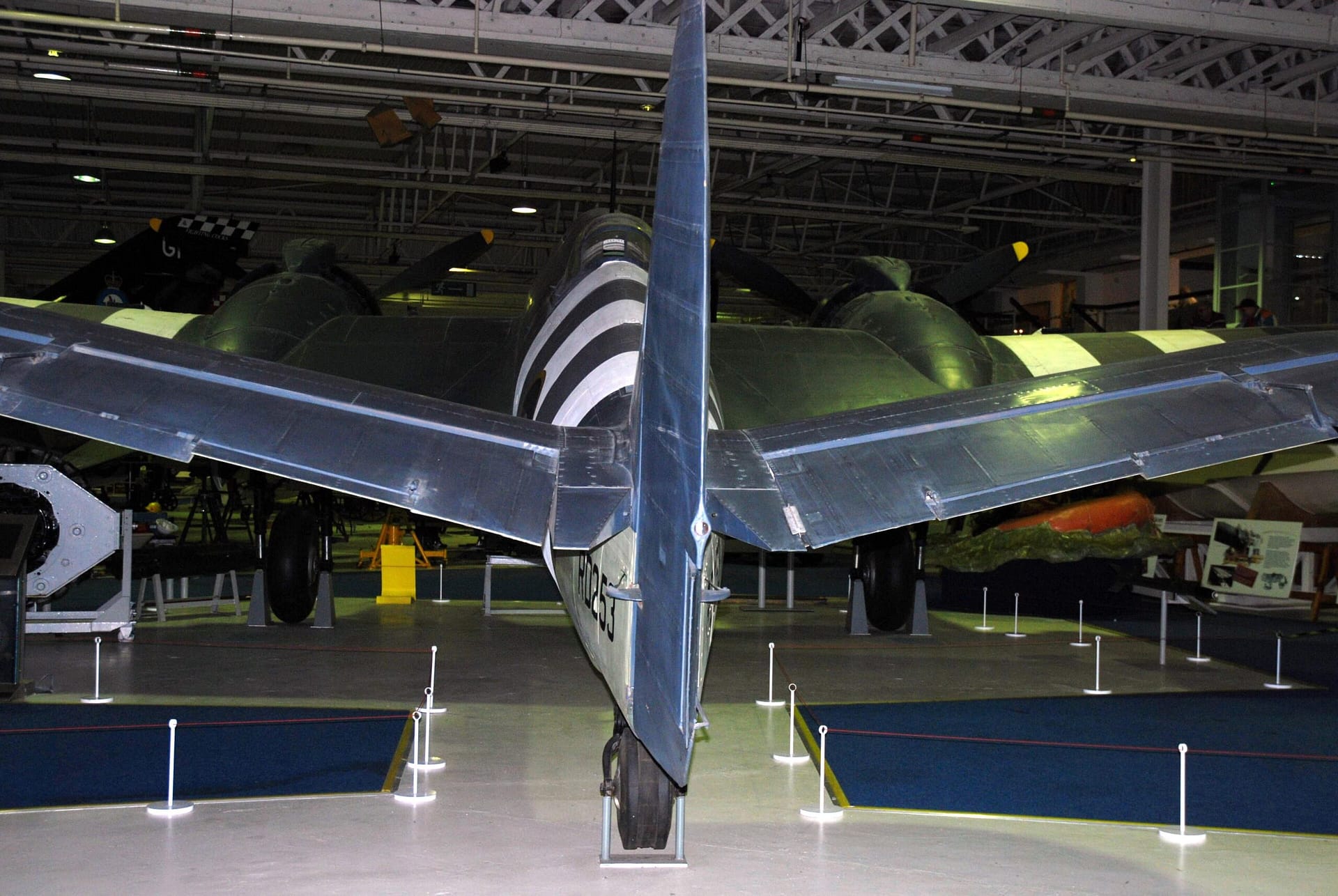
The first squadrons were night fighters, and the timing could not have been better. By summer 1940 the Luftwaffe had shifted to night bombing of British cities. The RAF had radar-equipped Bristol Blenheims trying to intercept them, but the Blenheim was too slow to catch a He 111 at altitude. The Beaufighter, with twice the engine power and an AI Mk. IV radar in the nose, flew its first operational sortie in September 1940 and scored its first kill — a Junkers Ju 88 — on 19 November 1940. The Whispering Death began at night, over Britain.
Why nobody heard it coming
The Bristol Hercules engine is the technical reason. Most piston aero engines use poppet valves — two or four valves per cylinder, opened and closed by a camshaft, with the characteristic clattering sound that aircraft of the era produced. The Hercules used sleeve valves: a moving cylindrical sleeve inside each cylinder, sliding up and down to expose intake and exhaust ports. Sleeve valves are quieter, more efficient at altitude, and far smoother. They are also fiendishly difficult to manufacture, and the Hercules was one of the very few aero engines that ever made the design work in mass production.
The Beaufighter wars
The aircraft fought three completely different wars. As a night fighter over Britain it shot down hundreds of Luftwaffe bombers. As a maritime strike platform with Coastal Command, fitted with rockets and a torpedo, it took a devastating toll of German coastal shipping along the Norwegian and Dutch coasts. And in Burma, equipped with cannon and a rocket payload, it became the RAF's primary anti-shipping and anti-convoy aircraft against the Japanese in the South-East Asia theatre.
It also produced an extraordinary safety record. The thick fuselage protected the crew from cannon fire. The engines were widely separated, so a single hit rarely killed both. The tail surfaces were large enough that the aircraft could be flown one-engine-out from Norway to Scotland, which it routinely did. Its loss rate per sortie was among the lowest of any British combat type of the era.
Why nobody talks about it
Three reasons. First, the Beaufighter was ugly. It had a snub nose, a deep fuselage, and a wing-to-fuselage joint that even Bristol's designers admitted looked agricultural. Aircraft of its era that survived in popular memory tended to be photogenic. The Spitfire is the standard the others are judged against. The Beaufighter just was not.
Second, its successor was the de Havilland Mosquito — which was faster, sleeker, made of wood and varnish rather than aluminium and rivets, and arrived in time to take over half the Beaufighter's missions by 1944. The Mosquito got the headlines and the films.
Third, the Beaufighter never flew with the Royal Navy or the Fleet Air Arm. There is no Beaufighter on a museum carrier deck. There is no Beaufighter at a major airshow in flying condition — none of the handful of surviving airframes is airworthy. The Whispering Death whispers on, quietly, in the archives. It deserves better.
Sources: Imperial War Museum, RAF Museum Hendon, Bristol Aero Collection.
Related Questions
What was the Bristol Beaufighter?
The Bristol Beaufighter was a British heavy fighter of World War II, first flown in 1939. Heavily armed with cannon and machine guns, it served as a night fighter, anti-shipping strike aircraft and ground-attack machine, and remained in service into the 1960s.
Why was the Beaufighter called 'Whispering Death'?
The nickname is attributed to Japanese forces, who reportedly heard the Beaufighter's attack only at the last moment. Its Bristol Hercules sleeve-valve engines ran unusually quietly, letting the heavily armed fighter sweep in on low strafing runs with little warning.
How was the Beaufighter armed?
It carried a formidable punch: four 20 mm Hispano cannon plus six .303 Browning machine guns, and it could also carry torpedoes or rockets. That heavy firepower made it deadly against ships, ground targets and other aircraft alike.
How many Beaufighters were built?
A total of 5,928 Beaufighters were built. The rugged, versatile aircraft served across many roles — night fighter, anti-shipping strike and ground attack — from 1940 until as late as 1960 in Australian service.
What engines did the Beaufighter use?
It was powered by two Bristol Hercules 14-cylinder sleeve-valve radial engines of about 1,600 hp each. The sleeve-valve design ran notably quietly, which contributed to the aircraft's Whispering Death reputation.
My father, a gunner in a MkV Sherman of 116 Rgt RAC (The Gordon Highlanders) never really spoke of his wartime experiences. Like most boys born at the start of the ‘60s with ex-service parents there was a fascination with militaria and I would love to spend time with dad constructing model kits. A favourite was the Beaufighter and it was then I heard my father say out load ‘whispering death’. Of course when I pressed him for more information he went characteristically quiet. I never knew him as an adult, he died when I was 14 years. So many memories lost.