Look at a photograph of the Blohm & Voss BV 141 for the first time and your brain does something interesting. It tries to correct the image. It assumes the photo is cropped oddly, or that you are seeing the aircraft from an unusual angle, or that something has gone wrong in printing. Because what you are looking at cannot possibly be right.
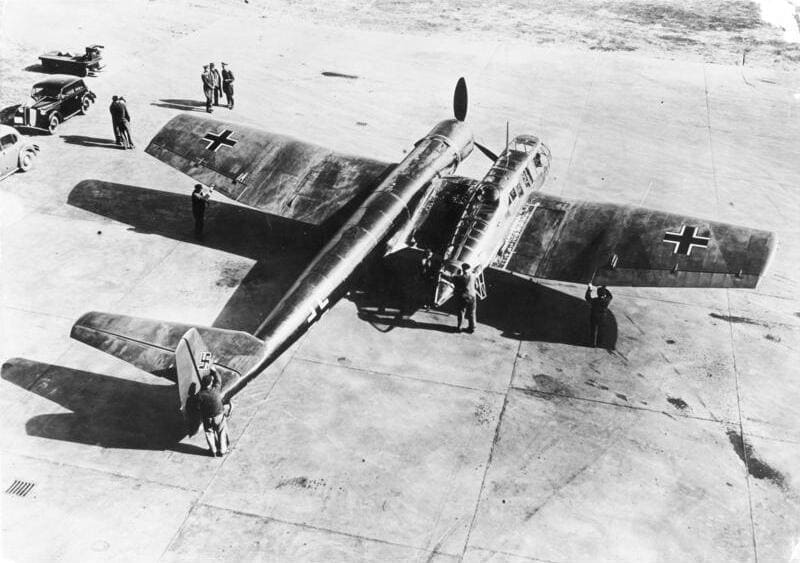
The cockpit is on one side. The engine and fuselage are on the other. The entire aircraft is deliberately, intentionally, structurally asymmetric — and it flew beautifully.
The BV 141 is one of the most unconventional aircraft ever to reach flight testing. It was designed by a brilliant engineer, praised by the pilots who flew it, and rejected by bureaucrats who could not get past the way it looked. It is the aviation equivalent of being too weird for the prom, no matter how well you danced.
Quick Facts
Aircraft: Blohm & Voss BV 141
Role: Tactical reconnaissance and army cooperation
Designer: Dr. Richard Vogt, Blohm & Voss
First flight: February 25, 1938 (BV 141 V1)
Engines: BMW 132N (early), BMW 801A (BV 141B)
Crew: 3 (pilot, observer, rear gunner)
Configuration: Deliberately asymmetric — crew gondola starboard of engine/tailboom
Built: ~17 total (prototypes + small batch)
Operational service: None — lost competition to Focke-Wulf Fw 189
Surviving examples: Zero
The Blohm & Voss BV 141 — one of the strangest aircraft ever flown. Via @jet.nerd on Instagram
The Method Behind the Madness
In 1937, the German Air Ministry issued a specification for a new single-engine tactical reconnaissance aircraft. The requirements were straightforward: good visibility for the observer, decent range, the ability to carry a camera and light defensive armament, and the reliability of a single-engine design.
Most aircraft companies submitted conventional proposals — twin-boom layouts, standard fuselages with greenhouse canopies. Dr. Richard Vogt, the chief designer at Blohm & Voss’s aircraft division, looked at the problem differently.
The issue with conventional single-engine reconnaissance aircraft, Vogt reasoned, was that the engine was always in the way. Stick a big radial engine on the nose and your forward visibility disappears. Put the observer behind the pilot and his view is blocked by wings, tail, and fuselage. Every conventional layout was a compromise between the pilot’s need to fly the aircraft and the observer’s need to see the ground.
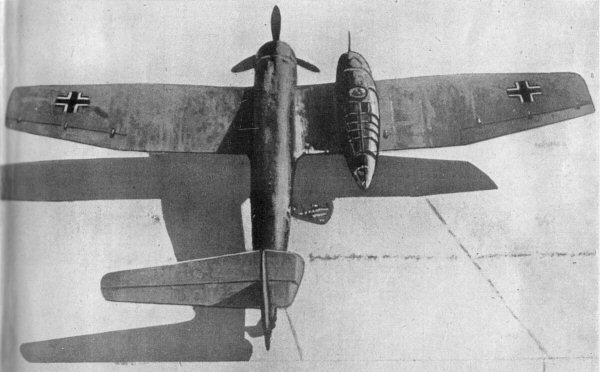
The BV 141 from behind — the asymmetry is unmistakable. The crew gondola sits entirely to the right of the engine nacelle and tail boom. Wikimedia Commons
Vogt’s solution was elegant in its radicalism: separate the crew from the engine entirely. Put the engine, propeller, and tail boom on one side. Put the crew in a fully glazed gondola on the other side, connected by a short wing spar. The observer gets an unobstructed 360-degree view. The pilot can see the ground below and ahead. The rear gunner has a clear field of fire. Problem solved.
The asymmetry, which looked insane, was aerodynamically sound. Vogt carefully calculated the thrust line, the centre of gravity, and the trim requirements to ensure the aircraft flew straight without constant rudder input. The propeller’s torque effect — which normally required trim tabs to counteract — was partially balanced by the offset mass of the crew gondola. The aircraft was, in a sense, designed to cancel out its own asymmetry.
A Plane That Flew Better Than It Looked
The Reichsluftfahrtministerium — the German Air Ministry, universally known as the RLM — took one look at Vogt’s proposal and declined to fund it. An asymmetric aircraft was too unconventional, too risky, too strange. They awarded the contract to Focke-Wulf’s Fw 189, a sensible twin-boom design that looked like a proper aeroplane.
Blohm & Voss, undeterred, built a prototype with their own money. The BV 141 V1 flew for the first time on February 25, 1938, powered by a BMW 132N radial engine. And from the very first flight, it was clear that Vogt’s calculations were correct.
The aircraft flew beautifully. Handling was responsive and predictable. Visibility from the crew gondola was, as promised, spectacular — better than anything the Fw 189 could offer. Pilots reported that the asymmetric layout was imperceptible in flight; the aircraft felt perfectly normal at the controls.
The RLM, impressed despite themselves, ordered five improved BV 141B prototypes with the more powerful BMW 801 engine. These flew from January 1941, and the reports continued to be positive. The aircraft was stable, easy to fly, and offered the best observation platform of any single-engine type in the Luftwaffe’s inventory.
Why the Luftwaffe Said No
So if the BV 141 flew well, looked great from the observer’s seat, and solved the visibility problem that plagued every other reconnaissance aircraft, why did the Luftwaffe reject it?
The answer is a mixture of timing, politics, and institutional conservatism. By the time the BV 141B was flying well in 1941, the Fw 189 was already in production and performing adequately on the Eastern Front. Switching to a new type would mean retooling factories, retraining crews, and disrupting a supply chain that was already stretched thin.
More critically, the BMW 801 engine that powered the BV 141B was desperately needed for the Fw 190 fighter — one of the Luftwaffe’s highest-priority programmes. Every BMW 801 that went into a reconnaissance aircraft was one that did not go into a frontline fighter. The engine allocation alone would have killed the BV 141 even if everything else had gone perfectly.
And then there was the look of the thing. Military procurement, in every era and every country, has a deep conservatism about unconventional designs. Engineers evaluate performance data; generals evaluate how something looks parked on a tarmac. The BV 141 looked wrong, and no amount of flight-test data could entirely overcome that visceral reaction in the corridors of the Air Ministry.
A total of roughly seventeen BV 141 airframes were built across both variants. None saw operational combat service, though at least one was evaluated by a Luftwaffe reconnaissance school on the Eastern Front. One aircraft was captured by British forces after the war and shipped to England for evaluation, where it generated considerable interest — and presumably considerable double-takes — before being scrapped.
The Genius of Richard Vogt
The BV 141’s failure was not a failure of engineering. Dr. Richard Vogt was one of the most innovative aircraft designers of the twentieth century, and the BV 141 was far from his only unconventional creation. He designed the BV 138 flying boat, the BV 222 Wiking — one of the largest flying boats of the war — and a series of increasingly radical asymmetric designs that never left the drawing board, including jet-powered variants.
After the war, Vogt went to the United States under Operation Paperclip and worked for American aerospace companies, applying his unconventional thinking to new problems. His fundamental insight — that symmetry is a convention, not a requirement — was ahead of its time. Modern aircraft like the Rutan Boomerang and various asymmetric drone designs owe an intellectual debt to Vogt’s work, even if their designers may not have known it.
A Plane the World Was Not Ready For
No BV 141 survives today. The prototypes were scrapped, the captured example was dismantled, and the drawings gathered dust in archives. For decades, the aircraft was a footnote — a curiosity mentioned in books about unusual warplanes, usually with a blurry photograph and a caption that said something like “bizarre asymmetric design.”
But the BV 141 deserves more than that. It was a serious engineering response to a real operational problem. It worked. Pilots loved it. The asymmetry that looked like madness was, in fact, a carefully calculated solution that delivered better visibility, better handling, and better crew protection than the conventional alternative.
The Luftwaffe picked the Fw 189 because it looked like an aeroplane was supposed to look. The BV 141 looked like a mistake. And that, in the end, was the only thing wrong with it.
Sources: War History Online, HistoryNet, Military Factory, PlaneHistoria
On October 24, 2003, three British Airways Concordes landed at London Heathrow within minutes of each other. One arrived from Edinburgh. One from the Bay of Biscay, where it had made a farewell supersonic run. One from New York — the last-ever scheduled supersonic...
A pilot pulls the handle. Two and a half seconds later, they are floating under a parachute. In between, they have been subjected to forces that would kill an unrestrained human being — and the engineering that makes it survivable is among the most violent and precise...
Every fighter jet ever designed starts with the same question: one engine or two? The answer shapes everything — the aircraft's size, weight, cost, survivability, performance envelope, and the missions it can fly. It is the single most consequential decision in combat...

 English
0 Comments