
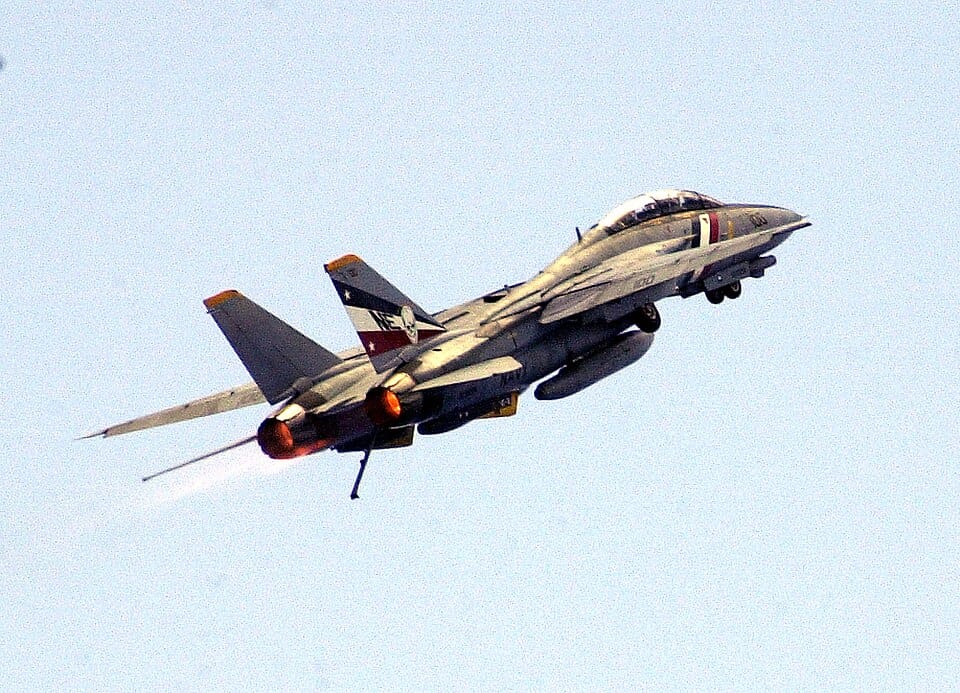
The Tomcat may fly again. Twenty years after the U.S. Navy retired its last F-14D and sent the survivors to museums, a bipartisan bill working its way through Congress would pull three of those airframes back out — and put one of them back into the sky.
It is being called, with admirable lack of subtlety, the Maverick Act.
The legislation would transfer three retired Grumman F-14D Tomcats from the Navy’s preservation pool to the U.S. Space and Rocket Center Commission in Huntsville, Alabama, with explicit authorisation to make at least one of them airworthy again. If it passes, it would be the first time a Tomcat takes off under its own power since 22 September 2006.
Quick Facts
Aircraft: Grumman F-14D Tomcat
Last Navy flight: 22 September 2006
Aircraft transferred: 3 (one earmarked for flight)
Recipient: U.S. Space and Rocket Center Commission, Huntsville, AL
Engines: 2 × General Electric F110-GE-400, 27,800 lb thrust each
Top speed: Mach 2.34
Why this is a very big deal
The F-14 is not just any retired fighter. It is the Top Gun jet — the swing-wing, two-seat, twin-engine missile platform that defined U.S. naval aviation for thirty-five years and then, in 2006, was unceremoniously parked. Every surviving Tomcat in U.S. hands has had its hydraulic lines, control surfaces and other key components rendered unflyable to keep them from leaking onto the open market and into Iranian hands. The only F-14s still flying anywhere on Earth fly under Iranian colours — and even those are barely held together with bailing wire and bravado.
Restoring a U.S. Tomcat to flight is therefore not a weekend project. It is a multi-year, multi-million-dollar undertaking that requires Congress to specifically waive the demilitarisation requirements and explicitly hand a museum the keys.

Three Tomcats, one mission
According to the bill text, the three airframes would be transferred to the Huntsville facility — better known to most Americans as Space Camp — which already operates a substantial historic-aircraft program. Two would remain on static display. The third, the Maverick Act explicitly states, would be put through the long, painful process of being “rendered safe for flight.”
That phrase is doing a lot of heavy lifting. The candidate airframe will need every flight control re-certified, both F110 engines fully overhauled or sourced, the entire hydraulic and fuel system rebuilt, and the airframe re-stressed for the demands of supersonic flight. It will then need an FAA experimental certificate. None of which is impossible — civilian operators have done it before with the F-86 Sabre, the MiG-21, even the MiG-29 — but no one has ever done it with a Tomcat.

Why now
The political timing is not subtle. Top Gun: Maverick made roughly a billion and a half dollars at the box office and reminded a generation that the F-14 was the coolest fighter ever bolted together. Top Gun 3 is in active production. The phrase “Maverick Act” did not appear on a Congressional bill by accident.
The deeper rationale, though, is less Hollywood. Backers argue that putting at least one Tomcat back into airworthy condition would preserve hard-won engineering knowledge that is otherwise quietly slipping away as the engineers and ground crew who built and maintained the jet retire or die. As one source put it: every year you wait, the surviving expertise gets thinner.
What happens next
The bill still has to clear committee, the House, and the Senate. Even if it sails through, an actual return-to-flight is years away. The Space Center Commission would need to identify a qualified restoration partner, secure private funding for what insiders estimate could be a fifty-to-eighty-million-dollar project, and choose which of the three airframes is the strongest candidate.
And then, somewhere over Alabama, a pair of F110s will spool up. Two big variable-geometry wings will sweep forward. And the unmistakable shape of a Tomcat — the only one in American skies in twenty years — will roll down a runway under its own power.
Goose, you might want to call your editor.
Sources: The Aviationist, U.S. Naval Institute, Federal Register, U.S. Space and Rocket Center.

 English
0 Comments