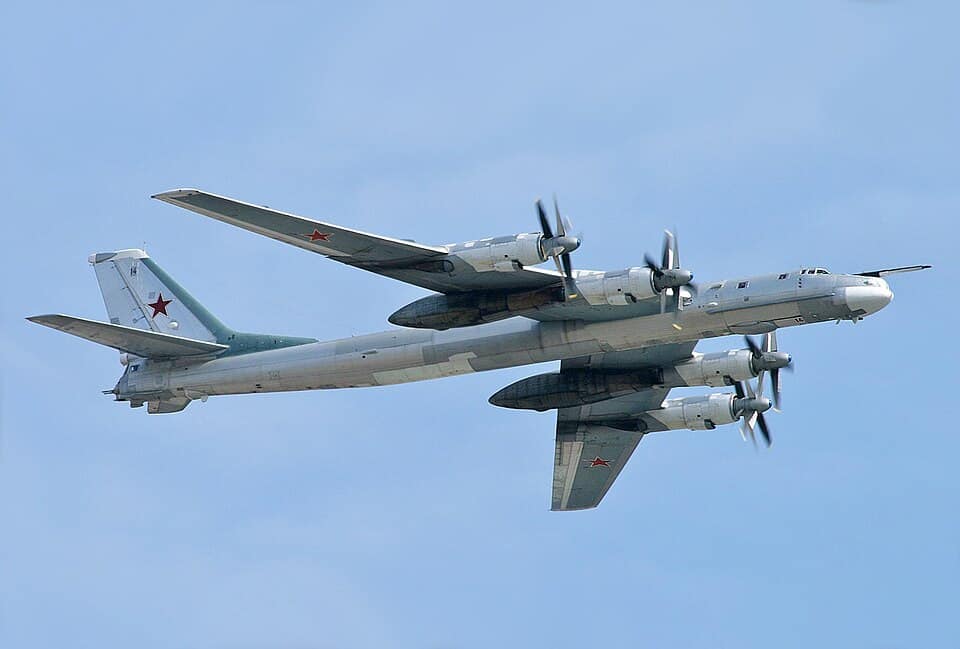
A Russian Tu-95MS Bear strategic bomber has been photographed carrying a Kh-101 air-launched cruise missile over the Barents and Norwegian Seas — the second time in twelve months that Moscow has publicly flaunted its premier stand-off weapon on a long-range patrol near NATO airspace. The April 30, 2026 flight lasted more than seven hours and included a four-aircraft package: two Tu-95MS bombers, at least one Su-30SM2 fighter escort, and an Ilyushin Il-78M aerial refuelling tanker.
The Russian Ministry of Defence released detailed video of the sortie, showing the turboprop bomber taxiing and taking off with what analysts assess is a single Kh-101 cruise missile mounted on a twin-rail AKU-5M ejection unit beneath the port wing’s outermost hardpoint.
Quick Facts
What: Tu-95MS Bear bomber flew with Kh-101 ALCM near NATO airspace
When: April 30, 2026 — seven-hour mission
Where: Barents Sea and Norwegian Sea (international airspace)
Weapon: Kh-101 ALCM — range up to 2,800 km, nuclear-capable variant Kh-102
Significance: Second publicly documented Kh-101 carriage flight in 12 months
The Sortie: Kh-101 Over Arctic Waters
The Russian MoD video shows a Tu-95MS departing its base in daylight with a clearly visible Kh-101 (or its nuclear-armed sibling, the Kh-102) mounted on an AKU-5M ejection rail beneath the left wing. The Tu-95MS can carry four such twin-rail launchers, giving it a total capacity of eight Kh-101/102 missiles — though on this flight, only one appears loaded.
In-flight footage captured the Tu-95MS being refuelled by an Il-78M Midas tanker, with at least one Su-30SM2 Flanker-H providing fighter escort. The Su-30SM2 was armed with R-73 short-range air-to-air missiles and carried wingtip electronic warfare pods. A second Tu-95MS was visible at a distance off the starboard side, though it is unclear whether it too was carrying a cruise missile.
An Ilyushin Il-78M Midas aerial refuelling tanker — the same type that accompanied the Tu-95MS bombers on their seven-hour Arctic patrol. Wikimedia Commons
Russian military aviation analyst Guy Plopsky assessed that the Kh-101 visible in both this flight and a similar sortie in May 2025 could be inert or captive-carry versions — test rounds used for training and integration flights rather than live weapons. Whether inert or not, the message to NATO is unmistakable.
A Pattern of Provocation
The April 30 sortie follows an identical flight pattern from May 20, 2025, when a Tu-95MS identified as “Murmansk” (Bort 24 Red / RF-94130) carried a Kh-101 on the same Barents Sea route. That earlier flight was escorted by Su-33 naval fighters armed with R-27 and R-73 air-to-air missiles.
Both missions were accompanied by the standard Russian statement that flights were conducted “in strict accordance with international rules of airspace use.” The MoD added that the bombers were “accompanied by fighters of foreign states” — almost certainly NATO interceptors, though neither NATO’s Allied Air Command nor the Norwegian, Swedish, or Finnish air forces had confirmed the interception at the time of reporting.
The Kh-101 air-launched cruise missile — Russia’s premier conventional stand-off weapon with an estimated range of up to 2,800 km. Wikimedia Commons
Armed Su-24s in the Baltic
In a separate incident on May 1, French Rafale fighters deployed to Lithuania’s Šiauliai Air Base as part of NATO’s Baltic Air Policing mission intercepted two Russian Su-24MR strike aircraft. The French Joint Staff reported that the Su-24s had penetrated Baltic airspace without a flight plan. Analyst Plopsky identified one aircraft carrying two RBK-500 series cluster bombs, while the second was armed with four OFAB-250-270 high-explosive fragmentation bombs. It remains unclear whether the weapons were live or inert.
The Kh-101: Russia’s Stand-Off Weapon of Choice
The Kh-101 is the conventional variant of Russia’s most advanced air-launched cruise missile family. With an estimated range of up to 2,800 kilometres, it is designed to fly at low, terrain-hugging altitudes to evade radar detection. The nuclear-capable Kh-102 variant reportedly extends the range further.
Ukraine has faced repeated Kh-101 strikes since 2022, and the combat experience has spawned several sub-variants. Versions with dual or tandem warheads, decoy and penetration aid dispensers, cluster warheads, and multiple types of terminal-stage optical seekers have all been documented in the field.
The Tu-95MS with its Kh-101 loadout fits into a broader pattern of Russian strategic aviation flights carrying frontline weapons near NATO borders. Tu-22M3 bombers have been spotted with Kh-22/32 anti-ship missiles over the Baltic, and MiG-31 interceptors have carried Kh-47M2 Kinzhal hypersonic missiles over the Sea of Japan. Whether these are captive-carry trials or deliberate deterrence flights, the signal to Western allies is consistent and intentional.
Russian film on the Tu-95MS strategic bomber
Tu-95 Russian strategic bomber — Red Bear Over BritainSources: The Aviationist, Russian Ministry of Defence, Guy Plopsky (X/@GuyPlopsky), French Joint Staff
Every fighter pilot trains for it. Most pray they'll never experience it. The moment a jet engine — the machine that keeps you flying at 500 knots and 30,000 feet — stops working. Whether it's a compressor stall that sounds like a cannon going off behind your seat, a...
Luca Parmitano has lived two lives that most people only dream about. In the first, he was a fighter pilot — flying AMX Ghibli attack jets for the Italian Air Force, deployed to Afghanistan, trained to fly low and fast into hostile territory. In the second, he became...
Before the Rafale, before the Mirage 2000, before the Mirage F1 — there was the Mirage III. Dassault's first supersonic fighter was a revelation when it entered service in 1961: a sleek, tailless delta that could break Mach 2, carry a nuclear bomb, and outfight...



 English
0 Comments