In 1970, Soviet engineers took a standard ER22 railway carriage, bolted two jet engines from a Yakovlev Yak-40 airliner to the roof, and sent it screaming down the tracks at nearly 250 kilometres per hour. This was not a fever dream. This was Soviet transport policy.
The SVL — Skorostnoy Vagon-Laboratoriya, or High-Speed Laboratory Car — was the Soviet Union’s attempt to answer a question that Western nations were also asking: could jet propulsion make trains fast enough to compete with aircraft on short-haul routes?
Quick Facts
Vehicle: SVL (Skorostnoy Vagon-Laboratoriya) — High-Speed Laboratory Car
Purpose: Research into high-speed rail dynamics and aerodynamics
Aviation Engines on Rails
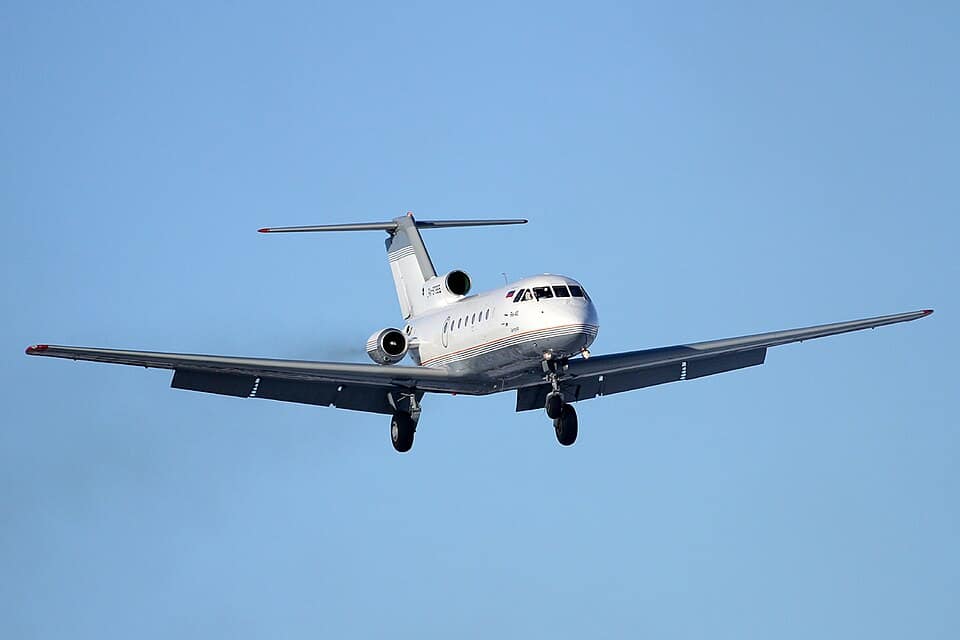
The concept was straightforward, even if the execution was audacious. The SVL used its wheels only for guidance and support — not for propulsion. All forward thrust came from the two Ivchenko AI-25 turbofan engines mounted on the roof, the same engines that powered the Yak-40 regional airliner. The railway carriage simply rode the rails while the jet engines pushed it forward, like strapping a rocket to a shopping trolley.
The AI-25 engines were relatively small and efficient by jet standards — each produced about 1,500 kilograms of thrust — but on a vehicle with steel wheels on smooth rails, that was more than enough. Friction was minimal. Aerodynamic drag was the primary limiting factor, and at 250 km/h, it became significant.
What They Learned
The SVL was never intended to become a production vehicle. It was a research platform — a moving laboratory designed to gather data on high-speed rail dynamics that the Soviet Union could not obtain any other way. At 250 km/h, phenomena like rail oscillation, wheel-rail contact dynamics, aerodynamic buffeting, and braking behaviour were fundamentally different from anything encountered at conventional speeds.
Soviet engineers instrumented the carriage with sensors measuring every conceivable parameter: lateral acceleration, vertical bounce, yaw rate, air pressure distribution, noise levels, and structural stress. The data fed into the development of future high-speed rail concepts and helped Soviet railway engineers understand the limits of their existing track infrastructure.
The Jet Train That Time Forgot
The SVL was not alone in the jet-train concept. The United States experimented with the M-497 Black Beetle in 1966 — a modified Budd Rail Diesel Car with two General Electric J47 jet engines from a B-36 bomber strapped to the roof. It reached 295 km/h on a test track in Ohio. France, Germany, and Japan were all pursuing high-speed rail through more conventional means, and their approaches — electric traction, purpose-built track, aerodynamic trainsets — ultimately won.
The SVL sits today as a rusting relic, a monument to an era when Soviet engineers believed that any problem could be solved by bolting a jet engine to it. They were not always wrong. But the future of high-speed rail belonged to the TGV, the Shinkansen, and the ICE — not to jet engines on the roof of a railway carriage.
The forgotten Soviet rocket streamliner — too advanced for its era
The turbojet trains that were not built for speedSources: Archived Dreams (Instagram), Soviet railway engineering archives
Every fighter pilot trains for it. Most pray they'll never experience it. The moment a jet engine — the machine that keeps you flying at 500 knots and 30,000 feet — stops working. Whether it's a compressor stall that sounds like a cannon going off behind your seat, a...
Luca Parmitano has lived two lives that most people only dream about. In the first, he was a fighter pilot — flying AMX Ghibli attack jets for the Italian Air Force, deployed to Afghanistan, trained to fly low and fast into hostile territory. In the second, he became...
Before the Rafale, before the Mirage 2000, before the Mirage F1 — there was the Mirage III. Dassault's first supersonic fighter was a revelation when it entered service in 1961: a sleek, tailless delta that could break Mach 2, carry a nuclear bomb, and outfight...



 English
0 Comments