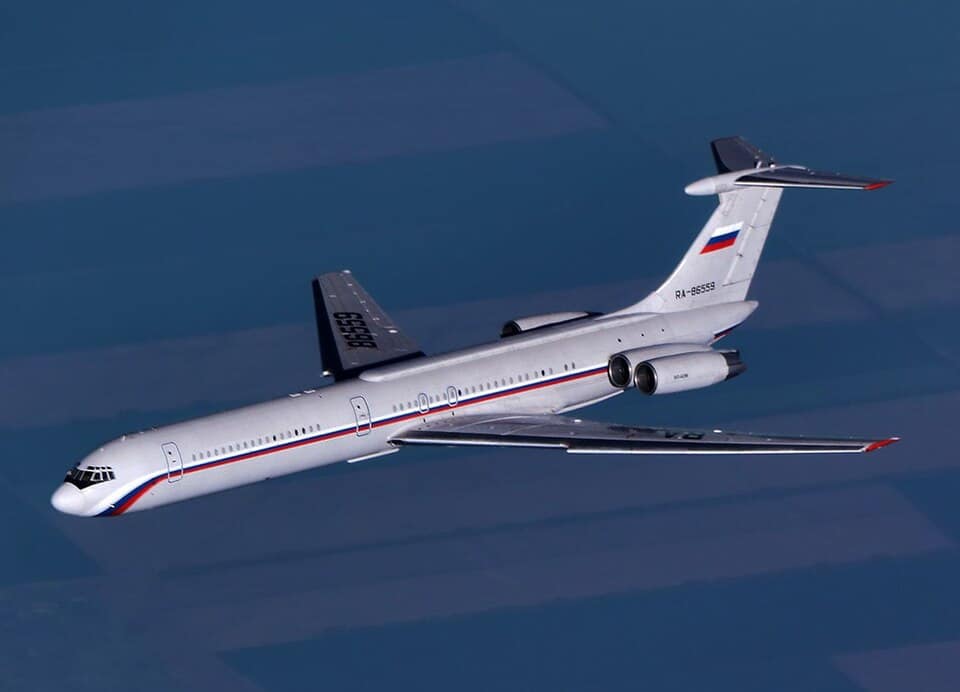
In 1989, an Ilyushin Il-62 — a four-engine Soviet jetliner designed for intercontinental routes — touched down on a grass field in Germany. Not a paved runway. Not an emergency strip. A grass field. For an aircraft that weighed over 70 tonnes empty and was built to operate from the long concrete runways of Sheremetyevo and Domodedovo, this was the aviation equivalent of parallel parking an oil tanker.
The photograph of this landing has become one of the most shared images in Cold War aviation history. And the story behind it is a perfect snapshot of Soviet-era aviation — ambitious, resourceful, and occasionally bewildering.
Why: Cold War-era aviation often wrote its own rules
Max takeoff weight: 165,000 kg (363,760 lb)
The Soviet Union’s Long-Range Flagship
The Ilyushin Il-62 was the Soviet Union’s answer to the Boeing 707 and the Douglas DC-8. First flown in 1963, it entered service with Aeroflot in 1967 and became the flagship of Soviet long-haul aviation. With four rear-mounted Soloviev D-30KU turbofan engines and a T-tail configuration, the Il-62 looked elegant in a way that few Soviet aircraft managed — a graceful machine designed to fly heads of state and flag-carrying routes to Havana, Delhi, and New York.
But the Il-62 was built for runways — long, hard, properly surfaced runways. Its landing gear was designed for concrete. Its approach speeds were calibrated for paved surfaces with proper braking action. The idea of putting this aircraft onto grass would have given any Aeroflot operations manual writer a heart attack.
Landing on Turf
Yet in 1989, an Il-62 did exactly that. The circumstances of the grass landing reflect the improvisational spirit that characterised Soviet and East German aviation during the late Cold War. Airports in the Eastern Bloc did not always meet the infrastructure standards that Western airlines took for granted. Grass strips, unpaved taxiways, and improvised surfaces were more common than official aviation authorities liked to admit.
The images from the landing show the massive jetliner settled on green turf, its wheels pressing deep ruts into the soft ground. The aircraft looks entirely out of place — like finding a whale in a swimming pool. Everything about it is wrong except for the fact that it clearly worked. The aircraft landed, it stopped, and it was later recovered.
Cold War Aviation’s Wild Side
The Il-62 grass landing is not an isolated curiosity. Soviet-era aviation was full of stories that would be unthinkable in the Western airline world. Aeroflot pilots routinely operated into airfields with minimal navigation aids, inadequate lighting, and surfaces that Western carriers would have refused. Military transport aircraft landed on frozen rivers, dirt strips in Siberia, and improvised fields across Central Asia.
This was not recklessness — it was necessity. The Soviet Union covered eleven time zones, and many of its most important cities, military bases, and industrial centres were located in regions where building and maintaining paved runways was extraordinarily difficult. The aircraft and their crews had to be adaptable, and they were.
The Il-62 on the grass field is a monument to that adaptability. It should not have worked. It did.
Ilyushin IL-62 landing on a grass field (1989)
Why they landed an IL-62 on a grass fieldSources: aircraftl0ver (Instagram), Aeroflot historical archives
UPDATE — 3 June 2026: This post updates our earlier coverage of the Harrier retirement. Read the original article here. At 10:00 Eastern this morning, five AV-8B Harrier IIs from Marine Attack Squadron 223 — the "Bulldogs," the last operational Harrier squadron in the...
The most expensive aircraft program in American history just kicked into a higher gear. Northrop Grumman and the U.S. Air Force have signed a $4.5 billion deal to increase B-21 Raider production capacity by 25 percent, compressing delivery timelines for the...
For the first time in nearly a decade, the U.S. Air Force's primary fighter fleet has fallen below the minimum size that Congress wrote into law. The number that was supposed to be a floor has become a ceiling, and the gap between what America needs in the air and...


 English
0 Comments