The GPS display goes blank. Smartphones lose their signal. Laptops cannot reach the internet. For three hours, the Royal Air Force Dassault Falcon 900LX carrying British Defence Secretary John Healey flies through electronic darkness over the Baltic Sea — and the pilots have no satellite navigation to guide them home.
The interference begins the moment the aircraft lifts off from Estonia on 21 May 2026, and it does not stop until the jet is well clear of the Baltic region. A UK defence source tells the BBC it was “reckless Russian interference.” The aircraft, an Envoy IV CC.1 registered G-ZABH and operated by 32 (The Royal) Squadron from RAF Northolt, is carrying political advisors, a British Army general, two photographers, and a journalist.
The pilots fall back on what the RAF calls “revisionary” navigation — inertial reference systems, ground-based radio beacons, and dead reckoning. Cold War methods. The kind of flying that GPS was supposed to make obsolete thirty years ago.
Quick Facts
Date: 21 May 2026
Aircraft: Dassault Falcon 900LX (Envoy IV CC.1), G-ZABH, 32 (The Royal) Squadron RAF
Passenger: UK Defence Secretary John Healey, returning from visiting NATO troops in Estonia
Duration of jamming: Approximately 3 hours — the entire return flight
Effect: GPS disabled, smartphones and laptops lost connectivity
Attribution: UK defence source described it as “reckless Russian interference”
Precedent: Similar incident hit Defence Secretary Grant Shapps near Kaliningrad in March 2024
Not the First Time — and Not the Worst
This is not an isolated incident. It is the latest in a pattern that has been accelerating since Russia’s full-scale invasion of Ukraine in February 2022. Nearly 123,000 flights over Baltic airspace were affected by Russian GPS interference in just the first four months of 2025. Latvia’s Electronic Communications Office recorded 820 cases of satellite signal interference in 2024, compared to 26 in 2022.
In March 2024, Healey’s predecessor Grant Shapps suffered a similar attack — his RAF Falcon 900LX was jammed for approximately 30 minutes near Russia’s Kaliningrad exclave while returning from Poland. In late August 2025, European Commission President Ursula von der Leyen’s aircraft was hit while flying to Bulgaria. A Spanish defence minister’s jet was interfered with near Kaliningrad around the same time.
The difference with the Healey incident is the duration: three hours of continuous interference, covering virtually the entire flight.
The Vulnerability Britain Chose Not to Fix
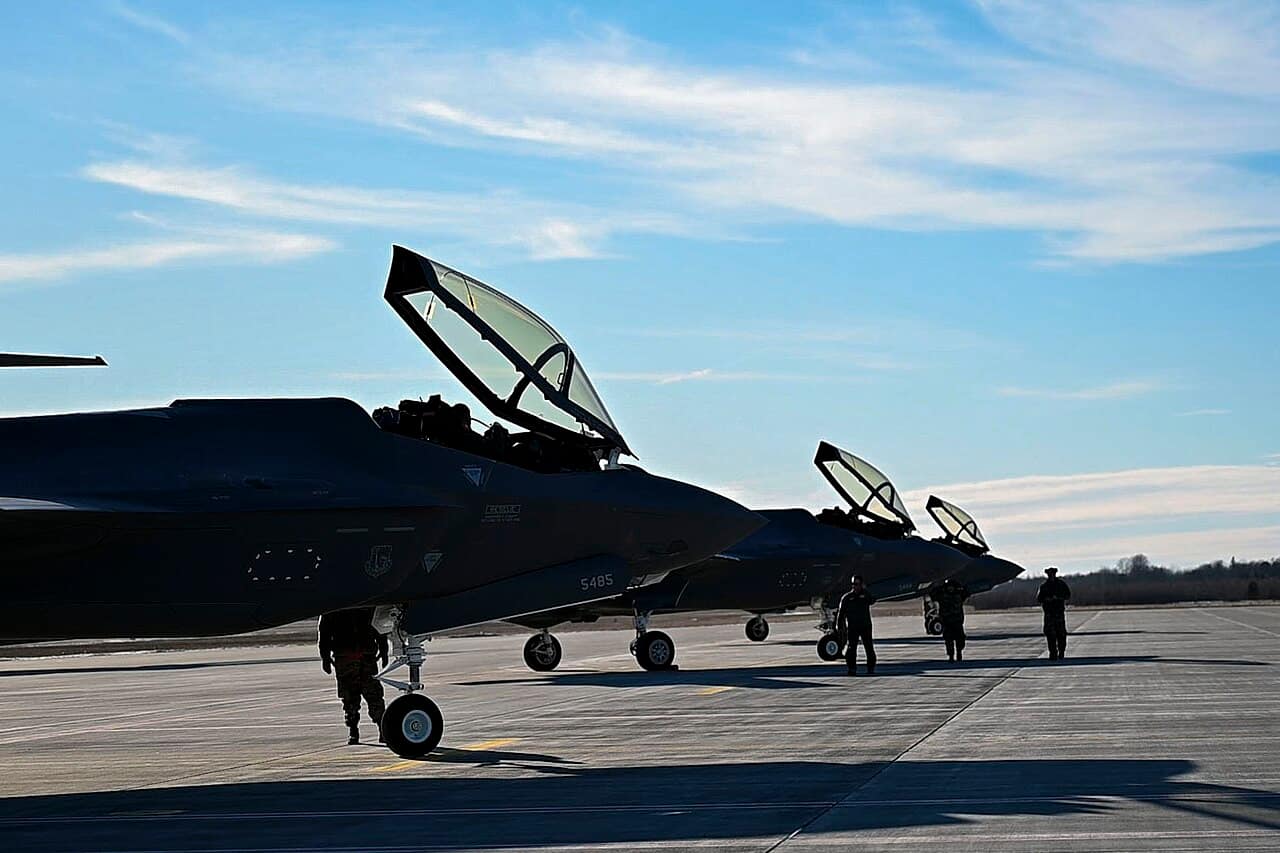
USAF F-35As at Ämari Air Base, Estonia — NATO’s forward-deployed fighters in the Baltic region where GPS jamming is now an almost daily occurrence. Wikimedia Commons
When the UK Ministry of Defence ordered its pair of Falcon 900LX aircraft in 2021, it opted against the most extensive defensive aids package available from Dassault. That decision drew sharp criticism after the 2024 Shapps incident — and it looks even more questionable now. The aircraft that carries Britain’s most senior defence official through the most electronically contested airspace in Europe lacks the kind of hardened navigation suite that front-line military aircraft take for granted.
The contrast with the fighter jets stationed just miles away at Ämari Air Base in Estonia is stark. NATO’s F-35s, Rafales, and F-16s operating on Baltic Air Policing rotations are equipped with military-grade inertial navigation systems, anti-jam GPS receivers, and electronic countermeasures. The VIP transport that carries the person who commands those fighters is not.
“GPS jamming by Russia is commonplace in certain areas of Europe. Airlines and aircraft users plan for its presence and have other means of safe navigation. But it’s indicative of how aggressive Russia is being in ways below a threshold of open conflict.”
Air Marshal (Ret.) Greg Bagwell — Former RAF Deputy Commander, Air Command
A Weapon Below the Threshold
GPS jamming occupies a deliberate grey zone in Russia’s hybrid warfare playbook. It is aggressive enough to disrupt navigation, endanger civilian aviation, and humiliate NATO governments — but calibrated to remain below the threshold of armed attack.
The jamming originates from military installations around Kaliningrad and western Russia. Researchers have traced the interference to systems including the Borisoglebsk-2 and Murmansk-BN electronic warfare complexes, which broadcast powerful signals on the same frequencies as GPS satellites, overwhelming receivers within hundreds of kilometres.
NATO has warned that if a commercial aircraft or passenger ferry were to crash as a direct result of Russian jamming, the alliance would treat it not as an accident but as a deliberate escalation — with consequences that could extend far beyond the electronic spectrum. Estonia, Lithuania, Latvia, Sweden, and Germany have all formally declared the interference a form of hybrid warfare.
Three Hours Blind — and Nobody Noticed
Perhaps the most unsettling aspect of the Healey incident is how routine it has become. The aircraft landed safely. The Defence Secretary continued with his schedule. No emergency was declared. In the Baltic airspace of 2026, flying without GPS for three hours is no longer extraordinary — it is the new normal. An average of 350 commercial flights per day are affected by the same interference.
For the passengers aboard that Falcon 900LX, the experience was a glimpse of what aviators across the Baltic endure every day: the quiet, invisible hand of Russian electronic warfare, reaching across borders without firing a shot.
Sources: BBC News, Kyiv Independent, AeroTime, Air & Space Forces Magazine
Before AWACS, air warfare was a knife fight in a dark room. Pilots relied on their own radar, ground controllers with limited visibility, and radio calls that were often confused, late, or wrong. After AWACS, one side had the lights on and the other did not. The...
On May 1, 1960, CIA pilot Francis Gary Powers took off from Peshawar, Pakistan in a Lockheed U-2 spy plane. His mission: fly across the entire Soviet Union at 70,000 feet, photographing military installations, and land in Bodø, Norway. He never made it. A Soviet S-75...
When the Sukhoi Su-47 Berkut rolled out in 1997, it looked like nothing else in the sky. Its wings swept forward instead of back — an aerodynamic concept that promised extraordinary agility, superior low-speed handling, and enhanced controllability at high angles of...



 English
0 Comments