
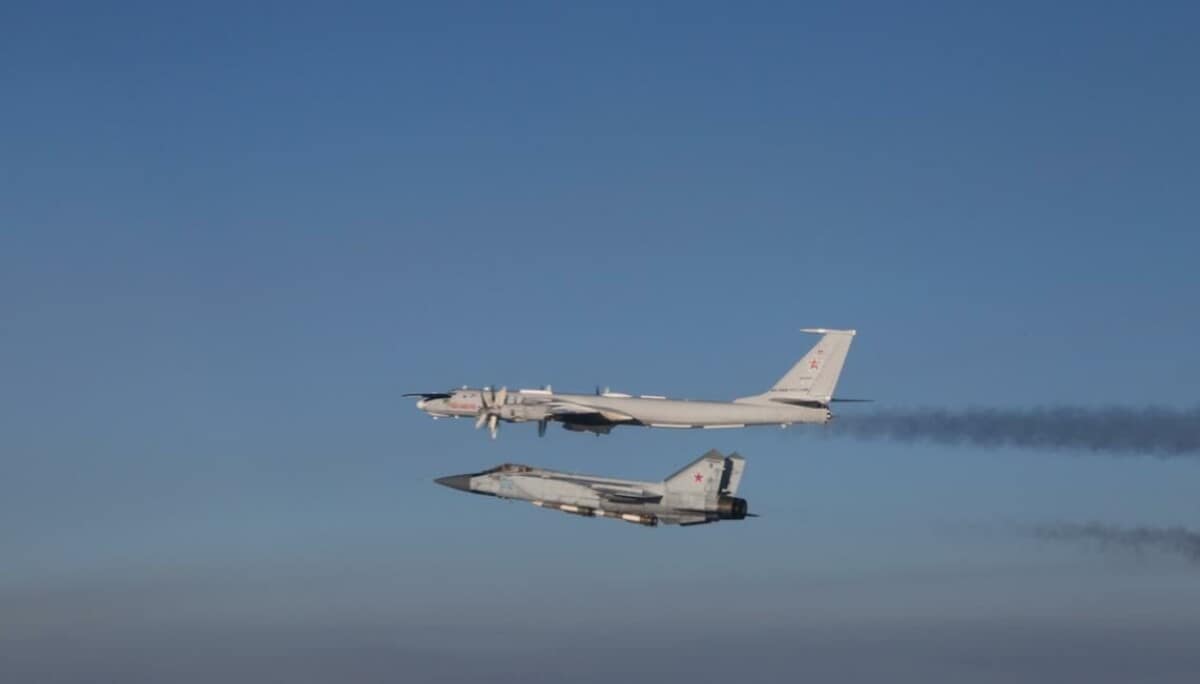
There is a particular silence in the early hours over the Sea of Azov, and on the night of 29-30 May 2026 it was broken not by jet engines but by the soft whir of Ukrainian strike drones. Their target sat on the apron at Taganrog, the home of the Beriev Aircraft Company: a pair of enormous, contra-rotating-propellered Tupolev Tu-142s, the maritime cousins of the legendary “Bear” bomber.
One of those airframes was no ordinary submarine hunter. It was a Tu-142MR, NATO codename “Bear J” — one of the rarest aircraft in the entire Russian inventory, and arguably the most strategically delicate. Its job is not to drop torpedoes, but to whisper to submarines hidden beneath the ocean, carrying the threads of Moscow’s nuclear chain of command.
Footage released by Ukraine’s Unmanned Systems Forces shows a drone slipping into the wing of one machine, striking the fuel tank. Seconds later, the airframe is wreathed in flame. For a fleet that fields perhaps a dozen of these aircraft worldwide, it is a loss that cannot simply be reordered.
Quick Facts
- Two Tu-142 aircraft, including a rare Tu-142MR “Bear J”, were struck at Taganrog airfield overnight on 29-30 May 2026.
- The strike was carried out by Ukraine’s Unmanned Systems Forces, commanded by Robert “Magyar” Brovdi.
- The Tu-142MR is a VLF radio-relay aircraft that carries launch orders to submerged nuclear-armed submarines.
- Analysts estimate only 12 to 14 Tu-142MR airframes exist, split between Russia’s Northern and Pacific fleets.
- The aircraft had been at Taganrog’s Beriev plant for repair and modernisation; both had been moved on the apron in mid-May.
- An Iskander launcher was also reportedly destroyed in the same operation.
Strike on Taganrog
Taganrog lies on the northern shore of the Sea of Azov, roughly 50 kilometres west of Rostov-on-Don and barely 40 kilometres from the front in occupied Donetsk Oblast. Its airfield is operated by Beriev, the firm that built the Tu-142 and which remains responsible for keeping the survivors flying. That made it a natural place for ageing Bears to gather — and a natural target.
The operation was claimed by the 1st Center of Ukraine’s Unmanned Systems Forces, a unit specialising in deep strikes far behind Russian lines. Video of the attack appeared on the channel of the 414th “Magyar’s Birds” brigade, showing the unmistakable silhouette of a Bear erupting after a precise hit to the wing root.
Russian authorities offered the usual muted acknowledgement. The Rostov regional governor conceded that a fuel tank, an oil tanker and an administrative building in the port had caught fire, and that two people were injured — a description carefully detached from the aircraft themselves.
Whisperer to the Deep
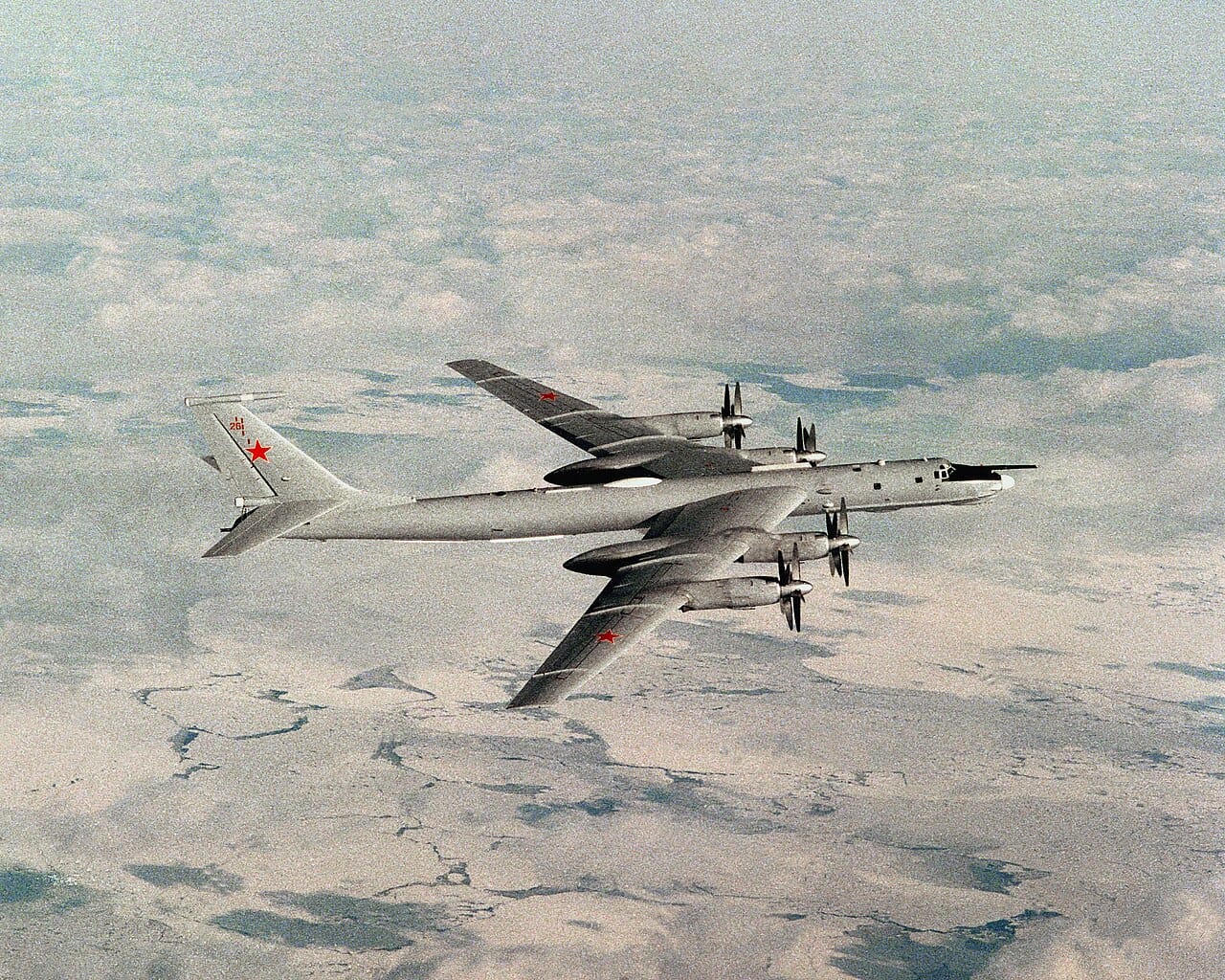
The Tu-142 comes in two principal flavours: the Tu-142MK, a conventional anti-submarine hunter, and the far rarer Tu-142MR communications-relay variant. The difference is visible to a trained eye — the MR carries a distinctive forward-facing pod on its tail fin where the MK mounts a rearward magnetic anomaly detector.
That pod betrays the aircraft’s true vocation. Using the Soviet-developed Oryol system, the Tu-142MR trails a long very-low-frequency antenna and acts as an airborne relay between Russia’s national command authority and its submerged submarines. Its mission is conceptually identical to the American E-6 Mercury “TACAMO”: ensuring that, even in the worst hour, launch orders can reach ballistic-missile boats, guided-missile submarines and attack submarines beneath the waves.
It is, in short, a strand of the nuclear deterrent itself — not a weapon, but the voice that commands the weapons. That is what makes the loss resonate well beyond the battlefield in Ukraine.
Twelve of Their Kind
Aviation analyst Piotr Butowski, author of Russian Air Power and a recognised authority on Moscow’s military aviation, was first to identify the destroyed machine as an MR, picking out that telltale tail pod in the Ukrainian footage. By his estimate, only 12 to 14 Tu-142MR airframes exist, divided between the Northern and Pacific fleets — the only two Russian fleets that operate ballistic-missile submarines.
The Northern Fleet’s Bears normally operate from Kipelovo in Vologda Oblast, though in recent years they have increasingly been spotted at Severomorsk-1 on the Kola Peninsula, from where they range across the North Atlantic and the Arctic. The Taganrog aircraft were there for the opposite reason: deep maintenance and modernisation, the slow surgery that keeps a Cold War design alive.

A Loss Out of Production
There is a wrinkle, and an honest writer must note it. Open-source analysts at Militarnyi traced the Taganrog airframes to a group of four Tu-142s stored at the plant since at least 2011 — hardly frontline assets. Yet satellite imagery showed three of them being shuffled across the apron between 19 April and 19 May, a movement consistent with restoration work, relocation, or use as bait.
Lars Peder Haga, Associate Professor at Norway’s Air Force Academy, judged that the targeted aircraft were most likely undergoing repair and had reached “a stage where they had started test flights.” If so, the implication is sobering rather than reassuring.
Production lines for the Tu-142 closed in 1994. Russia cannot build a replacement; it can only nurse the survivors. Destroy a machine that has just emerged from years of refit, and the remaining fleet must simply fly on, older and more tired, before their own turns in the workshop. For a niche capability woven into nuclear deterrence, even a single airframe carries strategic weight.
Russian Northern Fleet Tu-142 Bears hunting submarines over the North Atlantic.
A Strategic Tremor
For Ukraine, the strike is another demonstration that no corner of Russia’s vast military estate is beyond reach. For European observers — and for NATO’s northern flank in particular — the symbolism cuts deeper. These are the aircraft Norwegian F-35s scramble to meet off their coast, the quiet emissaries of Russian sea power in the High North.
Whatever the eventual ledger, the message is unmistakable. A drone costing a fraction of a fighter jet reached out and silenced one of the rarest voices in Moscow’s arsenal. In the contest between cheap mass and irreplaceable sophistication, the night of 30 May tilted, just slightly, toward the small machines.
Sources: The Barents Observer, Kyiv Independent, UNITED24 Media, Militarnyi



 English
0 Comments