
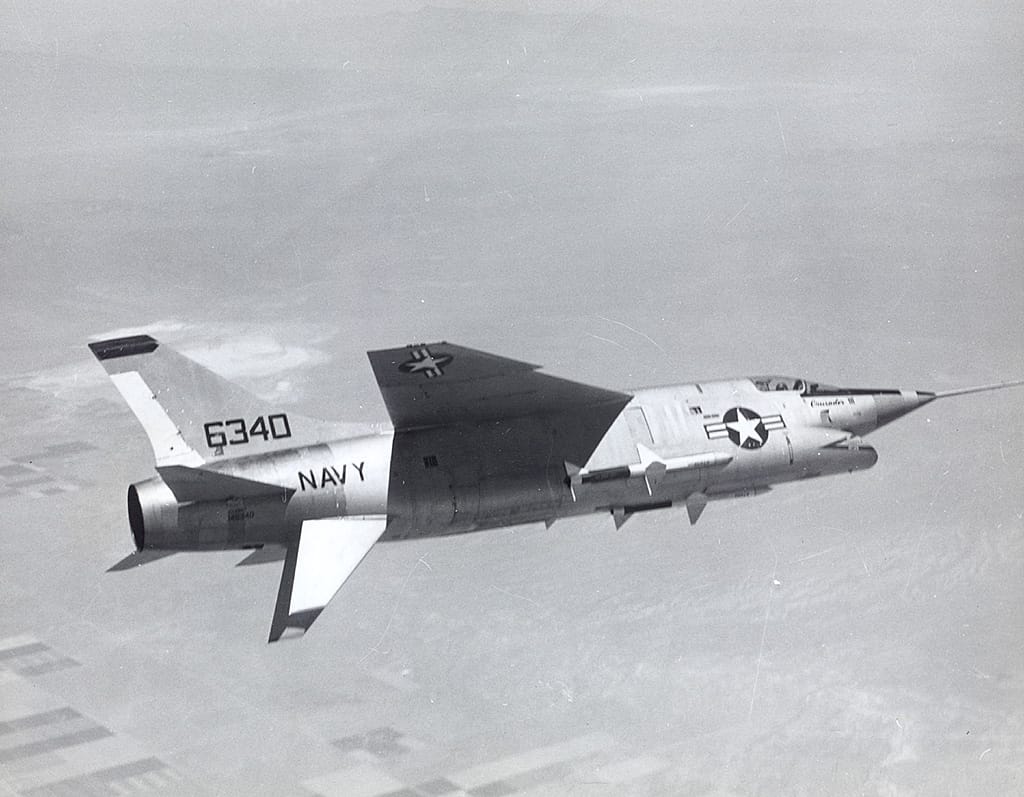
In late 1958, in the high Texas sky over Naval Air Station Dallas, Vought's chief test pilot John Konrad flew an aircraft that could outmanoeuvre, outclimb, outrun and outturn the future F-4 Phantom II. The aircraft had a single engine. It had no radar operator. It had a magnificently elegant, single-purpose airframe whose only job was to be a better Crusader than the Crusader. Konrad called it, in a phrase that has echoed through fifty years of Navy aviation lore, "the airplane that could fly circles around the Phantom."
The U.S. Navy bought the Phantom anyway.
The Vought XF8U-3 Crusader III — Konrad's aircraft, Mach 2.39 in level flight, with a wing-loading and thrust-to-weight ratio that would not be matched in U.S. naval aviation until the F-14 Tomcat fifteen years later — is one of the most haunted footnotes in U.S. military procurement history. Five airframes were built. Three flew. They proved every claim the Vought design team had made for them. Then they went to NASA for high-altitude research and the programme was buried under the F-4 Phantom production line.
The decision was made in December 1958. The Navy ordered the F-4 Phantom II in production quantities. The Crusader III was cancelled with five airframes built. Three of them, all flying examples, went to NASA for upper-atmospheric and aerodynamic research — work the Crusader III was uniquely suited to perform, because it could climb above 95% of the Earth's atmosphere and operate at speeds normal aircraft could not reach.

Why the Navy Made the Right Call (Kind Of)
The Crusader III's defenders have argued for sixty-seven years that the Navy made the wrong choice. The Phantom was bigger, heavier, less manoeuvrable, and required two crew to fight. The Crusader III, with the same airframe-engine combination scaled and refined, could have evolved into a long-serving Navy interceptor in the same way the F-8 Crusader did. There is no question that, in pure dogfighting terms, the Crusader III was the better fighter.
The argument against the Crusader III is the one the Navy actually made. Air-to-air combat in the late 1950s was widely believed to be moving toward missile-only engagements. The age of the gun, as Vietnam would later prove embarrassingly, was thought to be over. In a missile-era air war, the radar-operator position in the F-4 Phantom, the second pair of eyes, the larger missile load and the air-to-ground capability all mattered more than turn rate. The Navy bet on multi-mission. The bet was wrong about air-to-air dogfighting — Vietnam taught a brutal lesson there — but right about almost everything else. The Phantom flew air-to-air, air-to-ground, recon, electronic warfare, fleet defence, and ground-attack missions for thirty years across two dozen air forces. The Crusader III, had it been bought instead, would have been retired by the early 1970s, like the F-8 was, because it could not do any of those secondary missions.

A Long Echo
The Crusader III cast a long shadow over the argument that followed. After cancellation, NASA pilots flying the aircraft out of NAS Patuxent River routinely intercepted and out-flew Navy Phantom IIs in mock dogfights — until complaints from the Navy put an end to the harassment.
The five airframes are gone. The three that flew were scrapped after their NASA careers ended. The two static airframes were dismantled. No Crusader III survives. The only physical legacy is the photographs.
The intellectual legacy is the question every fighter designer has had to answer since: do you build the single-mission excellent fighter, or the multi-mission adequate one? The 1958 Navy answered. The pilots who flew Phantoms over North Vietnam often wished, particularly in their post-war memoirs, that the 1958 Navy had answered differently. The Crusader III is the aircraft that proved the Navy's answer was wrong, then quietly disappeared into the historical record before anyone could fix the mistake.
Sources: Wikipedia — Vought XF8U-3 Crusader III; Military Matters — Forgotten Aircraft; Defense Media Network; SilverHawkAuthor; GlobalSecurity.org; MilitaryFactory; Naval Aviation News archives.
Related Questions
What was the Vought XF8U-3 Crusader III?
The Vought XF8U-3 Crusader III was a 1950s American carrier-based jet interceptor, a refined development of the F-8 Crusader. First flown in 1958, it reached Mach 2.39 in level flight and out-flew the F-4 Phantom II in trials, but the U.S. Navy chose the Phantom instead. Only five airframes were built.
Why did the Navy choose the F-4 Phantom over the Crusader III?
The Navy bet on multi-mission capability. In December 1958 it judged that air combat was moving toward missile-only engagements, where the Phantom's second crewman, radar operator, larger missile load and air-to-ground capability mattered more than pure dogfighting. The single-seat Crusader III could not fly those secondary missions.
How fast was the Crusader III?
The Vought XF8U-3 Crusader III reached Mach 2.39 in level flight. Its wing-loading and thrust-to-weight ratio would not be matched in U.S. naval aviation until the F-14 Tomcat arrived roughly fifteen years later, making it one of the highest-performing fighters of its era.
How many Crusader IIIs were built?
Five XF8U-3 airframes were built and three of them flew. After the program's cancellation in December 1958, the three flying examples went to NASA for high-altitude and aerodynamic research, work they were well suited to because the aircraft could climb above most of the Earth's atmosphere.
Does any Crusader III survive today?
No Crusader III survives. The three flying airframes were scrapped after their NASA research careers ended, and the two static airframes were dismantled. The only physical legacy of the aircraft today is the surviving photographs.
Did the Crusader III ever beat the Phantom in mock combat?
Yes. After cancellation, NASA pilots flying the Crusader III out of NAS Patuxent River routinely intercepted and out-flew U.S. Navy F-4 Phantoms in mock dogfights, until Navy complaints about the harassment finally put a stop to the practice.
Related Posts
The YF-23: Faster, Stealthier, and It Still Lost to the F-22
The F7U Cutlass: The Jet That Killed Its Pilots

0 Comments