
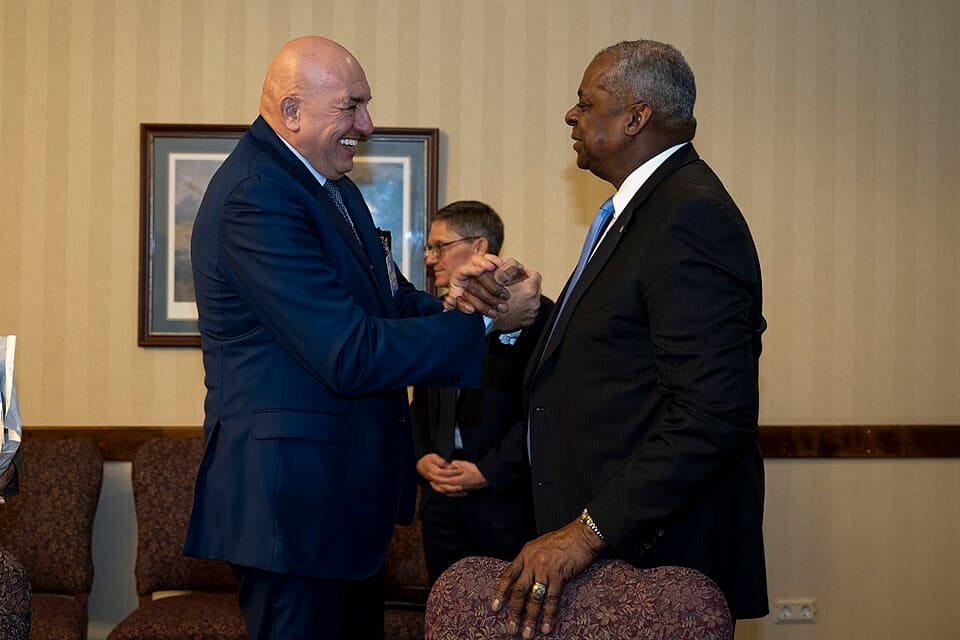
The United States has notified NATO that it intends to cut by 50% the long-range strike capabilities allocated to the defence of Europe. The announcement, expected to be formalised at the June NATO conference on force distribution, marks the most significant American military drawdown from the continent since the end of the Cold War.
Washington is not abandoning Europe entirely. The nuclear guarantee remains. But the conventional muscle — the armoured brigades, the long-range fires battalions, the forward-deployed strike aircraft — is being reduced at a pace that has caught several allied capitals off guard. An accelerated timeline, first reported by Welt am Sonntag citing Pentagon sources, suggests the plan could be presented to NATO allies as early as this month.
This is not a rumour. In May, the Pentagon withdrew 5,000 troops from Germany, including an armoured brigade combat team and a long-range fires battalion. NATO’s supreme commander told Military Times that allies should “absolutely” expect more withdrawals. The process, he said, will continue “for several years.”
Quick Facts
- What: 50% reduction in US long-range strike capabilities committed to NATO Europe
- Already withdrawn: 5,000 troops from Germany (May 2026), including armoured brigade + fires battalion
- Timeline: Accelerated plan expected at June NATO conference
- Nuclear guarantee: Maintained — conventional forces are what’s being reduced
- Rationale: European allies to assume “primary responsibility” for conventional defence
- Transition period: “Several years” according to NATO commander
What’s Actually Leaving
The May withdrawal from Germany was the down payment. The armoured brigade combat team represents significant firepower — M1 Abrams tanks, Bradley infantry fighting vehicles, and the supporting logistics chain. The long-range fires battalion brings HIMARS and Army Tactical Missile Systems. Together, they formed a substantial portion of the rapid-strike capability that NATO counted on for its eastern flank deterrence.
Withdrawing them doesn’t just reduce troop numbers. It removes the ability to hit targets deep behind enemy lines in the first hours of a conflict — exactly the capability the NATO Force Model was designed to guarantee. When the Pentagon says it will “significantly scale down” its commitment under that model, this is what it means.

Europe’s Reckoning
The White House rationale is straightforward: European allies have spent decades underspending on defence while sheltering under the American umbrella. Washington wants to accelerate the transition to a model in which EU nations assume primary responsibility for the continent’s conventional defence. The nuclear umbrella stays. Everything else is up for negotiation.
For European capitals, the math is brutal. Replacing American long-range strike capacity means buying HIMARS, Taurus cruise missiles, and deep-strike drones — and buying them at scale, not in symbolic batches. It means building ammunition stockpiles that have been depleted by shipments to Ukraine. It means maintaining readiness levels that most European armies have not sustained since 1989.
The Timing Problem
The drawdown comes while Russia is still fighting in Ukraine, while Russian drones are hitting NATO apartment buildings in Romania, while Russian fighters are flying SEAD rehearsals over the Baltic with anti-radar missiles under their wings. The threat environment has not decreased. The deterrent is being reduced anyway.
NATO Secretary-General Rutte has tried to calm nerves, insisting that the withdrawals “won’t hurt defences.” Whether that is reassurance or wishful thinking depends on how quickly Europeans can fill the gap. The June conference will reveal whether allies have a plan — or just a hope.
Sources: Time, Military Times, Welt am Sonntag, Reuters, NATO
 English
0 Comments