
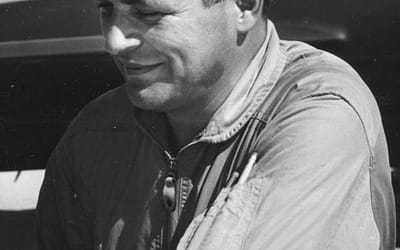
There is a photograph, taken in 1965, that tells the story of the twentieth century in a single frame. Wernher von Braun sits in his office at NASA’s Marshall Space Flight Center in Huntsville, Alabama. Behind him, arranged on a shelf like trophies, stand models of every rocket he ever designed — from the wartime V-2 to the towering Saturn V that would, four years later, carry three Americans to the surface of the Moon. He looks comfortable, confident, professorial. He looks like a hero. And that, perhaps, is the problem. Because before he was America’s greatest rocket scientist, Wernher von Braun was a member of the Nazi Party, an officer of the SS, and the man whose rockets were built by enslaved laborers — at least 20,000 of whom died in the process.
- Born: March 23, 1912 — Wirsitz, Province of Posen, German Empire
- Died: June 16, 1977 — Alexandria, Virginia, USA (age 65)
- Education: Ph.D. in Physics, Friedrich Wilhelm University, Berlin (1934)
- Key Rockets: A-4/V-2, Redstone, Jupiter-C, Juno I, Saturn I, Saturn IB, Saturn V
- NASA Role: Director, Marshall Space Flight Center (1960–1970)
- Notable Achievement: Chief architect of the Saturn V that powered Apollo 11
- Controversy: SS membership, V-2 program relied on forced labor from Mittelbau-Dora
The Boy Who Dreamed of Space
Wernher Magnus Maximilian Freiherr von Braun was born into Prussian aristocracy on March 23, 1912, in Wirsitz (now Wyrzysk, Poland). His mother, Baroness Emmy von Quistorp, gave him a telescope for his confirmation — a gift that ignited an obsession with the heavens. But it was a book that changed his life: Hermann Oberth’s Die Rakete zu den Planetenraeumen (The Rocket into Interplanetary Space), published in 1923. The young von Braun devoured it — and, when he realized it was full of mathematics he couldn’t understand, taught himself calculus and trigonometry to keep up.
By 18, he had joined the Verein fuer Raumschiffahrt (VfR) — the German Society for Space Travel — and was launching amateur rockets in the suburbs of Berlin. His talent was unmistakable. In 1932, the German Army’s ordnance department recruited him, recognizing that rocket propulsion had military potential that the Treaty of Versailles had not thought to ban. Von Braun was 20 years old. He received his doctorate in physics from the Friedrich Wilhelm University in Berlin on July 27, 1934 — a dissertation on liquid-propellant rocket combustion that remained classified for years.
Peenemuende and the V-2: Weapon of Terror
The Army moved its rocket research to Peenemuende, a remote site on Germany’s Baltic coast, where von Braun became technical director of what would become the most ambitious weapons program of the war. The result was the A-4 — better known by its propaganda name, Vergeltungswaffe 2, or V-2: “Vengeance Weapon 2.”
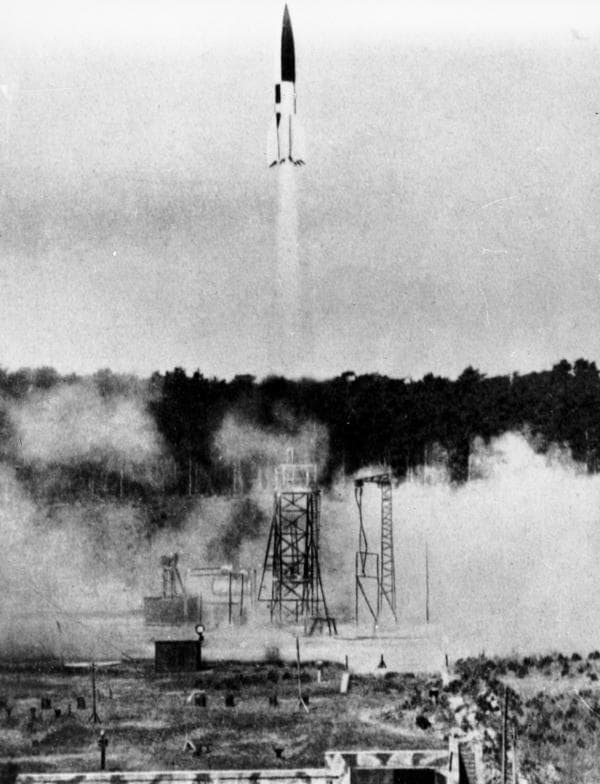
The V-2 was the world’s first long-range guided ballistic missile and the first man-made object to reach the boundary of space. It burned liquid ethanol and liquid oxygen, reached speeds of over 5,700 km/h (Mach 4.7), and carried a 980 kg warhead over a range of 320 km. There was no defense against it — it arrived before the sound of its own launch. Beginning in September 1944, more than 3,000 V-2s were launched against Allied cities. An estimated 2,754 civilians died in London alone, with another 6,523 injured. Antwerp, Belgium, was hit even harder — 1,736 killed, 4,500 injured. The deadliest single strike came on December 16, 1944, when a V-2 hit the crowded Cine Rex cinema in Antwerp, killing 567 people.
Mittelbau-Dora: The Horror Beneath the Mountain
But the V-2’s victims in London and Antwerp were not even its greatest toll. That distinction belongs to the people who built it. After an RAF bombing raid damaged the Peenemuende facility in August 1943, V-2 production was moved underground — into tunnels carved out of the Kohnstein mountain near Nordhausen, in central Germany. The underground factory, called the Mittelwerk, was supplied with labor from the adjacent Mittelbau-Dora concentration camp.
Approximately 60,000 prisoners passed through the Mittelbau camp system between August 1943 and March 1945. They were forced to work 14-hour days in damp, unstable tunnels, denied access to adequate food, sanitation, and medical care. Until spring 1944, prisoners were kept almost entirely underground, deprived of daylight and fresh air. At least 20,000 of them died — from exhaustion, starvation, disease, and outright murder by SS guards. The V-2 program killed more people in its production than in its deployment as a weapon.
Von Braun’s personal role remains a matter of historical record. A memo dated August 15, 1944, documents his visit to the Buchenwald concentration camp to select prisoner workers and arrange their transfer to Dora. He requested that the SS provide more laborers for V-2 production. He later claimed he was aware of the conditions but powerless to change them — a defense that historians have treated with deep skepticism. He was not a passive bystander. He was a member of the Nazi Party (joining in 1937) and held the rank of Sturmbannfuehrer (major) in the SS, a membership he later insisted was “honorary” and required for his work.

Operation Paperclip: A Devil’s Bargain
As the war ended, von Braun and approximately 125 of his top engineers surrendered to American forces, carrying with them 14 tons of technical documents. The U.S. government brought them to America under Operation Paperclip — a classified program that recruited over 1,600 German scientists and engineers, many with Nazi affiliations, to work on American military and space programs. Von Braun’s SS membership and his role in the slave labor system were quietly buried in classified files. He was given a clean record and a laboratory at Fort Bliss, Texas.
The moral calculus was straightforward and ugly: in the emerging Cold War, America needed these men more than it needed to punish them. The Soviets had their own version of Paperclip and their own captured German engineers. The space race — and the missile race — had begun before the rubble of Berlin had cooled.
From Redstone to the Moon
At Redstone Arsenal in Huntsville, Alabama, von Braun’s team developed the Redstone missile — the first American large ballistic missile — and then the Jupiter-C, which in 1958 launched Explorer 1, the first American satellite, into orbit. When NASA was established, von Braun’s group was transferred to the new agency, and he became the first director of the Marshall Space Flight Center in 1960.
Then came the Saturn V — his masterpiece. Standing 363 feet tall, weighing 6.2 million pounds fully fueled, and generating 7.5 million pounds of thrust from its five F-1 engines, it remained the most powerful rocket ever flown until SpaceX’s Starship Super Heavy first launched in 2023. On July 16, 1969, a Saturn V launched Apollo 11 from Kennedy Space Center. Four days later, Neil Armstrong and Buzz Aldrin walked on the Moon. Von Braun watched from the control room. The boy who had dreamed of space while reading Oberth’s book had made it happen.
The Uncomfortable Legacy
Wernher von Braun died of pancreatic cancer on June 16, 1977, in Alexandria, Virginia. He was 65. During his lifetime, his Nazi past was largely unknown to the American public. It was not until the 1980s, when investigative journalists and historians gained access to declassified documents, that the full scope of his wartime activities came to light.
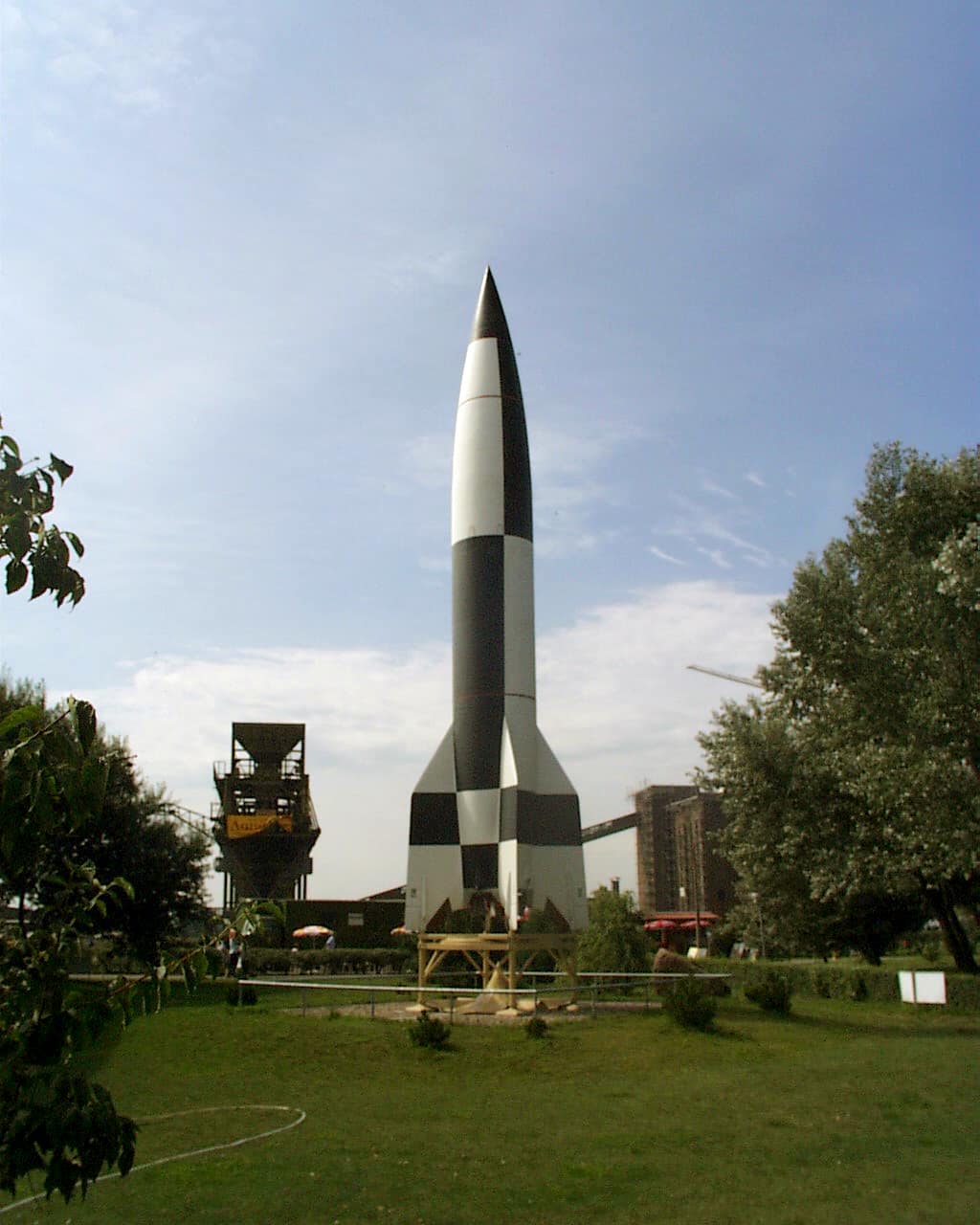
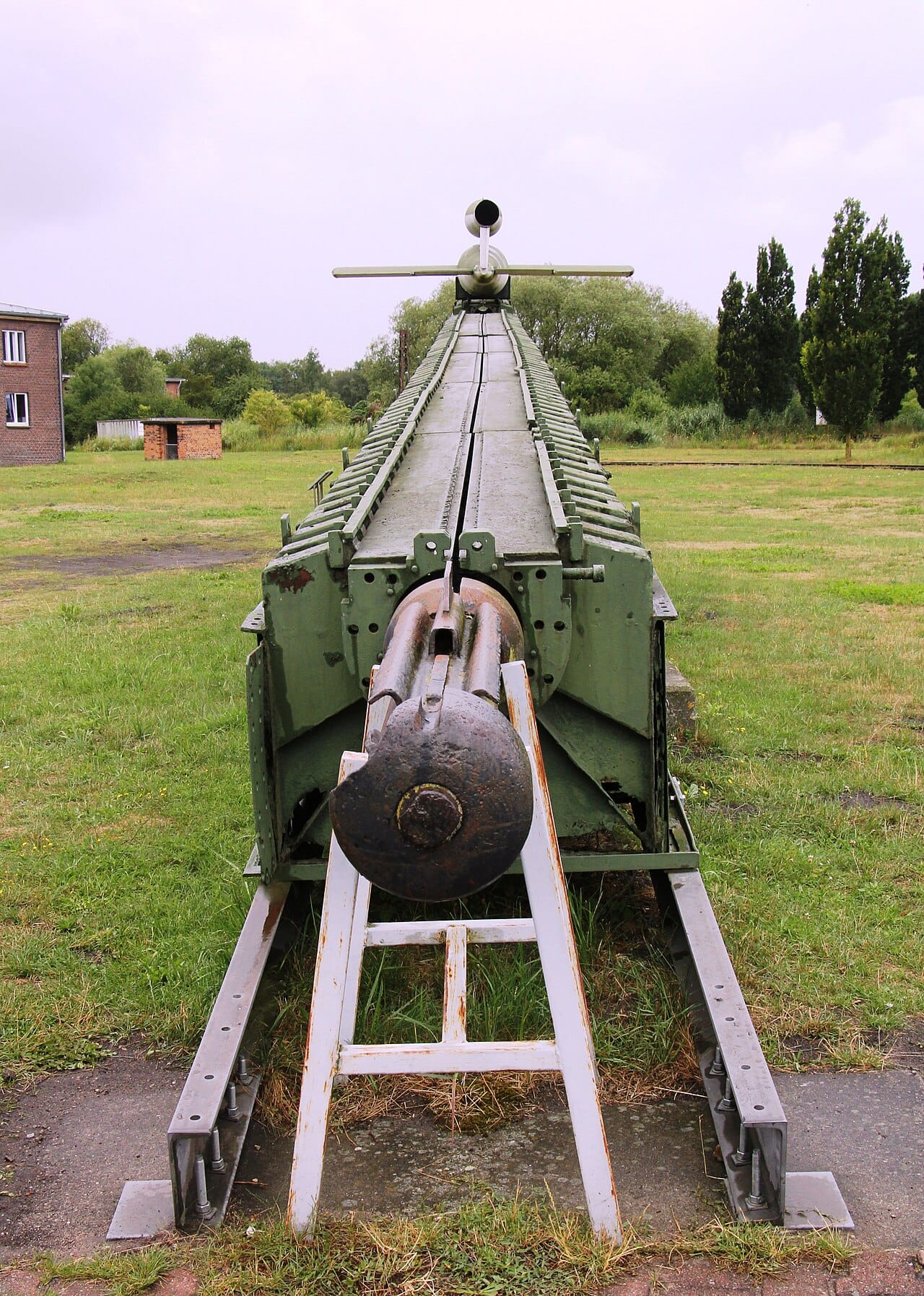
The place where it all began still stands. The bombed-out shell of the Peenemünde power station on the island of Usedom today houses the Historisch-Technisches Museum Peenemünde — with a checkered V-2 replica and a V-1 on its launch ramp standing in front of the old brick walls, where visitors can walk the ground where the space age and the terror weapons were born side by side.
The question that hangs over his legacy is not whether he was brilliant — he was, arguably, the most important rocket engineer in human history. The question is whether brilliance excuses complicity. He built weapons that killed approximately 9,000 people. He oversaw a program whose production killed at least 20,000 enslaved laborers. And then he went to America, built the rocket that took humanity to the Moon, and was celebrated as a hero.
There is no reconciling these facts. The 1965 photograph in his NASA office, rocket models arrayed behind him like the spine of an era, captures both the dream and the cost. The Moon landing is one of humanity’s greatest achievements. The road that led there passed through a concentration camp. Von Braun stood at the intersection of both, and history has never quite decided what to do with him.
 English
0 Comments