

Somewhere on a taxiway at a Northrop Grumman test facility, something remarkable happened last week — and nobody was in the cockpit. The YFQ-48A Talon Blue, Northrop Grumman’s contender for the Air Force’s Collaborative Combat Aircraft (CCA) program, completed a series of fully autonomous taxi tests, rolling under its own power and its own digital brain without a human touching a single control. The company announced the milestone via social media on May 18, and while a drone taxiing might not sound like front-page news, in the world of autonomous combat aviation, this is the starting gun.
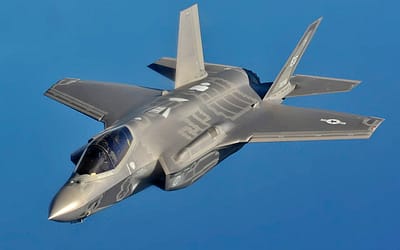
The test marks a critical step on the path to first flight for the Talon Blue, which is positioning itself as a contender for Increment 2 of the programme — after General Atomics’ YFQ-42A and Anduril Industries’ YFQ-44A Fury were selected for Increment 1 and are already in flight testing. The CCA program — one of the Pentagon’s highest-priority acquisition efforts — envisions fleets of relatively cheap, AI-piloted drones flying alongside crewed fighters like the F-35, absorbing risk, carrying weapons, and fundamentally changing the math of aerial combat.
✈ Aircraft: YFQ-48A Talon Blue (Northrop Grumman)
🤖 Milestone: Fully autonomous taxi tests completed
📅 Announced: May 18, 2026, via social media
🏅 Competition: Contender for CCA Increment 2 (YFQ-42A and YFQ-44A fly in Increment 1)
🚀 Program: Collaborative Combat Aircraft (CCA) — autonomous AI wingmen
💰 Target unit cost: Approximately one-third the price of an F-35
The CCA Race: Two Philosophies, One Prize
The CCA programme has produced a fascinating study in contrasts between legacy primes and defence newcomers. Northrop brings eight decades of experience building America’s most exotic flying machines — the B-2 Spirit, the B-21 Raider, the X-47B. They know how to build stealthy, survivable platforms that can penetrate the most defended airspace on Earth. The Talon Blue likely draws heavily on that institutional knowledge, although many details about the airframe remain undisclosed.
The stakes are enormous. The Air Force wants to buy at least 1,000 CCAs over the next decade, at a unit cost of roughly one-third the price of an F-35 — somewhere in the $25 to $30 million range. For Northrop Grumman, winning CCA would be transformative, adding a major new production line alongside the B-21 Raider. Anduril, for its part, already claimed that validation when its YFQ-44A Fury was selected for Increment 1. For the Air Force, it could be the single most important acquisition decision since the F-35 itself.
Sources: Northrop Grumman social media channels (May 18, 2026); U.S. Air Force CCA Program Office; Secretary of the Air Force Public Affairs; Congressional Research Service.
 English
0 Comments