
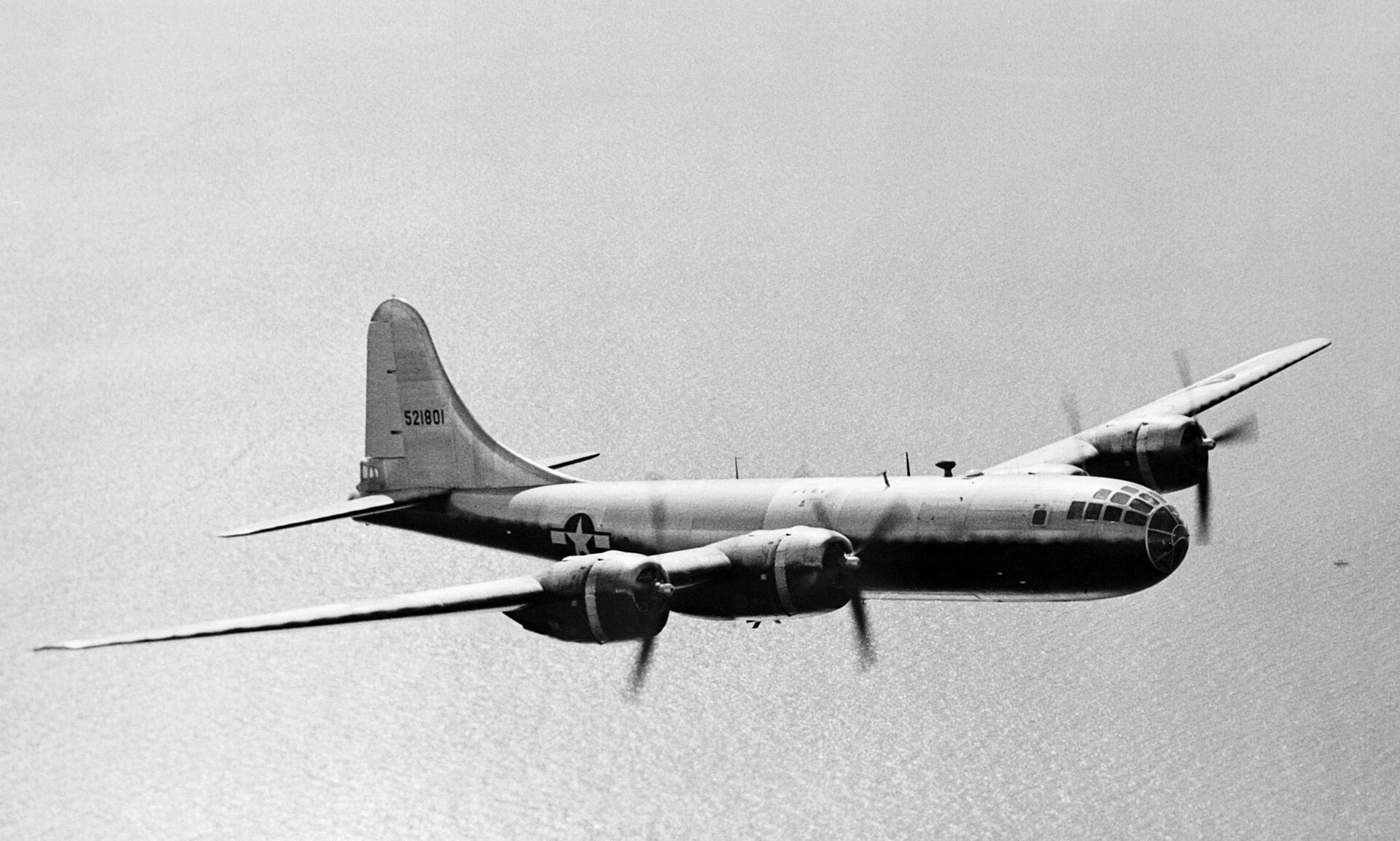
Boeing B-29
Superfortress
The most advanced bomber of the Second World War — a pressurised, computer-aimed, very-long-range machine that firebombed Japan, delivered the atomic bombs at Hiroshima and Nagasaki, and cost more to build than the atomic bomb itself.
The bomber that out-cost the atomic bomb
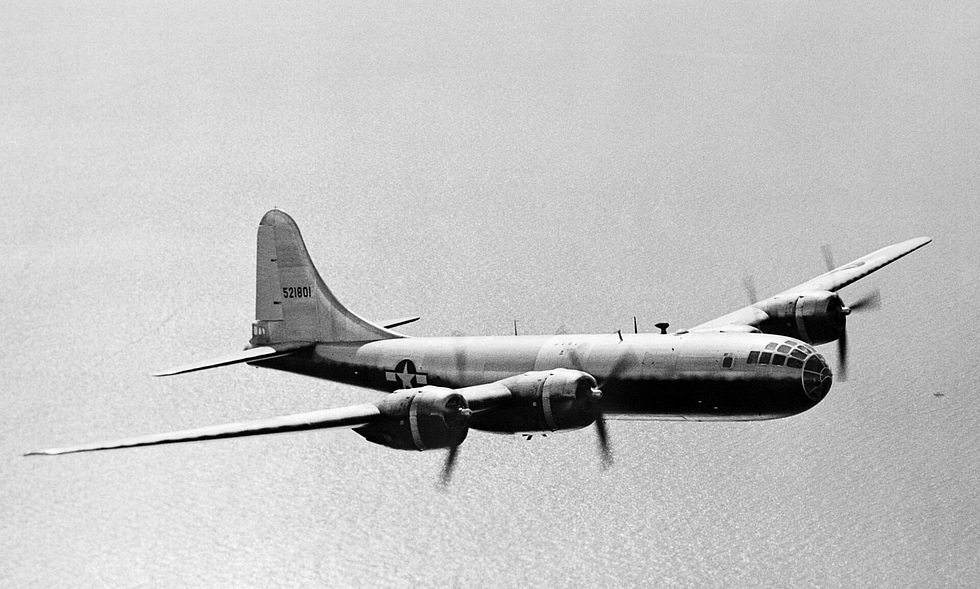
When the US Army Air Corps drew up its requirement for a pressurised, very-long-range “hemisphere-defence” bomber in 1939–40, it was asking for an aircraft years ahead of anything then flying. Boeing’s answer, the Model 345, became the B-29 Superfortress — a four-engine giant that could carry ten tons of bombs across the Pacific, fly above 30,000 feet in a heated, pressurised cabin, and defend itself with remote-controlled turrets aimed by an early analogue computer. Almost every system on it was new, and almost every one had to be made to work at once.
That ambition came at a staggering price. The B-29 programme is commonly estimated at around $3 billion — more than the roughly $2 billion spent on the Manhattan Project, making it the single most expensive US weapons programme of the war. Its development was troubled: the prototype first flew in September 1942, but in February 1943 the second aircraft caught fire in the air and crashed, killing Boeing’s chief test pilot Eddie Allen and everyone aboard. The culprit — overheating, fire-prone Wright R-3350 engines — would dog the type throughout its career.
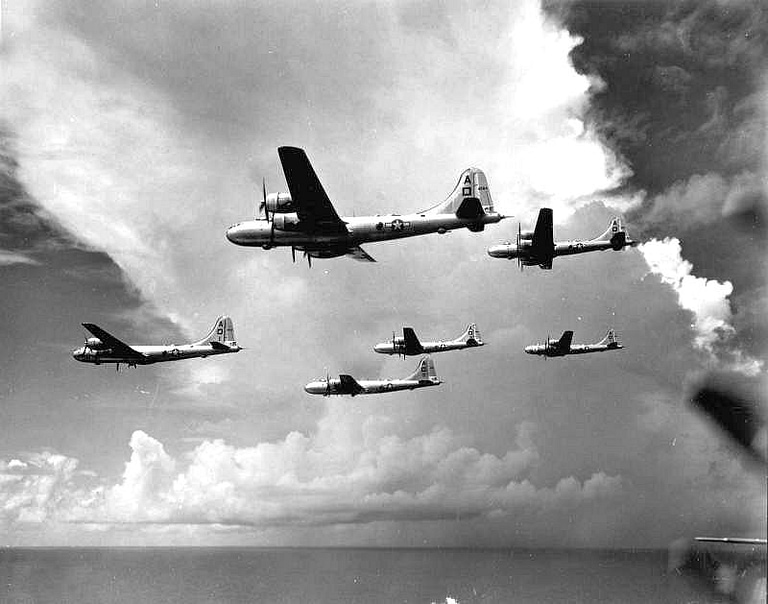
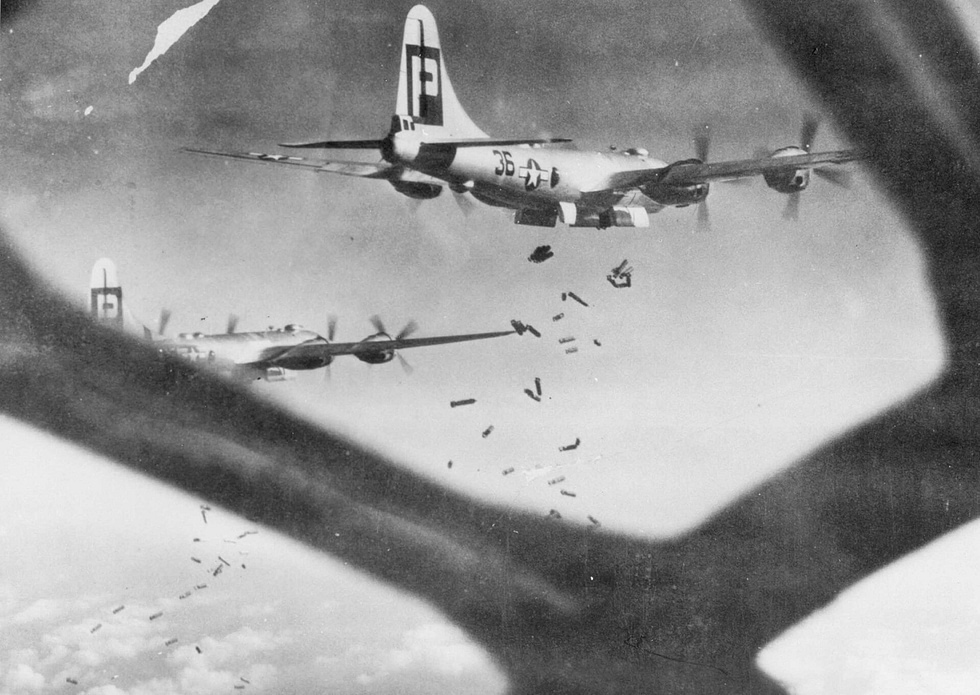
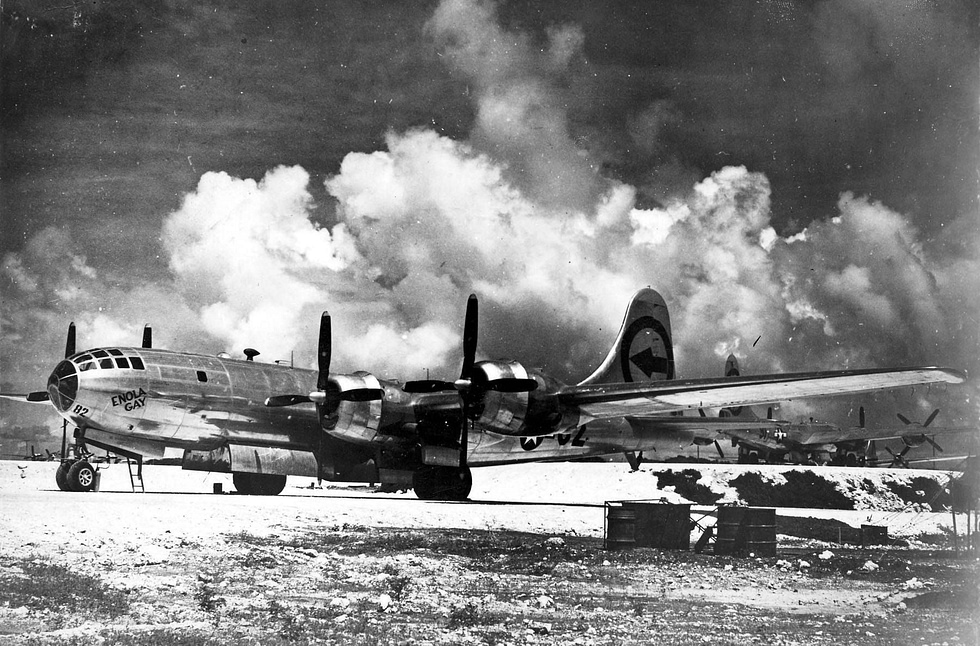
From bases in the Marianas the B-29 carried the strategic air war to the Japanese home islands. Under General Curtis LeMay the campaign shifted from high-altitude “precision” raids to low-level night incendiary attacks that burned out large areas of Japan’s cities; the Tokyo raid of 9–10 March 1945 remains the deadliest air raid in history. On 6 and 9 August 1945 two B-29s, Enola Gay и Bockscar, dropped the atomic bombs on Hiroshima and Nagasaki. These events are recorded here soberly, as history — the aircraft was the instrument of a campaign whose human cost was immense.
01The B-29 Superfortress and the birth of the very-long-range bomber: why America bet $3 billion on it
The B-29 was conceived before the United States entered the war, when planners feared they might have to strike distant enemies from bases far away. The specification demanded range, altitude and bomb load far beyond the B-17 — and pressurisation so crews could operate for hours above the weather and most defences. Meeting it required a new wing, new engines, new turrets and a new fire-control system all at once, and the aircraft was ordered into mass production “off the drawing board” before testing was complete.
The gamble worked, but only just. The R-3350 engines, the guns and the pressurisation all needed fixing in the field, and the “Battle of Kansas” in early 1944 saw crews rebuilding finished bombers by hand outdoors in winter to get them combat-ready. For all its cost and trouble, the Superfortress gave the United States a strategic reach no other air force could match — and it shaped the post-war bombers and tankers that followed.
What makes it special
A pressurised cabin and computer-aimed guns
The B-29 was among the first bombers with pressurised crew compartments, letting its ~11 men work in shirtsleeves above 30,000 ft. Rather than pressurise rotating turrets, Boeing gave the gunners sighting stations and a General Electric central fire-control system — an analogue computer that remotely aimed small streamlined turrets, correcting for ballistics, lead and parallax in real time.
Range, payload and altitude no bomber matched
Built for “very long range,” the Superfortress could carry up to 20,000 lb (~9,000 kg) of bombs to targets well over a thousand miles away and cruise above most fighters and flak. That reach is precisely what made the trans-oceanic bombing of the Japanese home islands from the Marianas possible — a capability no other WWII aircraft could offer.
The Wright R-3350: power, and fire
Four Wright R-3350 Duplex-Cyclone twin-row radials, ~2,200 hp each with twin turbo-superchargers, gave the B-29 its performance — but they ran dangerously hot. The rear cylinders overheated, and magnesium engine components could ignite and burn through a wing spar in seconds. Engine fires cost crews their lives in testing, training and combat.
02The B-29’s remote gun turrets: how a computer aimed the Superfortress’s guns
Most of the B-29’s defensive guns were not held by the men who fired them. Gunners sat at sighting stations — in the nose, an upper “barber-chair” position, two side blisters and the tail — and the General Electric central fire-control system slaved the aircraft’s four remote turrets to their sights. An analogue computer corrected each solution for gravity and air resistance, for the target’s movement, and for the parallax between sight and turret. According to the Smithsonian, the system delivered accuracy at far greater range than hand-aimed guns, and a gunner could hand control of a turret to another station — even automatically if he was incapacitated.
03The B-29’s Wright R-3350 engines: the fire risk that killed crews
The R-3350 was rushed into service and never fully shed its reputation for catching fire. Its rear cylinders ran too hot, and flammable magnesium in the crankcase and other parts meant that once an engine fire started it could burn through the wing structure before the crew could react. The flaw killed Boeing test pilot Eddie Allen and his crew when the second XB-29 came down in Seattle on 18 February 1943, and caused losses throughout the war. Revised cowl-flap procedures, better baffling and constant maintenance tamed the problem, but engine reliability remained a worry for as long as the type flew.
Full specifications
Airframe & Performance
- Экипаж
- ~11 (typically 9–14)
- Длина
- 30.2 m (99 ft)
- Размах крыльев
- 43.1 m (141 ft 3 in)
- Высота
- ~8.5 m (27 ft 9 in)
- Max takeoff weight
- ~60,560 kg (~133,500 lb)
- Max speed
- ~575 km/h (357 mph)
- Крейсерская скорость
- ~350 km/h (220 mph)
- Служебный потолок
- ~9,700 m (~32,000 ft)
- Combat range
- ~5,200 km (~3,250 mi)
- Bomb load
- up to ~9,000 kg (20,000 lb)
Propulsion, Armament & Cost
- Engines
- 4 × Wright R-3350 Duplex-Cyclone
- Power (each)
- ~2,200 hp, twin turbo-supercharged
- Defensive guns
- Remote turrets, 10–12 × .50-cal M2; tail 20 mm cannon (early)
- Fire control
- GE central (analogue computer)
- First flight
- 21 September 1942 (XB-29)
- Built
- ~3,970 (1943–1946)
- Unit cost
- ~$605,000 (1944); ~$930,000 avg (estimate)
- Programme cost
- ~$3 billion (estimate; exceeded the Manhattan Project)
04The B-29 Superfortress’s cost: the most expensive US weapons programme of WWII
The Superfortress was extraordinarily expensive to develop and build. The programme is widely estimated at around $3 billion in wartime dollars — more than the roughly $1.9–2 billion spent on the Manhattan Project — which made it the costliest US weapons programme of the Second World War, more expensive than the atomic bomb it was built to carry. Unit prices varied by model and year: one museum cites a 1944 figure near $605,000, with averages across the run put closer to $900,000. These totals are period estimates repeated across many sources rather than audited final accounts, and should be read as order-of-magnitude figures.
From drawing board to the atomic age and beyond
The requirement
The US Army Air Corps calls for a pressurised, very-long-range heavy bomber; Boeing’s Model 345 is selected and ordered in quantity before it has flown.
First flight
The XB-29 prototype flies on 21 September at Boeing Field, Seattle, with test pilot Eddie Allen at the controls.
The Eddie Allen crash
On 18 February the second XB-29 suffers an engine fire and crashes into Seattle, killing Allen, his crew and people on the ground — exposing the R-3350’s fire risk.
Into combat
B-29s enter service and fly their first missions in June, striking from India and China before the campaign moves to the newly captured Marianas.
Operation Meetinghouse
General LeMay switches to low-level night incendiary tactics; the Tokyo raid of 9–10 March remains the deadliest air raid in history.
Hiroshima and Nagasaki
On 6 and 9 August the B-29s Enola Gay и Bockscar drop atomic bombs on Hiroshima and Nagasaki; Japan announces surrender on 15 August.
Copies and cousins
The USSR reverse-engineers interned B-29s into the Tupolev Tu-4; the RAF borrows B-29s as the “Washington,” and the B-50, KC-97 tanker and Stratocruiser airliner grow from the design.
Korea, then retirement
B-29s bomb through the Korean War until MiG-15 jets force them onto night raids; the type leaves front-line US service soon after.
Twelve stories from the Superfortress
“She flew” — and then she burned
Boeing’s finest test pilot died proving the bomber that would end the war.
Read the full story
The Battle of Kansas
The B-29 nearly failed on the assembly line before it ever reached Japan.
Read the full story
Bombing Japan from China
The first raids on Japan came the hardest way possible — over the Himalayas.
Read the full story
The Marianas solution
A few square miles of Pacific coral unlocked the bombing of Japan.
Read the full story
LeMay rewrites the rulebook
Frustrated by high-altitude misses, one general changed the tactics — and the toll.
Read the full story
Operation Meetinghouse
The deadliest air raid in history is one many people have never heard of.
Read the full story
Hiroshima, 6 August 1945
A single B-29 opened the atomic age.
Read the full story
Nagasaki, 9 August 1945
Three days later, a second bomb fell.
Read the full story
Stalin’s carbon copy
The USSR built its first strategic bomber by cloning an American one, bolt for bolt.
Read the full story
FIFI and Doc
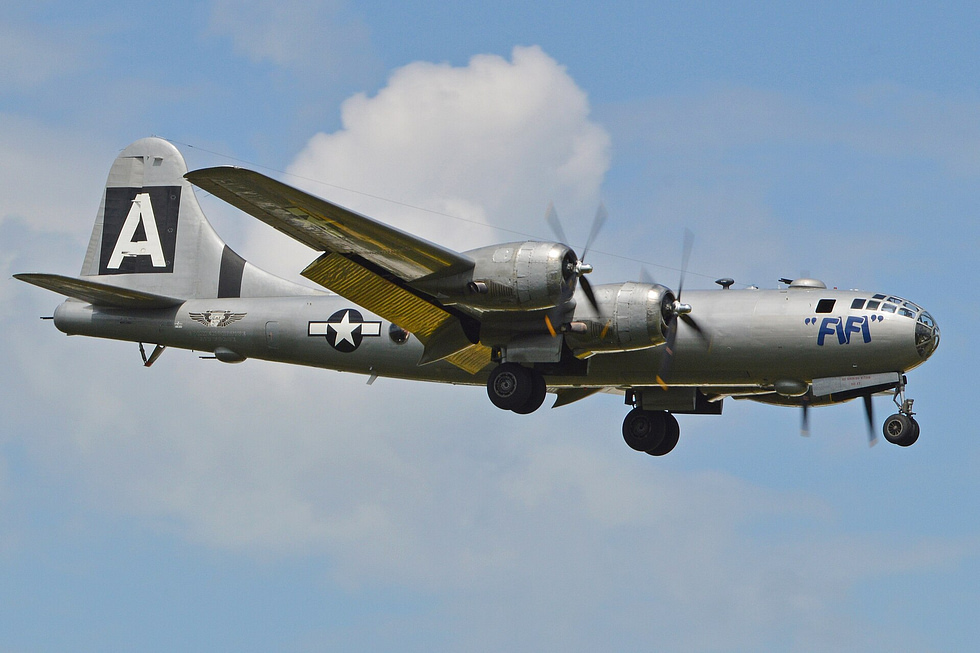
Of nearly 4,000 built, just two still fly.
Read the full story
The engine that fought back
The B-29’s deadliest enemy was often its own powerplant.
Read the full story
When jets ended the bomber’s daylight war
Over Korea the piston-engined queen of WWII met the jet age head-on.
Read the full story
The Superfortress in pictures
The Superfortress on film
Video coming soon. A verified, high-authority documentary embed will be added here.
Where the Superfortress flew
The record that defines it
The B-29 was a bomber, not a dogfighter, and its record is written in reach and in consequence. Flying from the Marianas it carried the strategic air war to the Japanese home islands — culminating in the firebombing campaign and the atomic missions of August 1945. These figures are stated plainly, as history.
Compare the combat record of every military aircraft. Figures as of July 2026.
Everything people ask about the B-29
Can I fly in a B-29?
How many B-29s are still flying?
Which B-29s dropped the atomic bombs?
Why was the B-29 so expensive?
What made the R-3350 engines dangerous?
Did the Soviet Union operate the B-29?
Is the B-29 still in service?
You can’t fly the B-29.
These, you can.
Some legends only live in museums — others are fuelled and waiting. MiGFlug has put civilians in real military jet cockpits since 2004.
 Fly the L-39 AlbatrosThe world’s most-flown jet trainer — aerobatics included
 Fly the F-104 Starfighter“The missile with a man in it”
 Fly the MiG-21The Cold War’s most-produced jet
 Управляйте самолетом T-33 Shooting Star.America’s first jet trainer
 Fly the DH VampireA piece of early jet history
 Fly the S.211Agile Italian jet trainer
 Fly the MB-326The classic Aermacchi jet
 Fly the MiG-15The Soviet legend of the Korean War
Continue the tour
Every fact, checked
- National Museum of the US Air Force — Development of the B-29Official USAF development history and combat-debut dates.
- Smithsonian NASM — Defending the SuperbomberThe GE computer-corrected remote turrets and pressurised gunner stations.
- Smithsonian NASM — The Flight of the Enola GaySober, primary-museum account of the Hiroshima mission and crew.
- The National WWII Museum — Operation MeetinghouseDetailed, factual account of the 9–10 March 1945 Tokyo firebombing.
- This Day in Aviation — 18 February 1943The fatal XB-29 test crash and the R-3350 engine-fire flaw.
- Air & Space Forces Magazine — Carbon Copy BomberHow the USSR cloned interned B-29s into the Tupolev Tu-4.
- The Aviation Geek Club — The Washington bomberRAF Washington B.1 service, numbers and disposal.
- B-29 DocConfirms the two airworthy B-29s and Doc’s 2016 return to flight.