
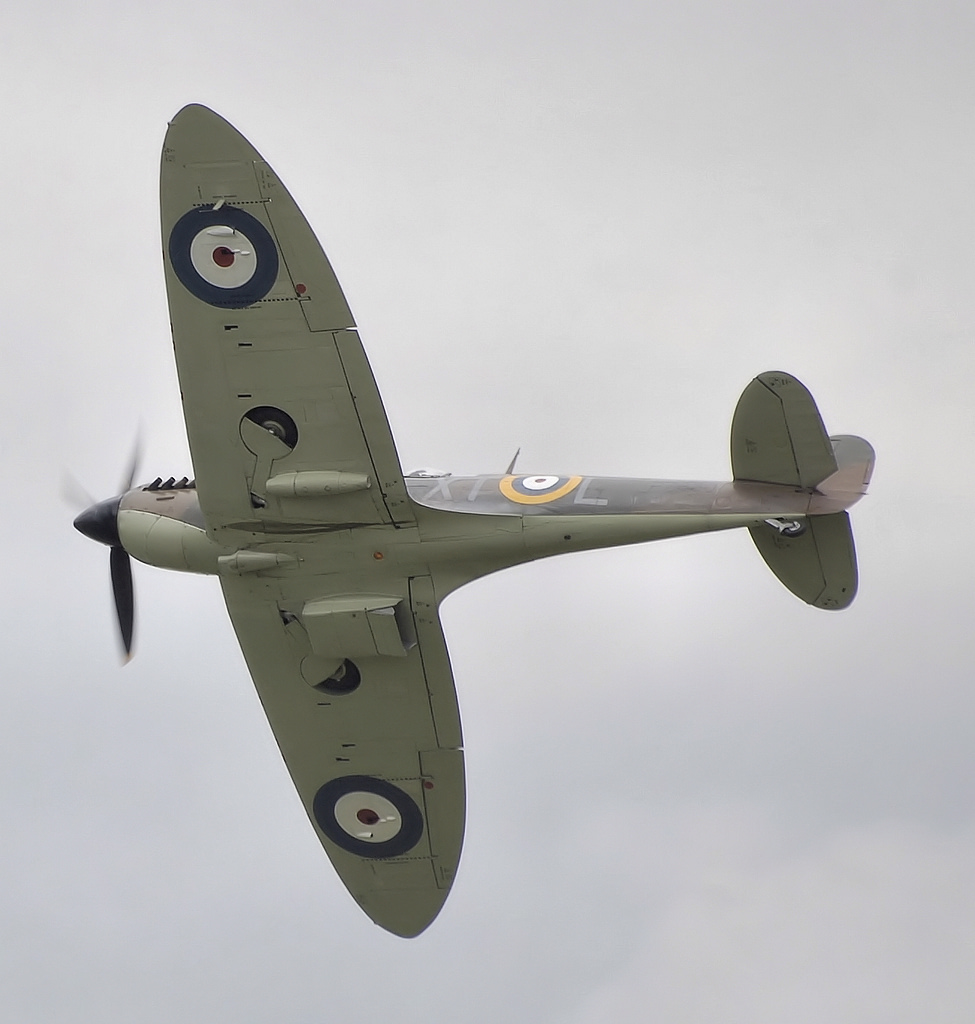
Supermarine Spitfire
“The Few’s Fighter”
R.J. Mitchell’s elliptical-winged masterpiece — the Merlin-powered fighter that helped win the Battle of Britain, stayed in frontline production before, during and after the Second World War, and remains the most beloved British aircraft ever built.
The fighter that saved Britain
The Supermarine Spitfire was the creation of Reginald J. Mitchell, whose signature contribution was a thin, elegant elliptical wing that minimised drag while leaving room at the root for guns, fuel and undercarriage. Powered first by the Rolls-Royce Merlin V12, the prototype K5054 first flew on 5 March 1936 from Eastleigh near Southampton, and the type entered RAF service in 1938 with No. 19 Squadron at Duxford.
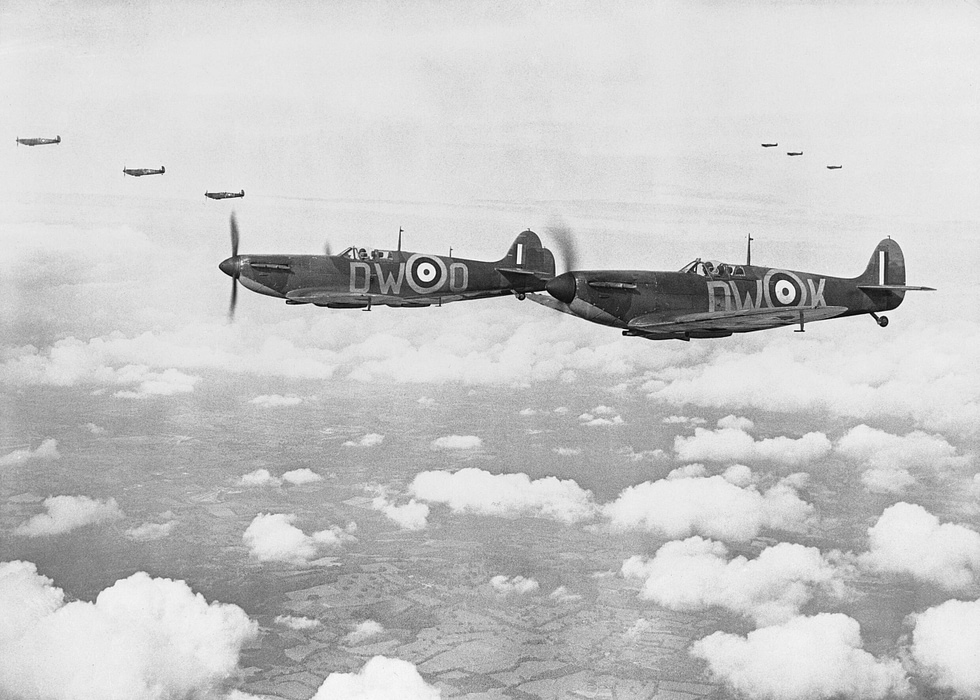
In the summer of 1940 the Spitfire earned its immortality over southern England. During the Battle of Britain the more numerous Hawker Hurricane bore much of the load, but it was the faster Spitfire — a match for the Messerschmitt Bf 109 — that captured the public imagination and became the enduring symbol of British defiance. When the invasion was called off, the Spitfire had become far more than a fighter: it was the machine that, alongside the Hurricane, had saved Britain.
It was built in extraordinary numbers — commonly cited at ~20,300+ airframes (more still with the naval Seafire) — and evolved across roughly 24 principal marks. Uniquely, it was the only Allied frontline fighter in continuous production and development before, during and after the entire Second World War. After Mitchell’s early death in 1937, Joe Smith carried the design through to the final Griffon-engined marks.
01The Spitfire’s numbers: how ~20,300 fighters kept one airframe competitive for a decade
Production totals for the Spitfire are large enough that sources disagree on the exact figure — credible tallies cluster around 20,300 to 20,351 Spitfires, and more when the carrier-borne Seafire is included. Manufacture ran from roughly 1937 to 1947, spanning the whole of the Second World War and beyond.
What makes the Spitfire singular is not just the count but the continuity. Between the Merlin-engined Mk I of 1938 and the Griffon-engined Mk 24, engine power and top speed roughly doubled while the basic airframe stayed recognisably the same. No other Allied fighter was improved so relentlessly, for so long, keeping a 1930s design in the front line into the jet age.
What makes the Spitfire special
The thin elliptical wing
Mitchell’s elliptical wing combined the lowest possible induced drag for a given lift with a high critical Mach number — letting late-war Spitfires dive to very high speeds — and enough internal volume for guns, ammunition, fuel and the retractable undercarriage. The catch was cost: it reputedly needed roughly three times the man-hours of the Bf 109’s simpler wing.
Rolls-Royce Merlin, then Griffon
The supercharged Merlin V12 grew from around 1,000 hp in the Mk I to about 1,700 hp by the two-stage Mk IX. Later marks adopted the bigger 36.7-litre Griffon delivering over 2,000 hp — nearly double the early Merlin — for the Mk XII, XIV and beyond.
Development across ~24 marks
No other Allied fighter was so continuously improved. Between the Mk I and the Griffon-engined Mk 24, engine power and top speed roughly doubled, keeping the airframe competitive from 1938 into the early jet age — plus dedicated photo-reconnaissance versions and the navalised Seafire.
02The Spitfire’s wing: an ellipse chosen by mathematics, loved by the eye
The elliptical planform was not styling. An elliptical lift distribution gives the theoretically lowest induced drag, and the shape let Mitchell make the wing thin — good for high speed — while keeping enough depth at the root to bury guns, fuel and the undercarriage. That thinness also raised the critical Mach number, so late Spitfires could dive closer to the speed of sound than most contemporaries. The penalty was manufacturing: the compound curves were labour-intensive, reputedly costing about three times the man-hours of a Bf 109 wing. Beauty, here, was pure aerodynamics.
03The Spitfire’s engines: from Merlin to Griffon without losing the shape
Early Spitfires flew behind a roughly 1,000 hp Merlin; by the Mk IX’s two-stage, two-speed engine it made around 1,700 hp. Then came the larger Griffon — over 2,000 hp — for the Mk XII and XIV, adding a snarling swing on take-off from its counter-rotating propeller. The airframe absorbed nearly double the power of the original and stayed a frontline fighter into the jet age, a testament to how much growth Mitchell’s design could take.
Full specifications
Representative figures for the Merlin-engined Spitfire Mk IX; dimensions and performance varied considerably across the type’s ~24 marks.
Airframe & Performance
- Экипаж
- 1
- Длина
- ~9.5 m (≈31 ft)
- Размах крыльев
- ~11.2 m (36 ft 10 in)
- Высота
- ~3.85 m
- Max speed
- ~650 km/h (≈405 mph) at altitude
- Служебный потолок
- ~13,000 m (≈43,000 ft)
- Number built
- ~20,300+ (all marks)
- Mk IX built
- ~5,600+
Propulsion & Systems
- Двигатель
- Rolls-Royce Merlin 61/63 V12
- Power
- ~1,565–1,650 hp (two-stage)
- Cannon
- 2 × 20 mm Hispano
- Machine guns
- 4 × .303 in Browning (Mk IXc)
- Bombs
- Provision for up to ~1,000 lb
- First flight
- 5 March 1936 (K5054)
- Unit cost
- ~£12,600 (wartime, approx.)
- Cost per flight hour
- No reliable public figure
04The Spitfire’s numbers, hedged: why the specs vary by mark and source
Quoting a single spec sheet for the Spitfire is misleading, because the type changed so much. Early marks were shorter (some sources cite ~9.12 m) than the Mk IX (~9.47 m), and top speeds climbed from the low 300s of mph in the Mk I to well over 400 mph in the Griffon marks. The oft-quoted wartime unit cost of about £12,600 is an approximation that varied by mark, factory and year. And the total-built figure — commonly ~20,300, sometimes stated as 20,351, more with Seafires — depends on exactly what is counted. Treat every single number here as representative, not definitive.
From Eastleigh to the jet age
First flight
Prototype K5054 makes its maiden flight at Eastleigh on 5 March, flown by Joseph “Mutt” Summers.
Mitchell dies
R.J. Mitchell dies of cancer; Joe Smith takes over design leadership and carries the Spitfire through the war.
Enters service
The Spitfire Mk I joins the RAF with No. 19 Squadron at Duxford.
Battle of Britain
The Spitfire duels Bf 109s over southern England and becomes a national icon.
The Mark IX answer
The Merlin 61-powered Mk IX is rushed into service to counter the Focke-Wulf Fw 190.
The Seafire goes to sea
The navalised Seafire enters Fleet Air Arm service aboard Royal Navy carriers.
Griffon power
Griffon-engined marks (Mk XII, later Mk XIV) reach squadrons with over 2,000 hp.
Production ends
After ~20,300+ built, manufacture winds down; the final Mk 24 is delivered.
Last combat sorties
Spitfires fight in the 1948 Arab–Israeli War; the last RAF operational sortie is generally dated to 1954 (a PR Mk 19 over Malaya).
From the record: twelve Spitfire stories
The Few’s finest machine
The fighter that became a nation’s shield in the summer of 1940.
Read the full story
Mitchell’s dying masterpiece
He perfected the wing while cancer finished him.
Read the full story
The perfect curve
An ellipse chosen by mathematics, loved by the eye.
Read the full story
From Merlin to Griffon
Doubling the horsepower without losing the shape.
Read the full story
PR blue, unarmed and alone
No guns, just cameras — and nerve.
Read the full story
The Seafire goes to sea
A thoroughbred learns to land on a moving deck.
Read the full story
Ride the legend
Two seats, one Merlin, the flight of a lifetime.
Read the full story
The most beautiful fighter
Form and function, impossibly aligned.
Read the full story
Spitfires over Malta
Flown off a carrier to save a besieged island.
Read the full story
The Mark IX answer
When the Fw 190 shocked the RAF, the Mk IX replied.
Read the full story
Last of the piston fighters
Cameras over the jungle into the 1950s.
Read the full story
Twenty thousand strong
The only Allied fighter in the fight from start to finish.
Read the full story
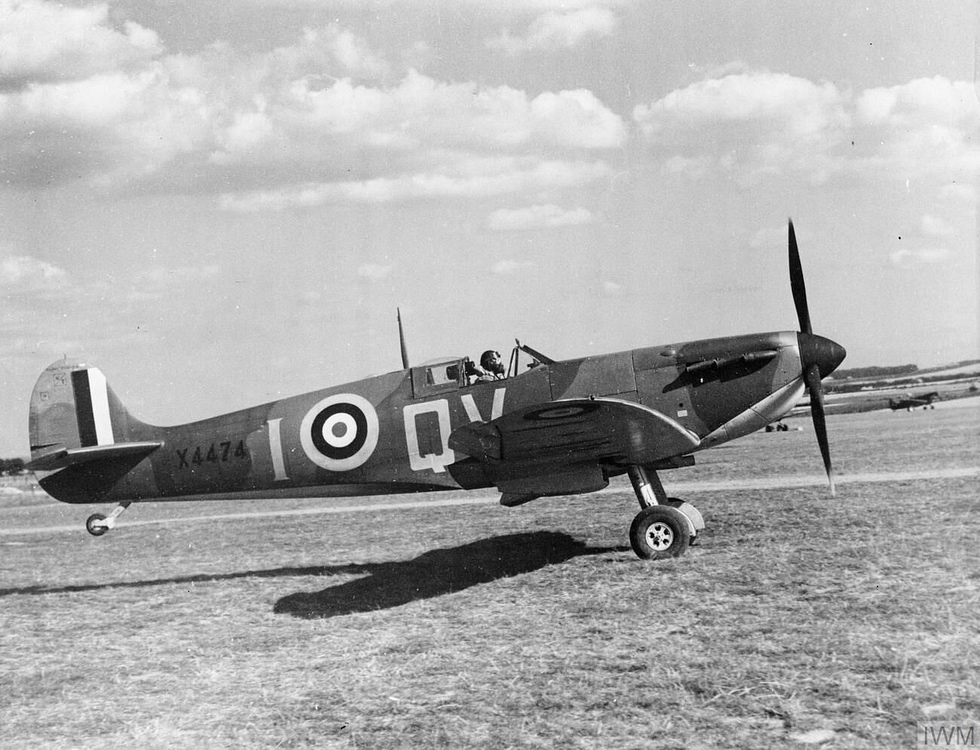
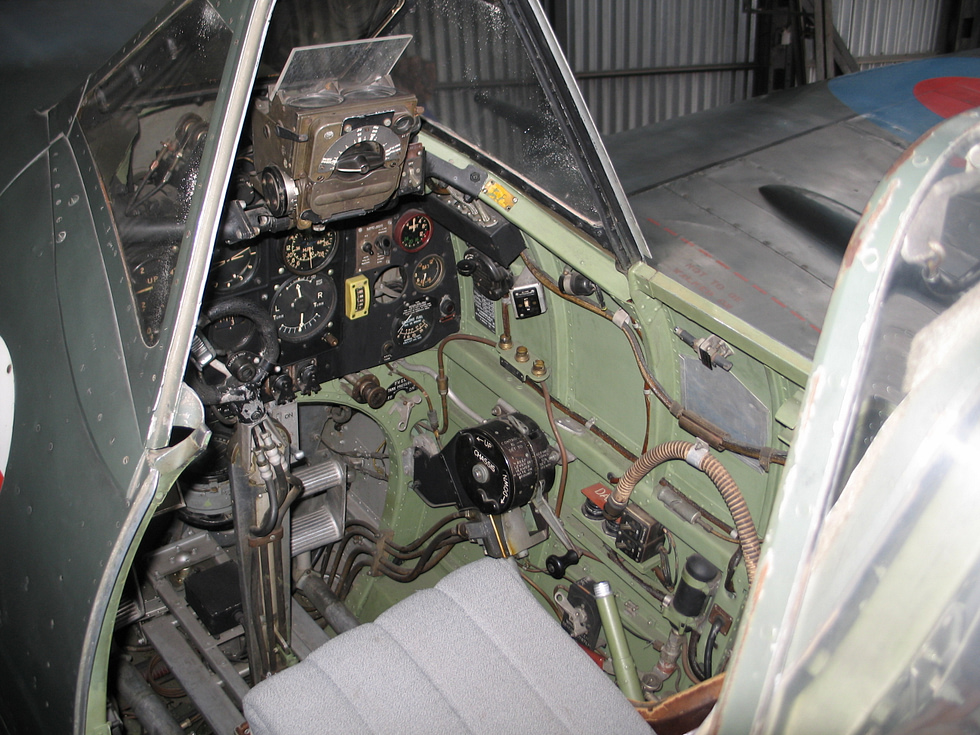
The Spitfire in pictures
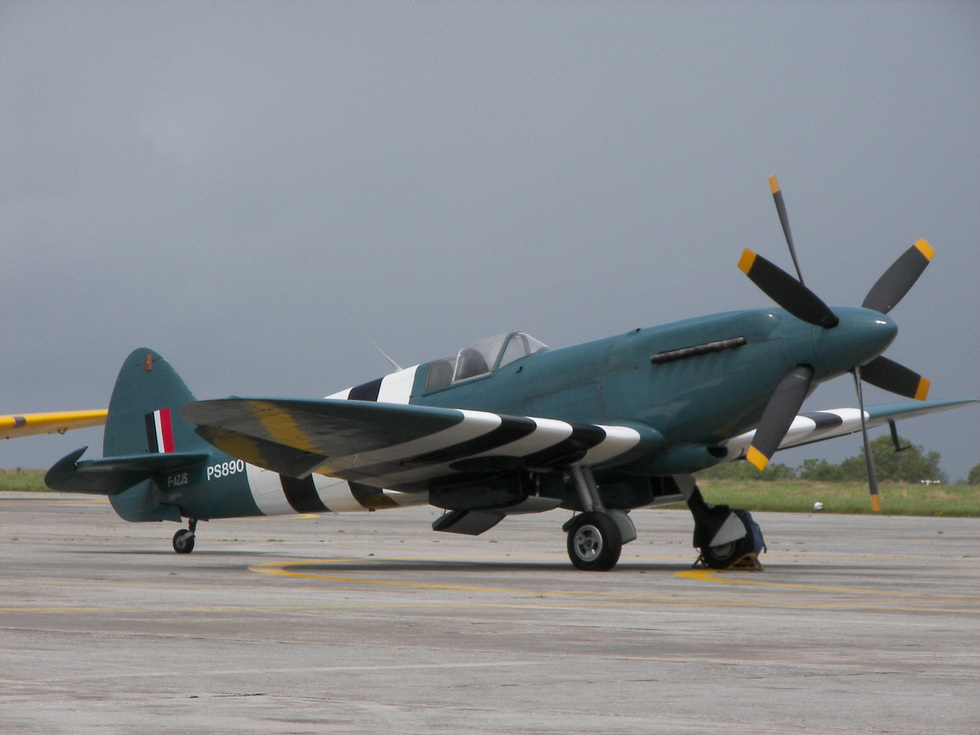
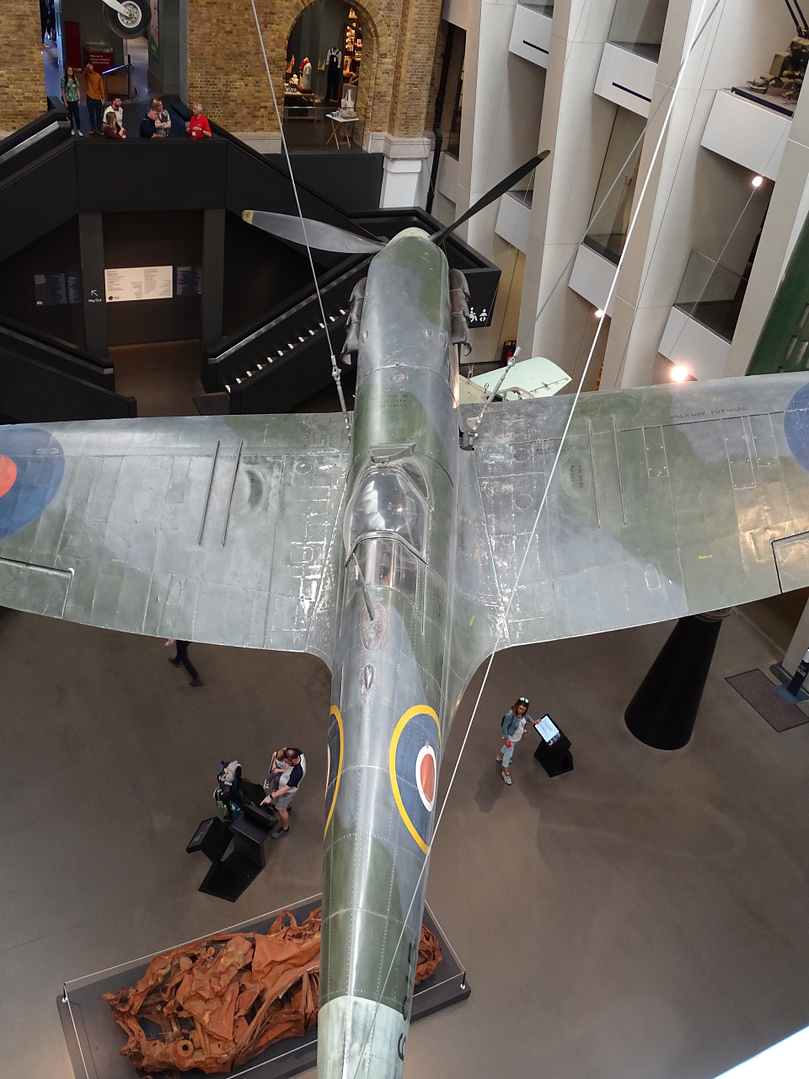
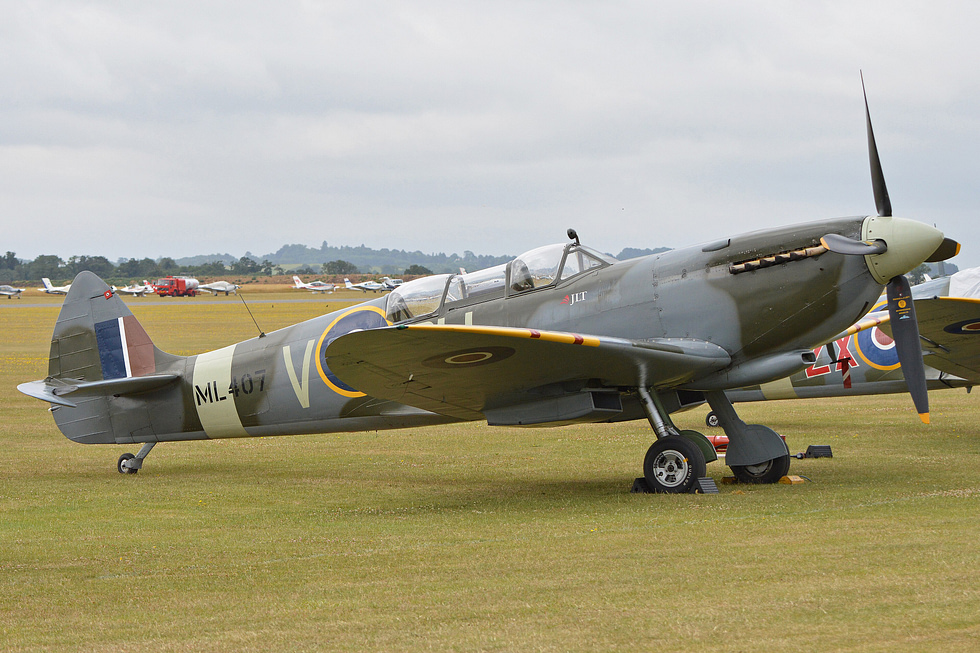
The Spitfire in motion
A hand-picked Spitfire documentary will be embedded here soon.
The Spitfire in motion
Real Engineering — one of the most-watched Spitfire films on YouTube.
Where the Spitfire flew
The fighter that fought the whole war
The Spitfire served from the first months of the Second World War to its end and beyond — Western Europe, the Mediterranean, Malta, North Africa, the Eastern Front, Burma and the Pacific. Ace tallies and “last sortie” dates differ between sources, so treat specific figures as claims, not settled scores. What is beyond dispute is the breadth of its fighting career.
Compare the combat record of every military aircraft. Figures as of July 2026.
Everything people ask about the Spitfire
Can I fly in a Spitfire?
Was the Spitfire fast?
Is the Spitfire still flyable today?
Spitfire vs Messerschmitt Bf 109?
How many Spitfires were built?
Merlin or Griffon — what’s the difference?
Who designed the Spitfire?
What was the Seafire?
You can’t fly the Spitfire.
These, you can.
Some legends only live in museums — others are fuelled and waiting. MiGFlug has put civilians in real military jet cockpits since 2004.
 Fly the L-39 AlbatrosThe world’s most-flown jet trainer — aerobatics included
 Fly the F-104 Starfighter“The missile with a man in it”
 Fly the MiG-21The Cold War’s most-produced jet
 Управляйте самолетом T-33 Shooting Star.America’s first jet trainer
 Fly the DH VampireA piece of early jet history
 Fly the S.211Agile Italian jet trainer
 Fly the MB-326The classic Aermacchi jet
 Fly the MiG-15The Soviet legend of the Korean War
Continue the tour
Every fact, checked
- Imperial War Museums — The evolution of the Supermarine SpitfireDevelopment history, marks and the Battle of Britain role.
- Imperial War Museums — 9 iconic aircraft from the Battle of BritainThe Spitfire’s place among the defining aircraft of 1940.
- RAF Museum — Supermarine Spitfire aircraft historyDesign, service and production overview.
- Encyclopaedia Britannica — SpitfireConcise reference on the aircraft and its significance.
- National Museums Scotland — The story of the SpitfireDesign and cultural legacy of the type.
- Military Factory — Supermarine Spitfire specificationsDimensional and performance data cross-check.
- Goodwood Aerodrome — Spitfire Flight ExperienceTwo-seat Spitfire passenger flights in the UK.
- Boultbee Flight Academy / spitfires.comTwo-seat TR9 Spitfire experience flights in the UK.
- MiGFlug — flights & pricesConfirms the Spitfire is not offered by MiGFlug; lists the jets that are.