
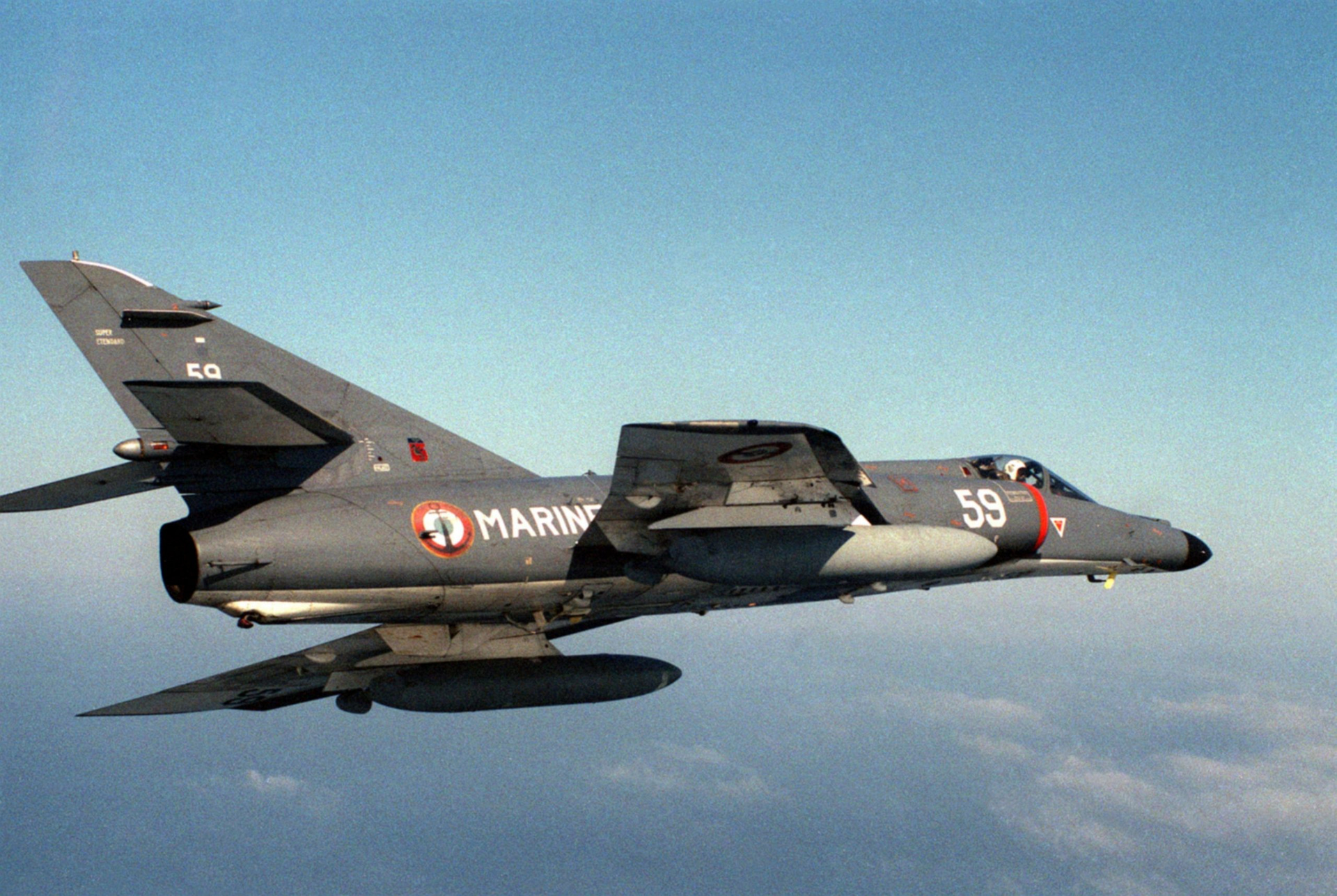
Dassault Super Étendard
The Exocet Striker
A compact French carrier-borne strike fighter that rewrote the rules of naval warfare — the jet whose AM39 Exocet missiles sank HMS Sheffield and the Atlantic Conveyor in the 1982 Falklands War, and which France flew from its carriers for nearly four decades.
The little strike jet that sank a warship
In the early 1970s the French Navy needed a new carrier aircraft to replace its ageing Étendard IV. It first looked at a navalised version of the Anglo-French SEPECAT Jaguar, but the marinised Jaguar M proved troublesome, and in 1973 the Aéronavale turned instead to Dassault’s proposal for a modernised development of its own Étendard IV. The result was the Super Étendard — broadly similar in shape to its predecessor but with a new wing, an uprated non-afterburning SNECMA Atar 8K-50 engine, and, crucially, modern attack avionics built around the Thomson-CSF Agave radar.
The prototype first flew on 28 October 1974, and the type entered French naval service in 1978. On paper it was unremarkable: a subsonic, single-engined, single-seat jet weighing about 12 tonnes fully loaded. What made it matter was the weapon it was designed to carry — the Aérospatiale AM39 Exocet sea-skimming anti-ship missile. Together, the Agave radar and the Exocet turned a modest carrier jet into a ship-killer that could strike from beyond a target’s horizon.
That combination was proven in the most dramatic way possible in 1982, when Argentina’s tiny force of Super Étendards used Exocets to sink two British ships in the South Atlantic. The jet went on to serve France over Lebanon, Bosnia, Kosovo, Afghanistan, Libya, Iraq and Syria, and to carry France’s airborne nuclear deterrent, before it was finally retired from carrier decks in 2016.
01Why France built the Super Étendard instead of a navalised Jaguar
The Super Étendard exists largely because a different aircraft failed. In the late 1960s France planned to replace its Étendard IV carrier jets with a marinised version of the SEPECAT Jaguar — the Jaguar M. But carrier trials exposed handling and engine-response problems, and the programme became entangled in cost and industrial politics. In 1973 the Aéronavale cancelled the naval Jaguar and accepted Dassault’s cheaper, lower-risk alternative: an updated Étendard IV. Because it reused a proven airframe layout, the Super Étendard could be fielded quickly — but it also inherited the older jet’s modest, subsonic performance. Dassault built roughly 85 of them, 71 for France and 14 for Argentina.
What makes it special
The Exocet & Agave radar ship-killer
The Super Étendard’s reason for being was the AM39 Exocet anti-ship missile. Its nose-mounted Thomson-CSF Agave radar could detect a ship at long range, hand off target coordinates to the missile, and let the pilot launch from tens of kilometres away. The Exocet then dropped to just a few metres above the waves and flew on its own radar to the target — a “fire-and-forget” sea-skimmer that gave a small jet the reach to sink a warship.
Built for the carrier deck
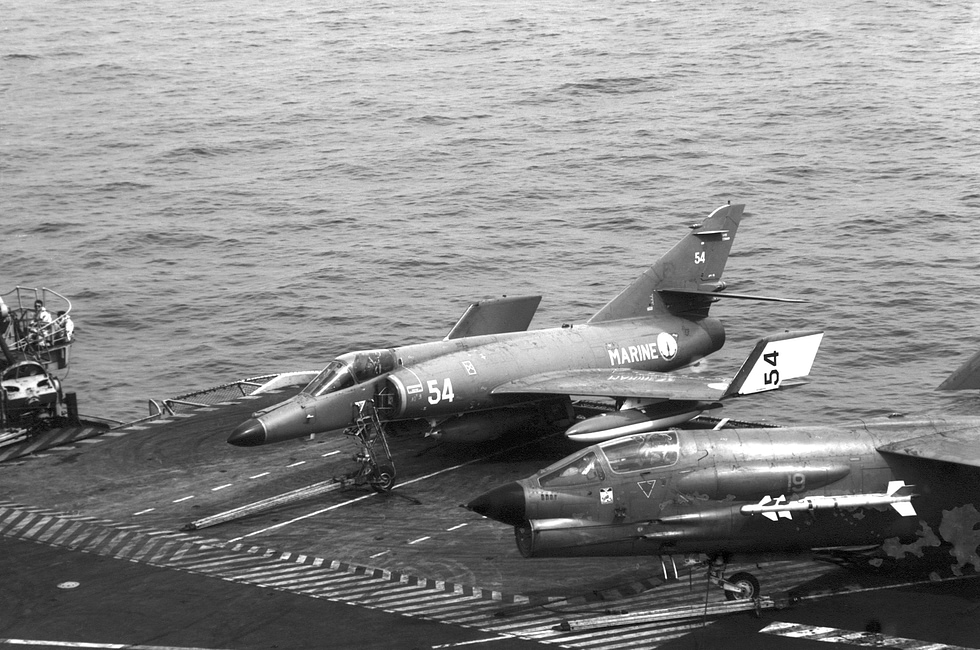
Everything about the airframe was shaped by the cramped decks of France’s Clemenceau-class carriers. It had folding wingtips to save hangar space, a reinforced structure and arrestor hook for catapult launches and arrested landings, and high-lift slats and flaps to keep approach speeds low. Compact and rugged rather than fast, it was optimised to operate reliably from a small deck at sea.
One modest engine — and a nuclear role
Power came from a single SNECMA Atar 8K-50 turbojet of about 49 kN — and, unusually for a fighter, it had no afterburner, capping the jet at around Mach 1. What it lacked in speed it made up in versatility: later upgrades let it carry laser-guided bombs, the AS-30L missile and the ASMP nuclear stand-off missile, making it a carrier-based leg of France’s nuclear deterrent.
02The Super Étendard Modernisé: a 1970s jet dragged into the digital age
By the 1990s the original Super Étendard was badly dated, and France could not yet field its replacement. Rather than retire the fleet, the Navy launched the Super Étendard Modernisé (SEM) upgrade. Around 50 airframes received a new central computer, a modern Thomson-CSF Anemone multi-mode radar with roughly double the range of the old Agave, a redesigned HOTAS cockpit, and later additions such as GPS-aided navigation, night-vision-goggle compatibility, improved countermeasures and the Damocles laser-designation pod. The SEM transformed a dedicated anti-ship jet into a flexible precision-strike and reconnaissance platform that stayed useful over Afghanistan and Libya into the 2010s.
03How a subsonic jet sinks a warship: the Exocet attack profile
The Super Étendard never needed to be fast, because the Exocet did the fighting. A typical attack saw the jet fly low to stay under the enemy’s radar horizon, pop up briefly to sweep with the Agave radar and fix the target’s position, feed those coordinates into the missile, then launch and turn away — often without ever seeing the ship. The AM39 dropped to sea-skimming height and closed at high subsonic speed, appearing on a defender’s radar only in the final seconds. Against warships not braced for it, that left almost no time to react — the lesson the Royal Navy learned the hard way in 1982.
Full specifications
Airframe & Performance
- Экипаж
- 1
- Длина
- 14.31 m
- Размах крыльев
- 9.60 m (folding wingtips)
- Высота
- 3.86 m
- Пустой вес
- ~6,500 kg
- Max takeoff weight
- ~12,000 kg
- Max speed
- ~1,200 km/h · about Mach 1
- Служебный потолок
- ~13,700 m
- Боевой радиус
- ~850 km (with one Exocet & drop tank)
Propulsion, Sensors & Armament
- Двигатель
- 1 × SNECMA Atar 8K-50 (no afterburner)
- Толкать
- ~49 kN
- Radar
- Thomson-CSF Agave (Anemone on SEM)
- Guns
- 2 × 30 mm DEFA 552 cannon
- Anti-ship
- AM39 Exocet missile
- Strike/nuclear
- AS-30L, laser-guided bombs, ASMP nuclear missile
- First flight
- 28 October 1974
- Built
- ~85 (France 71 · Argentina 14)
- Unit cost
- No official flyaway price published
- Cost per flight hour
- No reliable public figure
04The Super Étendard’s cost: why no clean price exists
The Super Étendard was a French state naval procurement, not a jet sold widely on an open market, so no reliable, consistent flyaway unit price circulates in public sources. Argentina’s 1979 order of 14 aircraft plus missiles is sometimes cited to estimate a per-aircraft figure in the low tens of millions of dollars for the 1980s, but that bundled airframes, weapons, spares and support and should be treated as an order-of-magnitude guide only. No credible cost-per-flight-hour figure for the type exists in open sources. Any exact dollar price you see attached to the Super Étendard is, in practice, an estimate.
From carrier jet to Exocet legend
Programme launched
France cancels the navalised Jaguar M and accepts Dassault’s modernised Étendard IV — the Super Étendard.
First flight
The prototype flies on 28 October 1974, powered by the new non-afterburning Atar 8K-50 engine.
Enters French service
Deliveries to the Aéronavale begin; Flottille 11F becomes the first operational squadron the following year.
The Falklands
Argentine Navy Super Étendards sink HMS Sheffield (4 May) and the Atlantic Conveyor (25 May) with air-launched Exocets.
Loaned to Iraq
France lends five Super Étendards to Iraq, which uses them to attack tankers in the Gulf during the Tanker War against Iran.
Super Étendard Modernisé
Around 50 French airframes are rebuilt with new radar, computer and cockpit, becoming precision-strike SEMs.
Modern wars
French SEMs fly strike and reconnaissance over Afghanistan and, in 2011, over Libya alongside the Rafale.
French retirement
The last French Super Étendards are withdrawn on 12 July 2016, replaced on carrier decks by the Rafale M.
From the deck: twelve Super Étendard stories
The jet that replaced a failure
A troubled navalised Jaguar opened the door for Dassault’s own design.
Read the full story
The sinking of HMS Sheffield
On 4 May 1982 a single Exocet crippled a modern Royal Navy destroyer.
Read the full story
The Atlantic Conveyor
A second Exocet strike on 25 May sank a ship carrying vital helicopters.
Read the full story
The hunt for the last Exocets
Argentina had only five air-launched Exocets — and Britain feared every one.
Read the full story
Agave, Exocet and the horizon
The radar-and-missile pairing let a small jet strike ships it never saw.
Read the full story
France’s jets in Iraqi service
In 1983 five Super Étendards were loaned to Iraq to attack Gulf shipping.
Read the full story
Folding wings and a low deck
Every design choice served the cramped decks of France’s carriers.
Read the full story
A carrier leg of the deterrent
Fitted for the ASMP missile, the jet carried French nuclear weapons to sea.
Read the full story
Precision over Afghanistan
Rebuilt SEMs traded anti-ship work for laser-guided strikes and recon.
Read the full story
Back into action
French Super Étendards struck ground targets in the 2011 Libya campaign.
Read the full story
The long goodbye
Argentina’s Super Étendards outlived France’s — barely.
Read the full story
The lesson of the sea-skimmer
A modest jet taught every navy to fear the anti-ship missile.
Read the full story
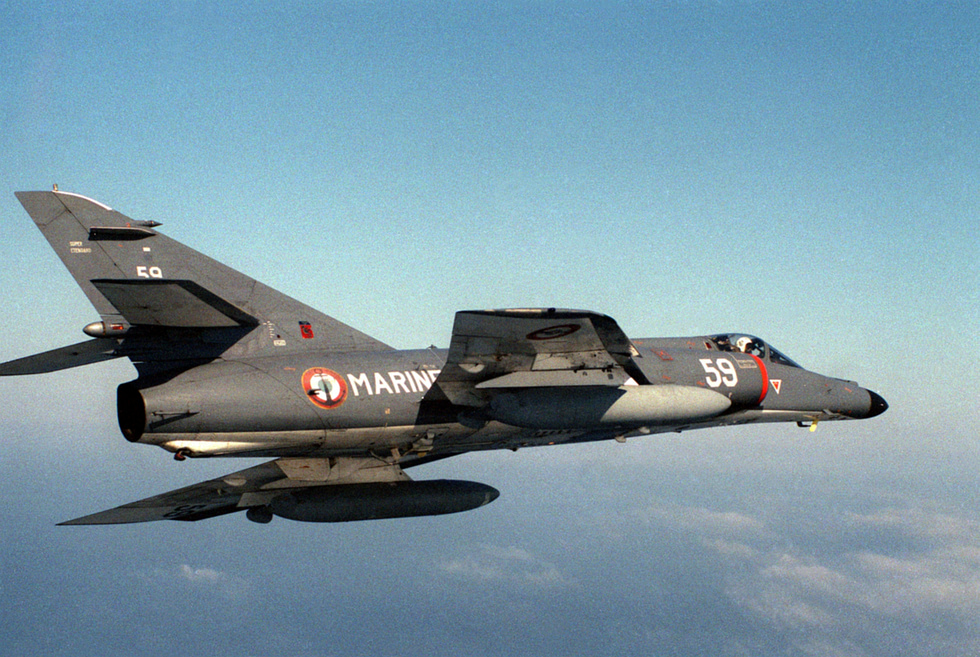
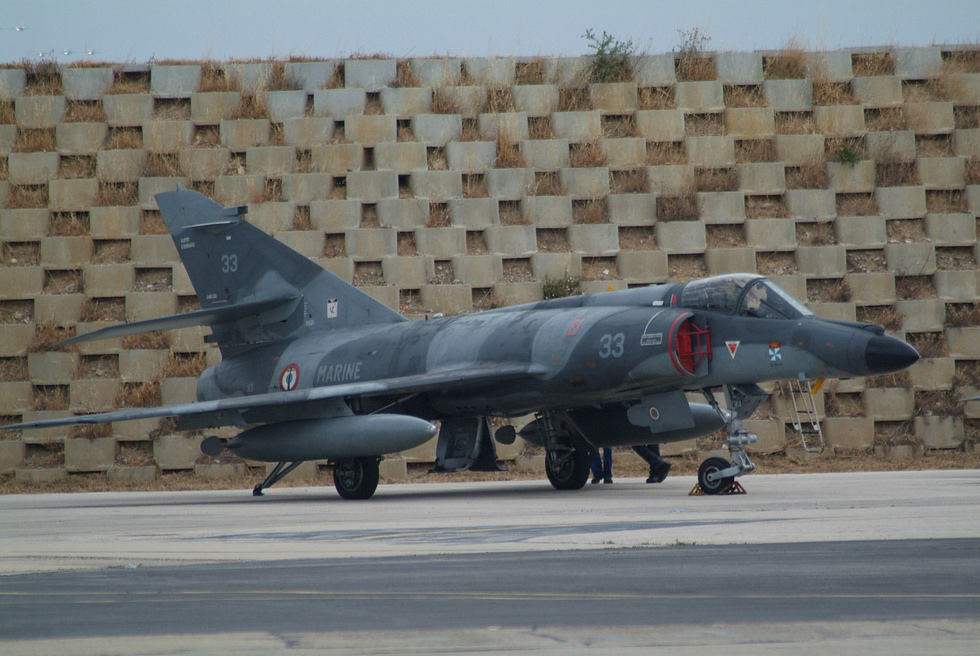
The Super Étendard in pictures
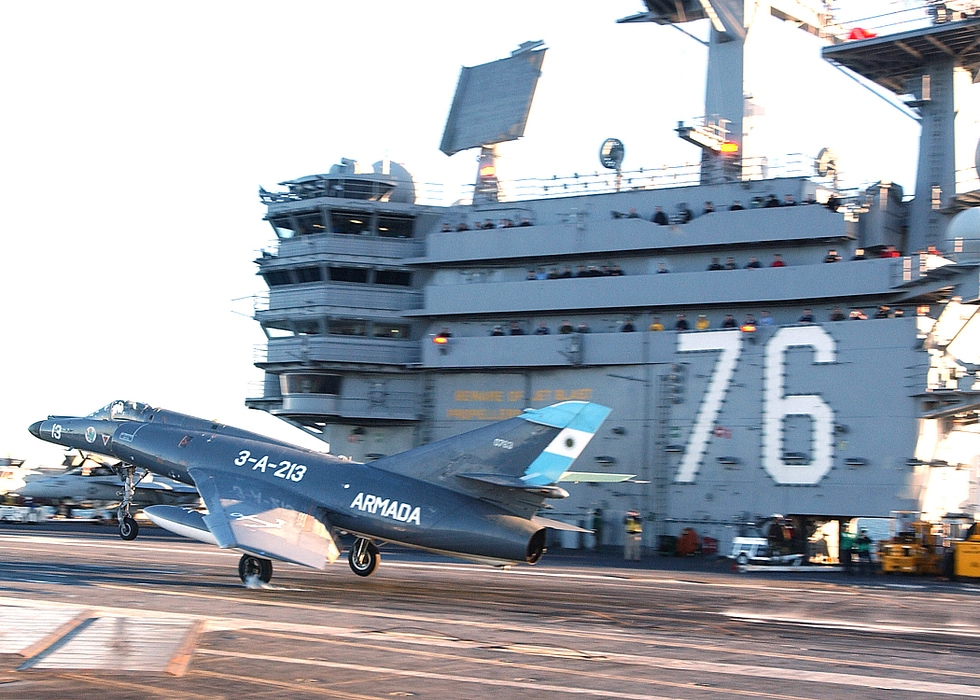
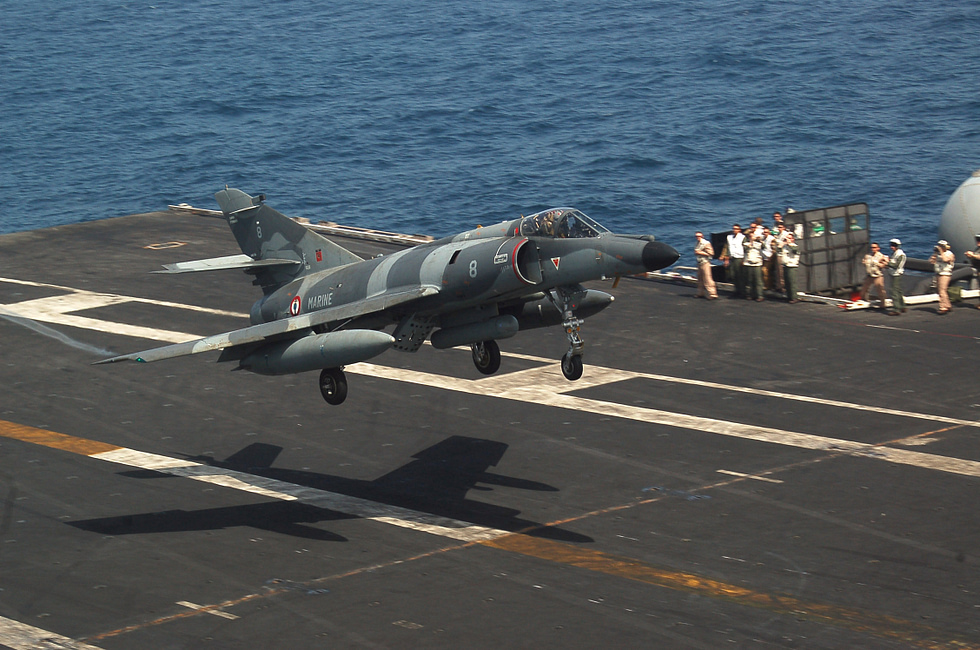
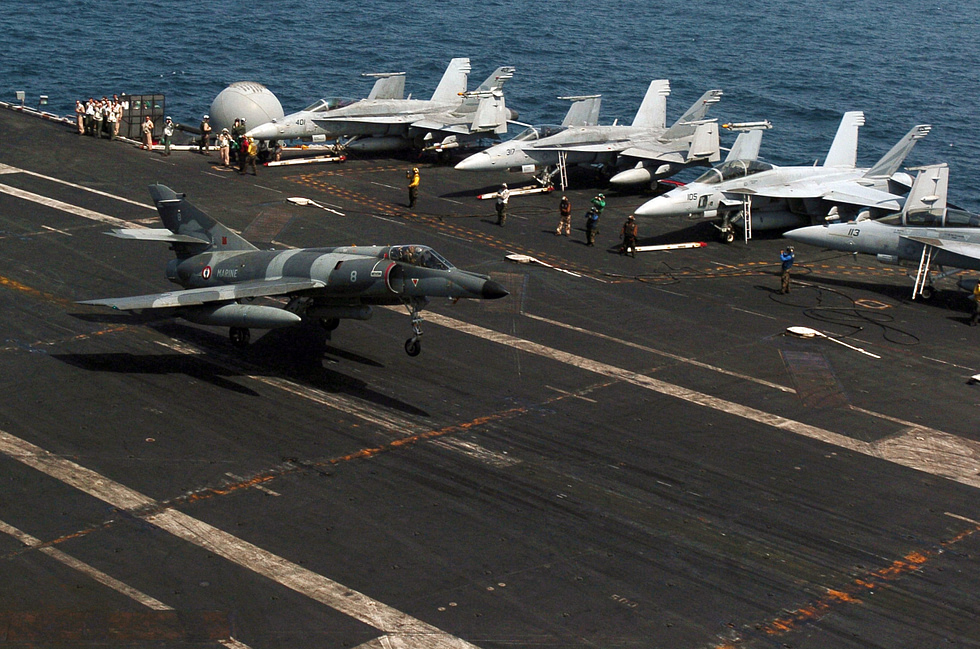
The Super Étendard in motion
A hand-picked video feature on the Super Étendard — its Falklands Exocet strikes, its carrier operations and its long French service — is coming soon to this exhibit. In the meantime, explore the stories, gallery and operations map above.
The Super Étendard in motion
PA38CBA — one of the most-watched Super Étendard films on YouTube.
Where the Super Étendard flew
The score that defines it
The Super Étendard is remembered for one thing above all: the Exocet. Its combat legacy is not air-to-air kills but ships sunk — and the shock those sinkings sent through every navy in the world. In just three weeks in 1982, a tiny Argentine force turned a modest carrier jet into one of the most consequential strike aircraft of the late 20th century.
Compare the combat record of every military aircraft. Figures as of July 2026.
Everything people ask about the Super Étendard
Can I fly in a Super Étendard?
Why is the Super Étendard so famous?
Did a Super Étendard really sink HMS Sheffield?
Was the Super Étendard supersonic?
Did Iraq really fly French Super Étendards?
What is the Super Étendard Modernisé (SEM)?
Is the Super Étendard still in service?
You can’t fly the Super Étendard.
These, you can.
Some legends only live in museums — others are fuelled and waiting. MiGFlug has put civilians in real military jet cockpits since 2004.
 Fly the L-39 AlbatrosThe world’s most-flown jet trainer — aerobatics included
 Fly the F-104 Starfighter“The missile with a man in it”
 Fly the MiG-21The Cold War’s most-produced jet
 Управляйте самолетом T-33 Shooting Star.America’s first jet trainer
 Fly the DH VampireA piece of early jet history
 Fly the S.211Agile Italian jet trainer
 Fly the MB-326The classic Aermacchi jet
 Fly the MiG-15The Soviet legend of the Korean War
Continue the tour
Every fact, checked
- Dassault Aviation — Super ÉtendardThe manufacturer’s own history of the aircraft’s development and service.
- U.S. Naval Institute — Legacy of the ExocetAnalysis of the Falklands Exocet strikes and their lasting effect on naval warfare.
- The Aviation Geek Club — Iraqi Super ÉtendardsDetail on the 1983 French loan and the Tanker-War tanker attacks.
- Military Factory — Super ÉtendardSpecifications, dimensions, armament and variant reference.
- Federation of American Scientists — Super ÉtendardOverview of the engine, avionics and the SEM upgrade programme.
- Fly a Jet Fighter — Super Étendard factsBackground on the type’s origins, carrier role and combat career.
- The National Interest — Falklands Super ÉtendardsThe Sheffield and Atlantic Conveyor sinkings and the Exocet threat.
- EurAsian Times — Argentine retirementArgentina’s late-life Super Étendard fleet and its withdrawal.