
On 10 February 1995, over a stretch of Amazon jungle that neither country could reach easily on foot, four Ecuadorian fighters shot down three Peruvian aircraft in about fifteen minutes. The Cenepa air battle is the only time an IAI Kfir has scored an air-to-air kill outside Israeli service, and it remains one of only two aerial victories credited to the type anywhere.
It is also one of the very few modern engagements where the two air forces involved still do not agree on what happened. Ecuador says three aircraft fell to missiles. Peru says one.
Thirty-one years later, nobody has produced the gun-camera film that would settle it.
Quick Facts
Date: 10 February 1995, early afternoon
Where: the upper Cenepa valley, on the disputed Ecuador–Peru Amazon border
Ecuadorian aircraft: two Mirage F1JA (callsign Conejos) and two Kfir C.2 (callsign Broncos)
Ecuadorian pilots: Mayor Raúl Banderas Dueñas and Capitán Carlos Uzcátegui Solís in the Mirages; Capitán Mauricio Mata Velástegui and Teniente Wilfrido Moya Salazar in the Kfirs
Weapons: Matra R.550 Magic Mk.II on the Mirages, Shafrir Mk.II on the Kfirs
Ecuadorian claim: two Su-22M and one A-37B
Peruvian position: the A-37B was lost to an air-to-air missile; the two Su-22s were not
Evidence released: none. No HUD or gun-camera footage has ever been published
Two air forces that had been rehearsing for each other
Ecuador and Peru had fought over the same jungle in 1941 and again in 1981. Ecuador lost both times, and between 1981 and 1995 it spent heavily on the assumption that there would be a third round. It bought Mirage F1JAs from France and Kfir C.2s from Israel, and it built a radar network that actually worked in the border sector.
Peru, on paper, had the stronger air force: Su-22 fighter-bombers, A-37B light attack aircraft, Canberras, and Mirage 2000Ps that were newer than anything Ecuador flew. On the day it mattered, almost none of that helped.
Peru’s radar coverage in the combat area was poor — roughly half of its sets were unserviceable, and most of the rest were deployed on the coast or looking into the shadow of the Ecuadorian Andes, which left its crews flying without useful ground control. Its Su-22s carried no radar warning receiver at all. And its Mirage 2000Ps had never been supplied with the Super 530D missile that would have given them a real beyond-visual-range punch.
The Ecuadorian pilots did not know that last part. Raúl Banderas, who led the Mirage pair, spent the whole campaign expecting to be shot at from fourteen miles by a weapon Peru did not actually have.
Ecuadorian strike aircraft over the Cenepa were escorted by Mirages and Kfirs. Peruvian helicopters and strike aircraft, for the most part, were not escorted at all.
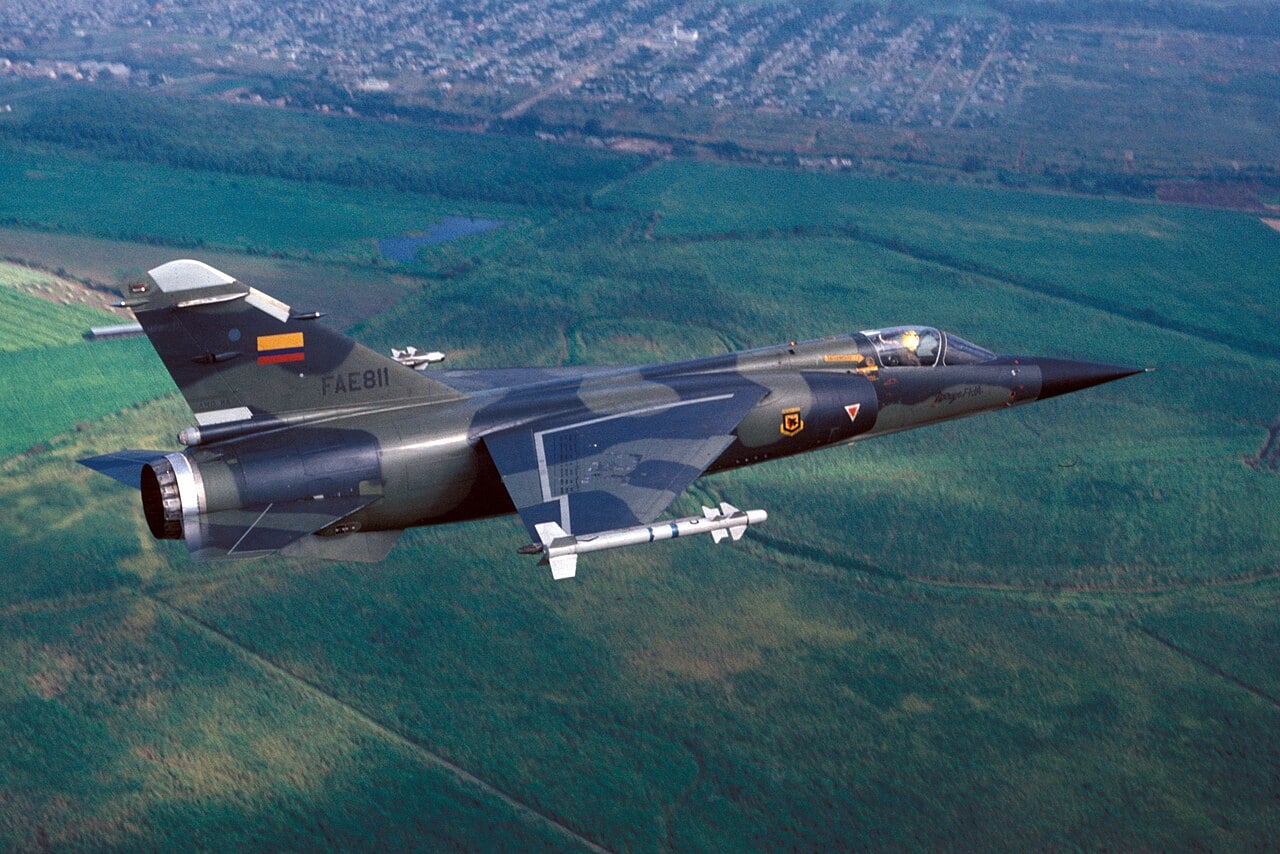
Kfirs and Mirage F1s of the Fuerza Aérea Ecuatoriana over Guayaquil. These are the two types that flew the 10 February intercept, in the markings they wore at the time.
The scramble
Ecuadorian radar picked up a Peruvian strike package heading for the Cenepa around midday. Two Mirage F1JAs, callsign Conejos, were ordered off: Banderas in FAE807 leading, Capitán Carlos Uzcátegui in FAE806 as his number two. A pair of Kfir C.2s, callsign Broncos, went with them — Capitán Mauricio Mata in FAE905 and Teniente Wilfrido Moya in FAE909.
Banderas’ own mission debrief puts the order at 12h47 and the wheels up at 12h49, accelerating to 450 knots and climbing to 30,000 feet on a heading of 140. Other accounts put the alert at 12:30 and the launch at 12:45. Nothing about the timeline of this battle is agreed, including by the people who flew it.
The Conejos and the Sukhois
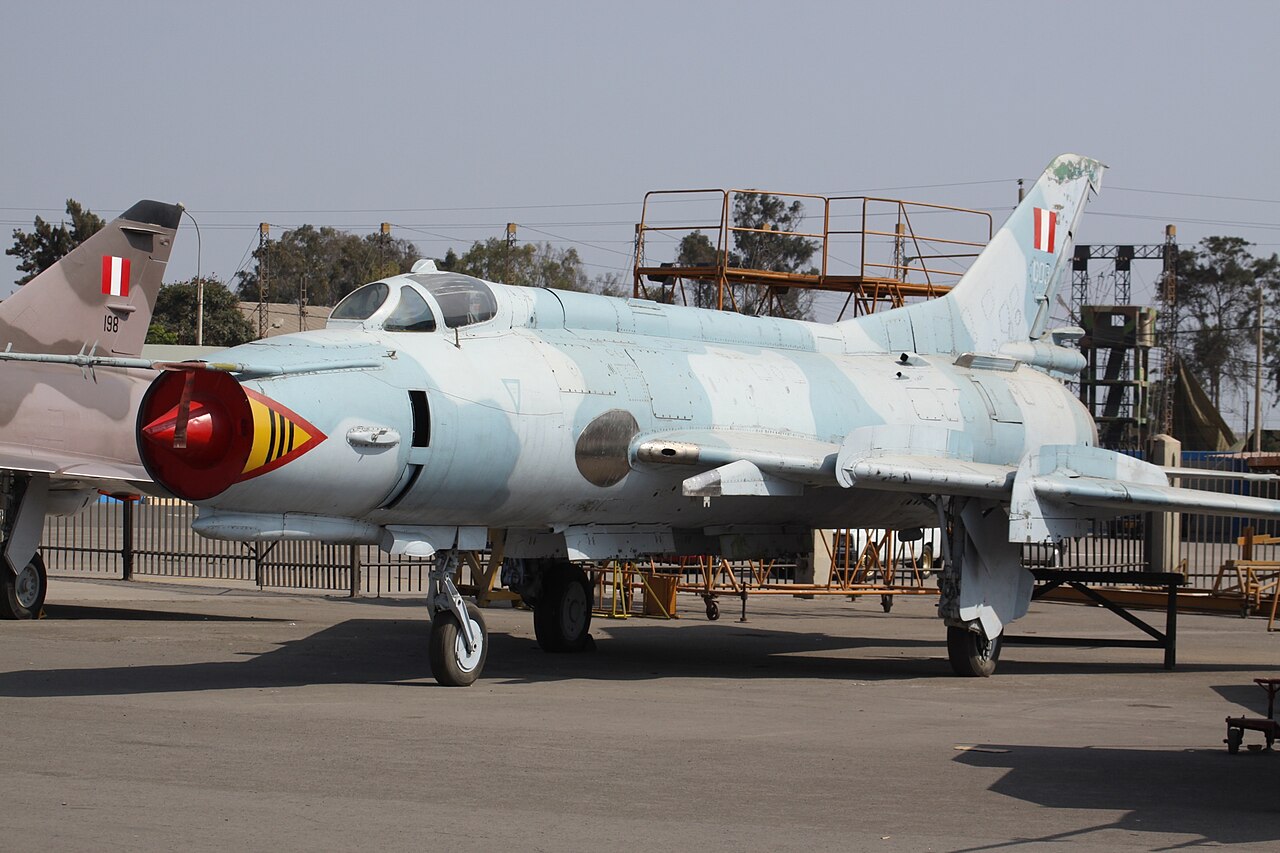
The two Mirages came in below and behind a pair of Peruvian Su-22Ms. The Sukhoi crews had no radar warning equipment and never saw them.
Banderas described the moment of the first launch in his debrief: climbing slightly, he could make out the cut-off nose of the Su-22s clearly, and fired from a range of one to one and a half miles. Uzcátegui fired at the other one.
Both Sukhois started streaming black smoke. Neither came down.
Banderas should have left — his radar warning receiver was chirping at something behind him that he never identified — but he judged that a damaged Su-22 might still turn and shoot. He came round again and fired his second Magic. That one hit the aircraft amidships. In his account the Sukhoi stopped in the air and fell.
That makes four missiles fired by the Mirage pair, two each. Tom Cooper’s widely-cited account of the battle says three. It is a small discrepancy, but it is a useful illustration of how little about this fight is nailed down.
The two Peruvian pilots were Teniente Coronel Víctor Manuel Maldonado Begazo and Mayor Enrique Caballero Orrego. Both were killed. Maldonado is generally held to have ejected and survived in the jungle for a week or more before dying; his body was recovered later in February. Caballero Orrego’s remains took far longer to find, and even the length of that delay is disputed — six months in one account, five years in another.
Which Ecuadorian killed which Peruvian is also contested. Ecuadorian sources pair Banderas with Maldonado and Uzcátegui with Caballero Orrego. Cooper reverses it.
The Broncos and the Dragonfly
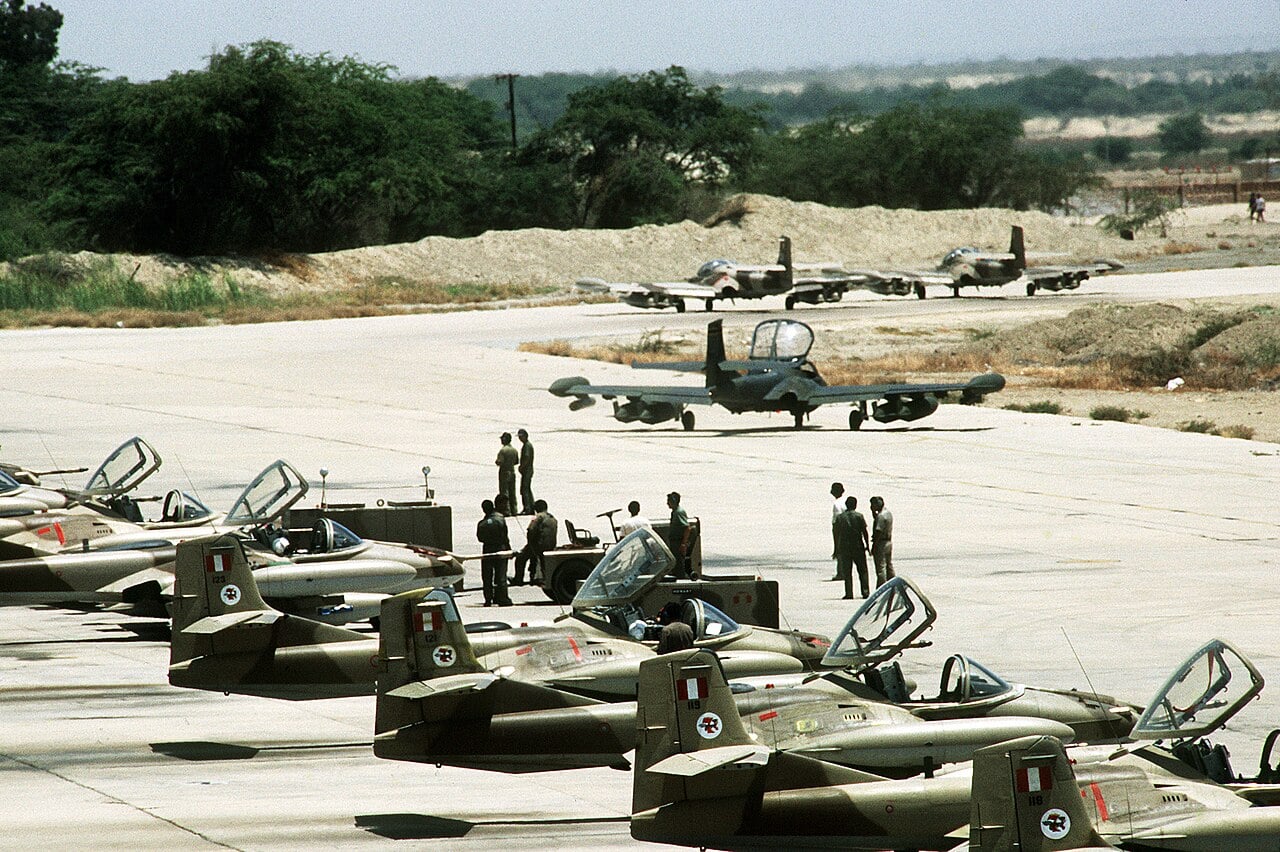
The Kfir pair found the other half of the Peruvian package: A-37B Dragonflies that had just released their bombs. The lead aircraft was flown by Teniente Coronel Hilario Valladares with Mayor Gregorio de Mendiola; the wingman was Teniente Coronel Fernando Hoyos. Both senior officers had volunteered for the mission to set an example for the younger pilots in their unit.
Two Shafrir missiles were fired at the lead Dragonfly. By the surviving pilot’s own testimony — reproduced in the standard Peruvian account of the war’s aircraft losses — he evaded the first and was hit by the second. Valladares and de Mendiola both ejected and were recovered. Hoyos got away.
Ecuadorian sources credit the kill to Mata. Cooper’s narrative credits Moya, though his own photo caption says Mata. On balance, Mata is the better-supported of the two.
With the A-37 down, the remaining Peruvian aircraft and helicopters were ordered out of the area. For the rest of the war, Ecuador had local air superiority over the Cenepa.
Raúl Banderas describing the engagement, from the Fuerza Aérea Ecuatoriana’s own channel. It is the official Ecuadorian account, told by the man who led the flight.
The only Kfir kill there has ever been
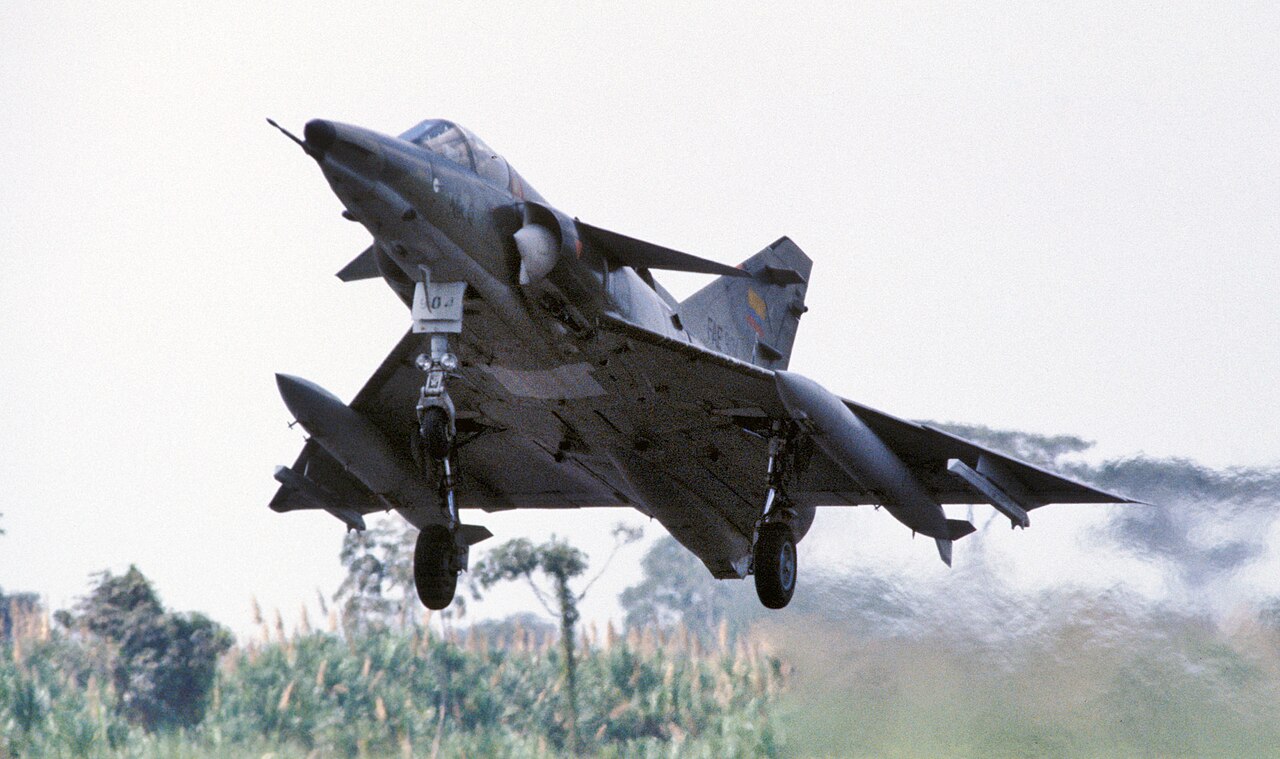
The Kfir is a good aeroplane with a strange career. Israel built it because a French embargo left it unable to buy more Mirages, so it married a Mirage 5 airframe to an American J79 engine and added canards. Israel flew it, then sold it on: Ecuador, Colombia, Sri Lanka, and later a fleet of privately operated aggressor jets in the United States.
For all that, the Kfir has only two credited aerial victories in its whole career. The first was Israeli: a Kfir C.2 downed a Syrian MiG-21 on 27 June 1979. The second was the Peruvian A-37B over the Cenepa. The type entered service just as Israel’s opponents stopped offering air battles, and spent most of its life as a bomb truck and later as an aggressor jet imitating MiGs for American aircrew. One kill outside Israeli service, in one afternoon, in a war almost nobody outside South America remembers.
The weapon matters too, because it is almost always reported wrongly. The Kfirs were carrying Shafrir Mk.II, an Israeli infrared missile of 1960s vintage that had to be fired from the rear quarter. Python 3 is widely quoted online and is almost certainly wrong for 1995; the confusion appears to come from photographs of later, post-war Kfir C.7s. The Mirages carried the Matra R.550 Magic Mk.II, a French weapon of comparable generation with better off-boresight performance but the same basic requirement: get close, get a tone, shoot.
Neither side used a radar-guided missile. For all the talk of Mach-2 fighters, this was a heat-seeker fight fought from inside two miles.
What Peru says
Peru accepts that it lost the A-37B to an air-to-air missile. It does not accept the Sukhois.
The standard Peruvian account attributes one Su-22 to Ecuadorian anti-aircraft fire or a shoulder-launched SAM and the other to an engine fire. Peru also points out that Ecuador’s first communiqué on 11 February claimed four aircraft, and was quietly revised down to three — which, in the Peruvian reading, is what a fabricated score looks like when it meets reality.
The evidentiary position is genuinely awkward for Ecuador. Beyond the radio traffic between the pilots and their controllers, the Fuerza Aérea Ecuatoriana has never released HUD or gun-camera video of the two Sukhoi kills. Thirty-one years is a long time to hold back footage that would end the argument.
Against that, the most damaging testimony about the state of the Peruvian air force in February 1995 came from a Peruvian general, under oath, in front of his own Congress.
What the Cenepa air battle actually settled
Militarily, it settled the air over the Cenepa. Peruvian bombing of Ecuadorian positions dropped away sharply after 10 February, and Peru shifted to artillery and mortars. Ecuador’s theatre commander, Gen. Paco Moncayo, made exactly that point in his own account of the war.
Strategically, the American analyst Gabriel Marcella, writing for the US Army War College in November 1995, described it as a limited Ecuadorian victory — and noted that it was the first military victory Ecuador had won over Peru since the battle of Tarqui in 1829. He credited it as much to Ecuador’s information campaign as to its weapons.
Peru has never accepted that framing. Gen. Roberto Chiabra, later Peru’s defence minister and one of its senior commanders in the conflict, has argued that Ecuador “fabricated a quick victory in the first week of February” and points out that Ecuador subsequently accepted the validity of the Rio Protocol and the Díaz de Aguiar arbitral award that assign the territory to Peru.
Both things can be true. Ecuador won the air battle and did not win the border.
Uzcátegui, who was killed in a flying accident at Salinas in 2002, left a description of the moment in his mission debrief that has nothing triumphant in it at all.
Banderas, who retired as a general, told Vistazo in February 2026 about meeting his Peruvian opposite number, Gen. Alfonso Artadi, at a reception some years afterwards. Artadi told him there had been four Sukhois that day, and that he himself had been about twenty miles ahead, which is why Banderas never saw him.
Be careful what you read about this battle
The Cenepa air battle is badly served by its sources, and a handful of errors circulate so widely that they are worth naming.
The missiles. Python 3 is repeatedly quoted for the Kfirs. It is almost certainly wrong for 1995; the Shafrir Mk.II is the version consistent with the delivery record.
“The first air combat in South America.” The Fuerza Aérea Ecuatoriana’s own commemorations have used this line. It is not true. There was air combat in the Chaco War, in the 1941 Ecuador–Peru war, and in the 1969 war between El Salvador and Honduras. The narrower claim does hold up: 10 February 1995 appears to be the first time two Mach-2-capable fighters fought each other in Latin America.
Pilot quotes attributed to Tom Cooper. Cooper’s ACIG article is the foundational English-language account of the battle, and it contains no quotation-marked pilot statements anywhere. Any “Cooper quote” from an Ecuadorian or Peruvian pilot has been invented somewhere downstream.
“The last dogfight in the Americas.” You will see this. No source we could find actually says it, and later Western Hemisphere shootdowns exist — though they are military aircraft firing on civil ones, which is a different thing.
What can be said with confidence is narrow and still remarkable: on one afternoon in February 1995, over jungle, two French fighters and two Israeli fighters flown by Ecuadorians intercepted a Peruvian strike package and shot at least one and probably three of it down, using heat-seeking missiles from inside two miles, and the argument about the other two has outlasted most of the people who were there.
Sources: Tom Cooper with Esteban Rivera, “Peru vs. Ecuador; Alto-Cenepa War, 1995”, ACIG.org, 1 September 2003; “Victoria Aérea sobre el Alto Cenepa: 10 de febrero de 1995”, Historia Militar Ecuatoriana, 13 May 2020; Cecilio Moreno interview with Gral. (r) Raúl Banderas, Vistazo (Ecuador), 10 February 2026; Fuerza Aérea Ecuatoriana commemoration, 9 February 2024; Jerome Long, Military History magazine, Summer 2023 (HistoryNet); Gabriel Marcella, US Army War College, November 1995; La República (Lima), 21 July 2001 and 22 February 2011; Peruvian confirmed-loss list, La Guerra del Cenepa, 23 September 2011.
A detailed English-language reconstruction of the 10 February engagement, including the Peruvian counter-arguments.
0 Comments