
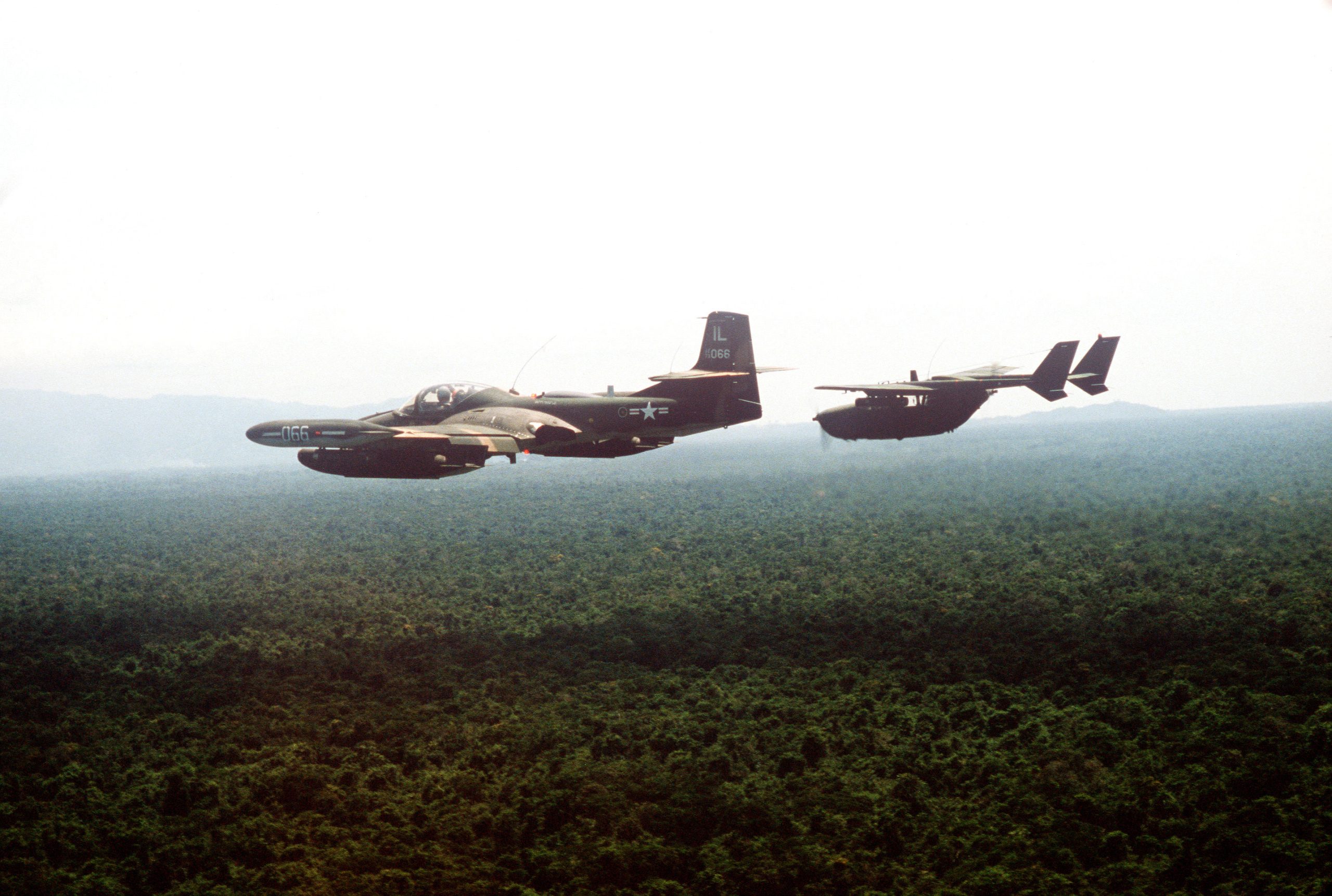
Cessna A-37 Dragonfly
“Super Tweet”
A jet trainer turned killer — the little twin-engined attacker that grew out of the T-37 “Tweet,” proved itself over Vietnam, and became Latin America’s favourite counter-insurgency aircraft for half a century.
The trainer that went to war
Most combat aircraft are designed to kill from the first sketch. The Cessna A-37 Dragonfly was not. It began life as the T-37 “Tweet,” the friendly side-by-side jet on which generations of US Air Force pilots learned to fly — a docile little trainer whose high-pitched engine whine gave it its name. When the counter-insurgency wars of the early 1960s created a sudden demand for a cheap, simple aircraft that could loiter over the jungle and hit small targets, the Air Force looked at the aeroplane it already had by the hundred and asked a blunt question: could the Tweet be taught to fight?
The answer, tested from 1963–64 with two rebuilt airframes designated YAT-37D, was yes — emphatically. Cessna roughly doubled the engine thrust, strengthened the wing, added six then eight underwing hardpoints, a nose-mounted 7.62 mm minigun, wingtip fuel tanks and armour, and turned a 3,000-kg trainer into a 6,000-kg attacker. Pilots called the result the “Super Tweet.” It kept the T-37’s honest handling and its two crew seats, but now it could carry a serious load of bombs, rockets and napalm and put them on target with unusual precision.
In August 1967 the Air Force sent 25 of them to Vietnam under the evaluation programme “Combat Dragon,” flying from Bien Hoa. The verdict was decisive: the Dragonfly was accurate, rugged, staggeringly reliable and cheap to keep flying — roughly two maintenance man-hours per flight hour, a fraction of what heavier jets demanded. Over the war the type flew more than 160,000 combat sorties. Hundreds went to the South Vietnamese Air Force (VNAF), which flew the A-37 to the very end — and when Saigon fell in 1975, dozens of captured Dragonflies were promptly turned around and flown by the victorious North.
That toughness and thrift made the A-37 an export success across the developing world. Chile, Peru, Ecuador, Colombia, El Salvador, Guatemala, Honduras, the Dominican Republic, Uruguay and South Korea all bought it, and it fought in a string of Latin American conflicts — the long Salvadoran Civil War and the brief, sharp 1995 Cenepa War between Peru and Ecuador among them. Small, honest and hard to kill, the little jet outlasted many far more glamorous machines: a handful were still flying combat patrols into the 2020s, more than half a century after the trainer it was built from first took to the air.
01The A-37 Dragonfly’s origins: how the T-37 “Tweet” trainer became the “Super Tweet”
The T-37 first flew in 1954 as a basic jet trainer — forgiving, side-by-side and, thanks to its shrill turbojets, universally nicknamed the “Tweet.” In 1962–63 the USAF formally evaluated whether it could do counter-insurgency work, and awarded Cessna a contract for two prototype YAT-37D conversions. The changes were dramatic: General Electric J85 turbojets in place of the trainer’s little Continental engines roughly doubled the power; the structure was beefed up; hardpoints, a minigun, armour and wingtip tanks were added. The production A-37A followed in 1967 and the definitive, more powerful A-37B from 1968. Crews inevitably christened the muscled-up attacker the “Super Tweet” — a rare case of a frontline warplane that pilots had first soloed on as students.
What makes it special
A trainer rebuilt as an attacker
The Dragonfly kept the T-37’s honest, easy-to-fly airframe and its two side-by-side seats, but almost everything else was strengthened or added. Cessna reinforced the wing for hardpoints and hard manoeuvring, fitted armoured ejection seats, nylon flak curtains and self-sealing fuel tanks, and gave the A-37B a nose refuelling probe. The result flew like the trainer thousands of pilots already knew — but could take hits and keep fighting.
Two little J85s — and a big punch
Power came from two General Electric J85 turbojets — about 12.7 kN (2,850 lbf) each in the A-37B, roughly double the trainer’s thrust. That gave the small jet real climb and a useful load: a 7.62 mm GAU-2 minigun in the nose plus eight underwing hardpoints for bombs, rockets, napalm and gun pods — up to around 2,300–2,600 kg of ordnance. Wingtip tanks stretched its endurance over the target.
Cheap, rugged, easy to keep flying
The A-37’s greatest weapon was its simplicity. It needed only about two maintenance man-hours per flight hour — a fraction of a fast jet’s appetite — could operate from short, rough strips, and was cheap to buy and run. That is exactly why it was exported so widely and why some air forces flew it for fifty years: for small budgets fighting small wars, nothing offered more attack capability per dollar.
02The A-37 Dragonfly’s firepower: the minigun, eight hardpoints and tip tanks
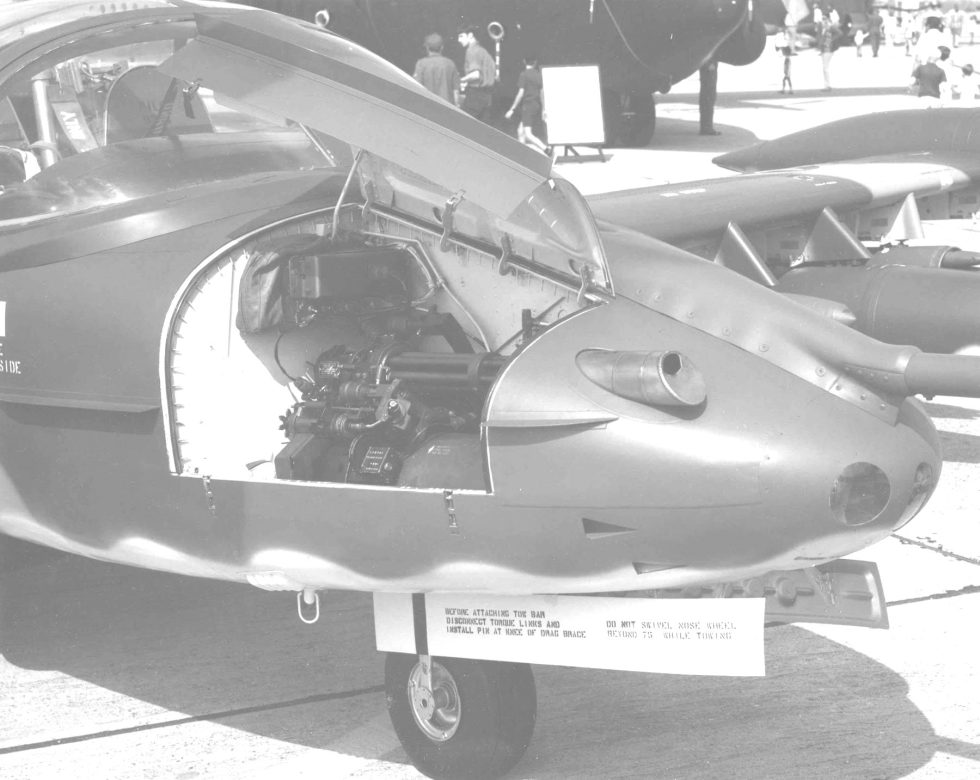
For its size the Dragonfly was heavily armed. Built into the forward fuselage was a GAU-2B/A 7.62 mm minigun, a six-barrel Gatling gun typically fed around 1,500 rounds and able to saturate a target with fire. Under the wings, eight hardpoints carried a flexible mix of iron bombs, cluster munitions, rocket pods, napalm and gun pods, with a maximum external load commonly cited at roughly 2,300–2,600 kg. Permanent wingtip fuel tanks extended loiter time over the battlefield — important for close air support, where staying overhead to protect troops mattered as much as raw speed. In USAF service the type reportedly achieved an average bombing accuracy of about 45 feet, praised by the forward air controllers who directed it.
03The A-37 Dragonfly’s survivability: armour, self-sealing tanks and redundant controls
Because it worked low and slow over hostile ground, the A-37 was designed to absorb punishment. The B model added foam-filled, self-sealing fuel tanks, armoured ejection seats, nylon flak curtains lining the cockpit, and elevator control runs deliberately routed far apart so a single hit was less likely to sever both. During the 1967 Combat Dragon evaluation, the 25 deployed Dragonflies flew thousands of sorties and, by the most-repeated accounts, lost none to enemy fire — only two were written off in landing accidents. Over the whole war a relatively small number of USAF A-37s were lost to combat given the enormous sortie count, a record that reinforced its reputation for toughness.
Full specifications
Baseline note: the figures below describe the A-37B — 577 of the 618 Dragonflies built, the mark that equipped the South Vietnamese air force, the United States Air National Guard and every export customer. Deltas for the two YAT-37D prototypes and for the 39 rebuilt A-37As are in grey. Four figures need settling before the tables begin. First, production: 577 is the A-37B run alone, and the type total is 618 once the 39 A-37A conversions and the two prototypes are added, so the widely quoted 577 undercounts the aeroplane by a sixth. Second, thrust: the T-37B’s Continental J69-T-25 gave 1,025 lbf a side and the A-37B’s General Electric J85-GE-17A gives 2,850 lbf, which is 2.78 times the installed thrust, not the "roughly double" that most accounts repeat. Third, the load factor, which reads backwards unless the weights are read with it: the A-37B is stressed for 6 g and the A-37A for 5 g, and a trainer limit set for a 2,982 kg aeroplane sounds higher, but 6 g at 6,350 kg is close to twice the absolute airframe load a T-37 structure was ever asked to carry — which is why the spar, the frames, the undercarriage and the skins were all rebuilt and why the two aeroplanes share almost no parts. Fourth, range: 740 km appears in most tables as "combat range with maximum payload" and roughly 630 km appears elsewhere as the same thing, and both are ranges rather than radii. The Dragonfly was short-legged, everyone knew it, and the A-37B grew a refuelling probe because of it.
Dimensions & weights
- Crew
- 2 — side by side under one canopy, on ejection seats, exactly as in the trainer. The United States Air Force flew it two-up with a second pilot working the radios and watching for ground fire; the South Vietnamese air force and most Latin American operators habitually flew it single-pilot and used the right seat for weight they would rather spend on ordnance
- Length
- 8.62 m (28 ft 3¼ in). Published tables give the T-37B as 8.92 m (29 ft 3 in), so the attack aeroplane measures shorter than the trainer it came from. That is a datum difference — where the nose probe is counted — rather than a shortened fuselage
- Wingspan
- 10.94 m (35 ft 10½ in) over the permanent wingtip tanks; the T-37B spans 10.30 m (33 ft 9 in) without them. The tanks are structure, not stores, and they cannot be jettisoned
- Height
- 2.71 m (8 ft 10½ in) — low enough that the ground crew loaded the wing pylons standing up, which is a larger part of the type’s sortie rate than any performance figure in these tables
- Wing area
- 17.08 m² (183.9 sq ft), aspect ratio 6.2. A straight, thick, unswept trainer wing, kept because it was docile at the speeds close air support is actually flown at
- Empty weight
- 2,817 kg (6,211 lb) — already 53 per cent heavier than a T-37B’s 1,840 kg (4,056 lb) before a single bomb is hung
- Max take-off weight
- 6,350 kg (14,000 lb); A-37A 5,443 kg (12,000 lb); T-37B 2,982 kg (6,574 lb). The Dragonfly takes off at more than twice the weight of the trainer whose shape it wears
- Maximum external stores
- ~2,600 kg (5,800 lb) is the figure most often printed; other tables give 2,200 kg (4,855 lb) and 2,177 kg (4,800 lb). The disagreement is real and comes from whether drop tanks and the eight-station structural limit are counted in
- Hardpoint ratings
- Four inner at 390 kg (860 lb), two intermediate at 272 kg (600 lb), two outer at 227 kg (500 lb) — 2,558 kg (5,640 lb) if every station is filled to its limit, which flight-manual fuel and centre-of-gravity rules rarely allowed
- Internal fuel
- 1,920 L (507 US gal) usable, including the two wingtip tanks at roughly 360 L (95 US gal) each. Up to four 380 L (100 US gal) drop tanks could be hung on the wing pylons, at the cost of ordnance stations
- Wing loading
- 372 kg/m² (76 lb/sq ft) at maximum take-off weight — heavy for a straight wing, and the reason a fully loaded Dragonfly in hot, high air was a sluggish, deliberate machine that had to be flown rather than pointed
- Load factor and fatigue life
- +6 g for the A-37B, +5 g for the A-37A. Airframe life was designed at 4,000 hours and was extended in service to 7,000 hours — the single most valuable number in the whole programme, because it is why 1960s airframes were still flying armed sorties in Central America half a century later
Performance
- Maximum speed
- 816 km/h (507 mph, 441 kn) at 4,875 m (16,000 ft), clean. Subsonic, straight-winged and slower than anything it might meet in the air, which never mattered in the war it was built for and mattered enormously in one it was not
- Never-exceed speed
- 843 km/h (524 mph, 455 kn) — a trainer wing sets the limit, and pull-outs from steep deliveries were flown against it rather than against engine power
- Maximum cruise
- 787 km/h (489 mph, 425 kn) at 7,620 m (25,000 ft). In practice the Dragonfly cruised much slower and much lower, because its work was finding people in jungle from a few thousand feet
- Stall speed
- 182 km/h (113 mph, 98 kn) — the number that made the type useful. A Dragonfly could hold a turn over a contact at a speed no fast jet could match and still see what it was shooting at
- Rate of climb
- 35.5 m/s (6,990 ft/min) at sea level, clean. Loaded with eight stations of ordnance in tropical air it was a fraction of that, and crews planned accordingly
- Service ceiling
- 12,730 m (41,765 ft) — a clean-aeroplane number of no operational meaning whatever. The A-37 worked between 300 m and 3,000 m and was never flown over North Vietnam, where the altitudes and the missiles were
- Range with maximum payload
- 740 km (460 miles, 400 nmi); some sources give about 630 km (390 miles) for the same condition. Both are ranges, not radii, and neither is generous
- Ferry range
- 1,629 km (1,012 miles, 879 nmi) with drop tanks — enough to self-deploy between Latin American bases, which is how most of the export fleet arrived
- Endurance
- Roughly 2 hours on internal fuel at loiter power; pilots were authorised to shut one engine down and cruise on the other to stretch time on station, an option a single-engine attack aeroplane does not have
- Delivery accuracy
- ~14 m (45 ft) average miss distance in South East Asia with unguided bombs and a fixed optical sight. That figure — achieved with no radar, no laser and no computing sight — is why ground commanders asked for Dragonflies within a hundred metres of their own positions
- Sortie tempo
- Turnaround just over 90 minutes between missions during the Combat Dragon evaluation, serviceability above 85 per cent, and about two maintenance man-hours per flight hour — roughly a sixth of what an F-101 Voodoo demanded. The daily sortie rate at Bien Hoa went from 12 to 60 within three weeks
Propulsion & systems
- Engines
- 2 × General Electric J85-GE-17A turbojets, 12.7 kN (2,850 lbf) each, non-afterburning
- What it replaced
- The T-37B’s two Continental J69-T-25 — licence-built Turbomeca Marborés — gave 4.56 kN (1,025 lbf) each. The A-37A’s J85-GE-5 gave 10.7 kN (2,400 lbf). Installed thrust therefore rose by a factor of 2.34 with the A-37A and 2.78 with the A-37B, and the airframe had to be redesigned around it
- Thrust-to-weight
- 0.41 at maximum take-off weight, rising past 0.6 as fuel and ordnance burned away. Modest by fighter standards, generous for a counter-insurgency aeroplane, and the reason it could get out of short, hot strips with a useful load
- Engine installation
- Canted slightly outward and downward in the wing roots — a deliberate choice that reduces the yawing moment if one engine fails and lets a pilot fly the aeroplane home on the other without heroics. Two engines on a light attack aircraft was the type’s quiet survivability advantage
- Fuel system
- Foam-filled self-sealing tanks on the A-37B — reticulated foam in the cells to suppress fire and explosion after a hit. The A-37A had neither, which is one of the two reasons the Combat Dragon aircraft were regarded as an evaluation fleet rather than a war fleet
- In-flight refuelling
- Probe-and-drogue probe on the nose of the A-37B , with the plumbing run visibly around the lower lip of the canopy. It doubled the aeroplane’s useful reach on paper. In practice the South Vietnamese air force was never equipped or trained to use it, so its 254 aircraft stayed tied to their airfields
- Flight controls
- Fully manual, cable and pushrod, no hydraulic boost — and at attack speeds heavy enough that Combat Dragon pilots listed control forces as a genuine complaint. The A-37B answered the other half of that complaint by splitting the elevator control runs and routing them as far apart in the fuselage as possible, so one burst could not sever both
- Crew protection
- Armoured ejection seats and nylon flak curtains lining the cockpit on the A-37B. Uruguay refitted its survivors with Martin-Baker Mk 8LD seats in 2018, forty-two years after delivery
- Avionics and sighting
- Deliberately simple — VHF, UHF and an FM set for talking directly to troops on the ground, navigation aids, a gun camera and a fixed optical sight. No radar, no inertial platform, no bombing computer, no radar warning receiver as built. The 14 m accuracy came from a stable aeroplane, a repeatable dive angle and pilots who flew the same valleys every day
- Landing gear and basing
- Strengthened wide-track tricycle gear with low-pressure tyres , taken well beyond trainer standards for operations from short, rough, forward strips. Ground servicing needed no special equipment, and the aeroplane could be rearmed and refuelled by a small team with hand tools
04The A-37 Dragonfly’s operating costs: why it was famously cheap to fly
The A-37 was prized above all for its economy, but precise dollar figures are hard to pin down. It was one of the cheaper combat jets of its generation — period accounts put the flyaway price in the low six figures in 1960s US dollars, though that should be read as an order-of-magnitude estimate rather than a sourced number. No reliable public cost-per-flight-hour figure exists for the type. What is well documented is the metric that mattered to the air forces that bought it: about two maintenance man-hours per flight hour, perhaps a sixth of what a contemporary fast jet demanded. Combined with its ability to fly from short, austere strips, that low running cost — not speed or sophistication — is the real reason the Dragonfly stayed in service for half a century.
Armament & payload
The Dragonfly hung more ordnance under its wings than a T-37 weighed empty, and aimed all of it by eye
One 7.62 mm minigun in the nose, eight wing stations and something between 2,200 and 2,600 kg of stores turned a two-seat jet trainer into an attack aeroplane that could put unguided bombs within about 14 m of an aim point. There was no radar, no laser, no computing sight and, for the whole of the type’s American and South Vietnamese career, no guided weapon of any kind — the accuracy came from an airframe that was slow, steady and unhurried in a dive, and from crews who flew the same ground day after day. The trade was equally plain: rifle-calibre guns that could not touch armour, a payload that had to be bought back with fuel, and no ability to work above the light anti-aircraft belt. Fits varied hugely by operator. The A-37A had neither armour nor self-sealing tanks; South Vietnamese aircraft flew without the refuelling probe being usable; Colombia was the only air force ever to drop a laser-guided bomb from a Dragonfly; and a good deal of the published stores list below is a clearance rather than something a squadron routinely loaded.
Gun
- One General Electric GAU-2B/A 7.62 mm minigun in the nose, offset to port, six rotating barrels, 1,500 rounds. At its 3,000 rounds per minute that is thirty seconds of continuous fire, and nobody fired it continuously
- Rifle calibre, and the honest verdict on rifle calibre is the one every operator reached independently: devastating against people in the open or in light cover, useless against a bunker, a vehicle or anything with plate on it. The A-1 Skyraider it partly replaced carried four 20 mm cannon
- SUU-11/A pods on the wing stations, each holding another 7.62 mm minigun, for operators who wanted volume of fire rather than weight of shell
- Heavier gun pods appear in clearance tables and in export service: the GPU-2/A with a three-barrel 20 mm and a 30 mm French-pattern pod. Neither was standard, and neither was common
- Aiming was a fixed depressible reflector sight and a gun camera. There was no lead computation and no ranging of any kind — the pilot flew the dive angle he had been taught and pulled at the height he had been taught
Air-to-air
- The AIM-9 Sidewinder appears in published clearance lists for the type. No operational A-37 squadron is recorded as having flown an air-to-air alert with one, and no Dragonfly has ever fired a guided missile in anger
- The A-37’s one confirmed aerial victory was scored with the nose minigun and was a catastrophe. On 20 April 2001 a Peruvian A-37B, cued by a CIA-contracted surveillance aircraft, shot down a Cessna 185 floatplane over the Amazon that was carrying American missionaries; Veronica Bowers and her seven-month-old daughter were killed. The programme was suspended and the episode remains the type’s most consequential engagement
- In the other direction the record is what you would expect from a 816 km/h straight-wing aeroplane with no radar. On 10 February 1995, during the Cenepa War, a Peruvian A-37B was shot down by an Ecuadorian IAI Kfir C.2 — the only known loss of a Dragonfly to a fighter
- Ecuador had 28 A-37Bs of its own in that same war, which makes Cenepa the only conflict in which both belligerents operated the type
- Chile is reported to have held armed T-37s and A-37s at readiness during the 1978 Beagle Channel crisis with Argentina. That says a great deal about the inventory available to the Chilean air force in 1978 and very little about the aeroplane
Air-to-surface guided
- None. Through Combat Dragon, the whole of the American war, the entire South Vietnamese career and the Vietnamese People’s Air Force campaigns in Cambodia, the A-37 carried nothing guided whatever
- That is the central fact about the type’s weapons fit and it should not be softened. Every result the Dragonfly produced in South East Asia was produced with iron bombs, napalm, cluster dispensers and a fixed sight
- The one exception is Colombia. Fuerza Aérea Colombiana A-37Bs were modified to carry the GBU-12 Paveway II laser-guided bomb and used them against guerrilla camps in the 2000s — making Colombia the only air force ever to drop a precision-guided weapon from a Dragonfly
- Even there the Dragonfly was half the system. It has no laser designator of its own, so the spot had to be provided by another aircraft or from the ground
- No anti-radiation missile, no anti-tank missile, no stand-off weapon of any sort was ever integrated. The aeroplane had to fly over the target, every time, at a height where a machine gun could reach it
Bombs
- Mk 81 250 lb (113 kg) and Mk 82 500 lb (227 kg) low-drag general-purpose bombs, and the M117 750 lb (340 kg). Four to six Mk 81s or four Mk 82s was the everyday South East Asian load
- BLU-1C/B and BLU-32B fire bombs. Napalm was used heavily by the United States Air Force, by the South Vietnamese air force and later by several Central American operators, and it is the part of this aeroplane’s record that ages worst
- CBU-12, CBU-22 and CBU-24 cluster dispensers, and the SUU-14 bomb dispenser for small submunitions — area weapons for troops in the open and for truck parks along the trails
- Three A-37Bs flown by defected South Vietnamese pilots dropped six Mk 81s on Tan Son Nhut air base on the evening of 28 April 1975. The damage was modest; the effect was not, since the strike helped end fixed-wing evacuation from Saigon and forced the shift to helicopters
- Colombia’s GBU-12 fit aside, no Dragonfly ever carried a retarded, laser-guided or satellite-guided bomb in the American or Asian fleets
Rockets
- 2.75 in (70 mm) folding-fin aerial rockets in LAU-3/A nineteen-tube pods, and in seven-tube pods on some fits; up to four pods, usually two so that bombs could be carried as well
- High-explosive heads for area attack, and white phosphorus marking heads — the working ammunition of the OA-37B when the type was reassigned to forward air control with the Air National Guard and Air Force Reserve in the 1980s
- Rockets were the cheap answer for a target that did not justify a bomb: a treeline, a sampan, a mortar position. A nineteen-tube pod salvo from a Dragonfly covered a great deal of ground for very little money
- The heavy 5 in Zuni carried by the Navy’s OV-10 Broncos was not a standard A-37 store, and the aeroplane’s outboard stations were rated too light for a comfortable four-round Zuni pod
- As with the gun, there was no ranging and no computing. Rocket accuracy was a function of dive angle discipline, and the Dragonfly’s low speed made that discipline easier to hold than in a fast jet
Pods & other stores
- Up to four 380 L (100 US gal) drop tanks on the wing pylons. Every tank hung was a station not carrying ordnance, and the whole of the Dragonfly’s tactical planning is contained in that sentence
- SUU-11/A minigun pods and SUU-14 dispensers, plus a gun camera as standard fit — the type’s only sensor worth the name
- Flare dispensers and parachute flares for the night interdiction sorties flown during Combat Dragon, when a two-aeroplane element would work a road by the light one of them dropped
- What was never carried is as revealing as what was: no electronic countermeasures pod, no radar warning receiver as built, no targeting pod, no reconnaissance pod, no external sensor turret in any fleet. The A-37 was cheap because it was empty
- The permanent wingtip tanks are not stores and cannot be jettisoned. They are the reason the aeroplane spans 64 cm more than a T-37 and the reason its roll rate is more sedate than the trainer’s
Three typical loadouts
- Combat Dragon close air support, 604th Air Commando Squadron, Bien Hoa, 1967
- GAU-2B/A with 1,500 rounds; four Mk 81 250 lb bombs on the inner stations; two LAU-3/A nineteen-tube pods of 2.75 in high explosive; two 380 L drop tanks outboard. Scramble to weapons release inside twenty minutes because the target was usually within eighty kilometres of the field. This is the load that produced the evaluation’s headline numbers: more than 4,000 sorties in four months, not one aircraft lost to enemy fire, and two written off in landing accidents.
- South Vietnamese air force battlefield interdiction, 1972–75
- Four Mk 82 500 lb bombs or a mixed load of two Mk 82 and two BLU-1C/B fire bombs; full minigun; no drop tanks. Flown from Bien Hoa, Da Nang, Pleiku, Binh Thuy and Phan Rang against targets close enough that fuel was not the constraint — which was just as well, since the refuelling probe on those 254 aircraft was never usable for want of tankers and training. Nine A-37 squadrons at peak strength, and roughly 187 airframes still on charge when Saigon fell.
- Colombian precision strike against a guerrilla camp, 2000s
- Two GBU-12 Paveway II 500 lb laser-guided bombs on the inner stations, minigun loaded, drop tanks outboard, the laser spot supplied by a second aircraft. Sixteen Dragonflies gave the Fuerza Aérea Colombiana a night-capable precision strike option at a fraction of the cost of its Kfirs, and kept doing so until the type was retired at the end of 2023 in favour of the T-6C Texan II. It is the only guided-weapon loadout in the aeroplane’s sixty-year history.
Sourcing caveat: the stores list above is assembled from United States Air Force clearance tables and secondary references, and reflects certification rather than habitual practice. The AIM-9 entry in particular is a paper clearance with no recorded operational use. Maximum external load is variously published as 4,800 lb, 4,855 lb and 5,800 lb; the differences turn on whether drop tanks and the sum of the eight station limits are included. Minigun ammunition is given as 1,500 rounds in almost all sources, and rate of fire as 3,000 rounds per minute, although the GAU-2B/A family was built in both 3,000 and 6,000 rounds per minute settings and a few tables quote the higher figure.
Variants
Cessna built 618 Dragonflies in three marks, and almost every later modification was made by somebody else
The factory list is short to the point of bluntness: two converted prototypes, 39 rebuilt trainers and 577 new-build A-37Bs between 1967 and 1977. There was no night model, no two-seat conversion trainer, no radar version, no stretched version. Cessna froze the design in 1967 and built the same aeroplane for a decade.
Everything interesting in the variant list therefore happened after delivery, and mostly outside the United States. The Air National Guard turned surplus attack aircraft into forward air control aircraft by changing the ordnance and the paperwork. Chile went the other way and armed its own T-37s into something close to an A-37 during a war scare. Vietnam flew captured aircraft against a former ally and shipped examples to Moscow, Warsaw, Prague and East Berlin for inspection. Colombia integrated a laser-guided bomb four decades after the aeroplane was designed, and Uruguay fitted new British ejection seats to airframes delivered in 1976. A design frozen this early stayed useful this long precisely because it was simple enough for other people to modify.
- YAT-37D, redesignated YA-37A (1963–65 / 2)
- Two T-37Cs rebuilt to Cessna Model 318 standard on a 1963 contract after the Special Air Warfare Center at Eglin judged the trainer promising as a counter-insurgency machine. J85-GE-5 engines, strengthened wing, wingtip tanks, tougher undercarriage, a GAU-2B/A in the nose and three pylons a side. First flight October 1964; the second aircraft followed a year later with four pylons a side. The first prototype, 62-5951, survives at the National Museum of the United States Air Force.
- A-37A, Cessna Model 318D (1966–67 / 39)
- Thirty-nine T-37B airframes rebuilt to the evaluation standard: two J85-GE-5 at 2,400 lbf, nose minigun, eight wing stations, tip tanks, 5 g airframe. No armour, no self-sealing tanks, no refuelling probe. Deliveries from May 1967. These were the Combat Dragon aircraft and they were explicitly an experiment rather than a war-fighting fleet.
- A-37B, Cessna Model 318E (1967–77 / 577)
- The definitive aeroplane, ordered in early 1967 as 57 aircraft and increased almost at once to 127. J85-GE-17A at 2,850 lbf, 6 g airframe, 4,000-hour design life later stretched to 7,000, foam-filled self-sealing tanks, armoured seats, nylon flak curtains, duplicated and widely separated elevator control runs, and a nose refuelling probe with the pipework wrapped round the canopy lip. Roll-out September 1967. Unit cost was about a quarter of an F-4 Phantom II.
- OA-37B (1981–92 / conversions from A-37B)
- Not a rebuild but a change of role. As the A-37B passed from Tactical Air Command to Air National Guard and Air Force Reserve units it was redesignated for forward air control: marking rockets, radios and a pair of eyes rather than a bomb load. OA-37Bs of the 24th Composite Wing flew in Operation Just Cause over Panama in December 1989. The mission then passed to the A-10, and the United States Air Force retired its last Dragonflies in 1992.
- B.J.6 (1970s–80s / 18)
- Royal Thai Air Force designation for the A-37B: sixteen received in the 1970s and two more in the 1980s, flown on border operations against communist insurgents. One of the aircraft now displayed in Thailand is a South Vietnamese airframe flown out during the collapse of April 1975 and never returned.
- Chilean armed T-37 (late 1970s / local conversions)
- The only case of the conversion being run in reverse by an operator. With the Beagle Channel dispute with Argentina close to war, the Fuerza Aérea de Chile armed its own T-37 trainers into a fit close to A-37 standard, alongside the 44 genuine A-37Bs it had received between 1975 and 1977. Chile retired the type in November 2009, flew the last two aircraft back to Santiago-El Bosque on 27 May 2010, and sold ten of the survivors to El Salvador in 2013.
- Vietnamese People’s Air Force A-37B (1975–early 1980s / ~95)
- Around 95 captured airframes, including 33 taken intact at Da Nang in late March 1975, were absorbed into the air force that had spent a decade being bombed by them. Former South Vietnamese A-37s flew most of the ground attack sorties of Vietnam’s 1978–79 invasion of Cambodia against the Khmer Rouge, and served during the 1979 border war with China. Spares ran out and they were withdrawn in the late 1970s and early 1980s. Examples were shipped to the Soviet Union, Czechoslovakia, Poland and East Germany for evaluation; the Kraków aircraft was a Vietnamese gift in 1978.
- Colombian A-37B with Paveway capability (2000s–2023 / up to 16)
- Sixteen aircraft, modified locally to carry the GBU-12 Paveway II. Used in the counter-guerrilla and counter-narcotics campaign for two decades, retired at the end of 2023 and replaced by the T-6C Texan II — a turboprop trainer, which is a fair measure of how the light attack requirement has shrunk.
- Uruguayan A-37B and OA-37B (1976–2026 / 16 plus 3 ex-Ecuadorian)
- Eight A-37Bs delivered new in October 1976 and ferried home from McConnell Air Force Base by Uruguayan crews; two A-37B and six OA-37B followed in 1988–89 to replace accident losses; three more came from Ecuador in 2014. Sixteen Martin-Baker Mk 8LD ejection seats were fitted in 2018. Squadron No. 2 retired the last of them on 13 May 2026 after almost fifty years, handing over to the Embraer A-29 Super Tucano.
- Salvadoran A-37B (1982–present / ~30 supplied, 10 more bought 2013)
- Supplied as American military aid from 1982 after guerrillas destroyed much of the Salvadoran air force on the ground at Ilopango; 21 A-37B and 9 OA-37B arrived during the civil war, of which nine were still serviceable at the 1992 peace accords. One was lost on 18 November 1989 when sniper fire killed the co-pilot, and another to an SA-7 missile on 23 November 1990. Ten ex-Chilean aircraft were bought in 2013 for roughly eight million dollars, and three original airframes were refurbished with American help.
Closing caveat on survivors: preserved originals are numerous and easy to confuse with airworthy warbirds. Genuine A-37 airframes on public display include the first prototype 62-5951 at the National Museum of the United States Air Force, A-37A 67-14525 at the Museum of Aviation in Georgia, A-37Bs at the March Field Air Museum and at Hurlburt Field, a Vietnamese-donated A-37B at the Polish Aviation Museum in Kraków, aircraft at the Vietnam People’s Air Force Museum in Hanoi and the War Remnants Museum in Ho Chi Minh City, one at the Royal Thai Air Force Museum and a former South Vietnamese airframe on a pedestal at Takhli, one in the Museo Nacional Aeronáutico y del Espacio in Santiago, and A-37B 69-6429 in Uruguay. Two A-37Bs are airworthy in Australia, one of them transferred to the Royal Australian Air Force in July 2019, and two more are held at Mount Maunganui in New Zealand. There are no A-37 reproductions and no replicas — every aeroplane wearing the marks is an original Cessna airframe, which is unusual for a type this old and follows directly from the 7,000-hour fatigue life.
Operators today
El Salvador is now effectively the last air force flying the Dragonfly as a front-line attack aeroplane
The A-37 spent fifty years as Latin America’s standard light attack jet and has left that role almost entirely within the last five. Chile retired the type in 2009 and flew its last two aircraft home in May 2010; Ecuador retired in 2009 in favour of the Super Tucano; Peru withdrew its Grupo Aéreo 7 fleet in 2023, including eight airframes South Korea had donated only in 2010; Colombia retired at the end of 2023 and replaced a jet with a turboprop trainer; and the Uruguayan air force flew its final Dragonfly sortie on 13 May 2026, closing a service career that began in October 1976. The United States retired its own in 1992, South Korea in 2007 and the Dominican Republic in 2001.
What is left is a very short list. The Fuerza Aérea Salvadoreña keeps the largest operational fleet of the type anywhere, a mix of three refurbished original airframes and ten bought from Chile in 2013, flown mainly on drug-interdiction and deterrence patrols while the government decides between a Super Tucano and a jet successor. Guatemala keeps a handful nominally serviceable as its only combat jets. Honduras is the reason this chart is shorter than the reference books suggest: eighteen A-37Bs remain on its books, and as of April 2024 all eighteen sat unflyable in store at Base Armando Escalón Espinal in San Pedro Sula, so they are omitted here rather than drawn as a bar.
These are estimates. Many airframes counted on paper are stored, in deep overhaul, or not operational — Honduras’s eighteen grounded aircraft are the clearest case and are excluded above for that reason. Sources: IISS The Military Balance and FlightGlobal World Air Forces, cross-checked against Salvadoran, Uruguayan and Peruvian service reporting; entries that could not be corroborated are omitted. No air force outside Latin America has flown an A-37 since the 2000s.
From primary trainer to fifty-year warplane
The Tweet flies
The Cessna T-37 basic jet trainer makes its first flight — the docile aircraft that will later be rebuilt into the Dragonfly.
YAT-37D
The USAF has two T-37s converted into armed prototypes with J85 engines to test the trainer as a counter-insurgency attacker.
Combat Dragon
Twenty-five A-37As deploy to Bien Hoa, Vietnam, for combat evaluation — flying close air support, escort, FAC and night attack.
A-37B in service
The more powerful, air-refuellable A-37B enters production; deliveries to the South Vietnamese Air Force begin.
Saigon falls
Dozens of A-37s are captured; on 28 April 1975 several are used to bomb Tan Son Nhut, then flown on by unified Vietnam.
Latin America’s workhorse
A-37s fight across the region, notably in the long Salvadoran Civil War, valued for cheap, precise close air support.
The Cenepa War
In the brief Peru–Ecuador border war, a Peruvian A-37 is shot down by an Ecuadorian Kfir — the type in high-intensity combat.
Still on patrol
A handful of operators — among them El Salvador, Peru and Guatemala — keep the Dragonfly flying more than 50 years on.
From the cockpit: twelve Dragonfly stories
The trainer they sent to war
The A-37 grew out of the T-37, the jet USAF students soloed on — hence “Super Tweet.”
Read the full story
25 jets, no losses to flak
In its Vietnam combat trial the Dragonfly flew thousands of sorties and, by most accounts, lost none to enemy fire.
Read the full story
“Somebody who can hit the target”
Forward air controllers loved the A-37’s precision, reportedly achieving an average accuracy of about 45 feet.
Read the full story
The VNAF’s favourite attacker
Hundreds of A-37s went to the South Vietnamese Air Force, which flew them intensively to the very end.
Read the full story
Captured — and turned around
On 28 April 1975 captured A-37s bombed Tan Son Nhut; unified Vietnam then flew the type for years.
Read the full story
Backbone of a civil war
A-37s flew relentless close air support through the long Salvadoran Civil War of the 1980s.
Read the full story
Shot down over the Cenepa
In the brief Peru–Ecuador border war a Peruvian A-37 was downed by an Ecuadorian Kfir.
Read the full story
Andes attacker
Chile armed T-37s and bought A-37s during the tense 1970s, flying them for decades over the Andes.
Read the full story
From attacker to airshow star
South Korea flew the A-37 from 1976, and its Black Eagles aerobatic team performed on the type for years.
Read the full story
Two hours of spanners
The A-37 needed only about two maintenance man-hours per flight hour — a fraction of a fast jet’s.
Read the full story
The probe on the nose
Unusually for a USAF jet, the A-37B refuelled by probe-and-drogue, with pipes wrapped over the canopy.
Read the full story
Fifty years on patrol
A handful of A-37s were still flying combat patrols in the 2020s, outlasting far more glamorous jets.
Read the full story
The Dragonfly in pictures
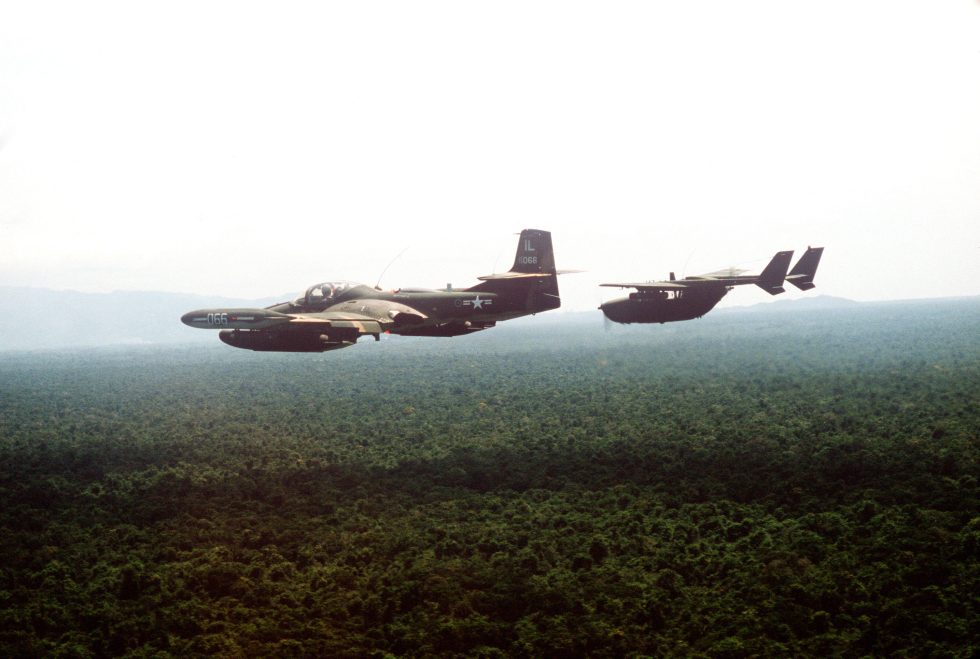
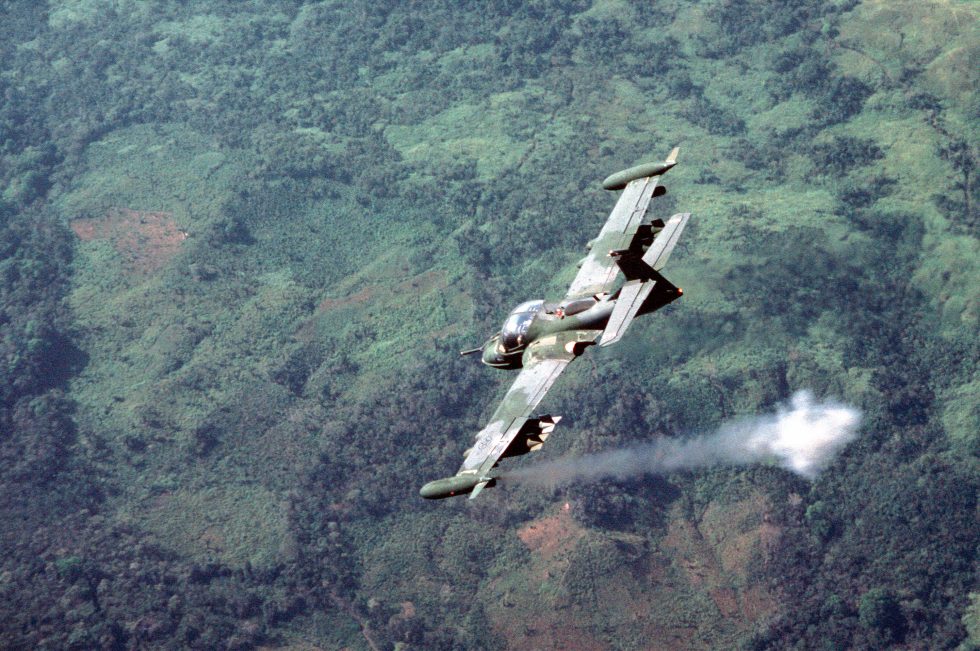
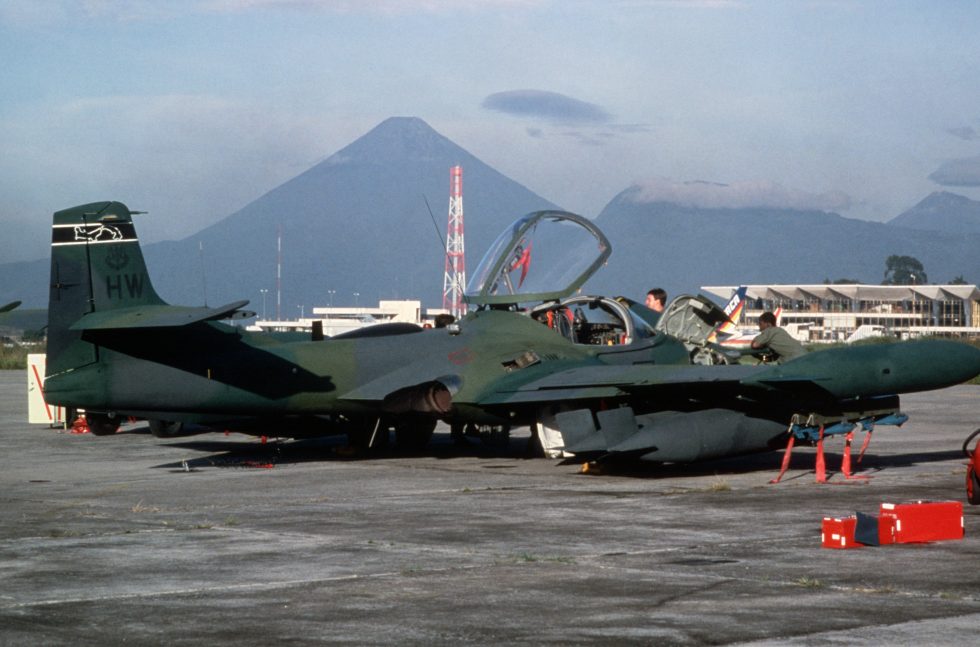
The Dragonfly in motion
A verified, high-authority video feature for the A-37 Dragonfly is coming soon — we only embed footage from established, credible channels, and we are still sourcing the right one for the Super Tweet. In the meantime, explore the gallery and stories above.
Where the Dragonfly flew
The score that defines it
The Dragonfly’s record is written not in air-to-air kills but in sheer effort — hundreds of thousands of close air support sorties flown cheaply and accurately across four decades of small wars. Its greatest strength was economy and precision; its exposed moment came in 1995, when a slow attacker met a supersonic fighter.
Compare the combat record of every military aircraft. Figures as of August 2026.
Everything people ask about the A-37 Dragonfly
Can I fly in an A-37 Dragonfly?
Why is the A-37 called the “Super Tweet”?
How is the A-37 different from the T-37 trainer?
What was Operation Combat Dragon?
How many A-37s were built?
Did the A-37 see air-to-air combat?
Is the A-37 Dragonfly still in service?
What replaced the A-37 in US service?
You can’t fly the Dragonfly.
These, you can.
Some legends only live in museums — others are fuelled and waiting. MiGFlug has put civilians in real military jet cockpits since 2004.
 Fly the L-39 AlbatrosThe world’s most-flown jet trainer — aerobatics included
 Fly the F-104 Starfighter“The missile with a man in it”
 Fly the MiG-21The Cold War’s most-produced jet
 Fly the T-33 Shooting StarAmerica’s first jet trainer
 Fly the DH VampireA piece of early jet history
 Fly the S.211Agile Italian jet trainer
 Fly the MB-326The classic Aermacchi jet
 Fly the MiG-15The Soviet legend of the Korean War
Continue the tour
Every fact, checked
- National Museum of the US Air ForceA-37 / OA-37B fact sheets: Combat Dragon, sortie counts and technical data.
- Hurlburt Field Fact SheetsOA-37B service history and the forward air control role.
- Military FactoryDevelopment from the T-37, specifications and operator list.
- War History OnlineThe “Super Tweet” story, Combat Dragon and the Vietnam record.
- Flying MagazineOrigins, pilot impressions and the forward air controller’s verdict.
- MAPS Air MuseumAirframe details and preserved-aircraft history.
- AeropediaVariant breakdown, exports and Latin American service.
- Global MilitaryOperator survey and current-fleet figures.