
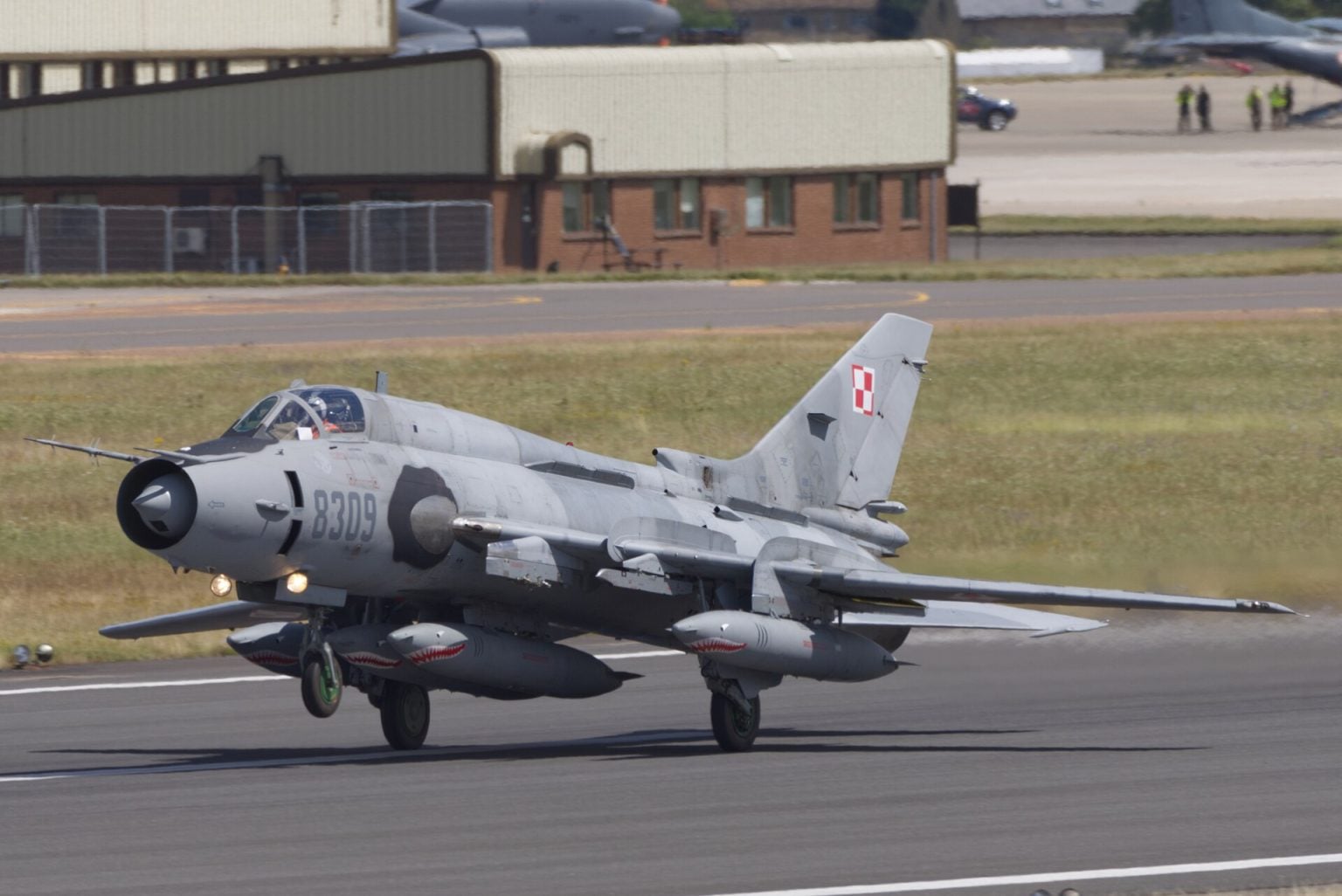
Sukhoi Su-17 / Su-22
“Fitter”
The Soviet swing-wing workhorse that squeezed a whole new aircraft out of the fixed-wing Su-7 — only the outer wing panels moved, but the fix turned a marginal fighter-bomber into a rugged strike jet that armed a dozen air forces and still flew into the 2020s.
A clever, cheap fix that made an old jet new
By the early 1960s Sukhoi’s Su-7 was a fast, sturdy fighter-bomber with one glaring weakness: its thin, sharply swept fixed wing needed enormous runways and could not haul much fuel or ordnance. Rather than design a wholly new aircraft, Sukhoi tried a shortcut. On a converted Su-7 — the S-22I demonstrator, first flown by Vladimir Ilyushin on 2 August 1966 — the engineers left the inner wing fixed and made only the outer panels swing. It was a deliberately modest, low-risk solution, and it worked.
Spreading the outer panels forward for takeoff and landing dramatically shortened the run and boosted low-speed lift and load; sweeping them back kept high speed at altitude. The production aircraft, the Su-17, entered Soviet service around 1970. Because it shared so much with the Su-7 it was cheap to build and easy for ground crews and pilots already familiar with the older jet.
The type became one of the Soviet bloc’s standard tactical strike aircraft and a major export. The domestic version was the Su-17; downgraded export models were sold as the Su-20 and, most widely, the Su-22. Roughly 2,867 were built between 1969 and 1990, and the family saw long, widespread service — a handful of operators kept Fitters flying into the 2020s, with Poland, the last European user, phasing its fleet out around 2025.
01Why the Su-22 Fitter swings only its wingtips, not the whole wing
Full variable-geometry wings — as on the American F-111 or the later MiG-23 — are heavy and complex, with pivots buried near the fuselage and elaborate structure to carry the loads. Sukhoi could not justify that cost simply to fix the Su-7’s field performance. So the design bureau placed the pivots partway out along the wing, leaving a large fixed inner glove and swinging only the outer sections. The moving panels are lighter and the fixed inner wing still carries the landing gear and pylons.
The trade-off is that a part-span swing wing gives less of a change in overall sweep and area than a full one, so the aerodynamic benefit is smaller. But it was cheap, robust and good enough: takeoff and landing distances fell sharply and payload and range improved, all on an airframe that shared much of its tooling with the Su-7. It is often cited as a textbook example of a pragmatic engineering compromise.
What makes the Su-22 special
The part-span swing wing
The Fitter’s defining feature is its part-span variable-geometry wing: only the outer panels pivot, between roughly 30° and 63°. Spread forward, they cut the Su-7’s long takeoff and landing runs and let the aircraft lift more fuel and weapons; swept back, they preserve speed at altitude. It was a cheap, low-risk way to fix the older jet’s biggest weakness without a clean-sheet design.
The big Lyulka AL-21 engine
Most definitive Fitters, including the Su-22M4, are built around a single Lyulka AL-21F-3 afterburning turbojet of roughly 110 kN (about 24,700 lbf) in reheat. It is a large, powerful and thirsty engine that gives the single-engined Fitter brisk acceleration and a useful war load, at the cost of high fuel consumption. Some earlier export Su-22s instead used the Tumansky R-29 engine.
A rugged, simple export workhorse
The Fitter was built to be tough, cheap and easy to operate from rough forward airfields. Its systems are relatively simple, it tolerates hard use, and it can carry a wide mix of bombs, rockets and guided weapons on around ten hardpoints, plus two built-in 30 mm cannon. Those qualities made it a natural export: it served across the Warsaw Pact, the Middle East, Africa, Asia and Latin America.
02The Su-22’s wing sweep: what the pilot actually controls
Unlike a fully automatic swing wing, the Fitter’s outer panels are set by the pilot to suit the phase of flight — broadly spread for takeoff, landing and low-speed manoeuvre, and swept for high-speed flight. Sources describe both selectable fixed positions and intermediate settings across the roughly 30°-to-63° range. Because only the outer panels move, the change in total wing area is modest compared with a full variable-geometry design, so the Fitter is best understood as a fast strike aircraft with much-improved field performance rather than an agile dogfighter.
03Su-17, Su-20, Su-22: how the same jet got three names
The confusion of designations reflects Cold-War export policy. The Su-17 was the domestic Soviet version. The Su-20 was an early, somewhat downgraded export model. The Su-22 covered the main export families, some with the Tumansky R-29 engine and simplified avionics and others — like the Su-22M4 — close to the Soviet standard with the Lyulka AL-21F-3. NATO gave the whole family one reporting name, “Fitter,” with letter suffixes (Fitter-C, -G, -K and so on) for individual variants.
Full specifications
Figures are for the Su-22M4 (Fitter-K), the definitive export variant. Published values vary between sources; treat them as representative.
Baseline note: the figures below describe the Su-22M4 (NATO Fitter-K), factory designation S-54K, the export version of the Soviet Su-17M4 and the definitive member of the family — built from 1983 to 1990 and the aircraft flown by Poland, Vietnam, Syria, Libya, Angola, Afghanistan, Peru and the two Germanies. Deltas for the fixed-wing Su-7 ancestor, for the first swing-wing Su-17M and for the two-seat Su-22UM3K are in grey. Published Fitter data is untidy because the family ran to more than a dozen production marks with different engines and different avionics under nearly identical skins; where Russian and Western tables disagree, both are given.
Dimensions & weights
- Crew
- 1 — 2 in tandem on the Su-22UM3K trainer, which keeps full combat capability but loses the port cannon and some internal fuel
- Length
- 19.02 m (62 ft 5 in) including the nose probes
- Wingspan, wings forward
- 13.68 m (44 ft 11 in) at 30° sweep
- Wingspan, wings swept
- 10.02 m (32 ft 11 in) at 63° sweep — almost exactly the span of the fixed-wing Su-7, which is the whole point of the design
- Sweep range
- 30° to 63° — only the outer panels pivot. The inner wing is fixed and carries the main undercarriage, the inboard pylons and the flap; the moving panel is about twice the span of the fixed stub and carries a slat, a flap and the aileron. The Su-7’s centre section, gear and fuselage carried straight over, which is why the conversion was so cheap
- Height
- 5.12 m (16 ft 10 in)
- Wing area
- 38.5 m² (414 sq ft) spread; 34.5 m² (371 sq ft) swept
- Aerofoil
- TsAGI SR-3S — 5.9 per cent at the root, 4.7 per cent at the tip
- Empty weight
- 12,160 kg (26,810 lb)
- Normal take-off weight
- 16,400 kg (36,155 lb)
- Maximum take-off weight
- 19,430 kg (42,835 lb)
- Internal fuel
- ~3,770 kg (~8,310 lb), roughly 4,850 litres, in a central tank, fuselage follower tanks and tanks inside the fixed wing stubs. Up to four external tanks of 800 or 1,150 litres each on the wet pylons
- Maximum ordnance
- ~4,000 kg (~8,820 lb) on 10 hardpoints — four under the fixed wing, two under the fuselage and four fuselage-side stations. Nothing hangs from the moving panels, another consequence of the cheap conversion
- Wing loading
- 426 kg/m² (87 lb/sq ft) at normal take-off weight with the wings spread
Performance
- Maximum speed, altitude
- 1,860 km/h (1,156 mph), Mach 1.7. The Su-22M4 lost the movable intake centrebody of the earlier marks, which had allowed Mach 2.1; the cone was fixed in place to house the larger Klyon-54 laser ranger, and nobody minded because the aircraft never flew that profile in anger
- Maximum speed, sea level
- 1,400 km/h (870 mph), Mach 1.13 clean. Russian tables commonly give 1,350 km/h (839 mph); the difference is within the noise of how a clean aircraft is defined
- Service ceiling
- 14,200 m (46,590 ft). Russian comparative tables give 15,200 m (49,870 ft) for the M4; the Su-7 reached 17,600 m (57,740 ft) because it was lighter and carried less
- Rate of climb
- 230 m/s (45,275 ft/min) at sea level
- Combat range, hi-lo-hi
- 1,150 km (715 mi) with a 2,000 kg (4,410 lb) warload. Read that as a mission distance, not a radius — the practical radius is roughly half, and a lo-lo-lo profile cuts it further. This is a short-legged aeroplane and always was
- Range at altitude, internal fuel
- 2,300 km (1,430 mi); 1,380 km (858 mi) flown at low level
- Ferry range
- 2,550 km (1,585 mi) with drop tanks
- Take-off run
- 1,500 m (4,920 ft) at maximum take-off weight, unstick at 360 km/h (224 mph). The comparison that matters is with the fixed-wing Su-7, which needed more runway at a lower weight; with the wings at 30° and a light load the Su-22 gets off in well under half this distance, and SPRD-110 rocket bottles cut it further still
- Landing run
- 1,100 m (3,610 ft) with the brake chute, touching down at 285 km/h (177 mph) at maximum landing weight
- Load factor limit
- +7 g
- Thrust-to-weight
- 0.68 at normal take-off weight with reheat
Propulsion & systems
- Engine
- 1 × Lyulka (now Saturn) AL-21F-3 afterburning turbojet — the same engine family as the Su-24 and the MiG-23B, and the single biggest improvement over the Su-7’s thirsty AL-7F. The export Su-22 and Su-22M used the Tumansky R-29BS-300 instead; the Su-22M4 and the Su-22UM3K reverted to the AL-21F-3, which is why the M4 is the export mark worth having
- Thrust
- 76.4 kN (17,180 lbf) dry, 109.8 kN (24,690 lbf) with reheat
- Intake
- Circular nose intake with a fixed shock cone on the M4 — the cone houses the Klyon-54 laser rangefinder and marked-target seeker. Extra fuselage inlets and a ram-air scoop at the fin root were added on this mark to get more cooling air through the bay
- Assisted take-off
- 2 or 4 × SPRD-110 jettisonable solid rocket bottles — about 29 kN (6,600 lbf) each for a few seconds. A Warsaw Pact aeroplane designed on the assumption that its runway would be cratered on day one
- Radar
- None. The Fitter never carried an attack radar of any kind. Aiming is done with the Klyon-54 laser ranger and designator, the ASP-17BTs gunsight and the PBK-3-17S bombsight. That is the honest ceiling on this aircraft’s capability: it is a clear-weather, visual, daylight attacker with a laser to sharpen it
- Navigation
- KN-23-1 system with an IKV-8 inertial attitude reference, DISS-7 Doppler, A-312 Radikal-NP short-range and A-720 Skip-2 long-range radio navigation, ARK-22 radio compass, RV-21 Impuls radio altimeter and the SAU-22M autopilot — enough to fly a three-waypoint route automatically and let down to 50–60 m before a manual landing
- Self-protection
- SPO-15LE Beryoza radar warning receiver, KDS-23 and ASO-2V chaff and flare dispensers, and SPS-141 or SPS-142 Siren and Gvozdika jamming pods carried externally
- Ejection seat
- KS-4S-32 — not zero-zero. It works on the ground roll above roughly 140–170 km/h (87–106 mph), which is a meaningful limitation on an aircraft whose job is to fly low and slow over people shooting at it
- First flight
- 2 August 1966 for the S-22I swing-wing demonstrator, flown by Vladimir Ilyushin; 19 June 1980 for the Su-17M4 on which the Su-22M4 is based
- Service entry
- 1970 for the Su-17 with the 523rd Regiment in the Far East; the Polish Air Force took its first Su-22M4 on 28 August 1984
- Number built
- 2,867 across the whole Su-17/Su-20/Su-22 family, 1969 to 1990, all at the Yuri Gagarin plant at Komsomolsk-on-Amur. Roughly 1,165 were exported to fifteen countries before 1991
04The Su-22’s cost: why no reliable price exists
Like other Soviet combat aircraft, the Su-17/Su-22 was a state product supplied to allies and clients on political and barter terms rather than sold on an open dollar market, so no firm flyaway unit price exists in the public record. Export deals were bundled with training, spares and credit arrangements that make any single figure meaningless. No credible cost-per-flight-hour number exists in open sources either. Any precise dollar figure attached to a Fitter should be read as an estimate, not a sourced fact.
Armament & payload
The Su-22M4 is a laser-aimed bomb truck with ten pylons, no radar and a very long export catalogue
Everything about the Fitter’s armament follows from one fact: it has no radar. What it has instead is a laser rangefinder and designator in the intake cone, and around that the Soviet Union built a genuinely useful clear-weather attack aircraft — two 30 mm cannon that will destroy almost any soft target, laser and television-guided missiles for point targets, anti-radiation missiles for air defences, a large unguided rocket and bomb catalogue, and, on Soviet aircraft only, a tactical nuclear bomb. The catch is that every export customer got a downgraded fit, and the differences between them are large.
In practice the great majority of Fitter combat sorties ever flown — in Afghanistan, Iran, Iraq, Syria, Libya, Yemen, Angola and Peru — were flown with iron bombs and rocket pods. The precision weapons existed, were integrated and occasionally were used; they were also expensive, needed a steady laser hold in a dive over a defended target, and were not what a hard-pressed air force in a civil war reaches for. Fits differ enormously by mark and operator: the Su-17M carried almost nothing guided, export Su-22 and Su-22M aircraft with the R-29 engine were deliberately given older avionics, only Soviet aircraft ever carried nuclear weapons, and the Iranian fleet has since been rebuilt with an entirely non-Soviet weapons set.
Gun
- Two Nudelman-Rikhter NR-30 30 mm cannon, one in each wing root, with 80 rounds per gun — a short-recoil weapon firing a 30×155 mm round with a 410 g projectile at about 780 m/s, roughly 900 rounds per minute
- The muzzle blast is severe enough that the wing skin around it is clad in stainless steel and each gun needs a muzzle brake with an integral flame damper. Twenty natures of ammunition existed; armour-piercing and high-explosive incendiary were the ones squadrons used
- This is the weapon that did most of the Fitter’s real work. In October 1980 an Iraqi Su-20 of No. 1 Squadron shot down an Iranian F-4E with the cannon — the type’s only air-to-air kill of the Iran–Iraq war
- Additional guns in pods: the UPK-23-250 and the SPPU-22-01, each holding a twin-barrel GSh-23L. The SPPU-22-01 barrels traverse down through 30° under control of the aircraft’s BSPPU fire-control system, and on a rearward-facing mounting they can be fired at 23° down as the aircraft flies away from the target
- Su-22UM3K: the port cannon is deleted to make room for the second cockpit
Air-to-air
- R-60 and R-60MK (AA-8 Aphid) short-range infrared missiles, normally two, on rails between the wing pylons. This is the standard Su-22M4 self-defence fit
- R-73 (AA-11 Archer) on later and upgraded aircraft, and K-13 / R-3S (AA-2 Atoll) on the earlier marks
- With no radar and no beyond-visual-range capability whatever, these are strictly for shaking off a pursuer. The Fitter cannot fight and was never meant to
- The most famous demonstration of that came on 19 August 1981, when two Libyan Su-22M3s met two US Navy F-14As of VF-41 over the Gulf of Sidra. One Libyan fired an Atoll head-on at an estimated 300 m closing range — a shot that had no chance from that aspect — the Tomcats evaded, turned in behind and shot down both with AIM-9L Sidewinders. Both Libyan pilots ejected
Air-to-surface guided
- Kh-25ML and Kh-25MR (AS-10 Karen) laser and radio-command guided missiles on APU-68 rails, and the older Kh-23M (AS-7 Kerry) radio-command weapon on the earlier marks, flown with a Delta NG command pod
- Kh-29L and Kh-29T (AS-14 Kedge) heavy laser and television-guided missiles on AKU-58 ejector racks — the bunker and bridge weapon, and the one the Klyon designator exists to serve. Some Su-17M4s carry an IT-23M cockpit display to show the Tubus-2 seeker picture from a Kh-29T
- Kh-58 and Kh-58U (AS-11 Kilter) and Kh-27PS (AS-12 Kegler) anti-radiation missiles, cued by a BA-58 Vyuga emitter-location pod under the fuselage. The Su-17M/Su-20 generation used the much larger and cruder Kh-28 (AS-9 Kyle) with a Metel-A pod
- Export Su-22 and Su-22M aircraft with the R-29 engine were fitted with Su-17M2-standard avionics and a correspondingly restricted missile set. What a given air force can actually launch depends on the mark it bought and on what it has been able to buy since
- Iran has gone its own way: from 2018 the IRGC Aerospace Force has publicly claimed to have overhauled and rearmed Su-22s with indigenous precision-guided weapons and datalinks. Treat the specifics with caution — they come from the operator and have not been independently verified
Bombs
- FAB-100, FAB-250 and FAB-500 general-purpose bombs and their OFAB fragmentation equivalents on BDZ-57MT or MTA racks. This, in quantity, is what the Fitter actually dropped in every war it fought
- RBK-250 and RBK-500 cluster bombs, KMGU-2 submunition dispensers, ODAB fuel-air bombs, ZAB incendiaries and BETAB concrete-piercing bombs for runway attack
- KAB-500Kr television-guided bombs on Soviet Su-17M4s. Export aircraft were generally not cleared for them, and no export operator is known to have used one in anger
- Nuclear: Soviet aircraft carried a tactical free-fall weapon on a BDZ-56FNM rack, with a coded arming device in the cockpit that had to be set correctly before release. Delivery was by toss bombing — run in low, pull up into a steep climb, release near the vertical and turn away in reheat — practised with the special IAB-500 simulator bomb. No exported Fitter ever had this capability
- Syrian Su-22s in the civil war were repeatedly documented dropping general-purpose, cluster and incendiary bombs on populated areas in flat low-to-medium-altitude runs, pulling up and dispensing flares. That is the type’s twenty-first-century record and it should not be softened
Rockets
- S-5 57 mm rockets in UB-16-57 and UB-32 pods — the oldest and least effective, but present on almost every operator’s aircraft
- S-8 80 mm rockets in B-8M pods, twenty per pod: the standard Soviet and post-Soviet unguided rocket and the usual fit
- S-13 122 mm rockets in five-round B-13L pods, with a penetrating warhead intended for shelters and runways
- S-24 240 mm and S-25 330 mm heavy rockets on single rails and in O-25 launch tubes — effectively short-range artillery, fired from a shallow dive and used heavily in Afghanistan against fortified positions
Pods & other stores
- PTB-800 and PTB-1150 drop tanks on the wet pylons, up to four. On any realistic strike profile at least two pylons go to fuel, which is the tax the Fitter pays for its thirsty single turbojet
- KKR (Kombinirovanny Konteiner Razvedki) combined reconnaissance pod on the centreline — cameras, an infrared line scanner and in some fits an ELINT receiver. Any mark could be turned into a reconnaissance aircraft this way; the dedicated versions are the Su-17M3R, Su-17M4R and Su-22M4R
- BA-58 Vyuga emitter-location pod for the anti-radiation missiles, and Prozhektor-1 laser designator pods on the earlier marks that lacked an internal Klyon
- SPS-141, SPS-142 and SPS-143 Siren and SPS-141MVG Gvozdika jamming pods; SPPU-22-01 traversing gun pods; SPRD-110 rocket-assisted take-off bottles
Three typical loadouts
- Battlefield interdiction, Afghanistan, mid-1980s
- Two FAB-500 bombs on the fuselage stations, two B-8M rocket pods on the inner wing pylons, two PTB-800 drop tanks and a pair of R-60 for self-defence. Run in at medium altitude to stay above the small arms, dive, release, pull up hard and dispense flares against Stingers. Sorties in this configuration were flown against Mujahideen positions from Bagram, Shindand and Kandahar throughout the Soviet war.
- Suppression of enemy air defences, Warsaw Pact plan
- Two Kh-58U anti-radiation missiles on the fuselage stations with a BA-58 Vyuga pod on the centreline, two PTB-1150 tanks and two R-60. Launch from a shallow climb at range against a NATO radar, then leave. Polish, Czechoslovak and East German Su-22M4 regiments trained for exactly this against Hawk and Nike batteries.
- Close air support, Syria, 2013–2017
- Four to six FAB-250 or FAB-500 bombs, two UB-32 rocket pods, no drop tanks and short sortie times from Shayrat, T-4 or Dumayr. Level or shallow-dive attacks from low to medium altitude, flares out on the pull-up. This is the fit the Su-22M4 shot down by a US Navy F/A-18E on 18 June 2017 was flying when it bombed Syrian Democratic Forces positions at Ja’Din.
Sourcing caveat: dimensions, weights and performance follow the Russian-language Sukhoi and TsAGI-derived tables cross-checked against Western references; where they disagree, both figures are given above. Weapons fits are drawn from the published Soviet mark-by-mark descriptions and from photographic evidence of what operators have actually carried, which are not the same thing — a great many stores listed as compatible in a manufacturer’s brochure were never seen on an export aircraft. Combat claims from the Iran–Iraq war in particular should be treated as contested: Iranian F-14 crews are credited with 21 Su-20/22s and F-4 crews with 18 in Western compilations, while official Iraqi accounts admit 29 losses to all causes across the whole war.
Variants
Sukhoi turned a mediocre aeroplane into a useful one by making only the outer half of each wing move
The Su-7 was fast, tough, simple and nearly useless. Its Lyulka AL-7F drank fuel so hard that a short-range sortie needed two of its four pylons for drop tanks, leaving 1,000 kg of bombs and a take-off run that demanded a long, hard, undamaged runway — the one thing nobody expected to have in a European war. Sukhoi was ordered to fix it, and in 1963, working with TsAGI, took the cheapest possible route to a variable-geometry wing: leave the centre section, the main undercarriage and the whole fuselage alone, cut the wing at a point just outboard of the gear, and hinge everything beyond that.
It is one of the great pieces of frugal engineering. The moving panel is roughly twice the span of the fixed stub, sweeping between 30° and 63°, driven by a single hydraulic motor on the number one booster system. The pivots sit far enough outboard that the aerodynamic centre barely moves as the wing sweeps, so no complicated trim compensation was needed. Nothing hangs from the moving panels, so the pylon and fuel plumbing stayed where it was. The result, first flown as the S-22I on 2 August 1966 with Vladimir Ilyushin at the controls, transformed take-off run, landing speed, range and endurance while leaving handling broadly better than the Su-7’s. The one thing lost was the pre-stall buffet warning, which the swept panel simply did not produce.
What followed was twenty years of steady, unglamorous improvement inside an almost unchanged shape. The AL-21F-3 replaced the AL-7 on the Su-17M. The Su-17M2 dropped the nose and added a laser rangefinder, gaining the unofficial nickname s borodoy — "with a beard". The Su-17M3 reused the deepened forward fuselage of the two-seat trainer to gain avionics volume and an extra fuel tank, and became the most numerous mark at close to a thousand built. The Su-17M4 fixed the intake cone in place to fit a bigger laser, accepted a Mach 1.75 limit nobody cared about, and added the navigation and countermeasures fit that made it usable. Sukhoi built 2,867 in all and exported about 1,165 of them to fifteen countries, which is why the Fitter turns up in almost every regional war of the last forty-five years.
Its combat record needs care, because two of the incidents most often attributed to it are frequently muddled. On 19 August 1981 two Libyan Su-22M3s were shot down by F-14As of VF-41 over the Gulf of Sidra after one fired an Atoll head-on at close range and missed. The second Gulf of Sidra shootdown, on 4 January 1989, did not involve Su-22s at all — those were two Libyan MiG-23 Floggers, engaged near Tobruk by F-14As of VF-32, and the encounter is properly filed under its own name. Then, on 18 June 2017, a Syrian Su-22M4 that had bombed US-backed Syrian Democratic Forces at Ja’Din was engaged by Lieutenant Commander Michael Tremel in an F/A-18E of VFA-87. Tremel’s first shot, an AIM-9X, was decoyed by the Syrian’s flares; his second, an AIM-120 AMRAAM, hit the Fitter in the rear fuselage. The pilot, Colonel Ali Fahd, ejected and was recovered. It was the first American shootdown of a crewed aircraft since 1999 and the first air-to-air kill by the Super Hornet.
The Fitter has also been shot down by almost everything else. Iranian F-14s, F-4s and F-5s accounted for dozens of Iraqi Su-20s and Su-22s between 1980 and 1988; USAF F-15s destroyed several more in February and March 1991 as the Iraqi air force fled to Iran, and forty of those that got there were impounded and are the origin of the Iranian fleet. A Chadian Stinger brought one down in 1987. Ecuadorian Mirage F1JAs claimed two Peruvian Su-22s in the 1995 Cenepa war, which Peru disputes. A Polish Su-22M4K was shot down by a Polish 2K12 Kub battery by mistake in 2003. Israeli Patriots destroyed a Syrian Su-22 in 2018. It is a durable aeroplane in a dangerous line of work.
- Su-7B family (1959–72, part of 1,847 Su-7s)
- The fixed-wing ancestor, NATO Fitter-A. A 62-degree swept wing, one AL-7F-1, two NR-30 cannon and four pylons, of which two had to carry fuel. Rugged, simple and short-ranged, and the reason the whole variable-geometry programme was ordered.
- S-22I / Su-7IG (1966, 1 converted)
- The demonstrator, NATO Fitter-B: a production Su-7BM with outer panels that could be set to 28°, 45° or 62°. First flown 2 August 1966 and shown at Domodedovo in July 1967. Later lost in an accident, having already proved the point.
- Su-17 (1969–73, 224 built)
- S-32, NATO Fitter-C. The first production swing-wing, still with the Su-7’s AL-7F-1 engine and a dorsal spine carrying wiring. A transitional aircraft that flew only with the Soviet air force.
- Su-17M and Su-20 (1972–75)
- The first properly useful mark: the AL-21F-3 engine, a revised fuselage, more fuel, eight hardpoints and a payload up to four tonnes. Export version designated Su-20 and sold to Egypt, Poland, Syria, Iraq and Algeria. The SRD-5M ranging radar carried over from the Su-7BMK is the only radar the family ever had, and it was gone by the next mark.
- Su-17M2, Su-22 (1974–78)
- NATO Fitter-D. The nose extended 380 mm and drooped for a better view forward, the ranging radar deleted, and a Fon-1400 laser rangefinder and marked-target seeker fitted under the intake — hence s borodoy. The first export Su-22 (Fitter-F) is this aircraft with the Tumansky R-29BS-300 engine in a bulged rear fuselage, an engine that gave no useful performance gain and hurt the range.
- Su-17M3, Su-22M and Su-22M3 (1976–84, close to 1,000)
- NATO Fitter-H and, for export, Fitter-J. The most numerous mark, built on the deeper forward fuselage of the trainer with the rear cockpit replaced by avionics and fuel — internal capacity up to 4,850 litres. Klyon-PS laser designator, SPO-15 Beryoza, air-to-air rails, and on the M3P standard the Kh-27PS and Kh-58 anti-radiation fit. The Libyan aircraft shot down in 1981 were Su-22M3s.
- Su-17UM3 and Su-22UM3K (1978–82)
- NATO Fitter-G. The two-seat combat trainer, with an entirely redesigned nose housing tandem cockpits, a taller fin to cure the longitudinal instability found on the earlier Su-17UM, one cannon instead of two and less internal fuel. Full avionics and full armament are retained, so these are combat-capable aircraft, and the Su-22UM3K with the AL-21F-3 is the version almost every export customer bought alongside its single-seaters.
- Su-17M4 and Su-22M4 (1981–90)
- NATO Fitter-K, factory S-54 and S-54K, and the baseline described above. Fixed intake cone housing a Klyon-54, extra cooling inlets and a fin-root ram scoop, RSDN long-range navigation, SPO-15LE, and clearance for the Kh-29 and Kh-58 families. The Soviet M4 was built 1981–88 and the export M4 1983–90; this is the mark East Germany, Poland, Czechoslovakia, Hungary, Bulgaria, Afghanistan, Vietnam, Syria, Libya and Angola flew.
- Su-17M3R, Su-17M4R and Su-22M4R (various)
- Factory S-52R, S-54R and S-59M: reconnaissance aircraft carrying the KKR combined pod on the centreline, with cameras, an infrared line scanner and in some fits an ELINT receiver. Not a rebuild so much as a wiring standard — any Fitter with the right pylon and connectors could fly the mission.
- Su-22M5 and Su-17M5 (proposals, not adopted)
- Two roads not taken. The Su-22M5 was a Russian-French upgrade package of the 1990s offering a modern cockpit, HOTAS and a Phazotron/Thomson-CSF radar in place of the laser ranger — the radar the aircraft never had. The Su-17M5 was a 1980s proposal to go back to a fixed wing frozen at 45° sweep and fit an AL-31F turbofan. Neither was built, and the family ended in 1990 with the last export Su-22M4.
A note on retirements, because the Fitter is disappearing quickly. Russia withdrew its last Su-17M4s in 1998 as part of a deliberate purge of single-engined strike aircraft, alongside the MiG-23 and MiG-27; one airframe still flies as a chase plane at Komsomolsk-on-Amur. The Czech Republic retired its aircraft in 2002, Slovakia grounded and sold its own around the turn of the century, Bulgaria finished in May 2004, Hungary in 1997, Peru in 2006, and the last German aircraft never entered Luftwaffe service at all. Poland, the last European operator, retired its Su-22M4s and Su-22UM3Ks in September 2025 after forty-one years, having deliberately kept a dozen flying into the 2020s because they were cheap to run, had a large stock of Soviet-era weapons behind them and were the only Polish aircraft equipped for electronic intelligence work. Syria’s fleet is the one to watch: the Syrian Arab Air Force was dismantled after the fall of the Assad government in December 2024, and by late 2025 FlightGlobal had removed all Syrian aircraft from its directory altogether.
From Su-7 offshoot to long-serving workhorse
Swing-wing demonstrator flies
The S-22I — a converted Su-7 with swinging outer wing panels — first flies on 2 August, piloted by Vladimir Ilyushin.
Su-17 enters service
Serial production begins and the Su-17 joins the Soviet Air Forces as a tactical fighter-bomber.
Exports as Su-20 and Su-22
Downgraded export versions spread to Warsaw Pact and client states across the Middle East, Africa and beyond.
Gulf of Sidra
Two Libyan Su-22 Fitters are shot down by US Navy F-14 Tomcats after one fires a missile — the type’s most famous air-to-air loss.
Iran–Iraq & Afghanistan
Iraqi and Soviet Fitters fly intensive ground-attack and strike missions in two major wars of the decade.
Production ends
After roughly 2,867 aircraft, Su-17/20/22 production winds down as the Cold War closes.
Shootdown over Syria
A US Navy F/A-18E downs a Syrian Su-22 near Raqqa on 18 June — the first US manned air-to-air kill in nearly two decades.
The last European Fitters
Poland retires its Su-22 fleet, ending the type’s frontline service in Europe; a few operators elsewhere linger on.
Twelve Fitter stories
The jet that came from another jet
Sukhoi fixed the Su-7’s runway problem by swinging only its wingtips.
Read the full story
A pragmatic compromise
The part-span wing gave most of the benefit of a swing wing for a fraction of the cost.
Read the full story
One jet, three numbers
Su-17 at home, Su-20 and Su-22 for export — and one NATO name, “Fitter.”
Read the full story
The Gulf of Sidra shootdown
Two Libyan Su-22s were downed by US Navy F-14 Tomcats off the Libyan coast.
Read the full story
Iran–Iraq War
Iraqi Fitters flew intensive strike missions through the long 1980s war.
Read the full story
The Soviet-Afghan War
Soviet Su-17s were among the workhorses of the air war over Afghanistan.
Read the full story
Fitters flee to Iran
In the 1991 Gulf War, Iraqi Su-22s were among aircraft flown to Iran to escape destruction.
Read the full story
Shootdown over Syria
A US Navy Super Hornet downed a Syrian Su-22 near Raqqa on 18 June 2017.
Read the full story
A contested Syrian mission
Su-22s were linked to a 2017 chemical attack — a claim Syria and Russia disputed.
Read the full story
From Peru to Vietnam
The Fitter armed air forces on four continents.
Read the full story
Still flying in the 2020s
Decades after the USSR fell, a handful of air forces kept Fitters in the air.
Read the full story
The end of a Sukhoi line
The Fitter closed out the family that began with the Su-7.
Read the full story
The Fitter in pictures
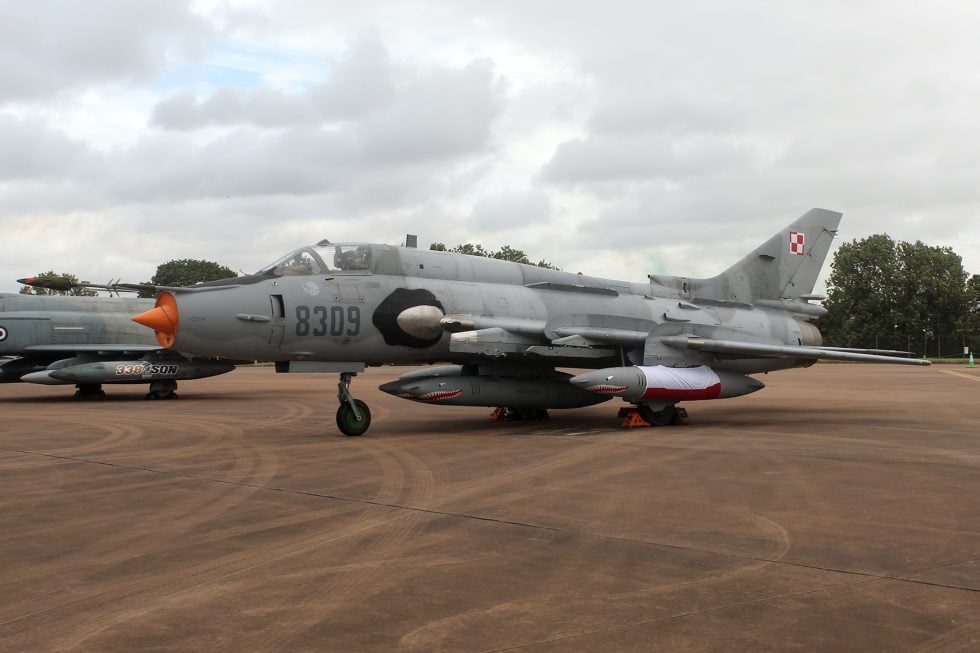
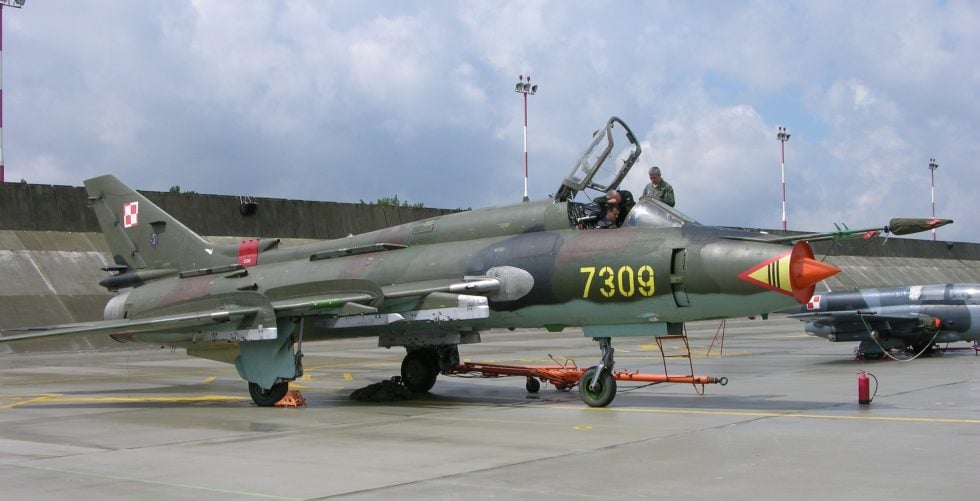
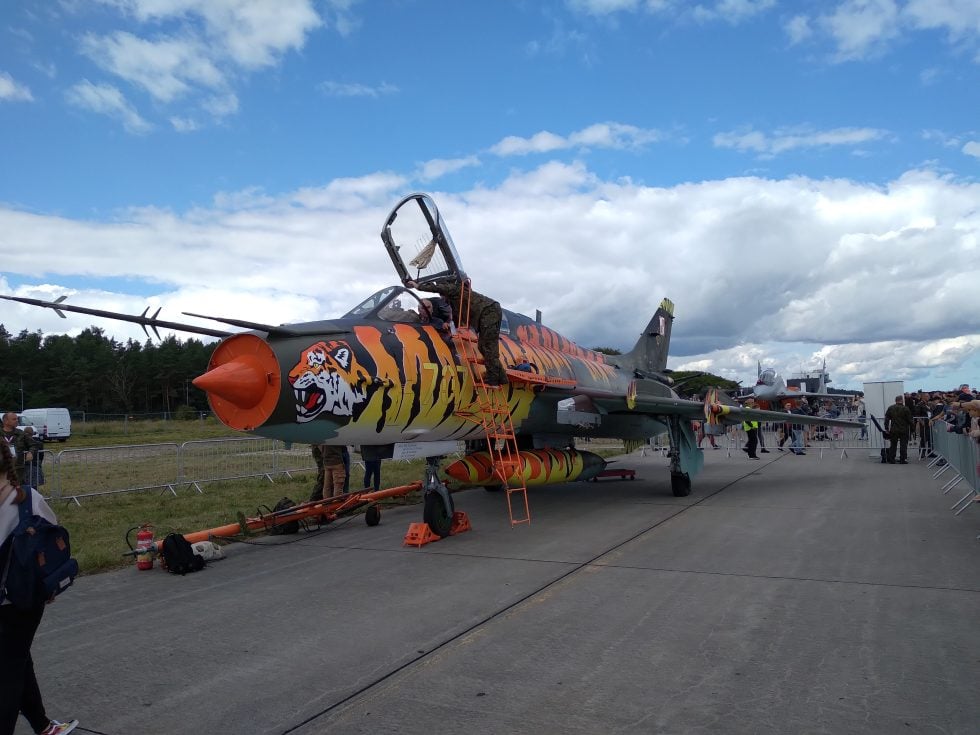
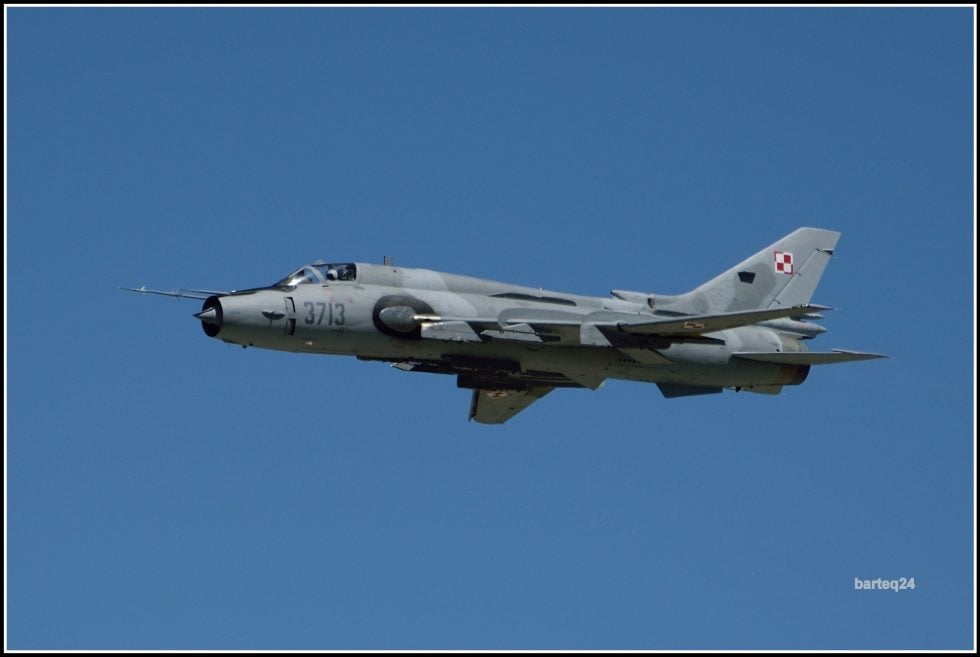
The Fitter in motion
A curated Su-22 Fitter video is coming soon. In the meantime, explore the gallery above and the operations map below to see where this swing-wing workhorse served.
Where the Fitter flew
Operators today
Four air forces still fly the Fitter, and none of them will be flying it for long
About 1,165 Su-17s, Su-20s and Su-22s were exported to fifteen countries before the Soviet Union ended, and the surviving fleets are the residue of that. Every one of them is being wound down: the average airframe is over forty years old, the design is two generations obsolete, remaining fatigue life is short and there is no economic case for modernising. Poland, easily the largest and best-run of the late operators, retired its aircraft in September 2025 and with it went the last Fitter in NATO service.
These are estimates. Many airframes counted on paper are stored, in deep overhaul, or not operational. All figures are delivered aircraft rather than orders, and all are owned rather than leased. Sources: IISS The Military Balance and FlightGlobal World Air Forces; entries that could not be corroborated are omitted, and no competitor dataset has been copied. Notes on the individual entries. Vietnam flies Su-22M3, M4 and UM3K aircraft in what were three regiments and is the only operator with a real fleet left; recent counts run between 24 and 26. Angola’s aircraft are a mixture of the original 1980s Su-22M4Ks and ex-Slovak Su-22M4s bought in 1999 and 2001. Iran’s Su-22s are ex-Iraqi: forty were flown across the border during the 1991 Gulf War and impounded, and the IRGC Aerospace Force overhauled a portion of them from 2013. The figure here follows The Military Balance rather than the much higher Iranian claims, and it should be read as a ceiling — US Central Command released footage in March 2026 of two Iranian Su-22s destroyed on the ground. Libya’s single airworthy aircraft belongs to the Libyan National Army, the remnant of a fleet that once ran to about ninety. Deliberately excluded: Poland, which retired all remaining Su-22M4 and Su-22UM3K aircraft in September 2025; Syria, whose air force was dismantled after December 2024 and whose entire inventory was dropped from FlightGlobal’s 2026 directory; Yemen, where a nominal figure of around twenty aircraft is still published but could not be corroborated against any current order of battle after a decade of civil war; and Peru, which retired the type in 2006 with a handful held in reserve.
A strike jet, not a dogfighter
The Fitter’s war record is written mostly in ground-attack: bombing and close-support sorties in the Iran-Iraq War, the Soviet-Afghan War and the Syrian civil war, flown by more than a dozen air forces. In air-to-air combat it was usually the loser — most famously when US Navy fighters downed Libyan Su-22s in 1981 and a Syrian Su-22 in 2017. Figures for its combat use are incomplete and, in several cases, disputed between the parties involved.
Compare the combat record of every military aircraft. Figures as of July 2026.
Everything people ask about the Su-22
Can I fly in a Su-22?
What is the difference between the Su-17, Su-20 and Su-22?
Why does the Su-22 only swing part of its wing?
Did a Su-22 ever get shot down by a US jet?
Is the Su-22 still in service?
How much ordnance can the Su-22 carry?
What replaced the Su-22 in Soviet service?
You can’t fly the Su-22.
These, you can.
Some legends only live in museums — others are fuelled and waiting. MiGFlug has put civilians in real military jet cockpits since 2004.
 Fly the L-39 AlbatrosThe world’s most-flown jet trainer — aerobatics included
 Fly the F-104 Starfighter“The missile with a man in it”
 Fly the MiG-21The Cold War’s most-produced jet
 Fly the T-33 Shooting StarAmerica’s first jet trainer
 Fly the DH VampireA piece of early jet history
 Fly the S.211Agile Italian jet trainer
 Fly the MB-326The classic Aermacchi jet
 Fly the MiG-15The Soviet legend of the Korean War
Continue the tour
Every fact, checked
- National Museum of the US Air Force — Sukhoi Su-22M4Official fact sheet on the Fitter-K variant, its engine and history.
- GlobalSecurity.org — Su-17/-20/-22 FitterDevelopment, variants and operator overview.
- Military Factory — Su-17/20/22 FitterSpecifications and production summary.
- USNI News — Super Hornet downs Syrian jet (2017)Contemporary report of the 18 June 2017 Su-22 shootdown.
- The Aviation Geek Club — Gulf of Sidra 1981Crew recollections of the 1981 Su-22 shootdown.
- The War Zone — Poland retires the Su-22The end of frontline Fitter service in Europe.
- flugzeuginfo.net — Su-17/20/22 dataTechnical data cross-reference.
- Global Military — Su-17/20/22 FitterOperators and current-status overview.