

The V-1 flying bomb carried a warhead of several hundred kilograms of high explosive and crossed the Channel at roughly the speed of a fast fighter. Shooting one down meant closing to gun range behind it and firing into a warhead that might detonate in your face.
So a handful of pilots stopped shooting. They slid a wingtip underneath the bomb's wing, held it there, and let the air do the rest.
It is one of the strangest tactics of the Second World War, it is frequently described wrongly, and it worked — though rather less often than the legend suggests.
Quick Facts
Campaign: Operation Diver, the defence of Britain against the V-1, from mid-June 1944
The technique: Sliding a wingtip to within about 6 inches (15 cm) of the underside of the V-1’s wing, using the airflow to lift it and topple the bomb’s gyros
First recorded tipping: 18 June 1944, by a P-51 Mustang flown by Major R. E. Turner of the 356th Fighter Squadron
How many: Sources disagree — accounts range from at least three to at least sixteen destroyed this way
Main interceptor: Hawker Tempest; fewer than 30 available at the start, with No. 150 Wing RAF
Top V-1 killer: Squadron Leader Joseph Berry, credited with 59 and a half, mostly at night
Tempest total: 638 flying bombs between June and 5 September 1944, of which No. 3 Squadron RAF claimed 305
Codename origin: “Diver” was the Royal Observer Corps codeword for a V-1 sighting
What a Diver Patrol Was Up Against
The first V-1s fell on England in mid-June 1944. The Royal Observer Corps gave sightings the codeword “Diver”, and the fighter sorties flown against them became Diver patrols.
The problem was arithmetic. A V-1 flew fast and low, and most Allied fighters could not catch one from level flight without a height advantage to dive from. When the attacks began, the only type with the outright low-altitude speed to be reliably effective was the Hawker Tempest, and there were fewer than thirty of them, concentrated in No. 150 Wing RAF.
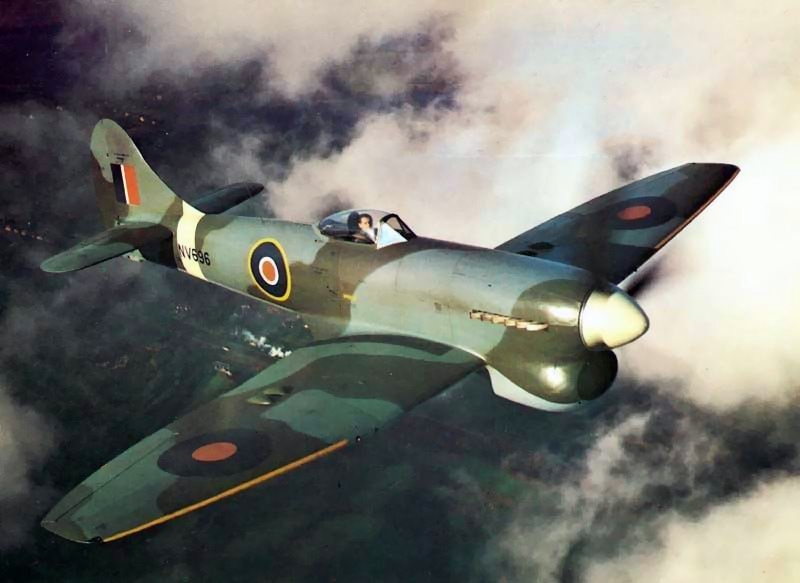
Everything else had to be modified to keep up. P-47 Thunderbolts were stripped of armour plate, half their fuel and half their guns, and had their engines boosted. Griffon-engined Supermarine Spitfire Mk XIVs and P-51 Mustangs were tuned for speed. At night the de Havilland Mosquito shared the work.
Then there was the shooting itself, which was genuinely dangerous. Machine guns did little against the V-1's sheet steel structure, so cannon were needed — and a cannon shell that detonated the warhead at close range took the fighter with it. Wing Commander Roland Beamont had the 20 mm cannon on his Tempest re-harmonised to converge at 300 yards rather than closer in. It worked well enough that the rest of 150 Wing followed.
The Imperial War Museums' account of the V-1 campaign and why it failed to change the war.
The Tipping Manoeuvre, Correctly Described
Here is the part that almost every retelling gets wrong. The pilots did not hit the bomb.
The V-1 flew on a simple gyroscopic autopilot. Upset the gyros and the bomb loses its reference and goes out of control. A fighter pilot could do that without contact at all, by sliding his wingtip underneath the V-1's wing and holding it there — about six inches, 15 centimetres, below the surface.
The air being pushed over and around the fighter's wing spilled upward against the underside of the bomb's wing and lifted it. The V-1 rolled, the gyros were overridden, and the bomb dropped away into an uncontrollable dive.
A wingtip strike would also work, in the sense that both aircraft would then be damaged. That was not the technique. The technique was a very precise piece of formation flying, held for several seconds, alongside a live warhead.
Who Did It First, and How Often
The first recorded success was not British. On 18 June 1944, Major R. E. Turner of the 356th Fighter Squadron tipped a V-1 with a P-51 Mustang.
How many were brought down this way is genuinely uncertain, and it is worth being honest about that. Wikipedia's article on the V-1 states that at least sixteen were destroyed by tipping; its article on Operation Diver says at least three. Both cite the campaign's own records. The truth is probably that tipping was tried more often than it succeeded, and succeeded more often than it was formally credited.
British Pathé footage from 1944 of a flying bomb in flight, watched from the ground by families — which is the other half of this story.
The Men Who Did the Real Damage
Tipping is the story people remember. Guns are what actually stopped the V-1 campaign in the air.
Between June and 5 September 1944, the Tempests of 150 Wing shot down 638 flying bombs, with No. 3 Squadron RAF alone claiming 305. The highest individual score belonged to Squadron Leader Joseph Berry of 501 Squadron, who was credited with 59 and a half, most of them at night, including seven in a single night on 23 July 1944.
Berry had come to the V-1 campaign as an experienced night-fighter pilot. His earlier citation, for work over Italy, gives a sense of the man before he ever saw a flying bomb.
Behind him came the Belgian ace Squadron Leader Remy Van Lierde of 164 Squadron with 44 destroyed and nine shared, Beamont with 31, and Flight Lieutenant Arthur Umbers of No. 3 Squadron with 28. A Dutch pilot in 322 Squadron, Jan Leendert Plesman — son of the president of KLM — destroyed twelve flying a Spitfire.
The Jet That Arrived Just in Time
The Gloster Meteor was not ready. It was rushed into service with No. 616 Squadron RAF anyway, because it had something nothing else had: speed to spare.
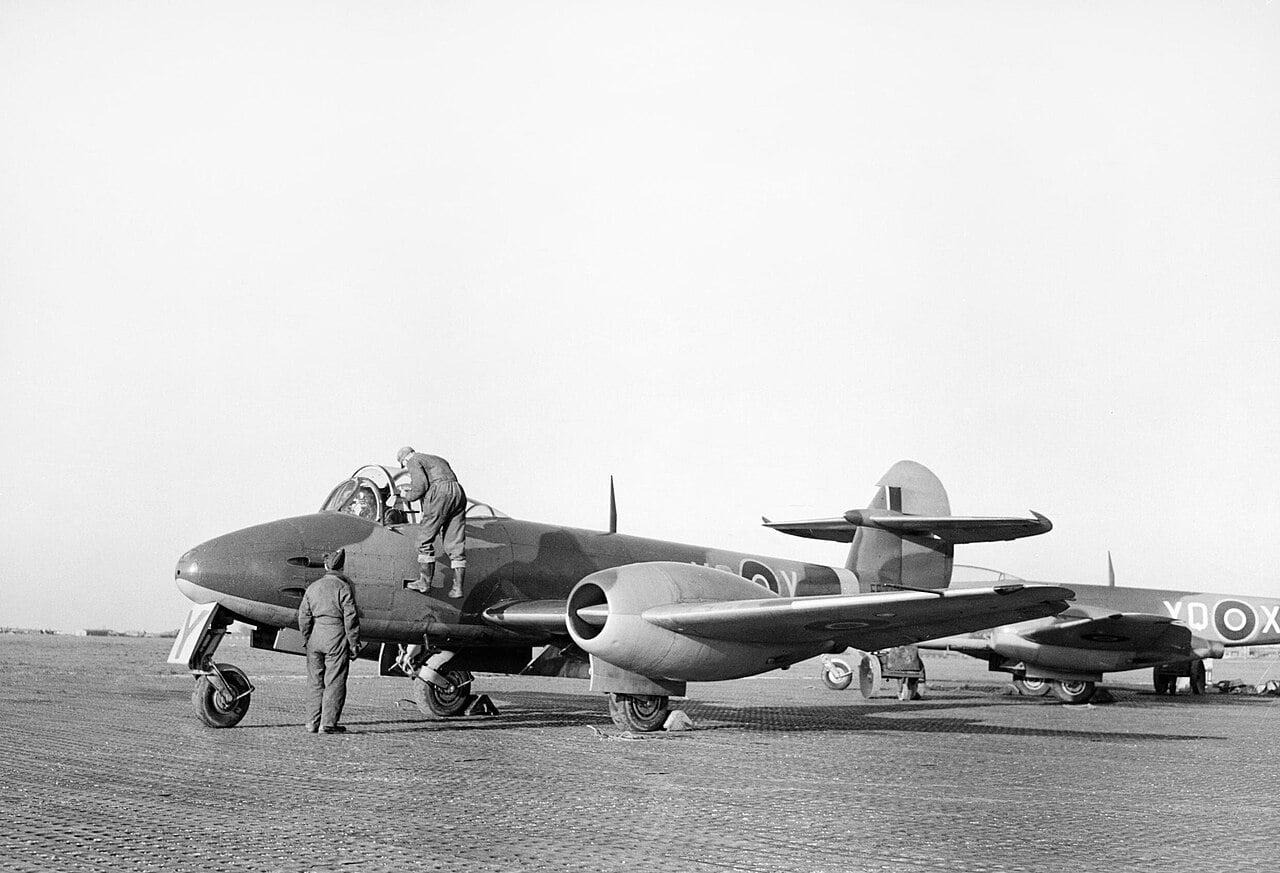
It did not go well. The Meteor's cannon were prone to jamming, and the type shot down only thirteen V-1s — fewer than a single good Tempest pilot managed on his own. It is a useful corrective to the idea that newer always means better. The jet had the performance and not the reliability; the piston fighter had both, and crews who knew it.
Pathé footage of flying bomb damage in Britain during 1944 — the consequence when one got through.
What It Was Actually For
The V-1 could not be aimed at anything smaller than a city. It was a terror weapon, and its purpose was to make London unlivable. It failed at that, but not because it was harmless.
Joseph Berry did not survive the war. On 2 October 1944, with the launch sites being overrun and 501 Squadron switched to ground attack, his Tempest was hit by small arms fire at fifty feet over Veendam in the Netherlands. He was 24.
The man who shot down more flying bombs than anyone else was killed by a rifle.
Sources: Wikipedia entries on the V-1 flying bomb, Operation Diver and Joseph Berry, including his published award citations; Imperial War Museums; British Pathé archive footage.
0 Comments