
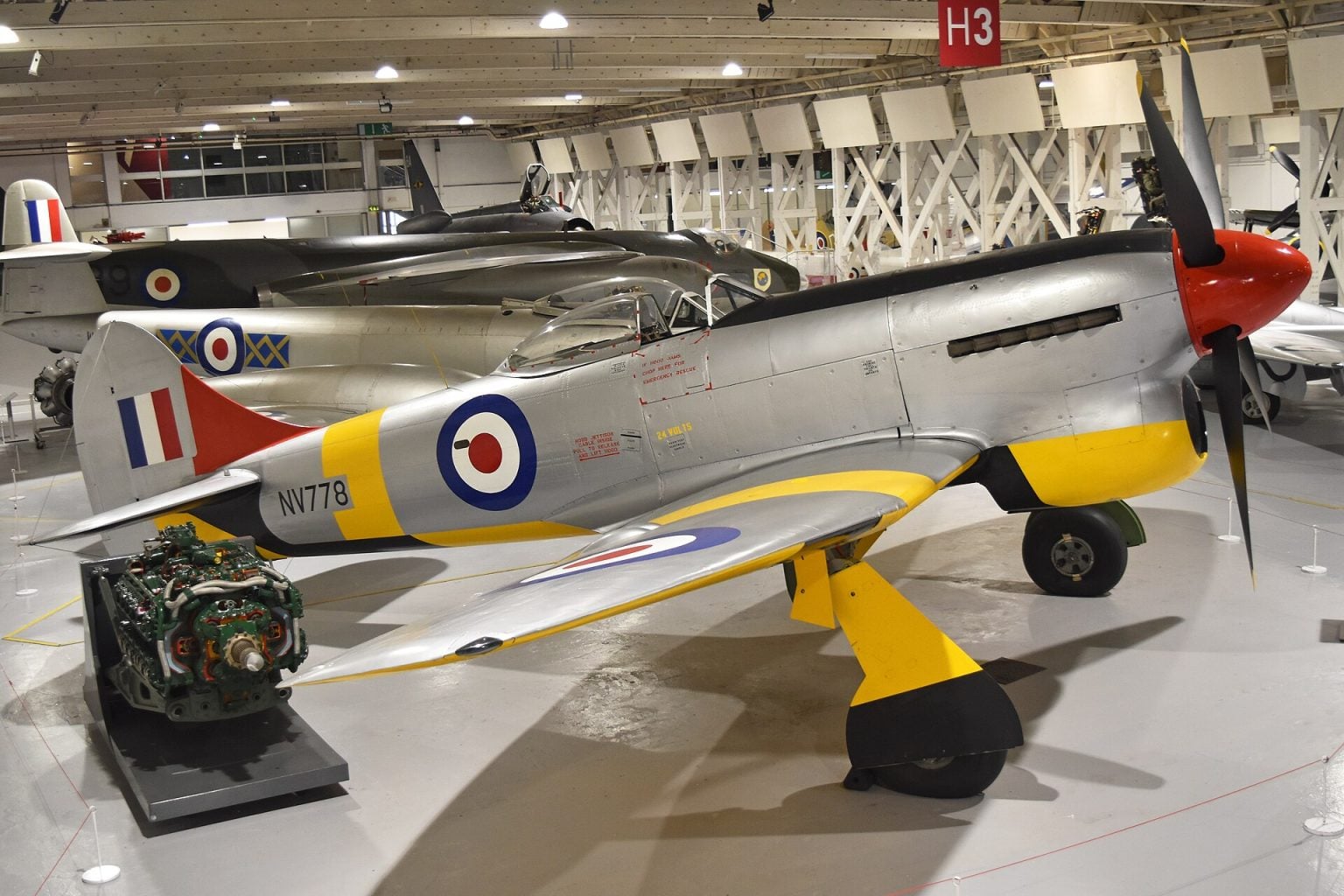
Hawker Tempest
The Typhoon perfected
A thin-winged redesign of the troubled Typhoon — the fastest low-level piston fighter the RAF flew, the deadliest V-1 flying-bomb hunter of the war, and one of the few aircraft to catch and kill the Me 262 jet.
Built to fix the Typhoon’s fatal flaw
The Hawker Typhoon was a brute of an aircraft — heavily armed, brutally fast at low level, and utterly deadly in the ground-attack role. But it had a crippling weakness. Its thick wing, around 18% thickness-to-chord, ran into compressibility at high speed and altitude: the airflow over it broke down in a dive, the controls grew heavy and the buffeting savage. As a high-altitude interceptor the Typhoon was a disappointment. Chief designer Sydney Camm and the Hawker team set out to cure it.
Their answer was a new, much thinner semi-elliptical wing of near-laminar-flow section, cut to about 14.5% thickness, which pushed the compressibility problems far higher up the speed range. The thin wing held less fuel, so the fuselage was lengthened and a tank added ahead of the cockpit. The result was so changed it earned a new name: first flown on 2 September 1942 and originally called the “Typhoon II,” it was renamed the Tempest in January 1942 and reached squadrons in early 1944.
What emerged was arguably the zenith of British piston-fighter design. Powered by the mighty 24-cylinder Napier Sabre, the Tempest V was the fastest thing the RAF had at low and medium altitude. That speed made it the war’s supreme V-1 flying-bomb killer in the summer of 1944, then a formidable air-superiority and ground-attack fighter over Germany — one of the very few types able to hunt down the jet-powered Messerschmitt Me 262.
01The Hawker Tempest’s origins: how a new wing turned the Typhoon into a war-winner
The Typhoon had been designed as a Hurricane replacement and interceptor, but its thick wing betrayed it above about 20,000 ft, where compressibility buffeting and heavy controls made high-altitude interception nearly impossible. It found its true calling lower down, smashing trains, tanks and shipping. Camm’s Tempest wing — thinner, elliptical in plan and laminar-flow in section — was the fix: it delayed the onset of compressibility, sharpened high-speed handling and gave the aircraft a genuinely fast, clean dive.
The trade-off was fuel: a thinner wing simply could not hold as much, so Hawker stretched the nose to add a forward fuselage tank, giving the Tempest a useful operational radius — reportedly on the order of 500 miles, far better than a Spitfire. Six prototypes were ordered around late 1941, each testing a different engine (Napier Sabre, Bristol Centaurus and Rolls-Royce Griffon variants), a deliberate hedge against engine-supply problems. The Sabre-powered Mark V won the wartime production race.
What makes it special
A thin laminar-flow wing — and blistering low-level speed
The heart of the Tempest is its thin, semi-elliptical, near-laminar-flow wing (about 14.5% thick versus the Typhoon’s 18%). It pushed compressibility troubles far up the speed range, giving clean high-speed handling and a fast dive. Married to the ~2,180 hp Napier Sabre, it made the Tempest V the fastest RAF piston fighter at low and medium altitude — roughly 435 mph (~700 km/h).
The war’s supreme flying-bomb killer
When the V-1 offensive opened in June 1944, the doodlebugs crossed the coast low and fast — exactly where the Tempest excelled. During Operation Diver, Tempest wings destroyed more V-1s than any other aircraft type, with commonly cited tallies in the range of 600–800. Some were “tipped” off course using wingtip airflow rather than gunfire — a technique later much mythologised.
Air superiority, jet-killing and ground attack
Over Germany with the 2nd Tactical Air Force, Tempest squadrons flew fighter sweeps and armed reconnaissance. Their four 20 mm Hispano cannon plus bombs or rockets wrecked trains, transport and airfields, and they were among the very few Allied fighters to shoot down the Me 262 jet — usually by catching it slow, in the take-off and landing phase near its bases.
02The Hawker Tempest’s engine: the temperamental Napier Sabre
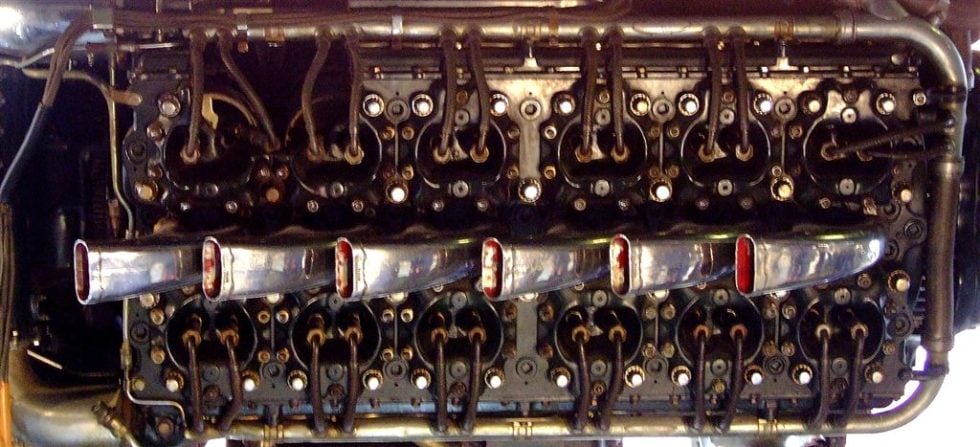
The Tempest V was built around the Napier Sabre, a radical 24-cylinder, horizontally-opposed (H-24), sleeve-valve, liquid-cooled engine designed by Frank Halford. It delivered around 2,180 hp in the Sabre II — enormous for its day — and later grew past 2,300 hp in the Sabre V of the Tempest VI. But it was notoriously troublesome early on: manufacturing faults in the sleeves caused seizures, and ground crews reputedly had to turn the engine over before start to avoid a lock-up. Reliability was only tamed with help from Bristol’s sleeve-valve expertise. When it worked, it was one of the most powerful piston aero-engines of the war.
03The Hawker Tempest II: the radial-engined version that missed the war
Not every Tempest used the Sabre. The Tempest II swapped the liquid-cooled H-24 for a Bristol Centaurus radial — simpler, air-cooled and better suited to hot climates. It promised excellent performance, but development dragged and it arrived too late for WWII combat. It became the postwar mainstay: rugged Centaurus Tempest IIs were handed to India and Pakistan at partition in 1947, and the thin-wing, radial formula led directly to the superb Hawker Sea Fury, one of the fastest piston fighters ever built.
Full specifications
Baseline note: the figures below describe the Tempest F. Mk V Series 2, the Sabre IIB-engined production standard that armed 122 Wing over the Netherlands and Germany in the winter of 1944–45 and to which nearly every published Tempest performance figure actually refers. Deltas for the single Sabre IV Tempest I, the Centaurus-engined Tempest II, the Griffon-engined Tempest III, the Sabre V Tempest VI and the post-war TT.5 target tugs are in grey. Two warnings before the tables begin. Sabre output was quoted at several different boost settings, so the same engine is credited with anything between 2,010 and 2,420 hp depending on which line of the engine card a compiler copied. And Jane's printed no empty weight for the Tempest V at all: the 9,000 lb figure repeated across the literature is a secondary estimate, not a manufacturer's number. Where authorities disagree a range is given rather than a false single figure. Tempest II and VI figures are documented far more thinly than Tempest V ones, and Indian and Pakistani service data hardly at all.
Dimensions & weights
- Crew
- 1. No two-seat Tempest was ever built; the two-seat Hawker of this family is the Sea Fury T.20, a later aeroplane
- Length
- 10.26 m (33 ft 8 in), against the Typhoon's 9.73 m (31 ft 11 in). The extra came from a 533 mm (21 in) fuel bay inserted ahead of the cockpit — the direct consequence of emptying the wing. Tempest II: 10.49 m (34 ft 5 in)
- Wingspan
- 12.50 m (41 ft 0 in). Marginally shorter than the Typhoon's 12.67 m (41 ft 7 in), and a different wing entirely rather than a clipped one
- Height
- 4.52 m (14 ft 10 in) in the rigging position with one blade vertical; 4.90 m (16 ft 1 in) tail down. Tempest II: 4.11 m (13 ft 6 in) rigging, 4.42 m (14 ft 6 in) tail down — the radial nose sat lower
- Wing area
- 28.06 m² (302 sq ft), against the Typhoon's 25.92 m² (279 sq ft). The thin wing was given more area, not less, to keep the landing speed tolerable
- Aerofoil
- Hawker H.14/14/37.5 at the root, H.14/10/37.5 at the tip — maximum thickness at 37.5 per cent chord. Thickness-to-chord 14.5 per cent root to 10 per cent tip, where the Typhoon ran 19.5 per cent to 12 per cent. Five inches of depth came out of the wing root, and that single change is what the whole aeroplane is for
- Wing planform
- Near-elliptical. The shape was not an aesthetic borrowing from the Spitfire but an arithmetic consequence: a thin wing with no fuel in it still had to swallow four Hispano cannon and 800 rounds, and the chord had to be carried outboard to do it
- Aspect ratio
- 5.57 — modest, and paired with spring-tab ailerons that gave the Tempest a roll rate above 400 km/h (250 mph) that no Bf 109G or Fw 190A could live with
- Undercarriage track
- 4.88 m (16 ft), widened over the Typhoon and given Dowty levered-suspension legs that shortened as they retracted, to clear the 4.27 m (14 ft) propeller and to cope with a 177 km/h (110 mph) touchdown
- Empty weight
- 4,082 kg (9,000 lb), a commonly repeated secondary figure rather than a published one — Jane's left the row blank. Treat it as an approximation of the right order, not a measured number
- Loaded weight, interceptor
- 5,171 kg (11,400 lb). Tempest II: 5,352 kg (11,800 lb). Tempest VI: 5,443 kg (12,000 lb). This is the condition in which the headline speed and climb figures were flown
- Loaded weight, fighter-bomber
- 5,670 kg (12,500 lb) with two 500 lb bombs, 6,124 kg (13,500 lb) with two 1,000 lb bombs; the Tempest II ran 454 kg (1,000 lb) heavier in each case. Maximum external stores 907 kg (2,000 lb)
- Wing loading
- 184 kg/m² (37.7 lb/sq ft) as an interceptor, rising to 218 kg/m² (44.7 lb/sq ft) fully bombed up — high by 1944 British standards and the reason the Tempest was flown fast and turned badly against a Spitfire
Performance
- Maximum speed
- 700 km/h (435 mph) at 5,180 m (17,000 ft). Tempest II: 711 km/h (442 mph) at 4,630 m (15,200 ft), though Jane's gives 708 km/h (440 mph) at 17,000 ft. Tempest VI: 724 km/h (450 mph) at 4,420 m (14,500 ft)
- Maximum speed at sea level
- 628 km/h (390 mph). Tempest II: 645 km/h (400.6 mph). Tempest VI: 636 km/h (395 mph). This row, not the one above it, is the Tempest's reason for existing — on the deck in 1944 nothing the Allies flew was faster
- Rate of climb, initial
- 23.9 m/s (4,700 ft/min) at combat power. Comfortably better than a Typhoon and roughly a match for a Spitfire IX at low level, falling away above 6,000 m (20,000 ft)
- Time to 6,100 m (20,000 ft)
- 6 minutes at combat power. Tempest II: 5 minutes. Tempest VI: 4 minutes 45 seconds — the Sabre V and Centaurus both bought back climb the Sabre IIB could not deliver
- Service ceiling
- 11,125 m (36,500 ft). Tempest II: 11,430 m (37,500 ft). Adequate on paper; in practice the single-stage supercharger meant that above roughly 7,600 m (25,000 ft) the Tempest was outclassed by the Spitfire XIV, and 2nd TAF planned accordingly
- Combat range
- 676 km (420 miles) on internal fuel with allowances for climb, combat and return. Short, and the reason drop tanks were treated as standard equipment rather than an option
- Radius extension on two 45 gallon tanks
- Hawker credited the pair of 205 litre (45 imp gal) tanks with adding some 800 km (500 miles) of operational radius. Armed-reconnaissance targets were routinely 400 km (250 miles) from Volkel
- Endurance on standing patrol
- 4 hours 30 minutes with drop tanks, flying anti-Diver racetracks off the Kent and Sussex coast in the summer of 1944. Very long for a single-seat fighter of the period, and central to the V-1 result
- Penalty for carrying drop tanks
- 8 to 16 km/h (5 to 10 mph) off maximum speed and about two per cent off range. Small enough that 122 Wing simply left the tanks on for the whole sortie, partly because they were awkward to jettison
- Landing speed
- 177 km/h (110 mph) — fast for a 1944 fighter, and the direct cause of the lengthened, wider-tracked undercarriage
- Compressibility behaviour
- Buffet-free to beyond 805 km/h (500 mph) indicated, where the Typhoon buffeted, tightened in the dive and in the worst cases shed its tail. Critical Mach number is usually given as roughly 0.78 against about 0.68 for the Typhoon; test reports differ, but the qualitative gap is not in dispute
- Power-to-weight
- 0.149 hp/lb (0.245 kW/kg) at 6,124 kg (13,500 lb). At interceptor weight it is materially better, which is why clean Tempests and bombed-up Tempests behaved like different aeroplanes
Propulsion & systems
- Engine
- One Napier Sabre IIB: 24 cylinders in an H layout, liquid-cooled, sleeve-valve, 36.7 litres (2,240 cu in), bore 127 mm (5.0 in) and stroke 121 mm (4.75 in), dry weight 1,070 kg (2,360 lb). The most complicated aero engine in British squadron service and, for two years, the least trusted
- Ratings
- 2,420 hp (1,804 kW) at +11 lb boost and 3,850 rpm for five minutes at sea level; 2,010 hp (1,499 kW) for take-off; 2,045 hp (1,525 kW) at 4,190 m (13,750 ft). Earlier Series 1 aircraft flew behind the 2,235 hp (1,667 kW) Sabre IIA
- Engines of the other marks
- Sabre IV in the one Tempest I; Sabre IIA, IIB and IIC across the Tempest V; Sabre V of 2,340 hp (1,745 kW) in the Tempest VI; Bristol Centaurus V of 2,590 hp (1,931 kW), an 18-cylinder two-row sleeve-valve radial, in the Tempest II; Rolls-Royce Griffon 85 with contra-rotating propellers in the single Tempest III, LA610
- Reliability, honestly
- The Sabre's sleeves, machined from chrome-molybdenum steel, failed and seized on the production line and in service. The Ministry of Aircraft Production had Bristol — which had spent a decade on sleeve valves — machine nitrided austenitic sleeves from Taurus forgings, and English Electric's takeover of Napier in December 1942 killed the speculative projects and forced the effort onto quality. Castings arrived uncleaned, rings broke, swarf was found inside engines. In cold weather ground crews ran Sabres every two hours through the night to stop the oil congealing. By 1944 the engine was reliable; its reputation never entirely recovered
- Propeller
- de Havilland Hydromatic or Rotol four-blade constant-speed, 4.27 m (14 ft) diameter. The four-blade unit cured the high-frequency vibration that had dogged the Typhoon. Tempest II: Rotol four-blade of 3.89 m (12 ft 9 in)
- Cooling
- Pressurised 70 per cent water, 30 per cent ethylene glycol. The production Tempest V kept the Typhoon's chin radiator; the abandoned Tempest I put radiators in the wing leading edges; the Tempest II used a close-cowled radial with automatic gills. Two Tempest Vs, EJ518 and NV768, flew Napier annular radiators worth 18 to 23 km/h (11 to 14 mph)
- Internal fuel
- 727 litres (160 imp gal), of which 345 litres (76 imp gal) sit in the nose tank forward of the cockpit and the remainder between the wing spars. The Typhoon carried fuel in its wing leading edges; the Tempest could not, and the whole nose and tail redesign follows from that one fact
- Oil
- 73 litres (16 imp gal). Tempest II: 64 litres (14 imp gal). Tempest VI: 100 litres (22 imp gal)
- External tanks
- Two 205 litre (45 imp gal) streamlined tanks designed by Hawker specifically for the type, with the plumbing built into the new wing. A 409 litre (90 imp gal) pair was also cleared
- Flight controls
- Spring-tab ailerons — the single most underrated feature of the aeroplane. They lightened stick forces so far that roll rate above 400 km/h (250 mph) became a decisive tactical advantage, and so far that a batch of aircraft had the tabs removed in late 1944 because pilots could overstress the airframe with them
- Protection
- Laminated bulletproof windscreen centre panel, 38 mm (1.5 in) outer over 6 mm (0.25 in) inner, in a three-piece screen whose framing was redrawn after Hawker examined captured Fw 190s. Armour behind the pilot; self-sealing tanks
- Sighting
- Reflector sight on early aircraft, the Mk IID gyro gunsight on later ones. The gyro sight mattered more than any other single fit for a type spending its war shooting at flying bombs and at jets in the circuit
04The Hawker Tempest’s cost: why no reliable price exists
The Tempest was a wartime British government product built under Air Ministry contract, never sold on an open market, so a firm flyaway unit price and a credible cost-per-flight-hour figure simply do not exist in the public record. Wartime aircraft costs were also heavily distorted by state financing, bulk contracts and shifting labour and material prices. Any precise dollar or pound figure attached to a Tempest today should be read as an estimate rather than a sourced fact. What is well documented is the scale of production — roughly 1,700 built across all marks, about 800 of them Sabre-powered Mark Vs.
Armament & payload
The Tempest carried four cannon, two drop tanks and very little else, and won its reputation with the guns alone
Four 20 mm Hispano and 800 rounds were the whole armament of a Tempest, and the aeroplane was built around them: the near-elliptical wing exists because the thin, fuel-free section still had to bury four guns, their belts and their ammunition boxes deep enough to leave a clean laminar surface. Everything else the type could hang under its wings was a later concession. The Tempest V was cleared for 907 kg (2,000 lb) of bombs, and it dropped them, but its 239 confirmed air-to-air victories, its 638 flying bombs and the great majority of the trains and vehicles it destroyed all came from cannon fire.
That is a fair description of the difference between the Tempest and the Typhoon it grew out of. The Typhoon became the RAF's rocket aeroplane; the Tempest became its gun aeroplane, held back for armed reconnaissance and low-level air superiority precisely because it was too valuable to spend on rocket attacks against flak-defended targets. The Centaurus-engined Tempest FB.II reversed that emphasis after the war, with reinforced wings, pylons and rails, and it was in that guise that the type dropped bombs in Malaya and flew ground attack for India and Pakistan. Fits varied considerably between the Series 1 and Series 2 Tempest V, the F.2 and FB.2, and RAF, Indian and Pakistani practice; treat any single loadout table as one operator's convention rather than the type's ceiling.
Gun
- 4 × 20 mm Hispano cannon in the wings, 800 rounds total. The first 100 Tempest Vs (Series 1) carried the long-barrelled Hispano Mk II, whose muzzles projected ahead of the leading edge under short fairings, at 200 rounds per gun
- From Series 2 onwards the short-barrelled Hispano Mk V was fitted, muzzles flush with the leading edge — lighter, faster-firing at roughly 750 rounds per minute, and aerodynamically cleaner. Series 1 wings could accept Mk V guns and some were retrofitted
- Tempest II carried slightly less ammunition: 162 rounds for each inboard gun and 152 for each outboard
- A four-cannon salvo was heavy enough to destroy a V-1 in a single burst and to knock down an Me 262 that had been caught slow. It was also heavy enough that pilots were taught to open fire on flying bombs from 200 m or more, because a warhead detonating at close range would take the fighter with it
- One Tempest V, SN354, was fitted post-war with two underwing Vickers 47 mm Class P anti-tank guns in slim pods, 38 rounds each. It went no further than trials
Air-to-air
- Guns only. Practical guided air-to-air missiles did not exist when the Tempest entered service and the type was gone from front-line units before they arrived
- Reflector sight on early aircraft, Mk IID gyro gunsight on later ones — a real capability increase for deflection shooting against jets and flying bombs
- Against the V-1 the standard method was cannon fire from astern at a safe distance. The famous alternative — sliding a wingtip under the bomb's wing to topple its gyro — was flown, and is often overstated: it was a technique for pilots out of ammunition, not a doctrine
- Tempest units finished the war with 239 confirmed victories, 9 probables, and 31 losses and probable losses in air combat, a ratio of roughly 8:1. The top-scoring Tempest pilot, Squadron Leader David Fairbanks of 274 Squadron, an American in the RCAF, had 11 or 12 destroyed and one shared when he was shot down and captured in February 1945
Air-to-surface guided
- None, in any mark, in any air force, at any time. The Tempest carried no guided air-to-ground weapon
- The card is kept because the absence explains the tactics. Everything the type did against ground targets it did with cannon in a shallow strafing pass, and the cost of that was paid in flak: seven Tempests were lost in a single week to the anti-aircraft belt at Rheine-Hopsten, and 122 Wing lost 47 pilots in January 1945 alone
- The Germans understood the arithmetic perfectly and ringed their jet bases with more than 150 quadruple 20 mm Flakvierling mounts. Unguided attack against a defended airfield was a losing trade, and the RAF eventually banned it outright for several days in March 1945
Bombs
- Two wing racks, each rated for a 500 lb or a 1,000 lb bomb — a maximum of 907 kg (2,000 lb) external
- The reinforced Series 2 spar structure was what made this possible; early Series 1 aircraft were flown as pure fighters
- Standard British stores: 250 lb, 500 lb and 1,000 lb general-purpose and medium-capacity bombs
- Bombing was a secondary trade for the Tempest V. In north-west Europe the wing's standing tasks were the destruction of the north German rail network by gunfire and the maintenance of low-level air superiority; the Tempest FB.II with strengthened wings and racks was the mark that carried bombs as a matter of routine, in Malaya and in Indian and Pakistani service
Rockets
- 8 × 3 in (76 mm) RP-3 rocket projectiles on underwing rails, four per wing, with 60 lb high-explosive or 25 lb armour-piercing heads
- This is one of the most frequently muddled points about the type. RP-3 carriage on the Tempest V was cleared late and used very little operationally — the RAF's rocket aeroplane in 1944–45 was the Typhoon, and Tempest squadrons were deliberately kept for other work
- The Tempest FB.II was the rocket-carrying mark in practice, and RAF Tempest IIs fired RP-3 against Malayan National Liberation Army camps during the early Malayan Emergency
- Rockets and bombs competed for the same wing stations, and both competed with the drop tanks the type needed to reach anything
Pods & other stores
- Two 205 litre (45 imp gal) streamlined drop tanks, designed by Hawker for this aeroplane, with plumbing built into the new wing. A 409 litre (90 imp gal) pair was also cleared. On armed reconnaissance these were carried throughout the sortie, empty, because they cost only 8 to 16 km/h (5 to 10 mph) and were awkward to jettison
- No radar, in any mark. The Tempest was never a night fighter and never carried an airborne interception set
- No camera installation and no reconnaissance variant. Tactical reconnaissance in 2nd TAF was flown by Mustangs and Spitfires; the Tempest's "armed reconnaissance" was an attack mission, not a photographic one
- No gun pods beyond the SN354 47 mm trial, and no countermeasures equipment of any kind
- Post-war TT.5 conversions carried a target-towing winch and windmill drive, and wore the yellow and black stripes of the trade. It is a melancholy end for the fastest low-level Allied fighter of 1945, and it is how most surviving Tempest Vs finished their careers
Three typical loadouts
- Anti-Diver standing patrol, 150 Wing, Newchurch, June to August 1944
- Full cannon load, two 45 gallon drop tanks, no bombs. Racetrack patrols of up to four and a half hours between the coast and the balloon barrage, vectored by coastal radar, with the tanks on until the moment of the intercept.
- Armed reconnaissance, 122 Wing, Volkel, winter 1944–45
- Eight aircraft in two finger-fours, full cannon, two 45 gallon tanks retained throughout. Cross the line at 2,100 to 2,400 m (7,000 to 8,000 ft), lead section down to 1,200 m (4,000 ft) or lower to hunt trains and vehicles, the second section 300 m (1,000 ft) higher and down sun, sections swapping until the ammunition ran out.
- Ground attack, Tempest FB.II, Malaya 1948–50 and Indian service
- Full cannon plus either two 500 lb bombs or eight RP-3 rockets, no drop tanks on short-radius work. This is the configuration in which the Centaurus Tempest actually fought, a decade after the mark was drawn up to fight the Japanese.
Sourcing caveat: cannon and store fits are drawn from Ovčáčík and Susa, Mason's 1967 monograph, Thomas and Shores, and the Hawker Tempest Page's transcription of the Air Ministry pilot's notes. Rocket and bomb clearances changed repeatedly between 1944 and 1948 and the surviving paperwork is not consistent; the 47 mm Class P installation is documented only in trials reports.
Variants
Five engines were tried in the Tempest and only two of them reached squadrons
The Tempest exists because Sydney Camm and his team were dissatisfied with the Typhoon before the Typhoon had entered service. The P.1012, the "Thin-Wing Typhoon", addressed the one thing the Typhoon could not be argued out of: a NACA four-digit wing 19.5 per cent thick at the root, which met compressibility early, buffeted, and made the aeroplane useless above about 6,000 m (20,000 ft). Camm gave it a new wing of 14.5 per cent root thickness with maximum depth at 37.5 per cent chord, a near-elliptical planform to make room for four cannon and 800 rounds in a section that had no depth to spare, a 533 mm (21 in) fuselage plug ahead of the cockpit to carry the fuel the wing could no longer hold, and a fin of nearly double the area with a bigger tailplane to cope with the longer nose. What emerged was a different aeroplane wearing a Typhoon's clothes.
Because the Sabre had already delayed the Typhoon badly, the Air Ministry insisted on prototypes with alternative powerplants — and it was right to. The Sabre IV Tempest I, the fastest of the family on paper at 750 km/h (466 mph), died with its engine. The Griffon Tempest III became a Fury prototype. The Centaurus Tempest II arrived too late for the war it was tropicalised for. Only the Sabre II Tempest V, the interim aeroplane, fought.
- Tempest Mk I — HM599 (first flight 24 February 1943 / 1 built)
- Napier Sabre IV, radiators buried in the wing leading edges, no chin radiator. Reached 750 km/h (466 mph) and was the design Hawker wanted. Abandoned when the Sabre IV was cancelled.
- Tempest Mk V prototype — HM595 (first flight 2 September 1942 / 1 built)
- Sabre II with the Typhoon's chin radiator, framed canopy and car door as a stopgap; quickly given a bubble canopy and the enlarged fin. The compromise that became the production aeroplane, and later the Tempest VI conversion.
- Tempest F. Mk V Series 1 (1943–44 / 100 built)
- Long-barrelled Hispano Mk II projecting ahead of the wing, Typhoon-pattern five-spoke wheels and a number of other Typhoon components. Sabre IIA of 2,235 hp.
- Tempest F. Mk V Series 2 (1944–45 / 701 built)
- Short-barrelled Hispano Mk V flush with the leading edge, Sabre IIB or IIC, forged wing spar booms, detachable rear fuselage and a spar structure cleared for 907 kg (2,000 lb) of stores. The mark that fought.
- Tempest Mk II — F.2 and FB.2 (1944–47 / 452 built: 402 by Hawker at Langley, 50 by Bristol at Banwell)
- Bristol Centaurus V radial of 2,590 hp in a close cowling with automatic gills, carburettor intakes in the wing roots. Prototypes LA602 and LA607 flew from 28 June 1943; the first production aircraft only on 4 October 1944. Of the Hawker aircraft, 100 were F.2 fighters and 302 FB.2 fighter-bombers with strengthened wings and pylons. Faster, smoother, better-climbing and better-ranged than the Tempest V — and too late for the war.
- Tempest Mk III and Mk IV (1943–44 / 1 flown, 1 cancelled)
- Griffon 61 (Mk IV, cancelled February 1943 without being built) and Griffon 85 (Mk III, LA610). Griffon supply went to the Spitfire, and LA610 was completed instead as the second Hawker Fury prototype, flying on 27 November 1944 with a six-blade contra-rotating propeller.
- Tempest F. Mk VI (1945–47 / 142 built of 250 ordered)
- Napier Sabre V of 2,340 hp, a larger radiator that pushed the oil cooler and carburettor intake out into the wing roots, and tropical filtering on most airframes. Equipped nine RAF squadrons, five of them in the Middle East, and was the last piston-engined fighter in RAF operational service. Phasing out began in 1949.
- Tempest TT. Mk 5 (1947–53 / conversions from Tempest V)
- Target tugs with winch and windmill drive. The claim that Tempest VIs were similarly converted appears in older references but is not supported by any service history or photograph.
- Experimental Tempest Vs — EJ518, NV768, SN354 (1945–47 / 3 modified)
- EJ518 and NV768 flew Sabre Vs behind Napier annular radiators that looked like a Tempest II nose and were worth 18 to 23 km/h (11 to 14 mph); NV768 later had a ducted spinner copied from the Fw 190 V1. SN354 carried two 47 mm Vickers Class P anti-tank guns.
- Indian and Pakistani Tempest FB.2 (1947–53 / 89 to India, 24 to Pakistan)
- Transferred from RAF stocks at partition; both air forces flew them until 1953. Indian Tempests flew close support over Kashmir in the 1947–48 war and intercepted Pakistani transports. Almost every Tempest airframe that survives today came home from India.
- Hawker Fury and Sea Fury (1944 onwards / about 860 built)
- Not a Tempest variant but its direct issue. Camm began the "Tempest Light Fighter" in September 1942 because the Tempest was judged heavy and oversized; the Fury took the Tempest's semi-elliptical wing and cut the centre bay out of it, put the fuselage on a true monocoque and raised the cockpit. The RAF cancelled its order; the Fleet Air Arm did not, and the Sea Fury FB.11 went on to fight MiG-15s over Korea.
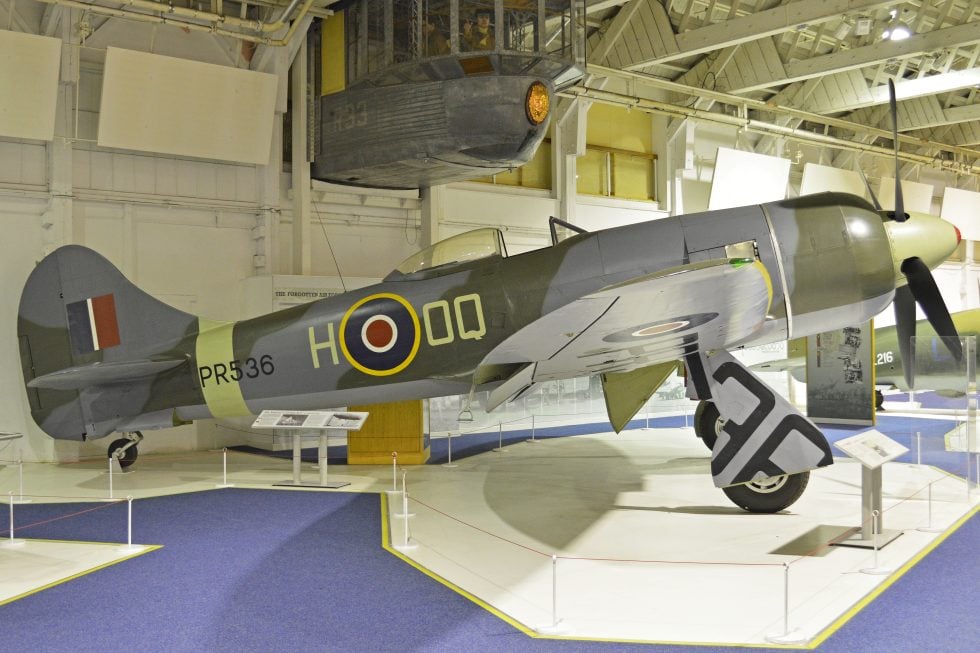
Two closing cautions. First, production totals do not reconcile. Mason's widely quoted total of 1,702 Tempests cannot be built out of the mark-by-mark figures, which give 801 Tempest V, 452 Tempest II and 142 Tempest VI — 1,395 production aircraft, or about 1,402 including prototypes, which is close to the 1,401 quoted elsewhere. The higher figure is best treated as an order total rather than a delivery total. Second, survivors: roughly a dozen airframes exist and all are original, since no Tempest reproduction has been built. Exactly one flies — Tempest II MW763, ex-Indian Air Force HA586, which returned to the air at Sywell on 10 October 2023 after a restoration that had run since 1989. Three are on public display: Tempest II PR536 at the RAF Museum Cosford, TT.5 NV778 at the RAF Museum London at Hendon, and Tempest II HA623 (ex-MW848) at the Indian Air Force Museum, Palam. Two Tempest IIs are stored: the prototype LA607 and MW401 in the United Kingdom. Five are under long-term restoration to fly — Tempest IIs MW404 and MW810 in Texas and MW376 with KF Aerospace at Kelowna, and Tempest Vs EJ693 for Kermit Weeks and JN768, the latter acquired by the Hawker Typhoon Preservation Group partly for use in the Typhoon RB396 rebuild. Note what that list means: every complete Tempest in the world is a Centaurus-engined Mk II recovered from India. Not one Sabre-engined Tempest V, the mark that flew the entire war, survives intact anywhere.
From Typhoon fix to postwar warhorse
The problem
Hawker begins studies to cure the Typhoon’s high-speed, high-altitude compressibility troubles with a new, thinner wing.
Prototypes ordered
Six prototypes are contracted, each testing a different engine — Napier Sabre, Bristol Centaurus and Rolls-Royce Griffon — against supply uncertainty.
First flight
Renamed from “Typhoon II” to Tempest, the Sabre-powered prototype (HM595) first flies on 2 September 1942.
Enters service
The Tempest V reaches No. 486 (NZ) Squadron in January and is operational by spring 1944.
Operation Diver
From 13 June, the Newchurch Wing spearheads the V-1 defence; Tempests become the war’s top flying-bomb killers.
Over Germany
With the 2nd Tactical Air Force, Tempest squadrons score ~240 air-to-air kills, including at least 20 German jets.
Partition
Radial-engined Tempest IIs pass to the new air forces of India and Pakistan; PAF forms Nos. 5 and 9 Squadrons at Peshawar.
End of the line
The Tempest VI is retired as the RAF’s last piston-engined fighter; the design lineage lives on in the Hawker Sea Fury.
From the cockpit: twelve Tempest stories
The wing that made the Tempest
Camm swapped the Typhoon’s thick wing for a thin laminar-flow one — and cured its worst flaw.
Read the full story
From “Typhoon II” to Tempest
The aircraft that began life as a Typhoon subvariant became a type in its own right.
Read the full story
The temperamental Napier Sabre
Frank Halford’s 24-cylinder sleeve-valve H-engine was mighty — and maddening.
Read the full story
The doodlebug summer
When the flying bombs came in June 1944, the Tempest was the right aircraft in the right place.
Read the full story
Tipping the flying bomb
Pilots learned to topple a V-1 with a wingtip — not by ramming it.
Read the full story
Joseph Berry, top doodlebug killer
The RAF’s leading V-1 ace scored most of his tally at night.
Read the full story
The wing in the Kent marshes
A spartan advanced landing ground became the front line of the V-1 battle.
Read the full story
Hunting the Me 262
The Tempest could not out-run a jet — so it caught it slow.
Read the full story
David “Foob” Fairbanks
An American in the RAF became the top-scoring Tempest pilot.
Read the full story
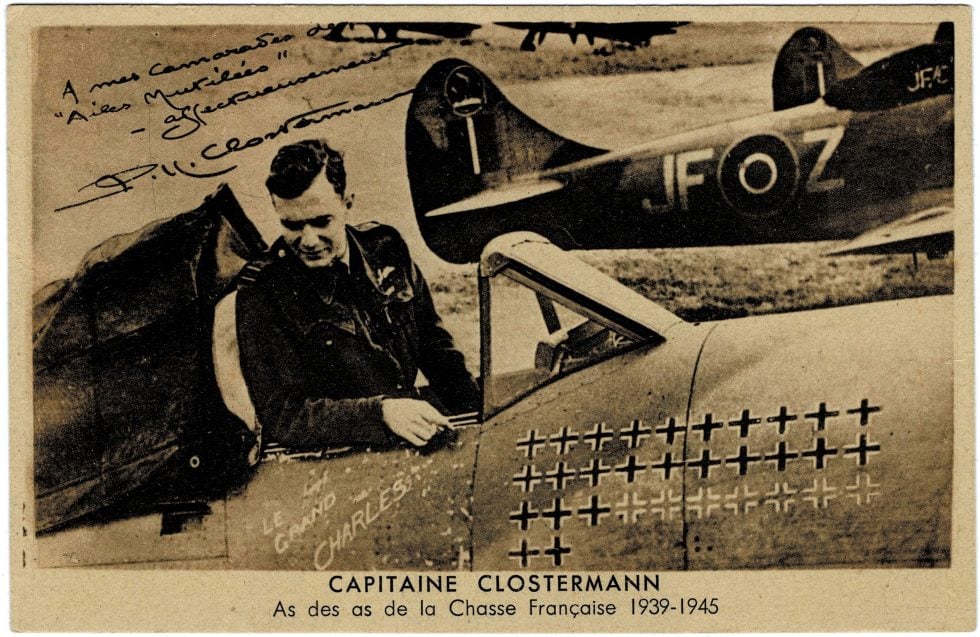
Clostermann and “Le Grand Charles”
The French ace flew Tempests in the last weeks of the war — and wrote about it.
Read the full story
Partition warriors
At Indian independence, radial Tempest IIs went to two new air forces.
Read the full story
The road to the Sea Fury
The Tempest’s thin-wing, radial formula produced one of the greatest piston fighters ever.
Read the full story
The Tempest in pictures
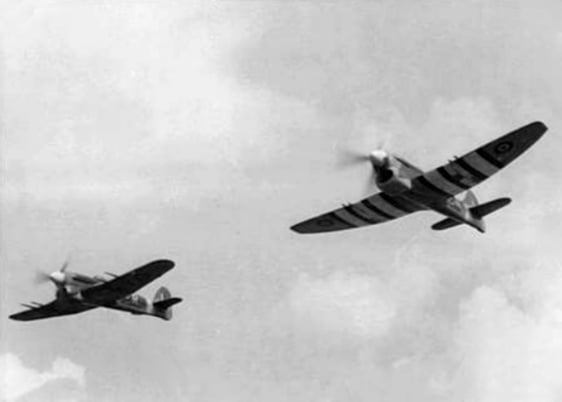
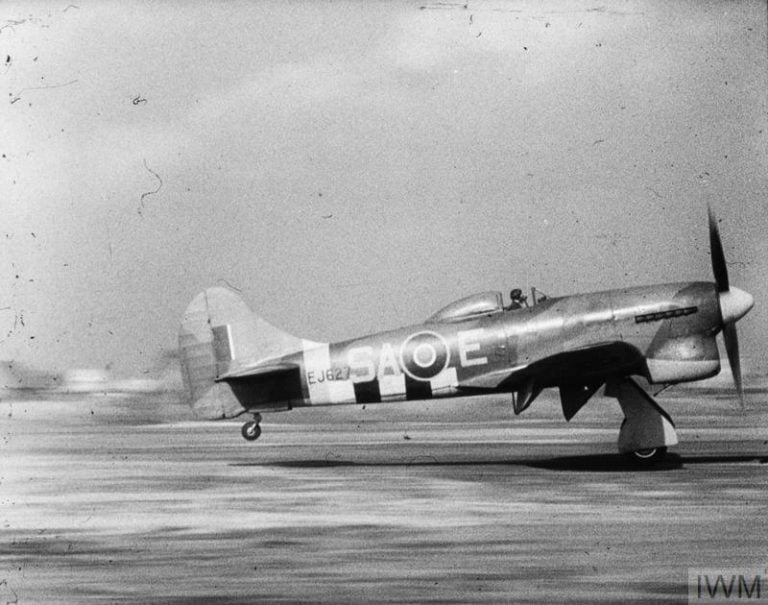
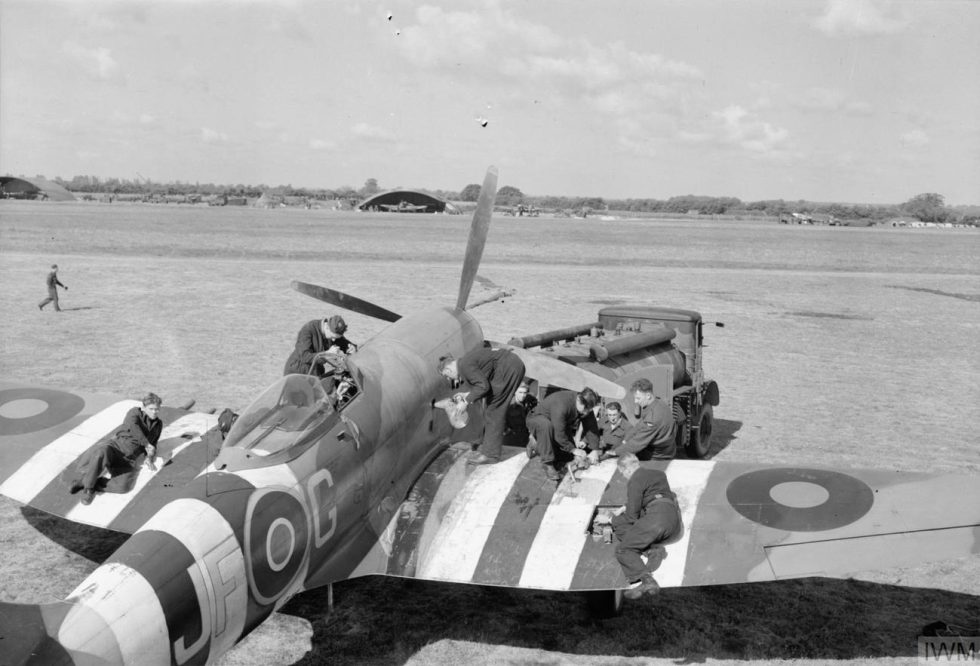
The Tempest in motion
Video coming soon. We are curating a high-quality documentary film on the Hawker Tempest — its origins in the Typhoon, the V-1 summer of 1944 and its air battles over Germany — to feature here.
Where the Tempest flew
The score that defines it
The Tempest’s combat record is written in three places: the flying-bomb battle over southern England, the fighter sweeps over Germany, and the ground-attack war against the Wehrmacht. It was the RAF’s deadliest V-1 hunter, one of the very few Allied fighters to down the Me 262 jet, and a fast, heavily armed opponent the Luftwaffe respected at low level. Figures below are the most commonly cited — individual tallies vary by source.
Compare the combat record of every military aircraft. Figures as of July 2026.
Everything people ask about the Tempest
Can I fly in a Tempest?
How fast was the Hawker Tempest?
How is the Tempest different from the Hawker Typhoon?
Did the Tempest really shoot down V-1 flying bombs?
Could the Tempest shoot down the Me 262 jet?
What engine did the Tempest use?
Did India and Pakistan operate the Tempest?
What did the Tempest lead to?
You can’t fly the Tempest.
These, you can.
Some legends only live in museums — others are fuelled and waiting. MiGFlug has put civilians in real military jet cockpits since 2004.
 Fly the L-39 AlbatrosThe world’s most-flown jet trainer — aerobatics included
 Fly the F-104 Starfighter“The missile with a man in it”
 Fly the MiG-21The Cold War’s most-produced jet
 Fly the T-33 Shooting StarAmerica’s first jet trainer
 Fly the DH VampireA piece of early jet history
 Fly the S.211Agile Italian jet trainer
 Fly the MB-326The classic Aermacchi jet
 Fly the MiG-15The Soviet legend of the Korean War
Continue the tour
Every fact, checked
- Royal Air Force MuseumTempest development, the Typhoon II renaming, wing-thickness figures, V-1 tally, Rat Code tactics and production totals.
- HistoryOfWar.org — Hawker TempestDevelopment timeline, first flight (2 Sept 1942), prototype engines and service history.
- Key Aero / Key PublishingNewchurch Wing, 2 TAF kill tally, and the Tempest as the zenith of British piston-fighter design.
- Imperial War MuseumsRoland Beamont oral history on commanding the Tempest wing and the V-1 “tipping” technique.
- Forces NewsExpert explanation that wing-tipping toppled V-1s via airflow, not physical ramming.
- IMechE — Engineers at WarThe Napier Sabre H-24 sleeve-valve engine: design, power growth and reliability troubles.
- Second To None (PAF history)Pakistan’s Tempest IIs, Nos. 5 and 9 Squadrons at Peshawar and their replacement by the Sea Fury.
- MilitaryMachine — Tempest Mk VConsolidated specifications: dimensions, Sabre power, speed, ceiling, range and armament.