
Hawker Typhoon
“Tiffy”
Britain’s big, brutal ground-attack fighter — nearly cancelled over a troubled engine and tails that broke off in flight, then reborn as the rocket-firing scourge of the Normandy battlefield.
The Hawker Typhoon: from near-failure to the RAF’s ground-attack scourge
In 1937 Hawker’s chief designer Sydney Camm set out to replace his own Hurricane with something far more powerful — a heavy interceptor built around one of the giant new 2,000-horsepower engines then on the drawing board. The aircraft that emerged, the Typhoon, was hung on the 24-cylinder Napier Sabre, a sleeve-valve monster of extraordinary output and even more extraordinary unreliability. The prototype first flew on 24 February 1940, and the type reached No. 56 Squadron in September 1941 as the RAF’s first fighter capable of more than 400 mph in level flight.
Its early service was close to a disaster. The Sabre was temperamental and prone to failure; the cockpit leaked carbon monoxide, so pilots flew on oxygen from take-off; and worst of all, aircraft began shedding their entire tail units in flight, almost always killing the pilot. Add a thick wing that strangled performance above about 20,000 ft — fatal for the high-altitude interceptor it was meant to be — and by 1942 the RAF came close to cancelling the whole programme.
It was saved by an accident of tactics. When Focke-Wulf Fw 190 fighter-bombers began fast “tip-and-run” raids on English coastal towns, the Typhoon turned out to be the only RAF fighter fast enough on the deck to catch them. From that low-level niche grew its real calling. Fitted with four 20 mm cannon, then bombs, then RP-3 rockets, the Typhoon became the spearhead of the 2nd Tactical Air Force — and in the Normandy summer of 1944 the most feared Allied aircraft over the battlefield.
01Why the Hawker Typhoon was almost cancelled in 1942
Three problems nearly killed the Typhoon before it found its role. The Napier Sabre was rushed into service half-developed — early engines managed only around ten flying hours between overhauls and had a habit of failing on take-off. Then came the structural failures: a run of aircraft lost their tails in the air, an accident sequence that eventually cost about two dozen pilots their lives before the cause was traced to a weak rear-fuselage joint and elevator flutter, and cured with riveted external “fishplates” by early 1943. On top of that, the Typhoon’s thick wing meant its performance fell away badly at height, so it failed at the very job — high-altitude interception — it had been designed for. Only the emergence of the low-level Fw 190 threat gave it a reason to survive.
What makes the Hawker Typhoon special
The Napier Sabre: 2,000+ hp and a maintenance nightmare
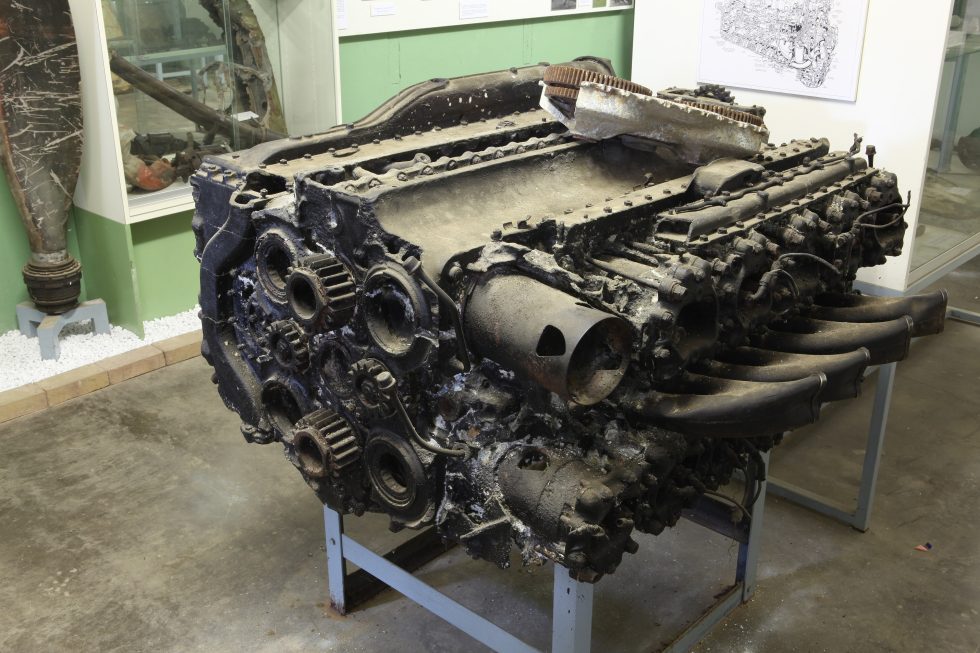
The Typhoon was built around the Napier Sabre, a liquid-cooled 24-cylinder “H”-configuration sleeve-valve engine of about 36.7 litres — effectively four six-cylinder blocks geared together. It gave roughly 2,180 hp, among the most powerful piston aero-engines of the war, but it was notoriously hard to start, prone to sleeve seizures and, early on, needed servicing every few flying hours. Taming the Sabre took years.
Fast and heavy at low level: four 20 mm cannon
Where the Typhoon shone was on the deck. At around 412 mph at low altitude it was the only RAF fighter that could run down the Fw 190 “tip-and-run” raiders. Its definitive Mk IB carried four 20 mm Hispano cannon — a devastating punch against locomotives, vehicles, shipping and aircraft, and the foundation of its later ground-attack career.
Rockets and the birth of modern close air support
From late 1943 the Typhoon carried up to eight RP-3 “60-lb” rockets or two 500–1,000 lb bombs. Directed from the ground by the famous “cab rank” system, rocket Typhoons could be called down onto a target within minutes — a template for the close air support that armies still rely on today.
02The Hawker Typhoon’s Napier Sabre engine: power at a terrible price
The Sabre’s sleeve-valve design promised smoothness and huge power from a compact package, and at its best it delivered well over 2,000 hp. But Napier struggled to manufacture the sleeves to tolerance, and early Sabres suffered seizures, hard starting and fires. Reliability only came with better materials and, crucially, chromium-plated sleeves developed with Bristol. In Normandy the engine faced a new enemy — abrasive dust on forward strips — which Napier countered with a hastily designed high-efficiency air filter. The Sabre was a brilliant, exhausting engine that the Typhoon’s whole troubled early career was hostage to.
03The Hawker Typhoon’s rockets: fearsome reputation, imperfect weapon
The RP-3 rocket projectile turned the Typhoon into a legend, but it was a blunt instrument. The unguided rockets left the rails in a spread and dropped steeply, so hitting a small moving target such as a tank was extremely hard — in one controlled trial four Typhoons fired all 64 rockets at a stationary Panther and scored just three hits. What made the Typhoon decisive was not pinpoint tank-killing but the sheer weight of cannon and rockets it could bring down on transport, supply columns and morale, forcing German armour to move only at night. (See the story carousel below for how post-war analysis punctured the tank-kill claims.)
Full Hawker Typhoon specifications
Baseline note: the figures below describe the Typhoon Mk IB in its late-production form — four 20 mm Hispano cannon, the one-piece sliding "bubble" hood, the four-bladed propeller and the enlarged Tempest tailplane — which is the aircraft that flew the north-west European campaign from 1944. Deltas for the twelve-machine-gun Mk IA and for the earlier car-door aircraft are in grey. A 1945 Typhoon looked and flew appreciably differently from a 1941 one: the type was modified continuously, so any single set of figures is a snapshot of one moment in a long and untidy development.
Dimensions & weights
- Crew
- 1
- Length
- 9.74 m (31 ft 11.5 in) with the four-bladed propeller; early aircraft were 38 mm (1.5 in) shorter
- Wingspan
- 12.67 m (41 ft 7 in)
- Height
- 4.67 m (15 ft 4 in) late production; 4.52 m (14 ft 10 in) on early aircraft
- Wing area
- 25.9 m² (279 sq ft)
- Aerofoil
- NACA 2219 at the root, NACA 2213 at the tip — thickness/chord 19.5 per cent at the root falling to 12 per cent at the tip. This is the single most consequential number on the page: it is a very thick wing for a 1940 fighter, it gave the aircraft its strength, its fuel volume and its rock-steady gun platform, and it also gave it the drag rise that ruined its performance above about 6,000 m
- Wing bend
- Slight inverted gull — 1° anhedral on the inner panels, 5.5° dihedral outboard of the undercarriage legs
- Undercarriage track
- 4.13 m (13 ft 6.75 in) — wide, inward-retracting, and one reason the Typhoon coped with the rough advanced landing grounds in Normandy better than a Spitfire did
- Empty weight
- 4,010 kg (8,840 lb)
- Normal loaded weight
- 5,170 kg (11,400 lb)
- Maximum take-off weight
- 6,010 kg (13,250 lb) with two 454 kg (1,000 lb) bombs
- Internal fuel
- ~700 litres (~154 imp gal; ~185 US gal) in four wing tanks — two 182-litre (40 imp gal) main tanks behind the undercarriage bays and two 168-litre (37 imp gal) nose tanks in the leading edges
- Drop tanks
- 2 × 205 litres (45 imp gal), the same cylindrical tanks the Hurricane had used since 1940
- Armour
- ~354 kg (~780 lb) added from 1943, lining the sides and floor of the cockpit and engine compartment and the radiator bath. It was fitted because the Sabre’s liquid cooling system was appallingly vulnerable to a single rifle-calibre round from the ground
- Wing loading
- 200 kg/m² (40.9 lb/sq ft) at normal loaded weight
Performance
- Maximum speed
- 679 km/h (422 mph) at 3,810 m (12,500 ft) with a Sabre IIA and the four-bladed propeller. Note where that peak sits: low down. At 6,100 m (20,000 ft) tests gave 660 km/h (410 mph) and the curve fell away sharply above it
- Maximum speed, rockets fitted
- 618 km/h (384 mph) — a full set of eight RP-3 rockets and their rails cost 61 km/h (38 mph). The rails alone, which could not be jettisoned, cost 24 km/h (15 mph) and were carried home whether the rockets had been fired or not
- Rate of climb
- 13.9 m/s (2,740 ft/min) at 4,360 m (14,300 ft) in full-supercharger gear at 3,700 rpm
- Service ceiling
- 9,690 m (31,800 ft) — the number that ended the Typhoon’s career as an interceptor before it began. A Spitfire IX reached about 13,000 m (43,000 ft)
- Best climbing speed
- 298 km/h (185 mph) indicated to 4,880 m (16,000 ft), reducing by 5 km/h (3 mph) for each further 305 m (1,000 ft)
- Range, clean
- 1,110 km (690 mi)
- Range with two 227 kg bombs
- 820 km (510 mi)
- Range with drop tanks
- 1,755 km (1,090 mi) — enough to reach deep into France, Belgium and the Netherlands, and the change that turned the Typhoon into an offensive aircraft in 1943
- Dive limit
- 845 km/h (525 mph) indicated. Above roughly 800 km/h (500 mph) compressibility produced buffeting and trim changes; this is exactly the problem that produced the thin-winged Tempest
- Speed limit with bombs
- 645 km/h (400 mph), a stability restriction rather than a structural one
- Stalling speed
- 142 km/h (88 mph) clean. Carrying two 227 kg (500 lb) bombs at 5,510 kg (12,155 lb) it rose to 145–161 km/h (90–100 mph) flaps up and 113–121 km/h (70–75 mph) flaps down. The stall dropped a wing sharply, as most fighters of the day did
- Power-to-weight
- 0.33 kW/kg (0.20 hp/lb) at normal loaded weight
Propulsion & systems
- Engine
- 1 × Napier Sabre IIA, IIB or IIC — a 24-cylinder H-block, liquid-cooled, sleeve-valve piston engine of 36.7 litres (2,240 cu in), dry weight about 1,070 kg (2,360 lb). Two flat horizontally opposed twelve-cylinder engines stacked one above the other, with the accessories grouped above and below rather than fore and aft
- Power
- 1,626 kW (2,180 hp) for the Sabre IIA; 1,641 kW (2,200 hp) for the IIB and 1,685 kW (2,260 hp) for the IIC
- Reliability
- Bad, and then survivable — the sleeves were the problem. Napier could not make them work in mass production; the Ministry of Aircraft Production had Bristol machine nitrided austenitic steel sleeves from Taurus forgings, which is what actually fixed the engine. It remained hard to start in cold weather, drank oil, and produced a high-pitched shriek that pilots found exhausting on a long sortie
- Propeller
- de Havilland or Rotol constant-speed — three blades until early 1944, four thereafter. The four-bladed unit was adopted for take-off performance with two 454 kg (1,000 lb) bombs, and it also cut the airframe vibration that had made pilots describe touching the cockpit walls as like a mild electric shock
- Cooling and filtration
- Chin radiator under the nose, with a Vokes and RAE drum filter (Mod 420) from mid-1944 and a streamlined tropical filter (Mod 421) faired behind the radiator on late aircraft — the filters were a direct response to Normandy dust, over 80 per cent of it hard abrasive material, which was wearing out Sabre sleeves in about three take-offs
- Cockpit environment
- Carbon monoxide seepage, never fully cured — standard procedure throughout the war was to breathe oxygen from engine start to engine shutdown. Cockpit temperatures were measured at 57 °C (135 °F) in April 1943 trials with 486 (NZ) Squadron
- Sight
- GM.2 reflector gunsight; the GM.IIL with a depressible reflector and a graduated scale for rocket aiming — there was no computing sight of any kind. Everything the rockets did or failed to do came down to the pilot judging range, dive angle, speed and trajectory drop by eye
- Radio, navigation and IFF
- VHF radio telephony, Mk III IFF from late 1943 with a bayonet aerial under the wing centre section, and a Rebecca beam-approach transponder fitted during 1944 — the whip aerial replaced the mast and its bracing from August 1943 to improve rearward view
- Escape
- No ejection seat — and on the early aircraft, no realistic way out at all. The forward-opening car doors could not be used reliably in the air, which is a large part of why the tail failures killed 23 of the 25 pilots involved
- First flight
- 24 February 1940 (prototype P5212, flown by Philip Lucas from Langley; delayed more than a year because the Sabre was not ready)
- Service entry
- September 1941 with Nos. 56 and 609 Squadrons
- Withdrawal
- October 1945 — out of operational use within five months of VE Day
- Number built
- 3,317 — all but a handful by Gloster at Hucclecote, because Hawker’s own lines were full of Hurricanes and later Tempests
04The Hawker Typhoon’s cost: why there is no clean price tag
The Typhoon was a wartime state production run of around 3,300 aircraft (the RAF Museum cites 3,317; some sources 3,330), built overwhelmingly by Gloster Aircraft because Hawker had no spare capacity. Wartime unit costs were accounted in 1940s pounds under emergency contracts and are not comparable to a modern flyaway price, and no meaningful cost-per-flight-hour figure exists for a type retired in 1945 with a single airworthy-condition survivor. Any precise dollar figure attached to a Typhoon today is an estimate.
Armament & payload
The Typhoon carried the heaviest punch of any single-engined RAF fighter, and its most famous weapon was also its least accurate
Four belt-fed 20 mm Hispano cannon, two 454 kg bombs or eight three-inch rockets: by 1944 no other Allied single-seater in Europe routinely went to work with that much aboard. The cannon were the reliable part of the armoury and did most of the actual destruction, chiefly to the soft-skinned lorries, fuel bowsers and ammunition columns on which German armour depended. The rockets were the part that made the reputation, and the postwar operational research is unambiguous that they hit far less often than anyone believed at the time. Fits varied sharply by squadron and by date: the first 110 aircraft carried twelve rifle-calibre machine guns instead of cannon, 2nd Tactical Air Force squadrons specialised as either rocket or bomb units rather than swapping between them, and the reconnaissance FR IB gave up one or two cannon for cameras.
Gun
- Four 20 mm Hispano Mk II cannon, two in each wing, with 140 rounds per gun — the belt-fed British version of the HS.404, made workable by a Martin-Baker feed mechanism after the 60-round drums of the Mk I had proved hopeless in a manoeuvring fighter
- Muzzle velocity 840–880 m/s, cyclic rate 600–700 rounds per minute, firing a 130 g shell. Semi-armour-piercing incendiary and high-explosive incendiary natures were the standard mix
- The thick wing made the installation easy and the aircraft steady: pilots consistently described the Typhoon as a rock at 645 km/h (400 mph), which is exactly what a gun platform needs
- Some 246 Axis aircraft were claimed by Typhoon pilots with these guns. Far more important was what they did to transport — a strafing pass into a fuel and ammunition column achieved more than a rocket salvo into a tank, and cost nothing but ammunition
- Mk IA: twelve .303 in (7.7 mm) Browning machine guns, six per outer wing panel, 500 rounds each. Fitted to the first 110 aircraft only because the Châtellerault cannon feed mechanism was in short supply; many were later converted to IB standard
Air-to-air
- None carried. No guided air-to-air weapon existed in RAF service in the Second World War; the four cannon were the air-to-air armament
- The Typhoon was nonetheless a genuine low-level interceptor for about a year. Alongside the Griffon-engined Spitfire XII it was the only RAF fighter that could catch a Focke-Wulf Fw 190A-4 or A-5 on the deck, which is why it survived cancellation in 1942
- Against the Luftwaffe’s "tip and run" coastal raids, squadrons held pairs on standing patrol at 150 m (500 ft) with another pair at two minutes’ readiness through daylight. 486 (NZ) Squadron alone claimed 20 fighter-bombers and three bombers between October 1942 and July 1943
- The first two Messerschmitt Me 210s destroyed over the British Isles fell to Typhoons in August 1942; on 20 January 1943 Typhoons destroyed four Bf 109G-4s and an Fw 190A-4 of JG 26 over London. The top-scoring Typhoon pilot, Johnny Baldwin, claimed 15 aircraft
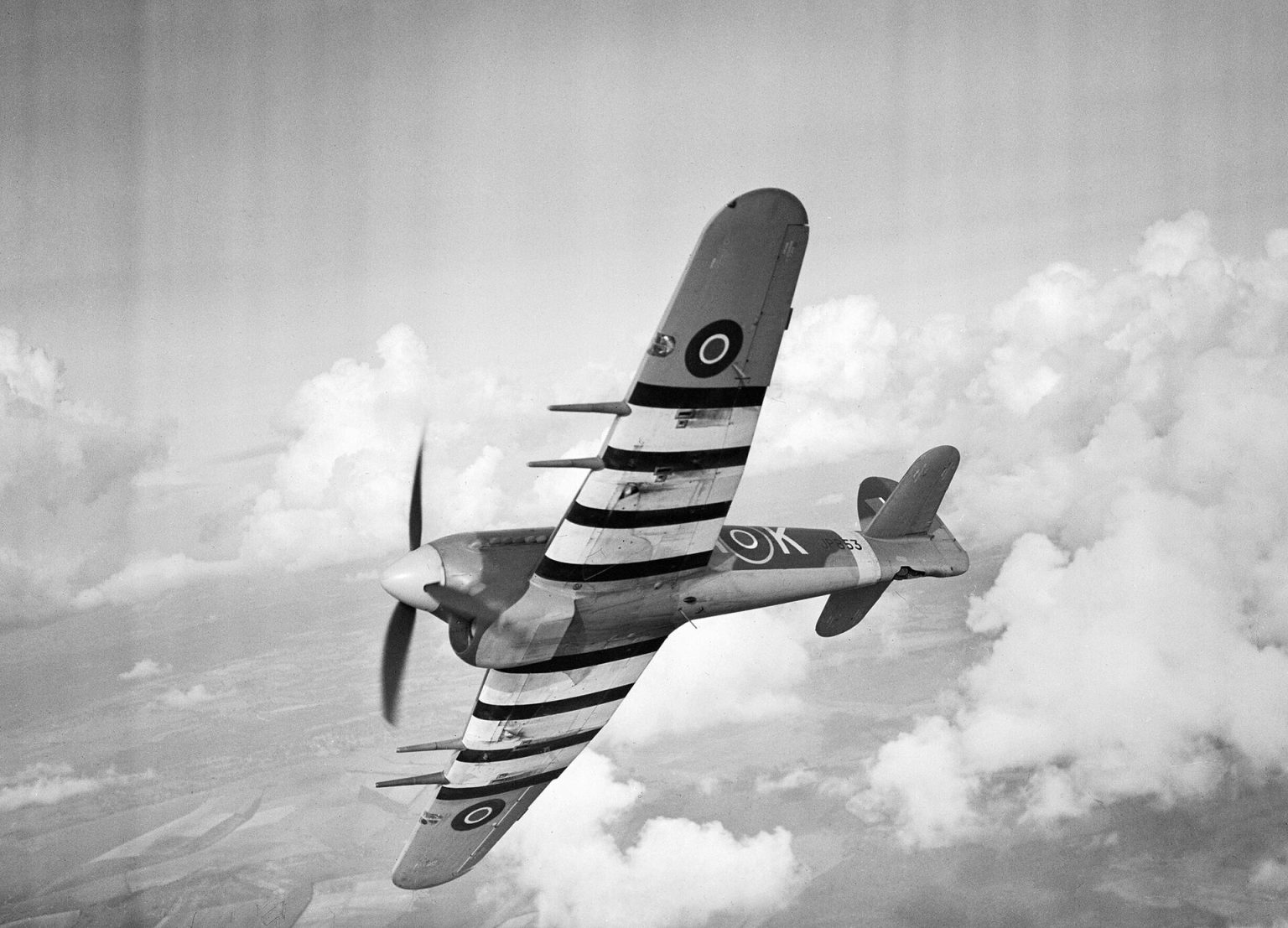
- The type’s planform resembled an Fw 190 from several angles and it was repeatedly shot at by its own side. White nose bands came first, then the black-and-white underwing stripes that were the direct ancestor of the D-Day invasion markings
Air-to-surface guided
- None. No guided air-to-ground weapon reached RAF fighter squadrons during the Second World War, and the Typhoon never carried one
- This matters more than it sounds. Everything the Typhoon threw was ballistic and unguided, aimed through a reflector sight by a man in a 645 km/h (400 mph) dive who was also being shot at
- The nearest thing to precision the type achieved was procedural rather than technical: the "cab rank", in which RAF controllers riding with the forward troops in radio-equipped vehicles called down orbiting Typhoons onto targets marked by coloured smoke shells
- The same system was used for intelligence-led strikes on German headquarters. On 10 June 1944, 42 Typhoons and medium bombers hit Panzergruppe West’s headquarters at La Caine, wounding its commander and killing much of his staff; on 24 October 1944, 146 Wing killed 17 staff officers and 36 other officers of the German Fifteenth Army in a single building in Dordrecht
Bombs
- Two 227 kg (500 lb) bombs on underwing racks from October 1942, first used operationally by 181 Squadron. The press called the result the "Bombphoon"
- Two 454 kg (1,000 lb) bombs after trials in 1943 — a load equal to a light bomber of only a few years earlier, off a single-seat fighter. This is what drove the four-bladed propeller, the larger Tempest tailplane and the bigger brakes
- Bomb release was limited to 645 km/h (400 mph) for stability reasons, and the cannon shell-case ejector slots had to be extended so that spent brass cleared the stores
- In theory rails and racks were interchangeable. In practice 2nd Tactical Air Force squadrons specialised — 198 Squadron flew rockets only, others bombs only — both to simplify supply and to let crews get genuinely good at one weapon
- By D-Day 2nd TAF fielded eleven rocket squadrons and seven bomb squadrons of Typhoons, with a further nine squadrons in Fighter Command
Rockets
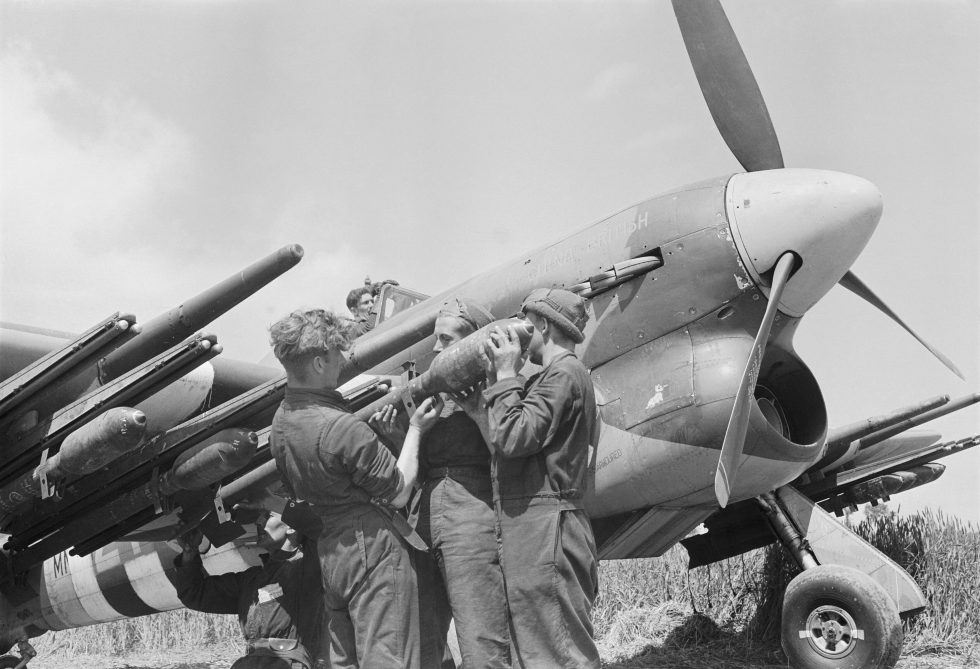
- Eight RP-3 three-inch rockets, four on Mk I steel rails under each wing, fired singly, in pairs or as a salvo. First operational use by 181 Squadron in October 1943
- Two warheads mattered. The 60 lb SAP/HE head — a 152 mm, 27.4 kg semi-armour-piercing high-explosive charge — was the standard land-attack fit and left the rail at about 230 m/s. The solid 25 lb (11 kg) armour-piercing shot, at about 380 m/s, was used against U-boats and shipping
- The steel Mk I rails weighed 218 kg (480 lb) per set and stayed on all sortie. Aluminium Mk III rails from December 1944 halved that to 109 kg (240 lb). Late in the war some aircraft double-banked to twelve or sixteen rockets, though the rough Normandy strips made this impractical for most units
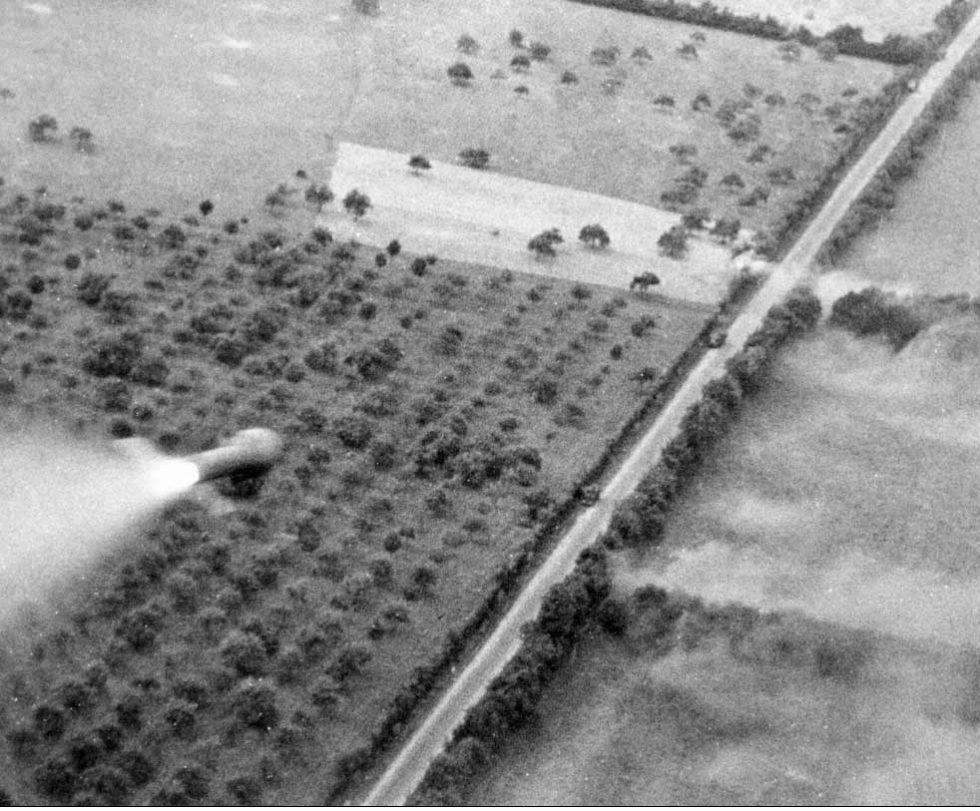
- Accuracy was poor and it was known to be poor. The rocket was spin-stabilised by four large fins, had no guidance, and demanded an exact speed, an exact dive angle and no sideslip or yaw at the moment of release, with a substantial trajectory drop to allow for. Analysis of destroyed tanks after Normandy gave a hit rate of about 4 per cent
- What the rockets did deliver was terror and paralysis. Prisoner interrogations found that the prospect of a rocket attack was in itself unnerving enough to stop movement, and Operational Research Sections repeatedly found vehicles abandoned intact or with only superficial damage
Pods & other stores
- Two 205-litre (45 imp gal) drop tanks on the same wing racks, plumbed from early 1943. With a tank under each wing the Typhoon’s radius roughly doubled; a mixed fit of one tank and two outboard rockets per wing was also flown
- Three F24 cameras on the FR Mk IB — one forward-facing 356 mm (14 in) and two vertical 127 mm (5 in) units — installed in place of the port inner cannon
- Concrete practice heads for the RP-3 in 25 lb and 60 lb weights, some fitted with a titanium tetrachloride smoke container that marked the impact point. Practice bombs of concrete were used the same way
- No gun pods, no external sighting pods, no countermeasures dispensers of any kind. A Typhoon carried its weapons, its fuel and nothing else — the electronic war passed this aeroplane by entirely
Three typical loadouts
- Low-level interception, Channel coast, spring 1943
- Four Hispano Mk II with 140 rounds per gun and nothing else. Standing patrol at 150 m (500 ft) over the south coast against Fw 190 fighter-bombers, with a second pair at two minutes’ readiness. Clean, this is the fastest the Typhoon ever was at low level, and it was the only thing Fighter Command had that could catch the raiders.
- Cab rank close support, Normandy, July 1944
- Eight RP-3 with 60 lb SAP/HE heads on steel Mk I rails, four cannon fully loaded, no drop tanks. Orbiting at low level over the bridgehead within radio range of a forward controller, waiting for a target marked by smoke shell. Top speed down 61 km/h (38 mph); endurance short enough that the airstrip had to be in France, which is why 2nd TAF lived on hastily bulldozed advanced landing grounds.
- Deep interdiction, Netherlands, autumn 1944
- Two 454 kg (1,000 lb) bombs, four cannon, four-bladed propeller and enlarged tailplane. Railway bridges, marshalling yards, canal traffic and headquarters buildings well behind the front. Released below 645 km/h (400 mph); alternatively two 227 kg (500 lb) bombs and a 205-litre drop tank under the opposite wing where the target was further out.
Sourcing caveat: performance figures follow Francis Mason’s Hawker Aircraft Since 1920 and the Air Ministry Pilot’s Notes; armament detail follows Shores and Thomas, Second Tactical Air Force. The rocket effectiveness numbers come from the wartime Operational Research Sections attached to 21 Army Group and 2nd TAF, whose reports are the primary evidence and are discussed at length in Terry Copp’s Montgomery’s Scientists. Those surveys have a known weakness — they sampled wrecks rather than counting every one, and smoke and dust made attribution genuinely hard — and some historians argue the resulting overclaim ratio is implausibly large by comparison with air-to-air overclaiming. The honest reading is that the rockets killed far fewer tanks than was claimed, that they killed some, and that the argument is about how many.
Variants
The Typhoon failed completely at the job it was designed for and then became the best ground-attack aircraft the Allies had in Europe
Sydney Camm began sketching a Hurricane successor in March 1937, before Hurricane production had properly started. What the Air Ministry eventually asked for, in Specification F.18/37, was a fighter that would do 645 km/h (400 mph) at 4,570 m (15,000 ft), reach at least 10,670 m (35,000 ft), and carry twelve rifle-calibre machine guns. Hawker offered two nearly identical airframes distinguished by their engines: the "R", with the X-block Rolls-Royce Vulture, became the Tornado, and the "N", with the H-block Napier Sabre, became the Typhoon. Both engines were 24-cylinder, both were meant to give more than 1,490 kW (2,000 hp), and both were the reason the aircraft existed at all. The Vulture failed and took the Tornado with it. The Sabre very nearly failed and very nearly took the Typhoon with it.
Three separate defects almost ended the programme. The first was aerodynamic and unfixable: the wing was thick, 19.5 per cent at the root, and the drag rise robbed the aircraft of the high-altitude speed and climb the specification had demanded. Above roughly 6,000 m the Typhoon was simply not competitive with a Spitfire IX, and as a Spitfire replacement it was a straightforward failure. The second was the engine. Napier could hand-build Sabres that made 1,640 kW but could not mass-produce them; sleeve valves seized, oil consumption was ruinous, cold starting was miserable and the engine’s shriek wore pilots out. It took Bristol’s sleeve-manufacturing experience and English Electric’s 1942 takeover of Napier to make the thing reliable enough to fly to war.
The third defect killed people. Typhoons began losing their entire tail sections, mostly in high-speed dives. The prototype had already split at the joint behind the cockpit in May 1940, and Philip Lucas landed it and got a George Medal for doing so. On 11 August 1942 the Hawker test pilot Ken Seth-Smith was killed when R7692, with eleven hours on the airframe, shed its tailplane in straight and level flight. The investigation found the mechanism: the bracket holding the elevator mass-balance bellcrank failed, unrestrained flutter set in, and the fuselage broke at a weak transport joint just forward of the tail. The cure came in stages — an internal steel strap from September 1942, then Mod 286, which riveted twenty alloy fishplates externally around the joint and stiffened the rear frames, then modified balance weights from May 1943 and a redesigned assembly from August 1944. It was never wholly cured. Twenty-five aircraft were lost and 23 pilots killed to tail failures, and the last batch was caused by a 1944 change to the undercarriage latch that let the fairings drop into the slipstream at speed. Add to that carbon monoxide leaking into a cockpit that reached 57 °C, so that pilots flew on oxygen from start-up to shutdown, and it is a wonder the type survived 1942 at all.
What saved it was the Focke-Wulf Fw 190. When the 190 appeared in 1941 and began cutting up Spitfire Vs, and then when the Luftwaffe started low-level "tip and run" raids across the Channel, the Typhoon turned out to be the only RAF fighter fast enough on the deck to catch them. The thick wing that ruined it at altitude gave it strength, fuel volume and stability down low. From late 1942 the squadrons found their real job. Bomb racks came in October 1942, drop tanks in early 1943, rocket rails in October 1943. By D-Day 2nd Tactical Air Force had eighteen Typhoon squadrons and the aircraft had become the most effective tactical strike aircraft the RAF possessed.
Which brings us to the tank-killing, the best-documented myth correction in the history of air power. During Operation Goodwood in July 1944 the 2nd TAF claimed 257 tanks destroyed, of which Typhoon pilots claimed 222 with rockets. When the ground was secured, No. 2 Operational Research Section walked the battlefield and could attribute exactly ten of the 456 knocked-out German armoured vehicles found there to Typhoon rockets. At Mortain in August, 2nd TAF and the US Ninth Air Force between them claimed 252 tanks; only 177 German tanks and assault guns took part in the battle at all, only 46 were lost, and nine were verified as Typhoon kills. At Falaise the Operational Research Sections found 17 vehicles destroyed by rocket strike alone. The pattern is consistent: the rockets were hitting at something like four per cent, and the claims were out by a factor of roughly twenty.
None of which makes the Typhoon a failure at Mortain or Falaise, and this is the part that gets lost when the correction is stated too baldly. The German Army’s own chief of staff signalled that the Mortain counter-attack had been brought to a standstill by one o’clock in the afternoon "due to the employment of fighter-bombers by the enemy, and the absence of our own air-support". Crews abandoned undamaged vehicles and walked away. Columns stopped moving in daylight. The 20 mm cannon shredded the unarmoured lorries carrying the fuel and ammunition that armour cannot fight without. The Typhoon’s effect at Falaise was moral and logistical rather than metallurgical — it did not kill many tanks, it stopped them being used — and that is a real and decisive military effect, just not the one the communiqués described. Eisenhower’s tribute to "the rocket-firing Typhoon aircraft of the Second Tactical Air Force" was earned; the arithmetic behind it was not.
- Hawker Tornado (1939–41, 4 built)
- Not a Typhoon variant but its twin: the same F.18/37 airframe around the X-block Rolls-Royce Vulture, identifiable by a ventral radiator and a rounder nose. The Vulture failed and was cancelled, and with it the Tornado. Worth knowing because it explains why an order for 1,000 aircraft in 1940 was split 500 Tornado and 250 Typhoon, with the balance to be decided later — the Air Ministry thought the Vulture was the more promising engine.
- Typhoon Mk IA (1941–42, first 110 aircraft)
- Twelve .303 in Browning machine guns with 500 rounds each, six in each outer wing panel. Built this way only because the cannon feed mechanism was short, and obsolete on arrival: by 1941 twelve rifle-calibre guns were not enough to bring down a modern fighter. Many were later converted to IB standard.
- Typhoon Mk IB, car-door (1941–43, the bulk of early production)
- Four Hispano Mk II cannon and the distinctive forward-opening car doors with wind-down windows. The first 162 aircraft had a solid metal fairing behind the pilot’s head armour; from late 1941 that became a transparent structure the pilots christened the "coffin hood". Heavy framing and clutter under the rear canopy made the view poor, and the doors made bailing out close to impossible.
- Typhoon Mk IB, bubble hood (1943–45, from JR333)
- The baseline described in the specifications above. A one-piece clear sliding canopy with a slim new windscreen and a cut-down rear fairing, tested on R8809 from January 1943 and standard on production aircraft from November 1943. Conversion kits were rushed out by Gloster, Hawker and Cunliffe-Owen so that as many 2nd TAF aircraft as possible had it before Overlord. Combined with the four-bladed propeller, the Tempest tailplane and the anti-shimmy tailwheel, this is the mature Typhoon.
- Typhoon FR Mk IB (1944–45, small number converted)
- Tactical reconnaissance fighter with three F24 cameras in place of the port inner cannon. Pilots disliked it: the asymmetric cannon fit made the aircraft yaw when firing, so the starboard inner gun was often removed as well, and the airframe and engine vibration blurred the photographs. Most served with 268 Squadron from July 1944 and the variant was phased out in January 1945 in favour of the Mustang.
- Typhoon N.F. Mk IB (1943, 1 converted)
- R7881, fitted with airborne interception radar, night-flying cockpit lighting and associated modifications. A prototype only. The Typhoon had already proved too fast for Turbinlite work with radar-equipped Havocs in 1942, which is how 486 (NZ) Squadron came to be a day-fighter unit.
- Typhoon "Tropical" (1943, 5 modified)
- Air filter in a fairing behind the main radiator housing. Three went to Egypt for trials with No. 451 Squadron RAAF. The Typhoon never served in the Mediterranean or the Far East, but the filter design came back into its own over Normandy as Mod 421.
- Sabre IV testbed (1944, 1 aircraft)
- R8694, rebuilt by Napier with the more powerful Sabre IV, an annular radiator in a redesigned nose and a four-bladed propeller. Napier claimed 727 km/h (452 mph). It was not pursued: the Tempest was coming, and disrupting Typhoon production for the gain was not judged worthwhile.
- Hawker P.1009 "Sea Typhoon" (1941, not built)
- A navalised proposal with a new centre section spanning over 13.7 m (45 ft), Hellcat-style rearward-folding wings, a longer rear fuselage, arrestor hook and catapult gear. The Admiralty concluded it would be no quicker than persisting with the Blackburn N.11/40, which eventually became the Firebrand. A land Typhoon, DW419, was allocated for carrier trials in 1942 but crashed in February 1943; by December the take-off run and stalling speed had settled the question.
- Typhoon Mk II, renamed Hawker Tempest (1942–45, 1,702 built)
- Camm’s answer to the compressibility problem: the same basic aeroplane with a thin laminar-flow wing of 14.5 per cent thickness at the root, an elliptical planform, a longer fuselage and a proper fuel arrangement to compensate for the wing tanks the thin section could no longer hold. The differences were so large it was given its own name. The Tempest V did everything the Typhoon could not — it was fast at altitude, it was the best low-level Allied fighter of 1944, and it shot down V-1s in numbers.
Survivors: one complete Hawker Typhoon exists anywhere in the world. MN235 is at the Royal Air Force Museum in Hendon; it spent the postwar years in the Smithsonian’s collection and came to Britain in 1968 in exchange for a Hurricane, marking the RAF’s fiftieth anniversary, then went on loan to the Canada Aviation and Space Museum in Ottawa and returned to Hendon in November 2018. That is the entire complete survival of a type built 3,317 times, and the reason is that the Typhoon was withdrawn from operational use in October 1945 and scrapped wholesale within a couple of years. Of the partial airframes, the significant one is RB396, a 174 Squadron aircraft that force-landed near Denekamp in the Netherlands on 1 April 1945 after being hit by flak. It is being rebuilt to fly by the Hawker Typhoon Preservation Group, formed in 2016, with structural work by Airframe Assemblies on the Isle of Wight and the Aircraft Restoration Company at Duxford, and with the cockpit section of Typhoon EJ922 incorporated into it. The project is still under way and has no flight date. The original aim of flying for the eightieth anniversary of D-Day in 2024 was missed; work paused at the end of 2021 for lack of funds and restarted in December 2023, and as of the group’s own most recent public statements the first major section is nearing completion. The rebuild is costed at around £5 million, of which over £1 million has been raised since 2016 — so the honest position is that RB396 is a well-run, genuinely progressing, entirely funding-dependent project rather than an aircraft about to fly. Elsewhere, Typhoon Ib JP843 is under long-term restoration to airworthiness in Canada, Typhoon Ia JR505 is in the Brian Barnes collection, an unidentified cockpit is displayed at IWM Duxford, the only known original car-door cockpit is being restored statically by the Jet Age Museum at Gloucester, and a partly original replica stands at the Mémorial de Caen in Normandy, near the Typhoon memorial dedicated at Noyers-Bocage in June 1994.
The Hawker Typhoon: from drawing board to Falaise
Design begins
Sydney Camm starts work on a Hurricane successor built around the new 2,000-hp Napier Sabre, to Air Ministry spec F.18/37.
First flight
The Sabre-engined prototype P5212 flies on 24 February 1940, in the middle of the Sabre’s worst reliability troubles.
Enters service
No. 56 Squadron receives the Typhoon in September — the first RAF fighter able to exceed 400 mph in level flight.
Crisis and reprieve
Tail failures and engine troubles nearly cancel the type; instead it is thrown against low-level Fw 190 tip-and-run raiders — and catches them.
The tank-buster is born
“Fishplate” fixes cure the tail; the fighter-bomber IB carries bombs, and on 25 October Typhoons fly their first RP-3 rocket attack.
D-Day and the cab rank
By 6 June, 26 Typhoon squadrons fly with the 2nd Tactical Air Force, orbiting on call to strike targets minutes after the army names them.
The Falaise pocket
Massed cannon and rocket attacks hammer the retreating German columns — the Typhoon’s most famous action, and its costliest month.
Retirement and the last survivor
Withdrawn in October 1945; the fleet is scrapped. Sole complete survivor MN235, in the USA since 1944, returns to the RAF Museum and goes on display at Hendon in 1972.
From the cockpit: twelve Typhoon stories
The engine that almost killed it
The Napier Sabre was so unreliable that the Typhoon nearly died before it could prove itself.
Read the full story
The tail that fell off
A run of Typhoons shed their entire tails in flight — and it took a test pilot’s death to crack the cause.
Read the full story
Catching the tip-and-run raiders
The Typhoon found its purpose chasing the Fw 190s that no other RAF fighter could catch on the deck.
Read the full story
Shot down by its own side
From head-on the Typhoon looked so like an Fw 190 that Allied gunners kept shooting it down.
Read the full story
Four cannon and a salvo of rockets
Cannon, bombs and rockets turned the Typhoon into a flying arsenal.
Read the full story
The cab rank over Normandy
Typhoons orbited the battlefield on call, minutes from any target the army named.
Read the full story
The killing ground
At Falaise the Typhoons fell on trapped German columns — the type’s most famous, and costliest, action.
Read the full story
Did Typhoons really destroy the German tank arm?
Post-war investigators found the famous tank-kill claims were wildly exaggerated.
Read the full story
A New Zealander leading a Typhoon wing
The Typhoon was RAF-only — but Commonwealth pilots flew it, some to the very top.
Read the full story
Did a Typhoon wound Rommel?
A famous strafing attack badly wounded Rommel — but the credited aircraft was probably a Spitfire.
Read the full story
MN235: the last complete Typhoon
Only one whole Typhoon survives — and it lived only because it left Britain in 1944.
Read the full story
From Typhoon to Tempest
The Typhoon’s fatal flaw — that thick wing — gave birth to one of the best fighters of the war.
Read the full story
The Hawker Typhoon in pictures
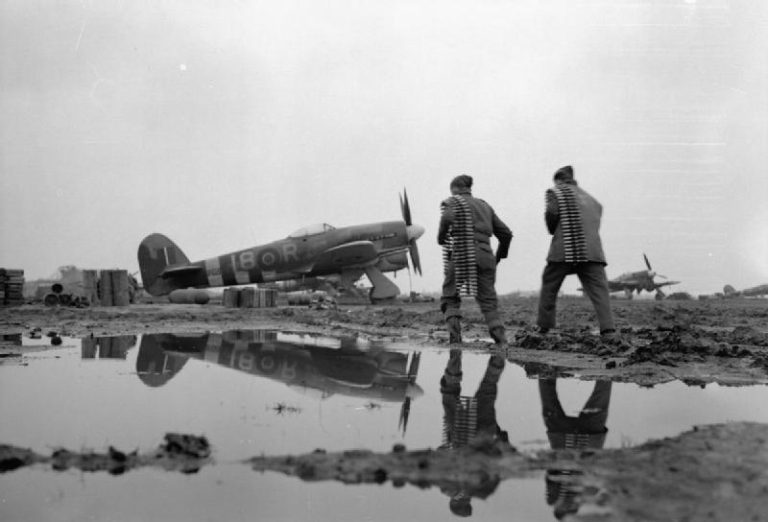
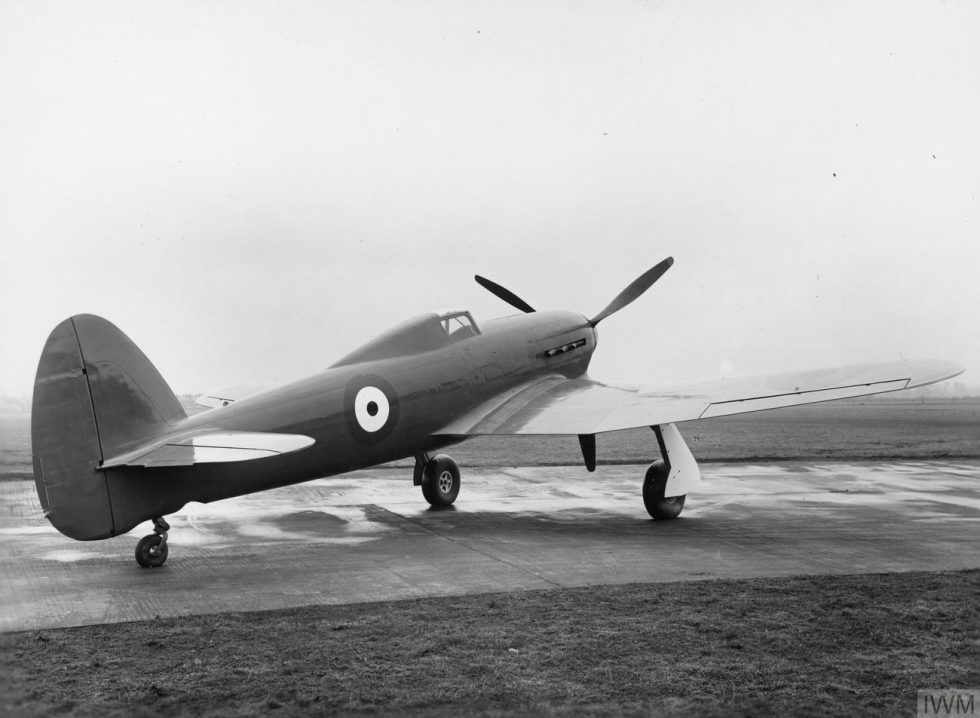
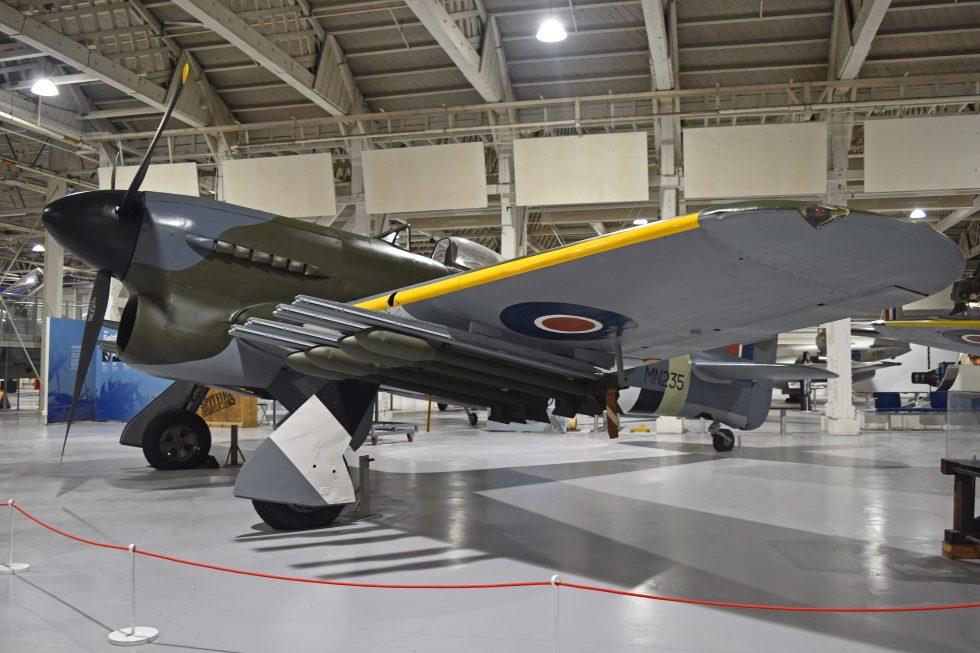
The Hawker Typhoon in motion
A hand-picked, high-authority Typhoon documentary is on the way. Video coming soon. In the meantime, explore the photo gallery and the twelve stories above.
Where the Hawker Typhoon flew
The Hawker Typhoon’s score, in context
The Typhoon was not a dogfighter — its record is written on the ground, not in aerial victories. Over Normandy it wrecked German transport and supply on a huge scale and terrified enemy tank crews, even if the celebrated tank-kill totals were later shown to be greatly overstated. Its most enduring numbers are the fleet that flew and the near-total loss of that fleet afterwards.
Compare the combat record of every military aircraft. Figures as of July 2026.
Everything people ask about the Hawker Typhoon
Can I fly in a Typhoon?
Why was the Hawker Typhoon nearly cancelled?
What was the Typhoon’s main job?
Did Typhoons really destroy hundreds of tanks?
How many Hawker Typhoons survive?
What is the difference between the Typhoon and the Tempest?
Did a Typhoon wound Rommel?
Who flew the Hawker Typhoon?
You can’t fly the Typhoon.
These, you can.
Some legends only live in museums — others are fuelled and waiting. MiGFlug has put civilians in real military jet cockpits since 2004.
 Fly the L-39 AlbatrosThe world’s most-flown jet trainer — aerobatics included
 Fly the F-104 Starfighter“The missile with a man in it”
 Fly the MiG-21The Cold War’s most-produced jet
 Fly the T-33 Shooting StarAmerica’s first jet trainer
 Fly the DH VampireA piece of early jet history
 Fly the S.211Agile Italian jet trainer
 Fly the MB-326The classic Aermacchi jet
 Fly the MiG-15The Soviet legend of the Korean War
Continue the tour
Every fact, checked
- RAF Museum — Hawker Typhoon IB (MN235)Institutional record of the sole complete survivor, its provenance and service history.
- History of War — Hawker TyphoonDates, specifications, production totals and development troubles.
- Tanks Encyclopedia — Tank-busting in WWIIThe Operational Research surveys that debunked the Typhoon’s tank-kill claims.
- HistoryNet — Restored: The Last TyphoonThe full story of MN235’s journey to the USA and back.
- Warfare History Network — The Falaise Pocket ScourgeNormandy operations, the cab-rank system, pilots and squadrons.
- Smithsonian NASM — Napier Sabre IIAAuthoritative data on the Typhoon’s 24-cylinder engine.
- Key.Aero — 75 years since the Typhoon was retiredService career, leading pilots and the type’s retirement.
- Te Ara — Desmond James ScottBiography of the New Zealand Typhoon wing leader and memoirist.