
Nobody climbs into a Eurofighter Typhoon on their first day in uniform. Between a cadet's first solo and their first sortie in a frontline fighter sits a ladder of aircraft, each one faster, heavier and less forgiving than the last. This week two very different countries showed two rungs of that ladder at once: Turkey took delivery of its first home-built Hürkuş-II turboprop trainers, and two Turkish Air Force pilots began converting to the Typhoon with the Royal Air Force at Coningsby.
Here is how the ladder works, using the RAF system as the worked example, and where Turkey's new aircraft fit into their own version of it.
Quick Facts
- Rung 1: Elementary flying training on a light piston or turboprop trainer
- Rung 2: Basic fast jet training on a high-performance turboprop
- Rung 3: Advanced fast jet training on a jet trainer
- Rung 4: Operational Conversion Unit (OCU) on the frontline type
- RAF example: Prefect T1, Texan T1, Hawk T2, then the Typhoon OCU at No. 29 Squadron
- Turkish example: Hürkuş-II turboprop now entering service; Hürjet intended to replace the T-38M Talon
- Swiss example: Pilatus PC-7 and PC-21 turboprops before the fighter squadron
Rung One: Learning to Fly the Military Way
In the United Kingdom, the whole ladder below the frontline is run under the UK Military Flying Training System, operated by Ascent Flight Training, a consortium of Lockheed Martin and Babcock International, under a 25-year Private Finance Initiative contract with the Ministry of Defence. It trains pilots for all three services, and it starts small.
Elementary Flying Training is flown on the Grob G 120TP, known in RAF service as the Prefect T1, with No. 57 Squadron at RAF Cranwell and at RAF Barkston Heath. Since January 2018 the course has delivered 40 hours of conventional flying and 20 synthetic hours. At the end of it, students are streamed: multi-engine pilots go to the Embraer Phenom T1 with No. 45 Squadron, helicopter pilots go to rotary-wing training, and those selected for fast jets head to Anglesey.
Rung Two: The Turboprop That Flies Like a Jet
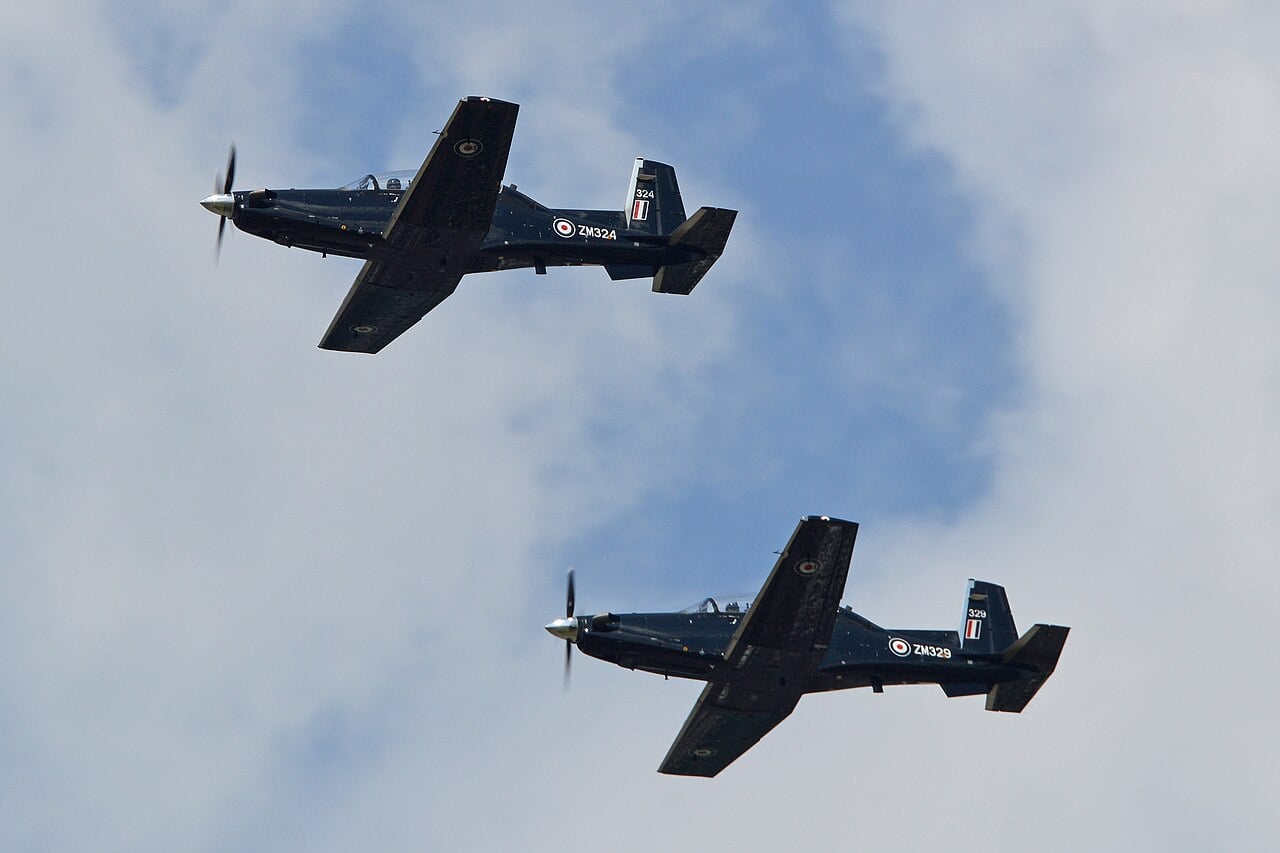
Basic Fast Jet Training is flown with No. 72 Squadron at RAF Valley on the Beechcraft Texan T1, the RAF's version of the T-6 Texan II. It replaced the Tucano, and the course moved to Valley so that it sits alongside the advanced jet phase. A modern turboprop trainer like the Texan has a glass cockpit, ejection seats and enough performance for aerobatics, formation and low-level navigation, which lets a student learn fast-jet habits before stepping into an actual jet.
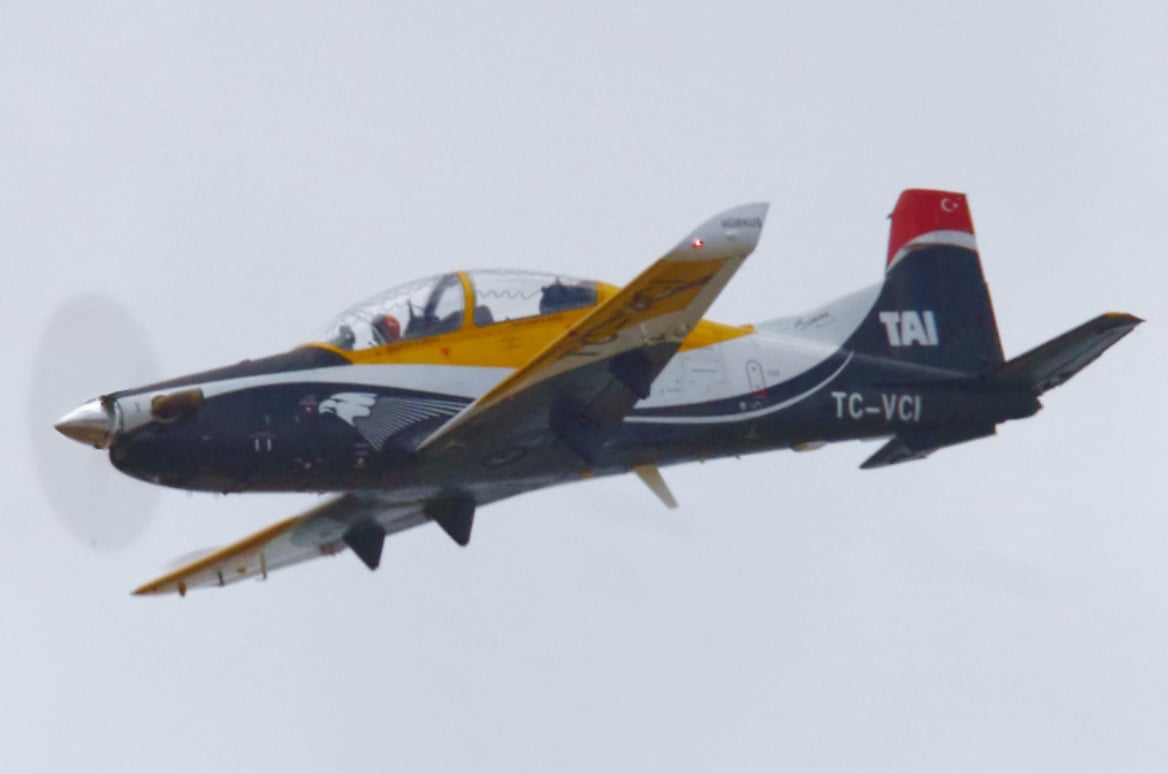
Turkey's equivalent rung is being rebuilt with its own aircraft. The Hürkuş-II, a lighter and improved version of the TAI Hürkuş, received its military type certificate from the Defence Industry Agency (SSB) in September 2026, and the first two were handed to the Turkish Air Force on 28 September. The air force has 55 on order. The aircraft is named after Vecihi Hürkuş, the pilot who built Turkey's first aircraft in 1925.
Switzerland follows the same logic with Swiss-built aircraft. Its pilots train on the Pilatus PC-7 and then the PC-21; the Swiss Air Force operates eight PC-21s for advanced training, a role previously filled by the BAE Hawk, which Switzerland retired in 2003.
Rung Three: The Jet Trainer
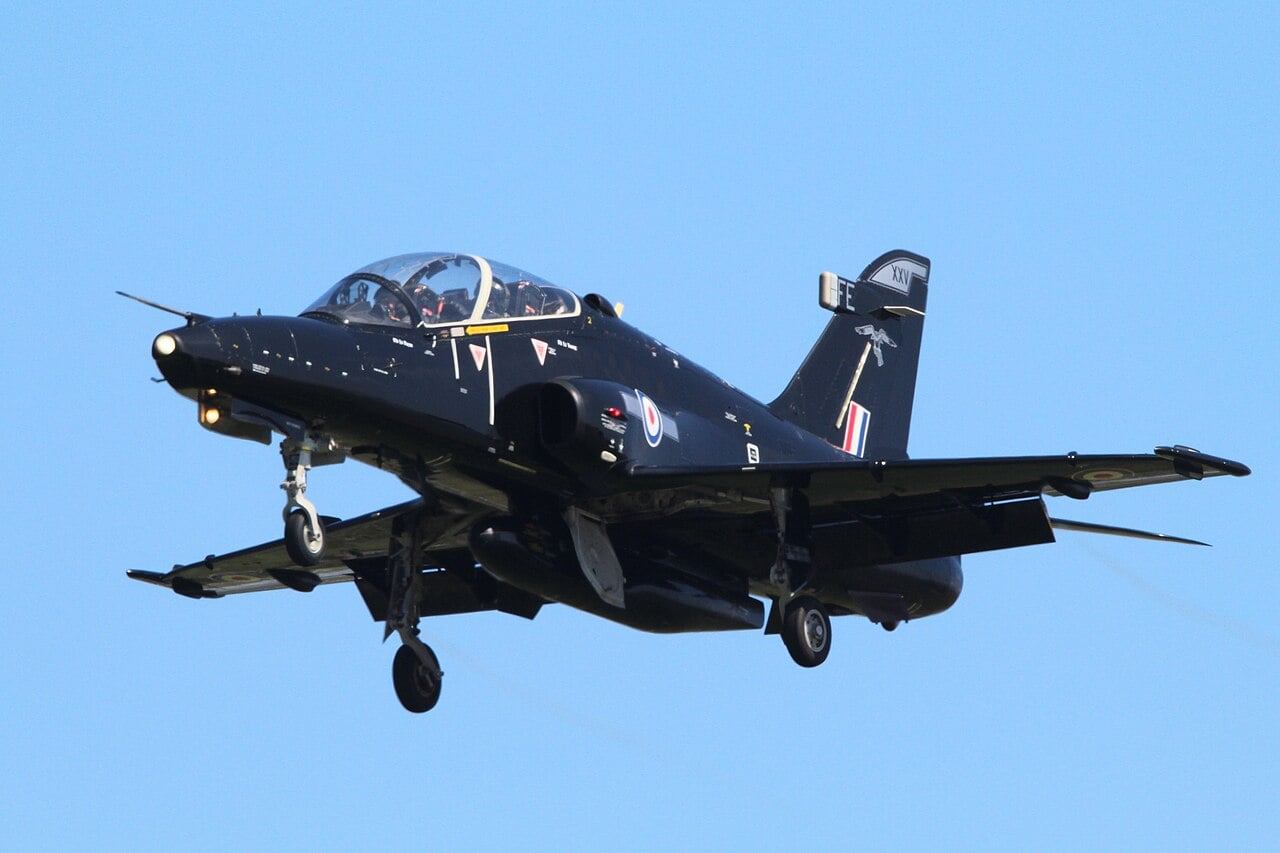
Advanced Fast Jet Training is where the student meets a jet. In the RAF this is the Hawk T2, flown by No. 4 Squadron and No. 25 Squadron at RAF Valley. The T2 was bought because the older Hawk T1 could not prepare pilots properly for a modern fighter: the Typhoon's arrival widened the gap between training and the frontline until the required standard for Typhoon aircrew was no longer achievable on the old jet. Hawk T2 training began in April 2012, with a glass cockpit that looks and works much more like the aircraft students will eventually fly.
This rung is under pressure right now. After a Hawk T2 crashed shortly after takeoff from Valley on 23 September 2026, with both pilots ejecting, the RAF temporarily paused Hawk flying as a precaution. We covered the crash in RAF Hawk T2 Crash at Valley: Both Pilots Eject, Fleet Paused.
Turkey's jet rung is the one it is about to replace. The Turkish Air Force intends the supersonic TAI Hürjet to take over from the Northrop T-38M Talon in the trainer role and to supplement the F-16 for close air support. The first production Hürjet flew at the end of August 2026.
Rung Four: The OCU
Wings on the chest do not make a Typhoon pilot. The last step is the Operational Conversion Unit, where a qualified pilot learns one specific frontline type. For the Typhoon in the RAF, that is No. 29 Squadron at RAF Coningsby in Lincolnshire, which reformed in 2003 as the Typhoon OCU and is responsible for aircrew training on the Typhoon FGR4.
The OCU is also where allies come to learn. Two Turkish Air Force pilots joined 29 Squadron this week for up to nine months of conversion training. Afterwards they are expected to stay on as instructors until Turkey's own Eurofighters arrive, from 2030.
Why the Ladder Matters
Each rung exists because the jump to the next aircraft is too large to take in one step. Modern turboprops and glass-cockpit jet trainers have let air forces push more of the learning down the ladder, into cheaper aircraft and simulators, so that the expensive hours on a frontline fighter are spent learning to fight rather than learning to fly. That is exactly why Turkey is building its own trainers alongside its own fighters: a nation that wants to fly its own jets needs its own ladder to climb.
Sources: Wikipedia (UK Military Flying Training System, No. 29 Squadron RAF, TAI Hürkuş, TAI Hürjet, Pilatus PC-21, Pilatus PC-7, Beechcraft T-6 Texan II); Royal Air Force; Daily Sabah. Featured image: Ian Gratton, via Wikimedia Commons, CC BY 2.0


0 Comments