
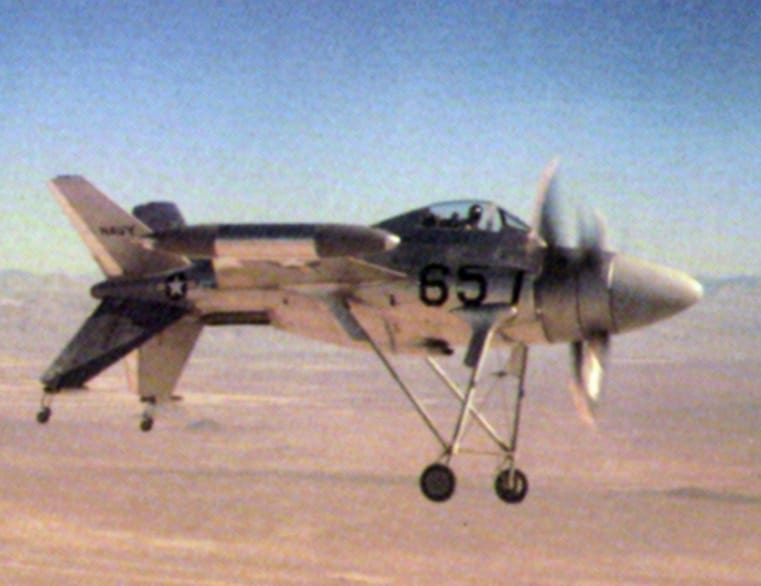
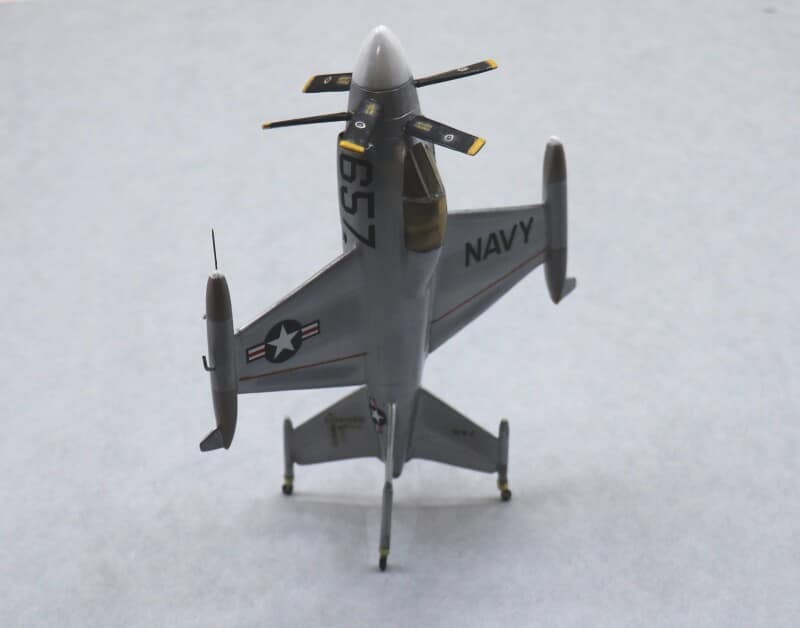
In the early 1950s, the U.S. Navy asked American industry a genuinely strange question: could a fighter take off straight up, standing on its tail, from a platform on the back of a warship? Lockheed’s answer was a stubby little aircraft that pointed its nose at the sky and sat on four small wheels stuck to the tips of its tail.
It was called the XFV-1, and it earned the nickname “Salmon.” It is remembered for a peculiar distinction: a vertical-takeoff fighter that never once took off vertically.
Kurzinfo
- Flugzeug: Lockheed XFV-1, an experimental U.S. Navy tail-sitting VTOL fighter
- Spitzname: “Salmon,” after chief test pilot Herman “Fish” Salmon
- Motor: Allison YT40 turboprop, contra-rotating propellers
- First official flight: 16 June 1954, on temporary conventional landing gear
- Aufzeichnen: 32 flights, 23 hours - and not one vertical takeoff
- Abgesagt: June 1955
A fighter that stood on its tail
The idea was born from Cold War fear. Airfields were vulnerable to attack, and the Navy wanted fighters that could launch from small platforms aboard ships to defend convoys. In 1951 the Navy handed Lockheed a contract for one answer and rival Convair a contract for another — the XFY-1 Pogo. Both used the same Allison turboprop spinning contra-rotating propellers.
Lockheed’s design, led by engineer Art Flock, had short, highly loaded straight wings much like the company’s later F-104 Starfighter, and a four-fin cruciform tail with tiny caster wheels at each tip. The pilot’s seat stayed level while the whole aircraft pointed skyward. On paper, it was elegant. In practice, it was terrifying.
The nickname and the fear
The XFV-1 became the “Salmon” after Lockheed’s chief test pilot, Herman “Fish” Salmon — a happy coincidence of name and behaviour, since the aircraft was meant to leap upward like a fish. Salmon was the only person who ever flew it.
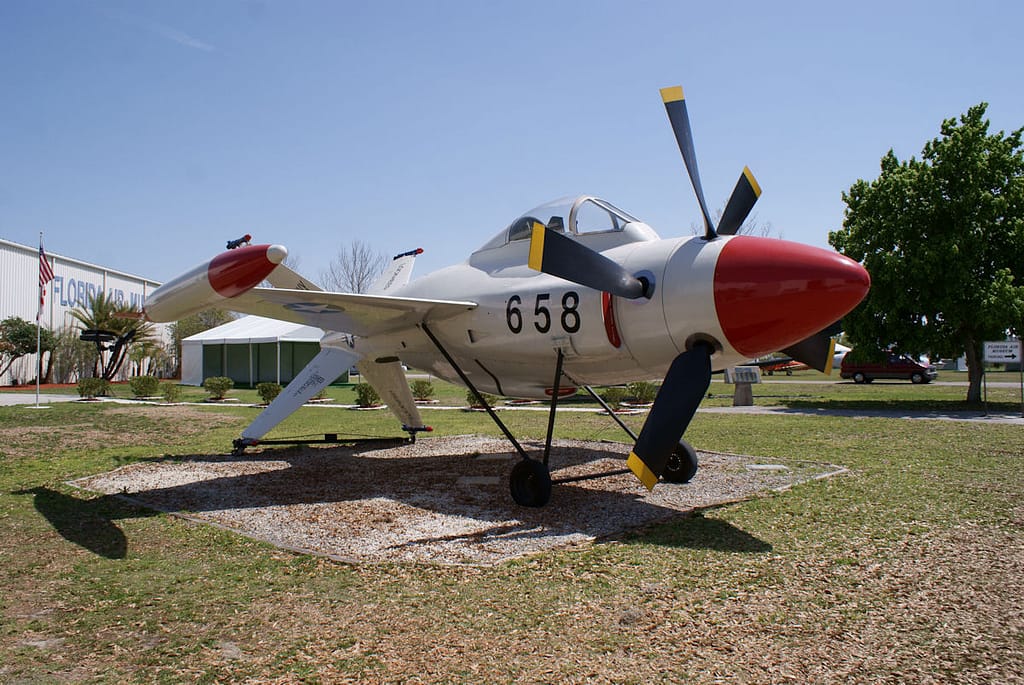
To fly at all, engineers bolted on a temporary, non-retractable undercarriage of long braced legs so it could take off and land like a normal aircraft while they worked out the hard parts. And the hard parts were very hard: how would a pilot judge his height above a pitching deck while descending backwards, tail-first, unable to see straight down? What was the right landing speed? Would an ejection seat even work pointing at the sky?
Thirty-two flights, zero vertical takeoffs
Between June 1954 and June 1955, Salmon flew the XFV-1 on 32 test flights totalling 23 hours. He coaxed it into transitioning from level flight to a vertical, hanging attitude and back again at altitude, and it hovered briefly on its propellers — but it never once made a true vertical takeoff or landing. The temporary landing gear that made testing possible also added drag, and even without it the projected performance would have trailed conventional fighters.
The end of the tail-sitters
By mid-1955 the Navy had seen enough. The performance was mediocre, the landing problem unsolved, and only specially trained pilots could ever hope to fly it. The XFV-1 was cancelled — as, eventually, was Convair’s Pogo, which at least managed real vertical flights. The tail-sitter dream was dead.
Its DNA lived on, though. The program’s engines went to Hiller’s experimental X-18, and Ryan borrowed ideas from both tail-sitters to build the jet-powered X-13 Vertijet. None worked as a practical warplane. Vertical flight would have to wait for a completely different idea.
The one completed XFV-1 survives in a museum today, nose forever pointed at a sky it never quite conquered the way its designers dreamed.
Sources: Norman Polmar, “The Tail-sitters, Part 1 - Lockheed,” Naval History magazine (U.S. Naval Institute); Vintage Aviation News; Wikipedia (Lockheed XFV).
0 Kommentare