

Every helicopter pilot knows the problem with ejecting from a helicopter. Above your head, turning at several hundred revolutions per minute, are the blades. Fire yourself upwards and you go through them.
Which is why, in more than a century of rotary flight, only one family of combat helicopters has ever been fitted with a working escape system. And why, on a day in March 2022, two Russian crewmen became the first people in history to use one in anger.
The solution the Kamov design bureau arrived at is characteristically blunt. Before the crew goes anywhere, explosive charges blow the rotor blades off.
Kurzinfo
Flugzeug: Kamov Ka-50 Black Shark (Hokum-A), single-seat; Ka-52 Alligator (Hokum-B), two-seat
Rotor: Coaxial contra-rotating, two three-blade rotors of 14.5 m. No tail rotor
Erster Flug: V-80 prototype hovered 17 June 1982; Ka-52 flew 25 June 1997
Im Einsatz: Ka-50 from 28 August 1995; Ka-52 from May 2011
Gebaut: Ka-50 roughly 12 to 19; Ka-52 more than 196 and still in production
Motoren: Two Klimov turboshafts, around 2,000 to 2,400 shp each
Pistole: One 30 mm Shipunov 2A42, 460 rounds, the same weapon fitted to the BMP-2
Escape system: NPP Zvezda K-37-800, used in combat exactly once
Two rotors, no tail
Almost every helicopter you have ever seen solves one problem with a compromise. A single main rotor pushes the fuselage the other way, so a tail rotor pushes back. That tail rotor eats something like ten to fifteen per cent of engine power, does nothing to lift the aircraft, and hangs on the end of a long boom where it is easy to hit.
Kamov had been building coaxial helicopters for the Soviet Navy for decades, because two rotors stacked on one mast and turning in opposite directions cancel each other out. No torque, no tail rotor, no boom to lose. The rotor disc is also smaller for a given lift, which matters on a ship, and all the power goes into lifting.
The design has costs. Two rotors on one mast is mechanically complex and tall, and in extreme manoeuvres the discs can flex towards each other. But it buys agility that conventional helicopters cannot match, and the ability to keep flying after losing the sort of tail-boom hit that would end most rotorcraft.
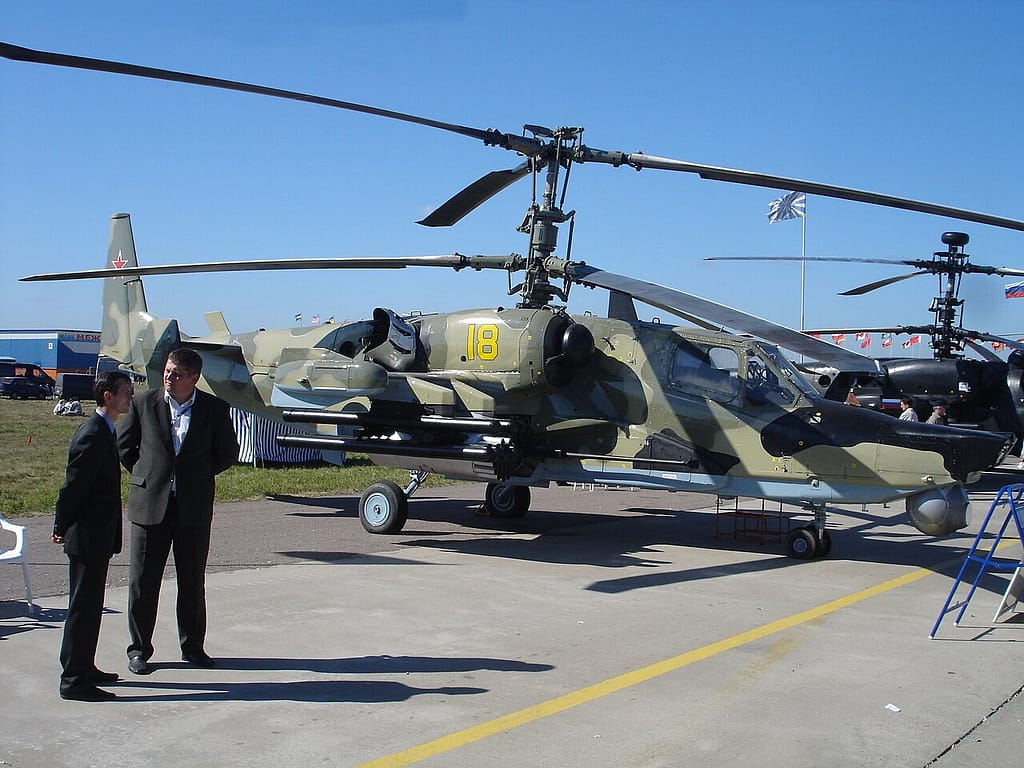
The single-seat experiment that did not take
Chief designer Sergey Mikheyev took the idea further than anyone else dared. The Ka-50, which first hovered as the V-80 prototype on 17 June 1982 with Nikolai Bezdetnov at the controls, was a single-seat attack helicopter. One man would fly it, find the targets, and shoot, in a role every other air force gave to two people.
It entered service in August 1995 and then quietly failed. Somewhere between twelve and nineteen were built against plans that ran into the hundreds. Flying nap-of-the-earth while managing sensors and weapons turned out to be more than one pair of hands could reliably do.
The fix became the Ka-52 Alligator, first flown on 25 June 1997 and in service from May 2011. It put two crew side by side rather than in tandem, which is unusual for an attack helicopter and gives the pair a shared view and the ability to physically point at things.
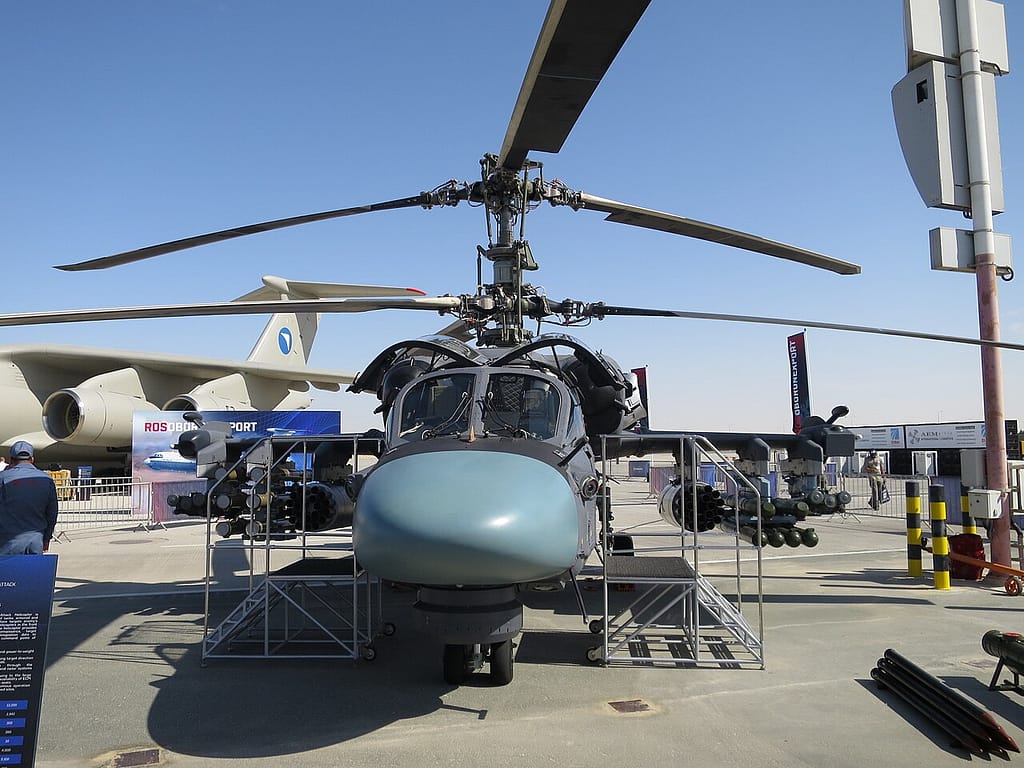
Pull the handle and the blades come off
The K-37-800 system built by NPP Zvezda works in a sequence that sounds alarming and is entirely logical. Explosive charges at the blade roots separate the rotor blades. The canopy goes. Then a rocket pack hauls the crew out and up, clear of an aircraft that no longer has anything spinning above it.
It sat unused for decades. Then, in mid-March 2022, a Ka-52 crewed by Roman Kobets and Ivan Boldyrev was hit over Ukraine. Both men pulled. Both survived. As quoted afterwards in Russian media, Kobets described the moment the aircraft was struck.
On the system itself he was briefer: all the pilot has to do is pull the handle, and the helicopter does the rest. Asked who pulled first, he said they both did.
It is worth being clear about the source. These accounts come from Russian state-adjacent media, and both men have since been decorated and promoted within Russia's wartime propaganda apparatus. The engineering claim, that the system worked, is corroborated by the fact that two men walked away. The framing around it is not neutral reporting.
Effective and expensive, at the same time
The Ka-52 has had a strange war. In the summer of 2023 British Defence Intelligence assessed it as one of the most influential Russian systems on the southern front, while noting that Russia had already lost roughly forty of them.
Both halves of that sentence held. By December 2025 the open-source tracking project Oryx had counted 66 visually confirmed Ka-52 losses, making it one of the most heavily attrited aircraft types of the war. At the same time the fleet gained the LMUR missile, with a reach of around fifteen kilometres, which let crews shoot from outside much of Ukraine's short-range air defence.
Compared with the Mil Mi-24 Hind, the Soviet gunship that came before it, the Ka-52 is a far more specialised machine: no troop compartment, no pretence of being a flying APC, just sensors and weapons.
Outside Russia, only Egypt flies the type, taking 46 machines locally nicknamed the Nile Crocodile, in service since December 2018.
Nearly forty-five years after that first hover, the Kamov remains the only combat helicopter in the world whose crew can get out. That it has been needed precisely once tells you either that the system is a triumph of foresight, or that helicopters usually do not give you the time. Both readings are probably correct.
Sources: Kamov Ka-50 and Ka-52 entries, English and Russian Wikipedia; UK Ministry of Defence Defence Intelligence Update, 27 July 2023, as reported by Al Arabiya English and Euromaidan Press; DefenseMirror, 25 June 2024; Oryx visual loss documentation, 3 December 2025; NPP Zvezda published material on the K-37 escape system.
0 Kommentare