
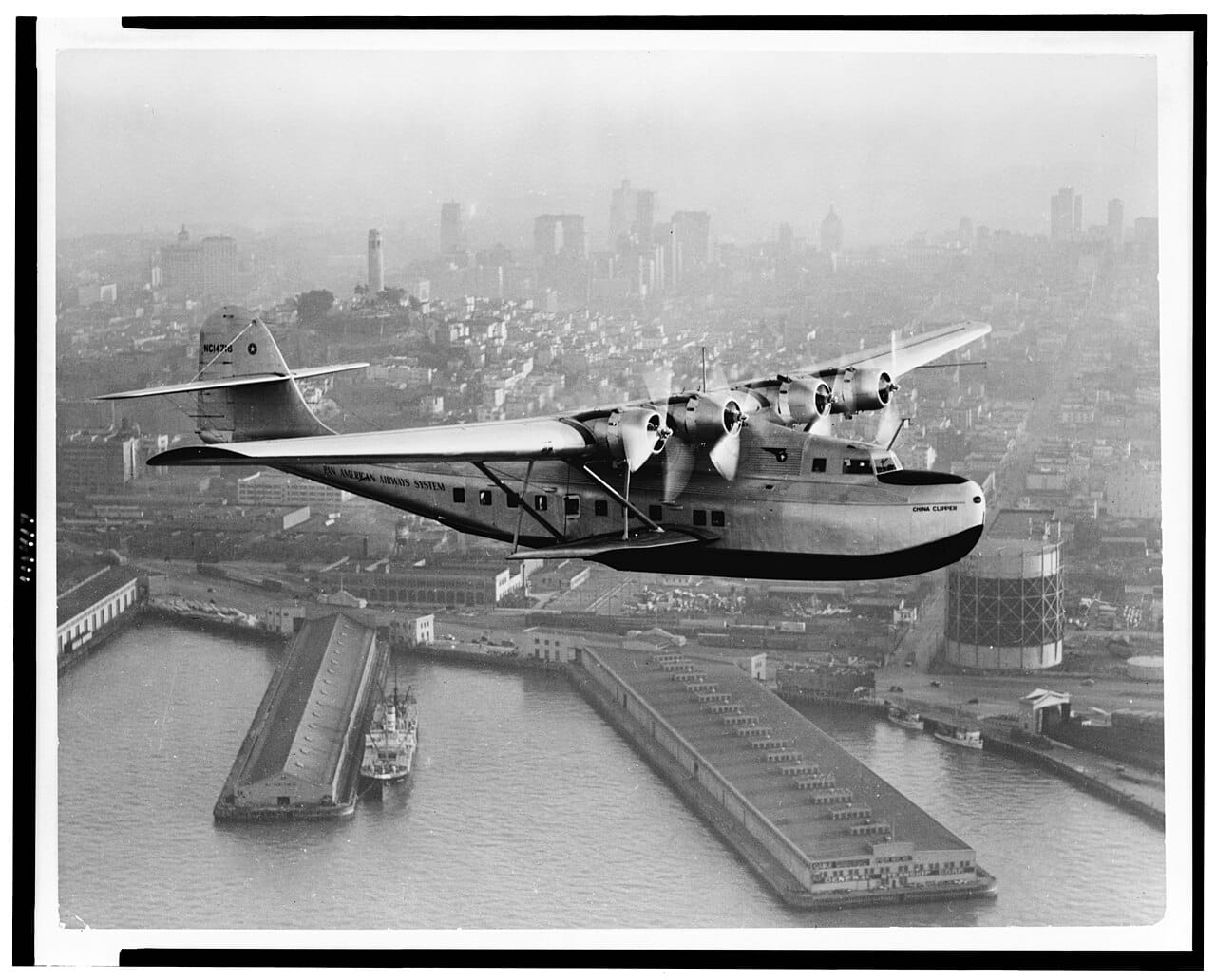
At 3:46 in the afternoon of Friday 22 November 1935, a four-engined flying boat lifted off the water at Alameda, California, and set course west across an ocean that no aeroplane had ever crossed on a schedule.
Around twenty thousand people were standing on the shore at Alameda. Estimates put another hundred thousand or more around San Francisco Bay. CBS and NBC were broadcasting live, and the feed was relayed onto seven foreign networks. The Postmaster General was there. So was the President of the Philippines and the Governor of California.
And within about a minute of getting airborne, the captain realised he was not going to clear the half-built San Francisco-Oakland Bay Bridge, and had to fly underneath it instead.
Kurzinfo
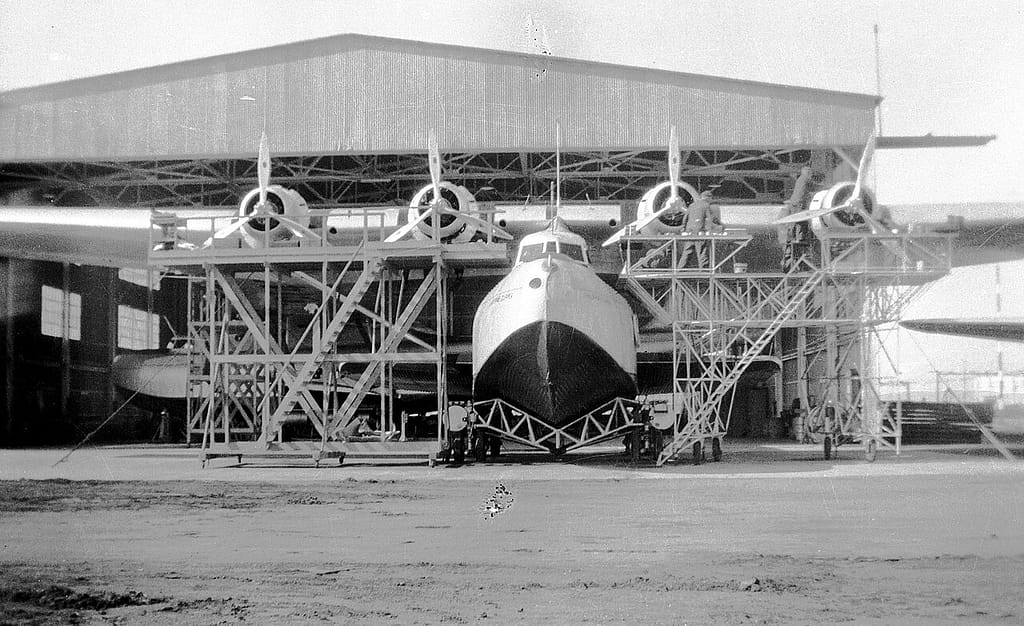
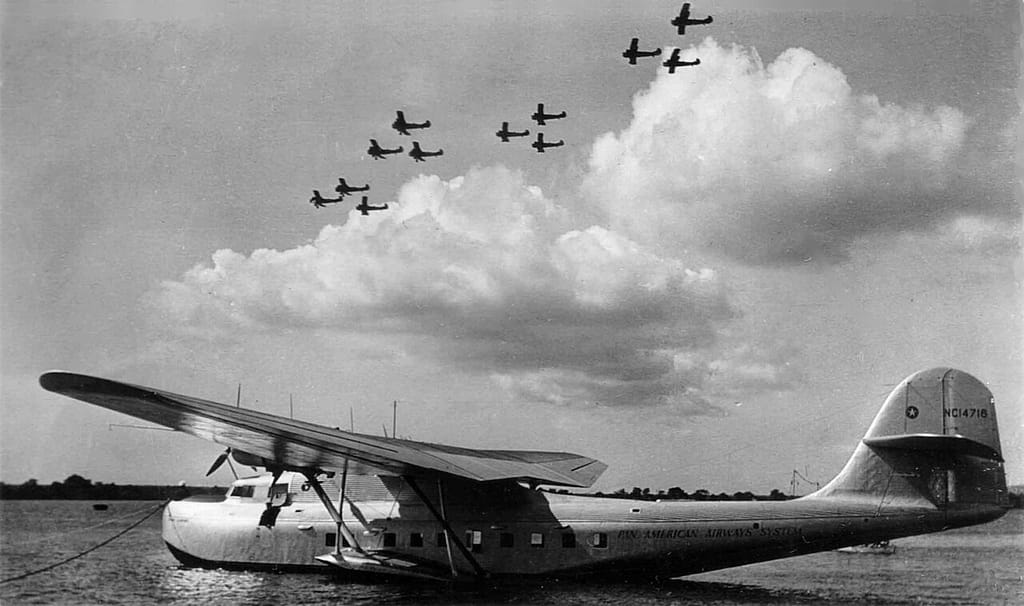
Flugzeug: Martin M-130 flying boat, registration NC14716, named China Clipper
Operator: Pan American Airways System
Kosten: $417,000, delivered to Pan Am on 9 October 1935
Sister ships: Hawaii Clipper (NC14714) and Philippine Clipper (NC14715). Only three M-130s were built
Abgereist: Alameda, California, 3:46 p.m. PST, 22 November 1935
Arrived: Manila, 29 November 1935
Route: Island-hopping via Honolulu, Midway, Wake and Guam
An Bord: Seven crew and the mail. No passengers
The order to cast off
The ceremony was written to sound nautical, because Pan Am wanted the public thinking about clipper ships rather than about the fact that the Pacific had swallowed a good many aeroplanes already. Postmaster General James A. Farley read out a message from President Roosevelt. Then Pan Am's president gave the order.
Musick replied that he was standing by for orders, sir. It was theatre, and it worked.
Roosevelt's message congratulated the crew as an air-minded sailor and noted that the flight also marked the centenary of the first clipper ship reaching San Francisco. TIME, reporting it the following week, added a small correction: the first clipper to reach San Francisco was the Samuel Russell, and it arrived in 1850.
Under the bridge
The Bay Bridge was still under construction in November 1935, a lattice of cables and dangling wires across the departure path. The plan had been to fly over it.
The newsreel cameras caught the aircraft leaving. What they did not catch was that the most famous departure in commercial aviation history nearly ended in the water in front of a hundred thousand people.
Seven men, and one name you know
There were no passengers. The aircraft carried mail and a crew of seven: Captain Edwin C. Musick, Pan Am's chief pilot; First Officer R. O. D. Sullivan; Second Officer George King; First Engineer Officer C. D. Wright; Second Engineer Officer Victor A. Wright, no relation; Radio Officer William T. Jarboe Jr.
And, as navigation officer, Fred Noonan.
Noonan is remembered now for how his career ended, somewhere over the central Pacific in July 1937 with Amelia Earhart. In 1935 he was simply the best celestial navigator Pan Am had, and finding Midway, Wake and Guam in an empty ocean by sextant and dead reckoning was precisely the skill the route existed to prove.
What it actually proved
The Clipper reached Manila on 29 November. The Philippines went, by contemporary accounts, slightly mad.
The engineering was less romantic than the branding. The Pacific could not be crossed in one go, so Pan Am built a chain of bases on specks of coral, shipping in fuel, accommodation and radio equipment to islands with no population and no fresh water. The aeroplane was the visible part; the logistics were the achievement.
Only three M-130s were ever built, and the type had a hard end. The Hawaii Clipper vanished with everyone aboard in 1938. The Philippine Clipper flew into a mountain in California in 1943. The China Clipper itself was lost in an accident at Port of Spain, Trinidad, in January 1945.
What survived was the idea. Before November 1935 the Pacific was something you crossed by ship over weeks. Afterwards it was a scheduled service with a departure time, and every transpacific flight since has been a variation on a route Pan Am proved with seven men, a sextant and a sack of mail.
Sources: TIME, Transport: Transpacific, 2 December 1935; Eric Niderost, Aviation History, March 2000, via HistoryNet; Pan Am Historical Foundation and Pan Am Museum Foundation material; airships.net; Martin M-130 and China Clipper entries, English Wikipedia; British Movietone and Philippine government newsreel archives.
0 Kommentare