
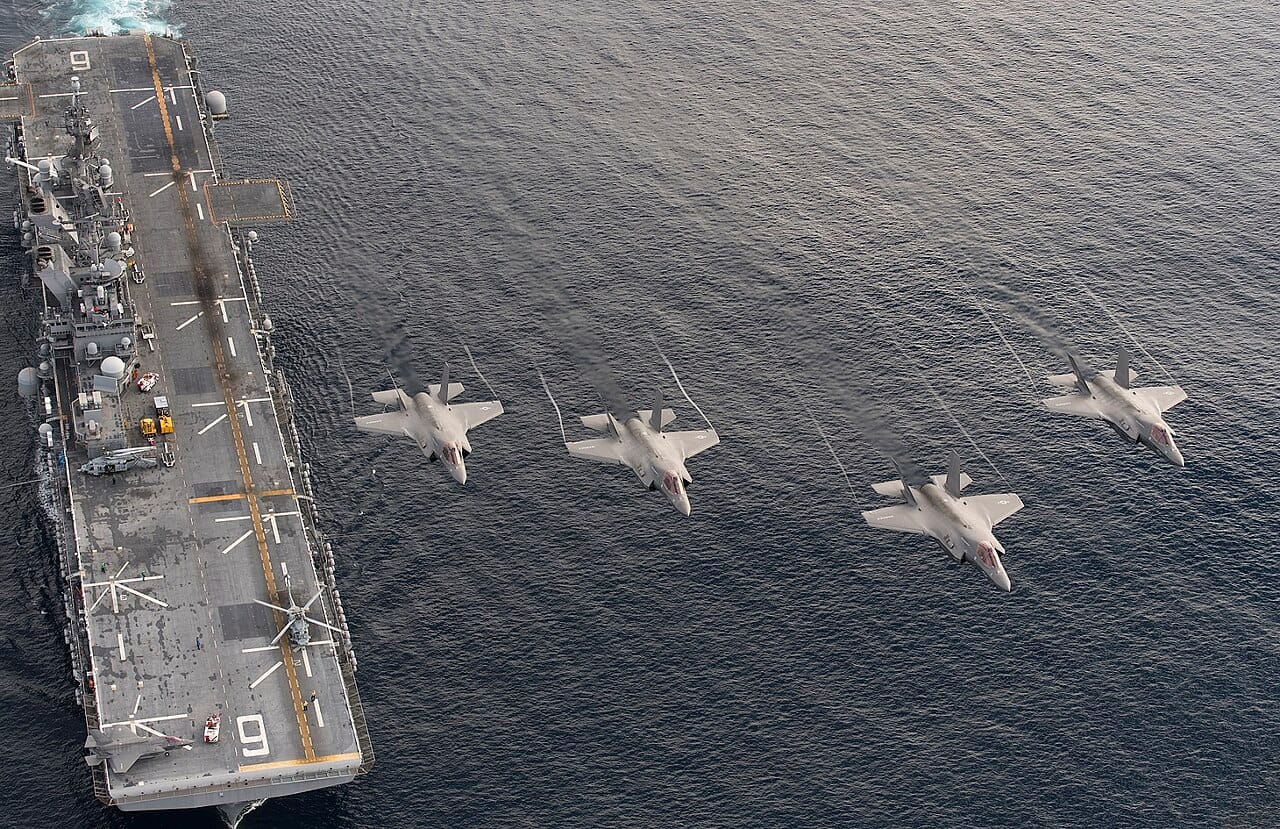
Five years ago this month, a US Marine Corps F-35B took off from a British aircraft carrier, landed on an American assault ship, took on fuel and weapons, and flew off again to attack a second set of targets.
The Marine Corps called it the first time in modern history that the United States had cross-decked aircraft for a mission using a foreign aircraft carrier. Stripped of the press-release phrasing, what happened on 20 August 2021 was a demonstration that allied flight decks could be treated as interchangeable — and that is a bigger idea than it sounds.
Kurzinfo
- Datum: 20 August 2021
- Standort: Philippine Sea
- Geschwader: VMFA-211 “Wake Island Avengers”, 10 F-35Bs
- Launched from: HMS Queen Elizabeth (R08), UK Carrier Strike Group 21
- Recovered aboard: USS America (LHA-6), then forward-deployed to Sasebo
- Sequence: Launch, land, rearm and refuel, relaunch against follow-on objectives
- Air wing: 18 F-35Bs aboard Queen Elizabeth — VMFA-211 plus RAF 617 Squadron
- Framing: US Marine Corps described it as a first “in modern history”
An American squadron on a British carrier
The starting point was itself unusual. When HMS Queen Elizabeth sailed in 2021 on Operation Fortis, she carried a blended air wing: ten F-35Bs of VMFA-211 alongside eight from the RAF’s 617 Squadron, the Dambusters. A US Marine squadron was not visiting a British carrier. It was part of her air wing for the deployment.
That gave the two navies something to build on. In the Philippine Sea that August, the British carrier and the American assault ship operated together, and someone asked the obvious question: if the aircraft are the same type, why should it matter which deck they come back to?
The sortie
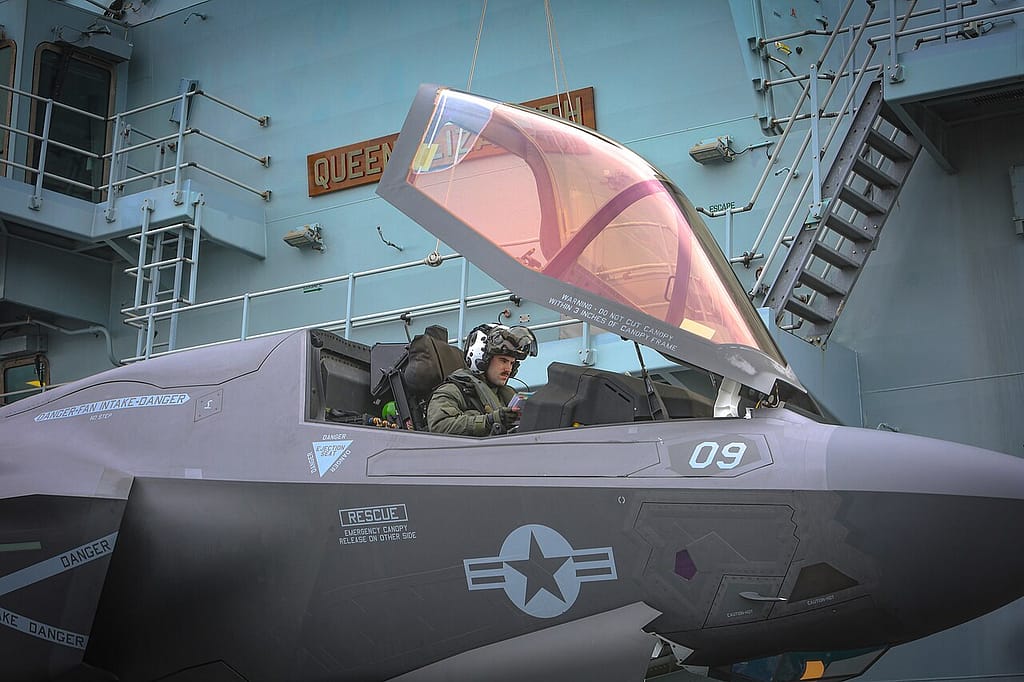
Aircraft launched from Queen Elizabeth’s ski jump, recovered vertically aboard USS America, were rearmed and refuelled on the American deck, and launched again to strike follow-on objectives.
The distinction that matters is between a cross-deck landing and a cross-deck mission. Aircraft from one nation had landed on another’s carrier many times before. What had not been done was the full armed cycle — launch, recover, rearm, relaunch, attack — spanning two nations’ decks inside a single operation.
One of the pilots was the squadron’s executive officer, who had come to the F-35B from Harriers and so had spent a career landing on ships.
Why anyone should care about refuelling
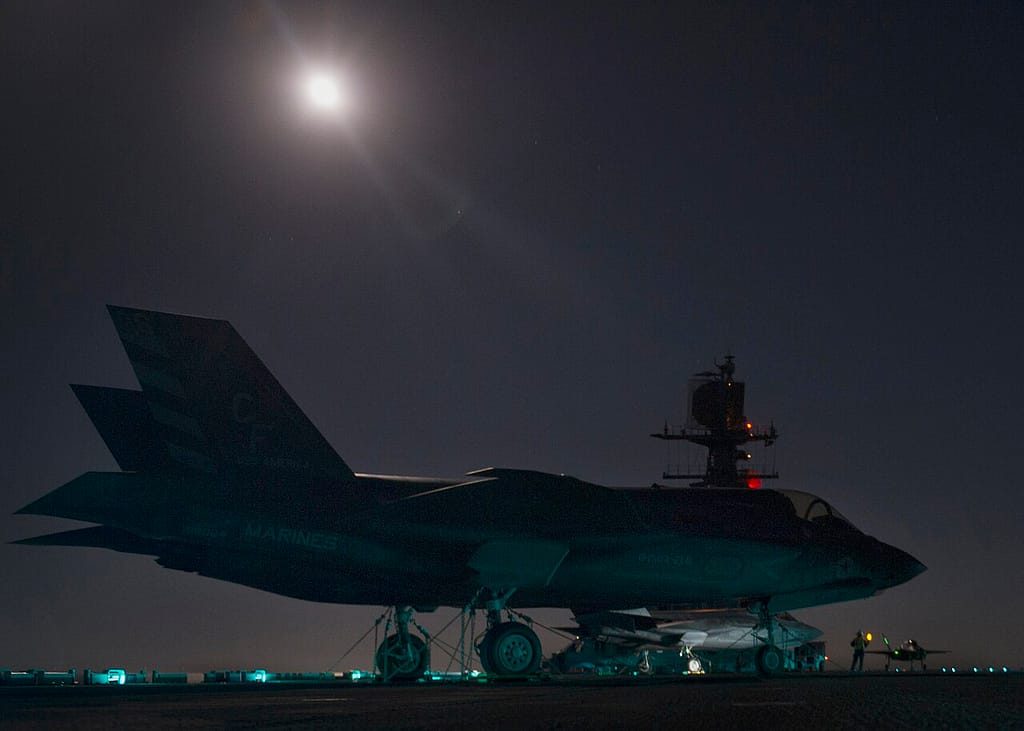
The tactical logic is unglamorous and important. A carrier air wing’s reach is set by fuel and by how quickly aircraft can be turned around. If an F-35B can only rearm on its own ship, that ship must stay within a certain distance of the target.
If it can rearm on any allied deck, the constraint dissolves. Allied ships become forward arming and refuelling points, and sortie radius and magazine depth both increase without anyone building another hull.
The Marine Corps tied this explicitly to distributed maritime operations — the doctrine of spreading naval forces out so an adversary cannot find, track and target them all, while still concentrating firepower where it is needed. The official release put it plainly: the operation extended the reach of the F-35, letting it strike objectives farther away, for longer, with more ordnance.
F-35B cross-deck operations between HMS Queen Elizabeth and USS America, August 2021.
It was the start of a series, not a one-off
This is the part that shows it was more than a photo opportunity. VMFA-211 repeated the exercise later in 2021 with USS Essex, and then with the Italian carrier Cavour. The Queen Elizabeth and America groups went on to conduct forty-eight hours of continuous cyclic flight operations together that same week.
And in July 2025 it happened in reverse: F-35Bs of VMFA-242 cross-decked from USS America to HMS Prince of Wales, ahead of Exercise Talisman Sabre, during the British carrier group’s Operation Highmast deployment.
Four years apart, the same manoeuvre in the opposite direction. That is the difference between a stunt and a procedure.
Where the ships are now
Queen Elizabeth is not at sea. She entered a planned docking period at Rosyth in August 2025, came back to Portsmouth in late April 2026, and went into further planned maintenance in June. The Royal Navy’s deployed carrier this year is HMS Prince of Wales, working in the North Atlantic and High North.
USS America left Sasebo in September 2025 after a decade as the only forward-deployed American amphibious assault ship, and is now homeported in San Diego.
The aircraft carrier has always been the most jealously national object in any navy — the thing a country builds to avoid depending on anyone else. What happened in the Philippine Sea in August 2021 quietly proposed the opposite: that with a common aircraft type, a deck is a deck, and whose flag flies over it is a detail.
Sources: US Marine Corps and DVIDS releases (August 2021), Stars and Stripes, USNI News, UK Defence Journal, Royal Navy

0 Kommentare