
The trick she was best known for went like this: fly a biplane upside down, ten feet off the grass, and cut a ribbon strung between two poles with the propeller. The poles were held by Steve Wittman and Bill Brennan. On the first attempt the engine quit. On another she flew under the ribbon instead.
Betty Skelton was 22. She had already been flying for a decade, because she first soloed at twelve — which was thoroughly illegal, and which is why nobody wrote it down.
Kurzinfo
Full name: Betty Skelton (later Frankman, later Erde), 1926–2011, born Pensacola, Florida
First solo: Age 12, in a 40 hp Taylorcraft — unofficial and unlogged
Licences: Private at 16, commercial at 18, flight instructor at 19
Aerobatic titles: International Feminine Aerobatic Champion 1948, 1949 and 1950
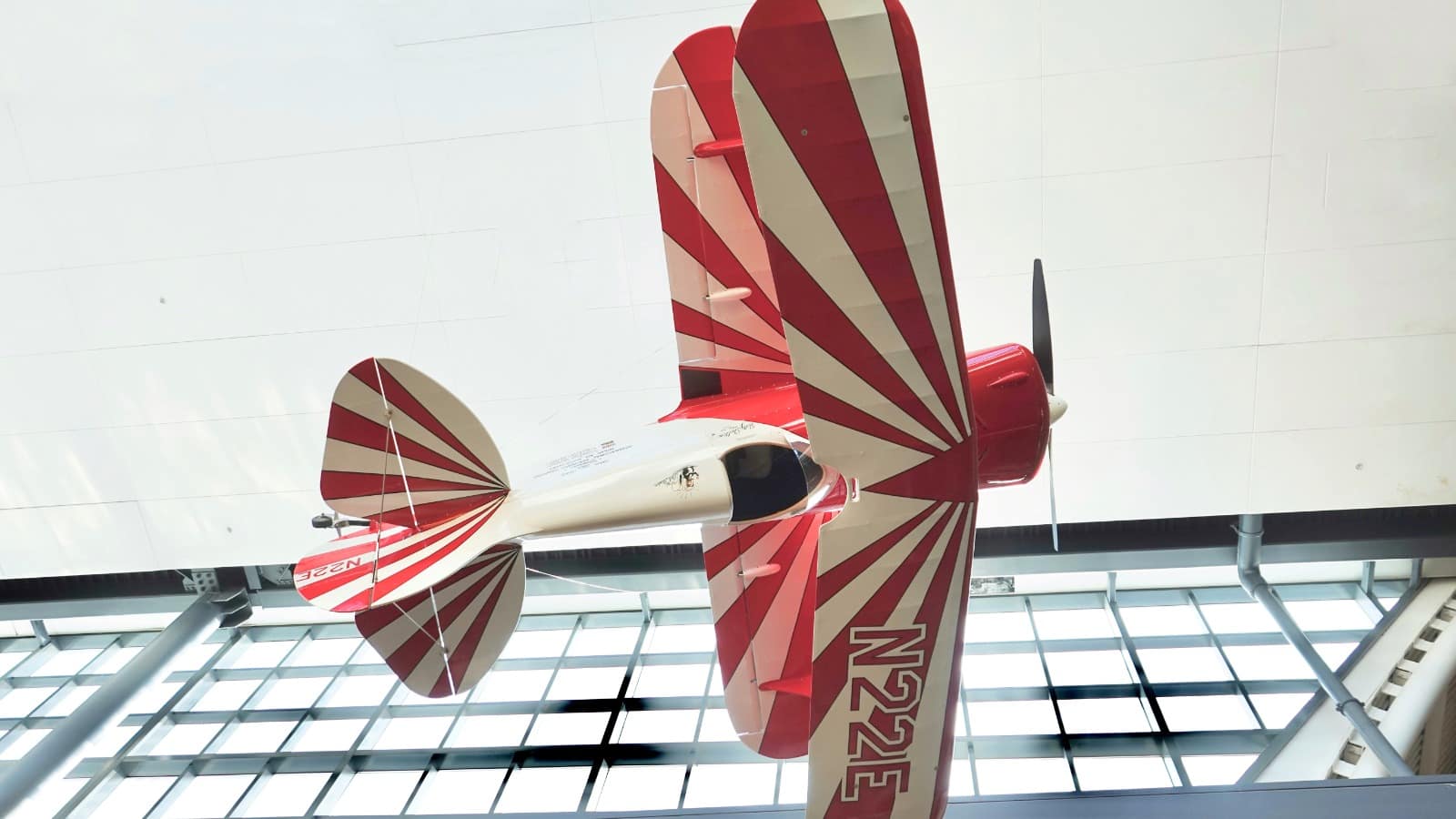
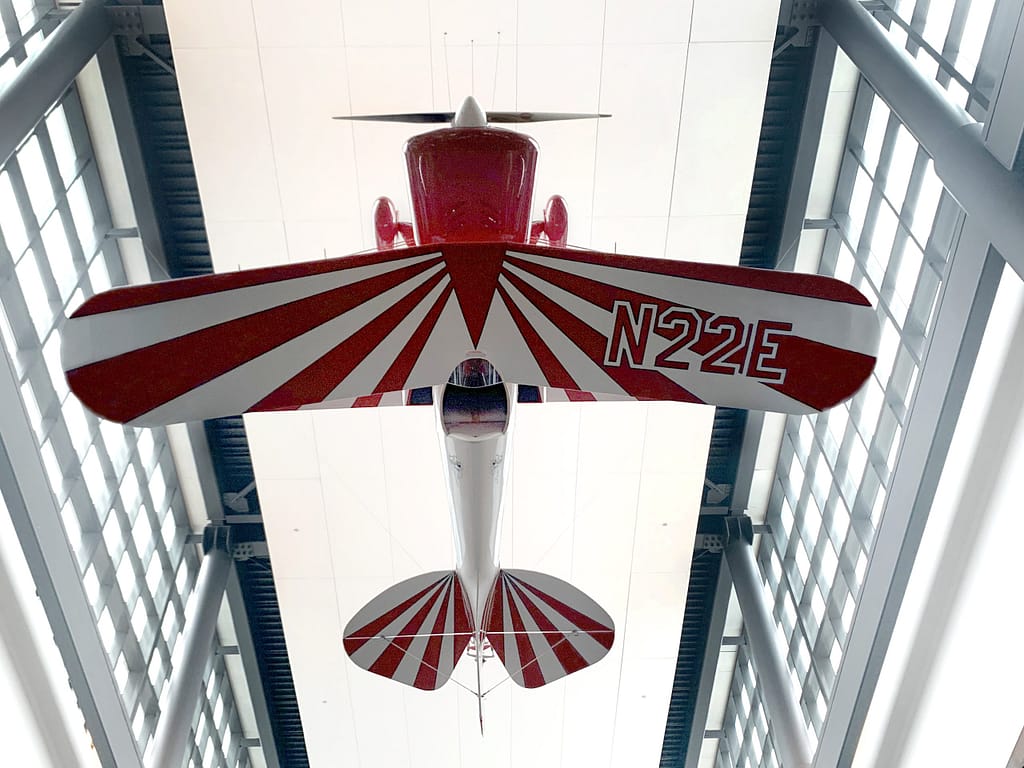
The aeroplane: Pitts Special S-1C, the second Pitts ever built — registered NX86401, later N22E, named Little Stinker
Altitude records: 25,763 ft in 1949 and 29,050 ft in 1951, in a Piper Cub
On land: Women’s land speed record at Bonneville in 1965, around 277 mph average, in Art Arfons’ jet car
Records total: 17 combined aviation and automotive records
Little Stinker
Skelton won her first championship in 1948 flying a Great Lakes biplane. In August that year she paid $3,000 for the second Pitts Special ever built — a tiny, savagely quick single-seater with a wingspan not much wider than a car is long. She won the next two championships in it.
Its original registration, NX86401, was too long to fit the airframe neatly, so in 1949 she had it reissued as N22E. It wears that today. She gave it to the Smithsonian in 1985; after a restoration running from 1996 to 2001 it went on display in 2003, and it hangs inverted, which is the correct way to display an aeroplane whose owner spent most of her career that way up.
Then she got out of the aeroplane and into a car
Aerobatic competition in the early 1950s paid nothing. In February 1954 Skelton drove the pace car at Daytona Speed Week, then took a Dodge out on the sand and set a women's stock car record at 105.88 mph. She became the first woman to hold an AAA competition licence and the first female test driver in the American car industry.
From 1956 she worked for Chevrolet through the agency Campbell-Ewald, became the marque's public face, and was the founding editor of Corvette News. The National Corvette Museum credits her with 145.044 mph over the Daytona measured mile in a Corvette that year.
The big one came in 1965 at Bonneville, in Art Arfons' jet-powered "Green Monster — Cyclops": a women's land speed record of roughly 277 mph average, with a one-way run reported at about 316 mph.
Florida Memory’s archive film of Betty Skelton Day, 11 July 1948 — the year of her first championship.
The astronaut story, straightened out
In 1959 Look magazine commissioned something unusual: it arranged for Skelton to take a number of the same physical and psychological tests being given to the Mercury astronauts, over roughly four or five months, at facilities including the School of Aerospace Medicine at Brooks. She appeared on the cover of the 2 February 1960 issue, labelled "7½" — the nickname the Mercury Seven had given her.
What this was not: astronaut selection. Mercury required military test-pilot qualification and 1,500 hours of jet time, neither of which any American woman could legally accumulate at the time. Skelton knew it perfectly well and said so. The frequently repeated versions online — that she "completed Mercury training", or was "the eighth astronaut" — are not supported by anything.
Seventeen records
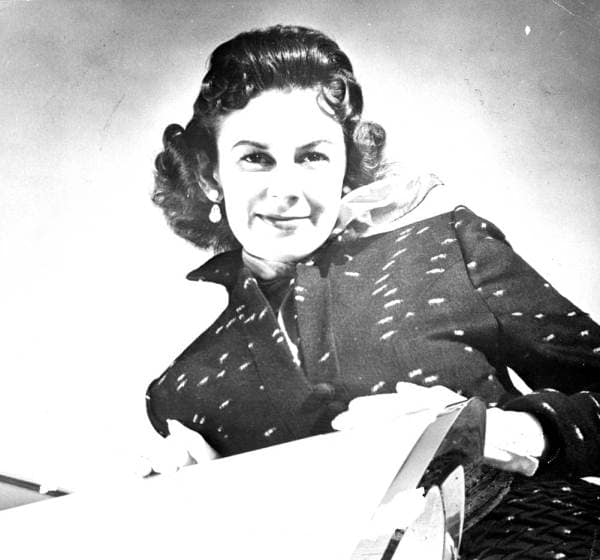
The figure that keeps coming back, across the National Aviation Hall of Fame, the Motorsports Hall of Fame and her obituaries, is 17 — combined air and land records, more than any other individual has held across both. Popular retellings inflate it to "dozens"; 17 is the number anyone can actually source.
She was inducted into the International Aerobatic Club hall of fame in 1988, Women in Aviation's in 1997, the National Aviation Hall of Fame in 2005 and the Motorsports Hall of Fame of America in 2008 — and was the first woman in the NASCAR International Automotive Hall of Fame, in 1983.
The National Aviation Hall of Fame’s biography film.
Betty Skelton died on 31 August 2011, aged 85. Her aeroplane is still upside down in Virginia, which she would have approved of.
Sources: NASA Johnson Space Center Oral History Project transcript, 19 July 1999; National Air and Space Museum object record A19850806000; National Aviation Hall of Fame; Motorsports Hall of Fame of America; National Corvette Museum; The New York Times obituary, 10 September 2011; Flying; Wikipedia cross-checks.


0 Kommentare