

When Emmanuel Macron flew to Stockholm at the end of August, the headline deal was maritime: four French frigates for the Swedish navy, a multi-billion-euro vote of confidence in NATO’s newest member. But tucked alongside it was something that could matter far more to European air power. France, Paris signalled, is open to building the continent’s next fighter jet together with Sweden.
There is no signed programme, no shared design, not even a memorandum — only an opening. Yet after the spectacular collapse of Europe’s flagship fighter project, an opening between Dassault and Saab is worth paying attention to.
Kurzinfo
| Story | France signals openness to a joint next-generation fighter with Sweden |
| Kontext | Signed during Macron’s state visit to Sweden, 31 Aug 2026 |
| Auch einverstanden | France to supply Sweden four frigates |
| Warum jetzt? | The Franco-German-Spanish FCAS collapsed in June 2026 |
| Players | Dassault (Rafale) and Saab (Gripen) |
| Status | No formal fighter agreement yet; talks only |
| Swedish timeline | Decision on its future combat-air path expected by Sept 2027 |
Why France is suddenly courting Stockholm
The backdrop is the wreckage of FCAS — the Future Combat Air System launched in 2017 by Macron and Angela Merkel, later joined by Spain, and meant to deliver a sixth-generation fighter, stealth drones and a battlefield ‘combat cloud’ for around €100 billion. It foundered on a single question: who leads. Dassault, prime contractor for the crewed jet, insisted on being in charge; Airbus refused a subordinate role. In June 2026 Berlin and Paris ended their cooperation, and Germany’s chancellor declared the crewed Next Generation Fighter dead.
That left France with world-class fighter expertise and no partner. Sweden, meanwhile, has Saab — a company that builds an entire modern fighter, the Gripen, for a fraction of what its rivals spend, and that is weighing what comes after it.
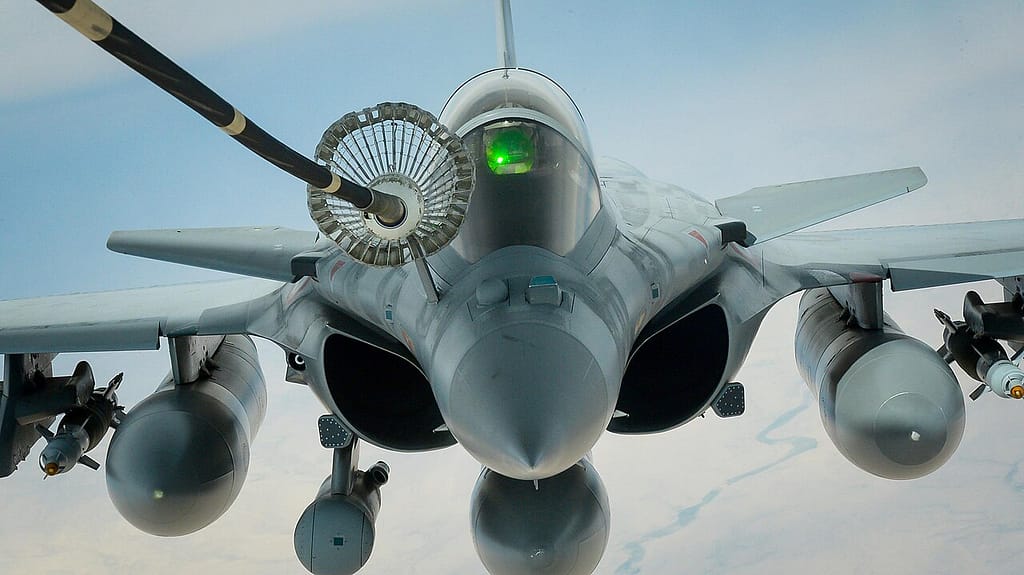
Two proud fighter nations
On paper the fit is intriguing. France and Sweden are two of the very few European countries that can design and build a combat aircraft nose to tail. They already collaborated on the nEUROn stealth-drone demonstrator, and their industrial ties are deepening fast: the frigate deal, plus France’s own order for two Swedish GlobalEye radar aircraft.
The obstacles are just as real. Dassault’s insistence on leadership is exactly what sank FCAS, and Saab is not a junior partner by temperament. Sweden has said it will decide on the future of its combat-aviation programme by September 2027, which sets a natural clock on any talks.
An opening, not a jet
For now this is diplomacy, not engineering. But it hints at how Europe’s fractured fighter ambitions may reorganise: not one grand tri-national programme, but smaller coalitions of the willing and the capable. If Paris and Stockholm can avoid the trap that killed FCAS — the fight over who is in charge — they might yet build something. If they cannot, this will be remembered as one more handshake that never became an aircraft.
Sources: Politico Europe; Opex360; Euronews; Government of Sweden; AP.


0 Kommentare