
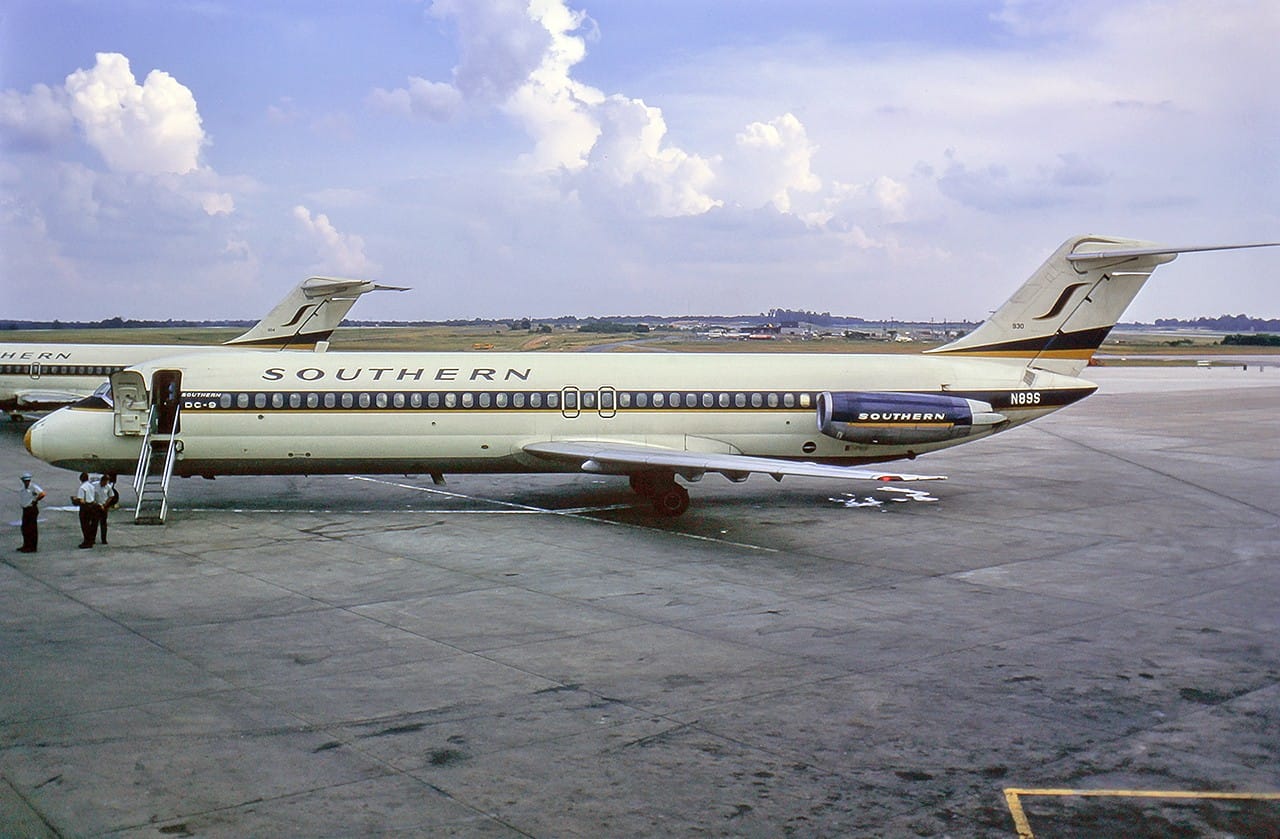
At 4:17 in the afternoon on 4 April 1977, a first officer named Lyman Keele said nine words into a cockpit voice recorder that would be played back for decades afterwards.
“Bill, you’ve got to find me a highway.”
His DC-9 had no engines. It had a hole punched through the windshield by hail. It was descending through 4,000 feet over rural Georgia with nothing on the charts within reach, and the only runway left in the world was a two-lane road called Georgia State Route 381.
Kurzinfo
- Flug: Southern Airways Flight 242, Muscle Shoals to Atlanta via Huntsville
- Datum: 4 April 1977
- Flugzeug: Douglas DC-9-31, registration N1335U
- Was ist passiert: Both Pratt & Whitney JT8D-7A engines destroyed by water and hail ingestion
- Landeplatz: Georgia State Route 381, New Hope, Paulding County, Georgia
- Maut: 63 of the 85 people aboard and nine on the ground died; counts vary slightly by source
- Unterscheidung: Still the deadliest aviation accident in the state of Georgia
The storm they could not see
The crew had flown the same stretch of sky earlier that day and met nothing worse than light rain. In the hours since, the weather had gone from scattered cells to one of the worst systems on record for the region — a system that would eventually spawn 20 tornadoes and 30 severe thunderstorms.
Nobody told them. They had been warned of embedded thunderstorms before leaving Huntsville, but not that the cells had merged into a squall line. So Captain Bill McKenzie and Keele did what crews did: they read their onboard radar and looked for a gap.

The gap was not a gap. Heavy rain nearer the aircraft was absorbing the radar energy and painting the ferocious cell behind it as calm — the effect known as attenuation. On the tape the captain sounds unconvinced right up to the moment they commit.
Ninety seconds that ended both engines
Descending from 17,000 to 14,000 feet near the Rome VOR, the DC-9 flew into hail so violent it broke the windshield. Both JT8D engines swallowed water and ice, stalled, suffered serious internal damage and flamed out. The electrical power failed for 36 seconds, came back, then failed again for over two minutes.
The crew's exchanges compress from procedure into something rawer. “Left engine won’t spool.” Then, seconds later, the other one. Then: “Stand by — we lost both engines.”
Nothing in the DC-9 flight manual told them what to do next. Until that afternoon, no airliner had ever had both engines put out by a thunderstorm. The possibility was considered too remote to write a procedure for.
Thirty-two and a half miles
What the two pilots did next deserves to be remembered independently of how it ended. From 14,000 feet the DC-9's theoretical maximum glide was about 34 miles. McKenzie and Keele coaxed roughly 32.5 miles out of it, hand-flying an aircraft neither had ever been trained to fly as a glider, while working restarts and talking to controllers.
Atlanta offered Dobbins Air Force Base, 20 miles east. Too far. Cartersville, 15 miles north, had a 3,200-foot runway meant for light aircraft — and it was behind them. A third field, Cornelius Moore, sat closer still, but it lay outside the controllers' airspace and never appeared on their screens.

So they picked a road. The aircraft touched down on Route 381 and slid roughly 1,830 feet before its wing struck a combined grocery store and gas station. It swerved, broke up and burned.
Sixty-three people aboard died, both pilots among them. Nine people on the ground were killed, including a family of seven. The rhythm and blues singer Annette Snell was among the passengers lost. Twenty-two people walked out of it, including both flight attendants.
The dissent that got it right
The NTSB's official probable cause named the mechanism: the “total and unique loss of thrust from both engines while the aircraft was penetrating an area of severe thunderstorms,” caused by ingesting massive amounts of water and hail.
One board member thought that explained nothing at all.
McAdams argued the majority had described what happened rather than why. His view has largely won. The lasting lessons of Flight 242 are about weather radar attenuation, about the gap between a forecast at departure and the sky an hour later, and about the fact that airborne radar shows you rain, not danger.
Modern crews get datalink weather, ground-based composite radar and dispatch updates in flight. All of it exists because of afternoons like this one.
Häufig gestellte Fragen
What happened to Southern Airways Flight 242?
Why did both engines fail on Southern Airways 242?
Why did the crew fly into the storm?
How far did the DC-9 glide without engines?
How many people died on Southern Airways 242?
What did the NTSB conclude about Flight 242?
Sources: NTSB final report, Wikipedia, Tailstrike CVR archive, AOPA, and Smithsonian Magazine.


0 Kommentare