
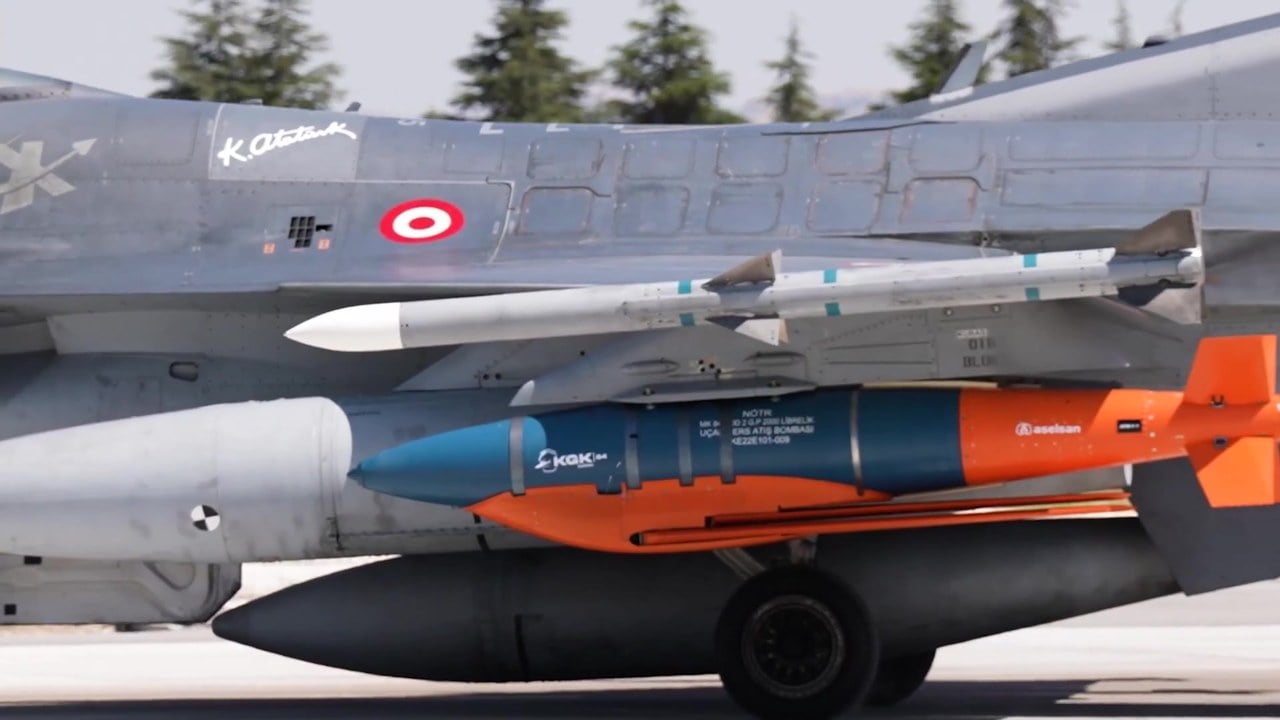
A Turkish F-16 has released a 2,000 lb bomb that flew itself to its target on a pair of pop-out wings. On 26 October 2026, ASELSAN announced that its KGK-84 winged guidance kit had completed its first qualification range firing from an F-16 at the Sinop firing range on Turkey’s Black Sea coast.
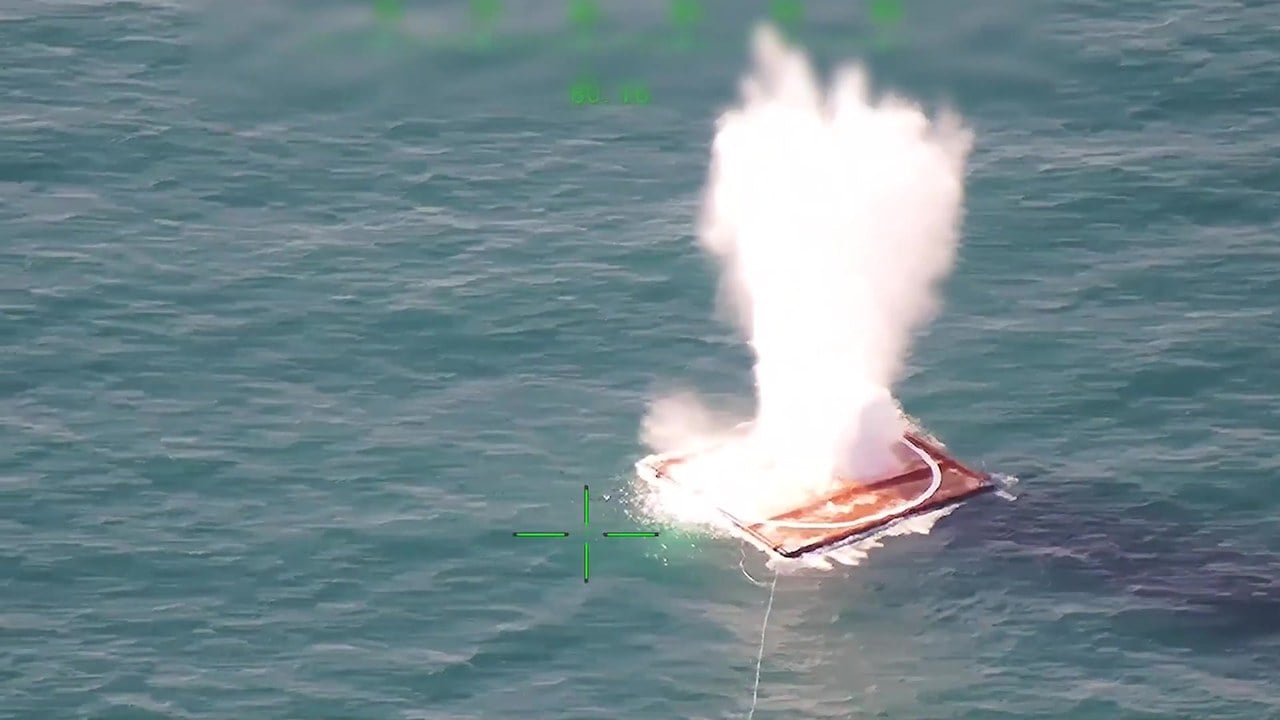
Qualification firings are the step between development testing and a weapon the customer can buy. TURDEF reports that the shot moves the ASELSAN KGK-84 further towards serial production. ASELSAN did not say how far the bomb flew this time or from what height it was released, but its own video shows the round striking a floating target at sea, and Turkish daily Sabah reported a direct hit.
Kurzinfo
- System: ASELSAN KGK-84 winged guidance kit
- Meilenstein: First qualification range firing, announced 26 October 2026
- Launch aircraft: Turkish F-16
- Reichweite: Sinop firing range, Black Sea coast
- Bombs: 2,000 lb class: Mk-84, Mk-84-T, NEB, NEB-T
- Erreichen: Up to 100 km from an F-16, unpowered (ASELSAN)
- Anleitung: INS plus satellite navigation, CRPA anti-jam antenna
- Earlier tests: First live drop December 2025; development test April 2026
A dumb bomb that glides
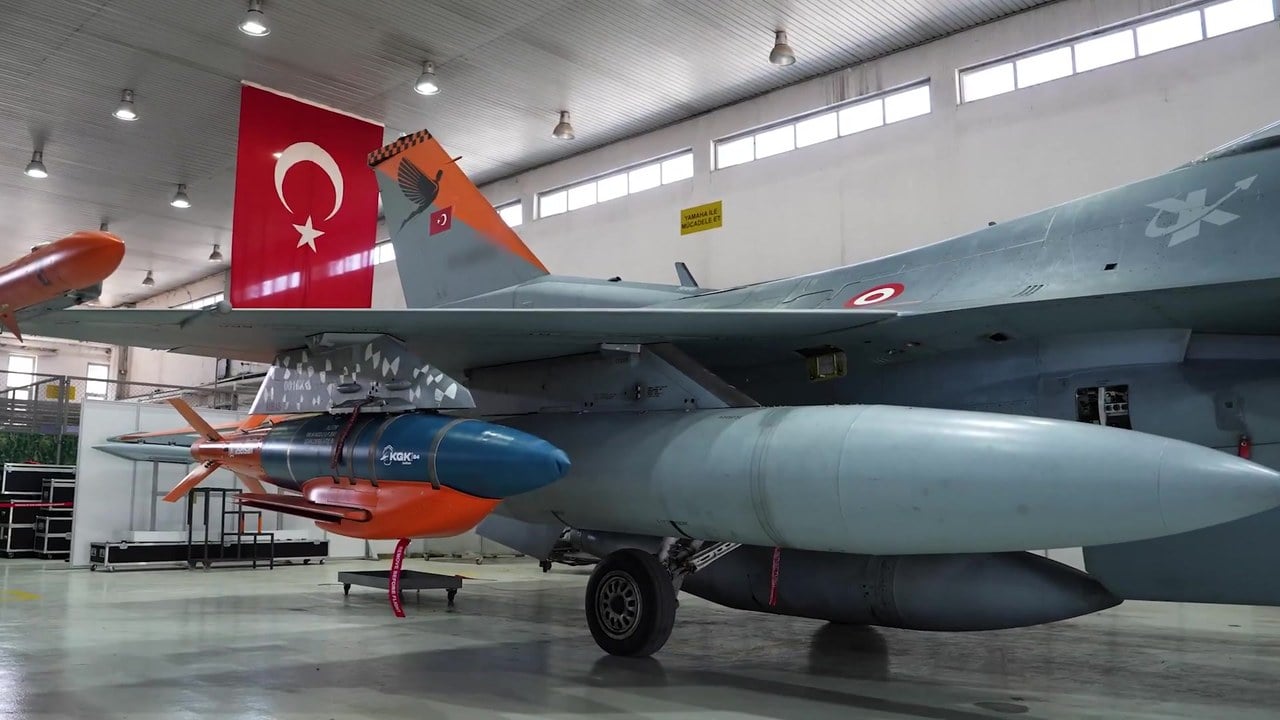
The idea is simple and powerful. The KGK-84 bolts onto ordinary 2,000 lb-class bombs: the Mk-84 general-purpose bomb, the Mk-84-T, and the NEB and NEB-T penetrators. After release, a wing assembly unfolds and the bomb glides towards its target instead of falling on a ballistic arc.
That turns a free-fall weapon into a stand-off one. According to ASELSAN, an F-16 can reach targets up to 100 km away with the kit, which lets the jet strike from outside the reach of many enemy air defences. The kit has no engine, which keeps the cost down.
Guidance comes from an integrated inertial navigation system paired with satellite positioning. A controlled reception pattern antenna (CRPA) helps it resist GNSS jamming, and the bomb can follow pre-programmed waypoints and hit at a selectable impact angle, day or night and in any weather. ASELSAN’s published figures, cited by TURDEF, give a circular error probable of less than 10 metres. The kit also complies with MIL-STD-1760, the standard electrical and data interface between a combat aircraft and its smart weapons.
Three tests in ten months
The 26 October firing is not the kit’s first trip off an F-16. In December 2025 ASELSAN released video of the KGK-84’s first live drop test, in which it scored a direct hit on a defined maritime target after following waypoints from long range. According to TURDEF, ASELSAN’s January 2026 bulletin said the bomb was released at 37,000 feet and Mach 0.87 and flew more than 80 km.
A second development test followed in April 2026. TURDEF reports that ASELSAN released the KGK-84 from an F-16 under aggressive manoeuvring, after which the bomb rolled to set up a vertical impact angle and flew more than 100 km without propulsion.
TRT Haber’s report on the KGK-84 firing from an F-16, published on 26 October 2026 (in Turkish).
The newest footage shows how far the program has come. In ASELSAN’s video, the orange-and-blue test round hangs under the wing of a Turkish F-16, drops away over the sea and ends its flight on a floating target raft.
Filling the heavy end of the family
ASELSAN’s KGK family already covers lighter bombs. The KGK-82 and KGK-83, for 500 lb and 1,000 lb weapons, are in service. The KGK-84 extends the same concept to the 2,000 lb class, the weight TURDEF says is needed against fixed and hardened targets.
For the Turkish Air Force, that means heavy stand-off strike from its F-16 fleet using bombs it already holds, without buying expensive powered missiles for every target. ASELSAN chief executive Ahmet Akyol called the kit a game-changer when the first live drop was announced, pointing to its long range for one-ton munitions and its low-cost, unpowered design.
ASELSAN’s own message on 26 October was blunt: KGK-84, it said, is ready for deployment. A qualification shot is not the same as an order. But for a kit that first hit a target only ten months ago, the heaviest member of the KGK family is moving fast.
Sources: ASELSAN (X, 26 Oct 2026), TURDEF, Sabah, Haber7, Türkiye Today, Defence Industry Europe, TRT Haber
0 Comments