
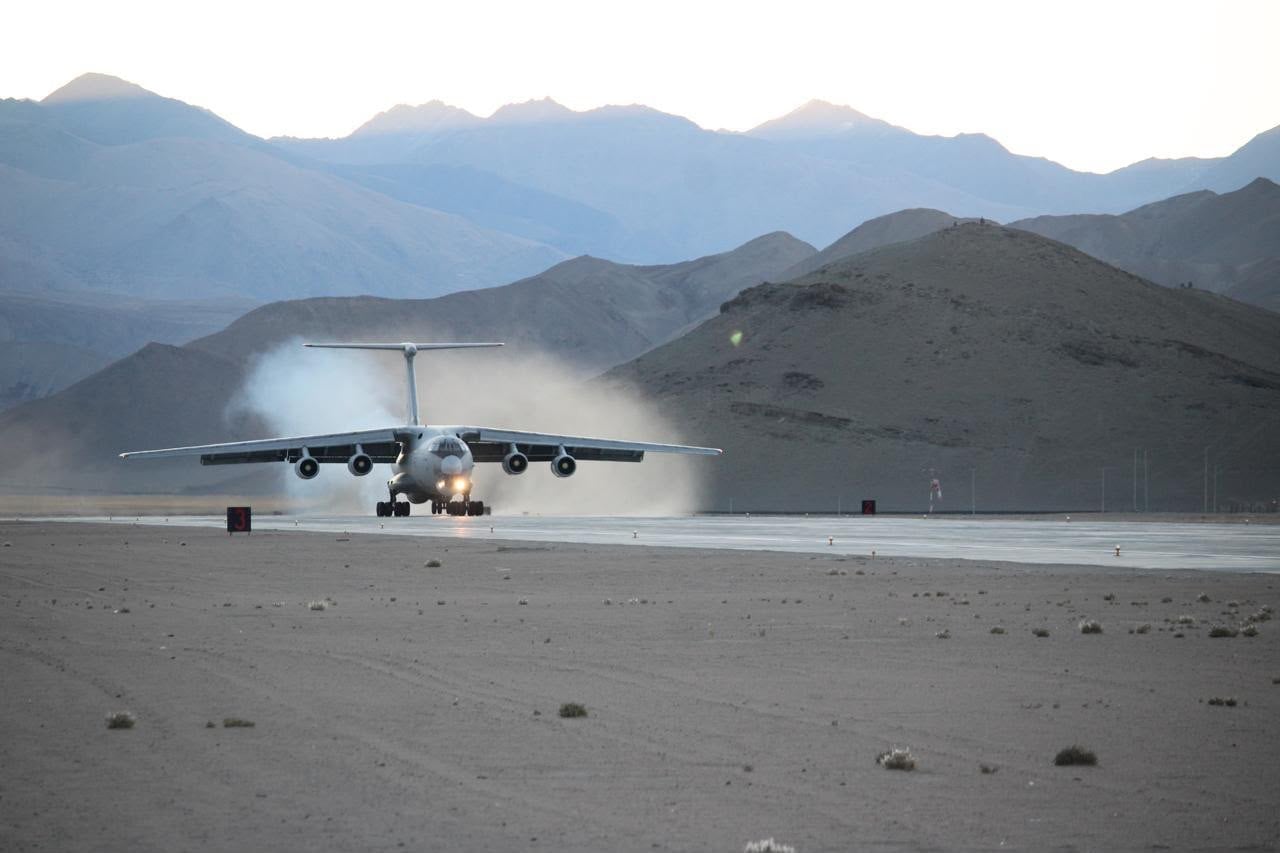
The runway sits in a bowl of bare brown mountains, about 25 km from the Line of Actual Control with China. Dust boils up behind four turbofans as a grey IL-76MD plants its main gear on the concrete. The air outside is thin enough that every kilogram of payload has to be argued for.
On Saturday, 7 November 2026, the Indische Luftwaffe announced that one of its IL-76MD heavy-lift transports had landed at Nyoma airbase in eastern Ladakh, at an elevation of 13,629 feet. The service called it the highest-altitude landing ever achieved by the aircraft anywhere in the world.
Kurzinfo
- Flugzeug: Ilyushin IL-76MD heavy-lift transport (IAF name: Gajraj)
- Operator: Indische Luftwaffe
- Airfield: Nyoma (Mudh-Nyoma) airbase, eastern Ladakh
- Elevation: 13,629 ft, per the IAF
- Angekündigt: 7 November 2026, on the IAF's X account
- IAF claim: Highest-altitude landing ever achieved by the IL-76MD anywhere in the world
- Distance to LAC: About 23 to 25 km, per Indian reports
- Airbase inaugurated: 12 November 2025, with a C-130J landing
- IL-76 in IAF service: Since 16 June 1985
What the IAF Actually Claimed
Read the wording carefully, because Indian headlines did not. Many outlets ran the IL-76MD Nyoma landing as a world record. The IAF's own post on X was narrower: it said the IL-76MD had made "the highest-altitude landing ever achieved by the aircraft anywhere in the world." That is a claim about this aircraft type, not an absolute altitude record for transport aircraft.
It is also the IAF's claim, not a ruling from any record-keeping body. No independent registry of IL-76 landings exists, and the type has flown with dozens of operators since the 1970s. Afterburner found no published report of an IL-76 landing higher, but that is not the same as proof that none ever has.
The date is slightly fuzzy too. ANI reported the landing took place on Saturday, while the Hindustan Times quoted officials as saying the record-breaking landing was made on Friday, 6 November. The announcement came on Saturday morning, India time.
The Indian Air Force's own announcement of the Nyoma landing, posted on 7 November 2026.
A Base Built Against the Clock
Nyoma has a long, odd history. It was built as an advanced landing ground during the 1962 war with China and then lay unused for decades. The IAF reactivated it on 18 September 2009, when an An-32 landed there, according to the Times of India.
Turning a dirt strip into a real airbase took the 2020 standoff in Ladakh. Defence Minister Rajnath Singh laid the foundation stone in September 2023, and the Hindustan Times reports that a team of women officers spearheaded the upgrade project, costed at about 218 crore rupees. The Times of India puts the estimate at 214 crore, a small gap between the two reports.
On 12 November 2025, then air chief Air Chief Marshal A.P. Singh formally opened the base by landing a C-130J Super Hercules there. Hindustan Times describes a 2.7 km runway able to handle fighters, transports and helicopters, plus hangars, an air traffic control building and hard standing for parking.
Why a Heavy Lifter at Nyoma Matters
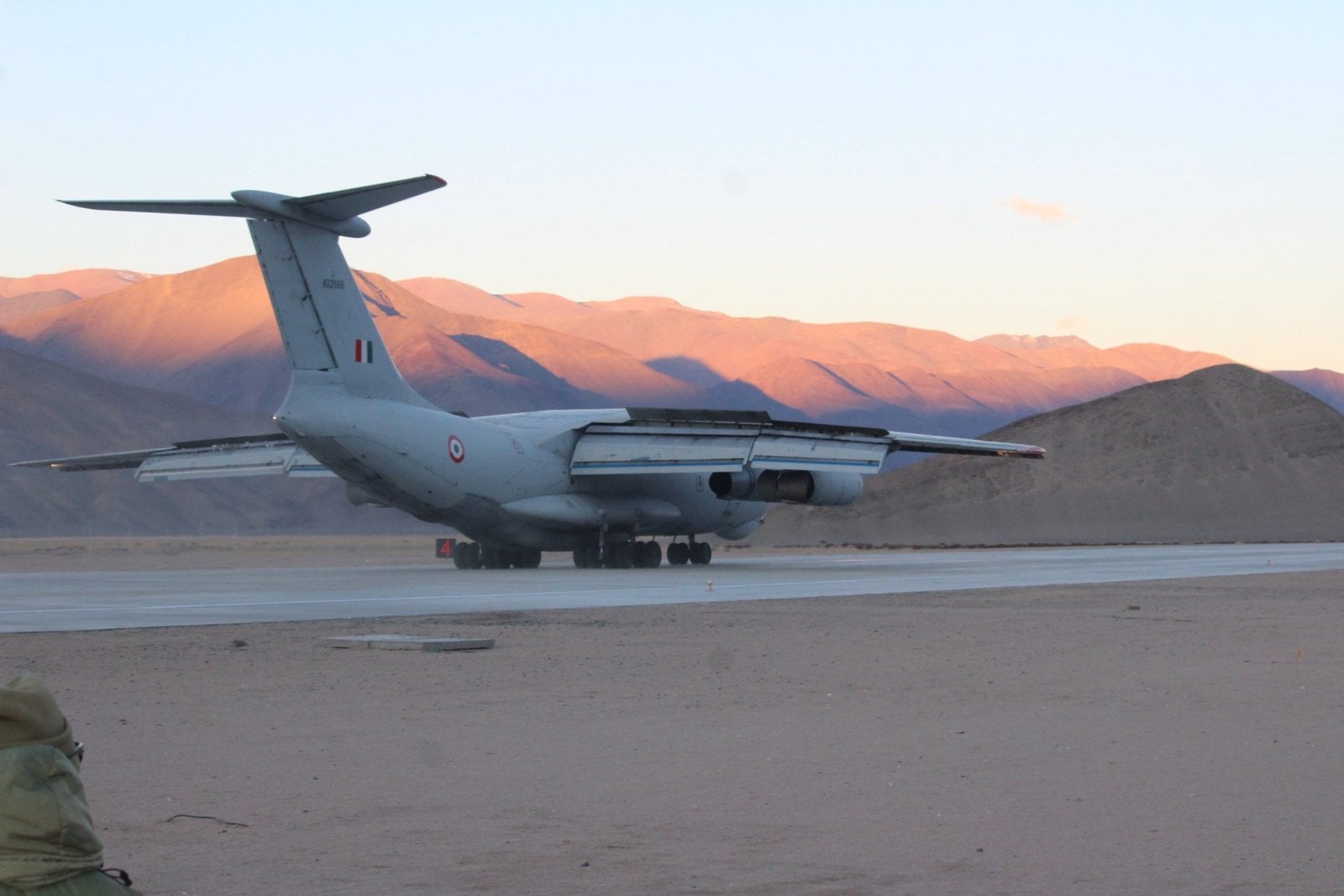
Altitude is the enemy of every transport pilot. Thin air means less lift from the wing and less thrust from the engines, so take-off and landing distances grow and payload shrinks. A big four-engine freighter landing at more than 13,000 feet is working near the edges of its envelope, which is why the IAF credited the skill, precision and professionalism of the crew.
The payoff is time. The IL-76 already operates regularly from Leh and Thoise, the Times of India notes, but both lie much farther from the frontier. A forward strip that can take a strategic airlifter cuts deployment and reaction times, speeds up evacuation and supports surveillance near sensitive sectors such as Demchok and the south bank of the Pangong Tso.
India learned that lesson the hard way. During the Galwan crisis, the IAF airlifted more than 68,000 troops, 90 tanks and 330 infantry combat vehicles into the region, according to the Times of India. Daulat Beg Oldi, at 16,614 feet, and Fukche remain higher landing grounds, but the paper says neither can currently handle strategic airlifters like the IL-76 or the C-17.
NDTV's report on the IL-76MD landing at Nyoma, with the IAF's footage of the touchdown.
The View From Across the Line
Nyoma does not exist in a vacuum. On the other side of the Line of Actual Control, the Chinese air force has built a network of high-altitude bases across the Tibetan Plateau. The Times of India lists Qamdo Bamda at about 14,200 feet, and Lhasa Gonggar and Ngari Gunsa among the high fields, many with very long runways to compensate for the thin air.
That context is worth holding next to the record headlines. Nyoma is not the highest military airfield in the region, and the IAF did not say it was. What it showed is that India's oldest heavy lifter can now reach a fighter-capable base within roughly 25 km of the frontier, which the Times of India frames as being less about matching China base for base than about cutting reaction time.
The IL-76MD, which the IAF calls Gajraj, joined the service on 16 June 1985, according to ANI. Four decades on, it is still the aircraft the IAF reached for when it wanted to make a point in Ladakh. The service summed up the flight in its own words: "Pushing boundaries. Redefining limits."
The timing carried its own message. The landing came a week after Air Chief Marshal Ashutosh Dixit took command of the IAF, and almost exactly a year after the base opened. For a force that spent four years staring across the LAC, a Gajraj on the Nyoma runway is a quiet way of saying the road to the frontier now runs through the sky.
Sources: Indian Air Force (official X post), ANI, Hindustan Times, The Times of India, News On AIR, NDTV

0 Comments