

Photographs circulating from Iran this week show a scatter of scorched composite panels, burnt wiring and a small turbojet, laid out on bare ground. Iranian sources say it was shot down. What it is, is more interesting than how it got there.
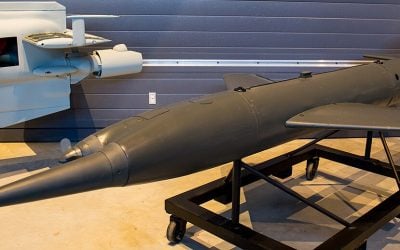
The parts belong to a Raytheon ADM-160 Miniature Air-Launched Decoy: an unarmed, 6.5-foot flying machine whose only job is to look, to a radar operator, like something far larger and far more dangerous than itself.
TWZ, which identified the wreckage, is careful about provenance, and so are we. Iranian state and military channels have a long record of overstating and mislabelling, and the location and circumstances of this loss have not been independently established. But the identification itself looks solid. The munitions analyst Trevor Ball pointed out the detail that settles it: the CAGE code 15090, Raytheon's US government supplier identifier, visible on the tail fins and other fragments.
Kurzinfo
| What was found | Wreckage identified as a Raytheon ADM-160 Miniature Air-Launched Decoy |
| Wo | Iran; exact location and circumstances not independently confirmed |
| When imagery emerged | 20 to 21 September 2026 |
| Identifying detail | CAGE code 15090, Raytheon’s supplier identifier, visible on the tail fins |
| What a MALD does | Mimics the radar signature of aircraft or standoff weapons; carries no warhead |
| ADM-160B dimensions | About 6.5 feet long, roughly 5.6 feet span deployed, small turbojet |
| Reichweite | Around 550 miles |
| Variants | ADM-160B decoy; ADM-160C MALD-J adds stand-in jamming |
A machine built to be shot at
Most air-launched stores are designed to survive or to destroy. The MALD is designed to be believed.
It carries no warhead. Instead it carries equipment that reproduces the radar signature of a specific aircraft or standoff weapon, and it can be programmed to fly an intricate route that behaves the way the thing it is imitating would behave. To a surface-to-air missile crew watching a screen, it is an inbound strike package. To the aircrew who released it, it is a lightning rod: a decoy that draws attention, tracking radars and, ideally, missiles away from aircraft with people in them.
Raytheon won the US Air Force development contract for the current ADM-160B in 2003. The B is a substantially different machine from the original A-model, which Teledyne Ryan, later Northrop Grumman, began developing in the late 1990s; the B has a more powerful turbojet and greater reach. The later ADM-160C, MALD-J, adds an electronic warfare payload so it can jam from inside the threat envelope rather than merely pretending to be a target.

Why the wreckage matters more than the shoot-down
Iran has framed this as an interception, and it may well have been one. It is equally possible the decoy simply flew its programmed route, ran out of fuel and came down, which is exactly what an expendable store is supposed to do at the end of its mission. The wreckage cannot settle that question, and it does not identify the aircraft that launched it either.
What it does establish is that MALDs are being used in the Iranian battlespace, which is the first physical confirmation of something that has been strongly suspected for over a year.
The suspicion dates to Operation Midnight Hammer, the June 2025 American strike on Iranian nuclear facilities, where US officials described an elaborate deception plan built to stop Iran working out the true direction and composition of the attack. MALD was always the obvious candidate. The opening phase of Operation Epic Fury very likely saw them used as well. And American A-10Cs have returned from the theatre carrying mission markings that include MALD symbols alongside Small Diameter Bombs, Paveways, APKWS rockets and Mavericks.
The electronic order of battle
Here is the part that makes this a story about intelligence rather than about one destroyed decoy.
Air defence systems are only dangerous when you do not know where they are and how they work. The moment a radar transmits, it announces its position, its frequency, its pulse characteristics and its operating doctrine. Building and maintaining a picture of all of that, an electronic order of battle, is the precondition for any serious air campaign, and it decays constantly as an adversary moves, repairs and reconstitutes.
A decoy is an extremely economical way to keep that picture current. Fire something that looks threatening enough to make Iranian operators switch on and engage, and the surveillance aircraft, satellites and other collectors listening nearby harvest everything that radiates. Nobody is put at risk. Nothing expensive is lost. And because kinetic activity in this conflict has slowed to a trickle rather than stopped, launching a decoy that looks like a strike does not read as an escalation the way a manned sortie would.
That is the argument TWZ makes about this wreckage, and it is the right one. The interesting fact is not that a decoy was destroyed. It is that decoys are still being flown at all, which tells you somebody is keeping the target folder warm.
Strange lights, and why nobody is laughing
The MALD wreckage surfaced the same day as videos of unidentified objects over Tehran began circulating, with no clear explanation offered by anyone.
The temptation is to dismiss that as noise. The better instinct, as TWZ's editor-in-chief Tyler Rogoway noted, is caution in both directions. Cheap drones and decoys are now used not only to stimulate air defences but to distract populations and to test how information moves out of a denied area. In a theatre where one side is deliberately generating false radar tracks, unexplained things in the sky are exactly what you would expect to see, and exactly what you should be slowest to interpret.
Warum jetzt?
Iran's central military command said on Sunday it had information that Washington was preparing to resume attacks. Trump told Fox News he was in a “deciding mode”, weighing further military action alongside economic pressure. Qatar and Pakistan are pushing to restart negotiations.
If large-scale operations do resume, the first hours will depend on how accurate the picture of Iran's air defences is on that morning. Which is why, in a conflict that has gone quiet, something that costs a few hundred thousand dollars and exists only to be shot at is still being launched into Iranian airspace.
Raytheon’s own explainer on how MALD is meant to work against an integrated air defence system.
Sources: TWZ, Raytheon, the US Air Force, Tasnim News Agency, Fox News, Axios, open-source analysis by Trevor Ball.
0 Comments