
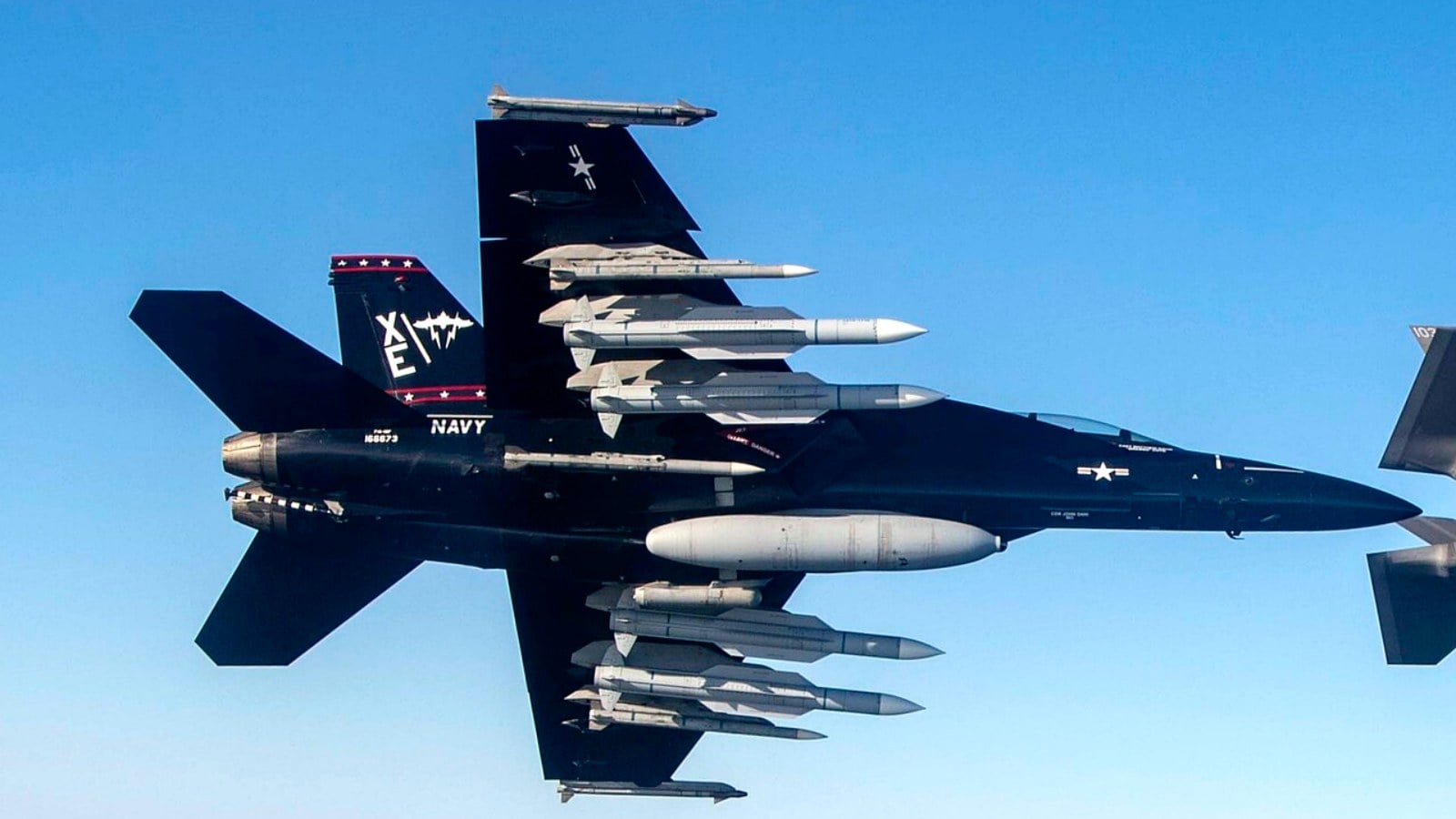
A grey Super Hornet over the Mojave, blue-banded test rounds under its wings, and a first for US naval aviation. On 14 October 2026, an aviation photographer caught a US Navy F/A-18F from Air Test and Evaluation Squadron 31 over Ridgecrest, California, carrying an AIM-174B and an AIM-260 at the same time.
The image, published by TWZ and Naval News on 21 October, is the first known public record of the AIM-174B and AIM-260 on the same aircraft. Both rounds were inert captive-carry shapes, identified by their blue bands, and the jet also carried an IRST21 infrared search and track sensor in a modified centreline fuel tank.
On its own, a test jet with two missiles is routine at China Lake. What makes this picture worth a second look is the pairing: the Navy’s longest-reaching air-to-air weapon and its next-generation AMRAAM successor, flying together on the fighter that will carry both into the Pacific.
Kurzinfo
Photographed: 14 October 2026, over Ridgecrest, California
Veröffentlicht: 21 October 2026 (TWZ, Naval News)
Flugzeug: US Navy F/A-18F Super Hornet, VX-31 “Dust Devils”, NAWS China Lake
Loadout: Inert AIM-174B and AIM-260A JATM (captive carry), IRST21 pod
AIM-174B: Air-launched SM-6 derivative by Raytheon; deployed since 2024
AIM-260A: Lockheed Martin Joint Advanced Tactical Missile, AIM-120 successor
Ranges: Classified for both weapons
A test squadron, a long lens and a first
VX-31, the “Dust Devils”, flies from Naval Air Weapons Station China Lake, the Navy’s weapons development range in the California desert. The squadron’s F/A-18F Super Hornets do the unglamorous work of integration: carriage, separation, software and sensor trials long before a weapon reaches a fleet squadron.
Both outlets credited the image to aviation photographer @_photosxlyss2_. Neither the Navy nor the manufacturers have commented on what the flight was testing. Captive carry of two different long-range missiles together, plus a passive IRST sensor, does at least suggest work on how a single Super Hornet manages a mixed long-range loadout.
The IRST21 matters in that picture. It detects and tracks aircraft passively, by their heat, without the radar emissions that tell an opponent a fighter is looking. According to TWZ, the Block II version went into full-rate production around a year ago for Navy and Air National Guard fighters. A silent sensor and two long-range missiles on one jet is a combination worth testing early.
AIM-174B: an SM-6 with wings to ride on
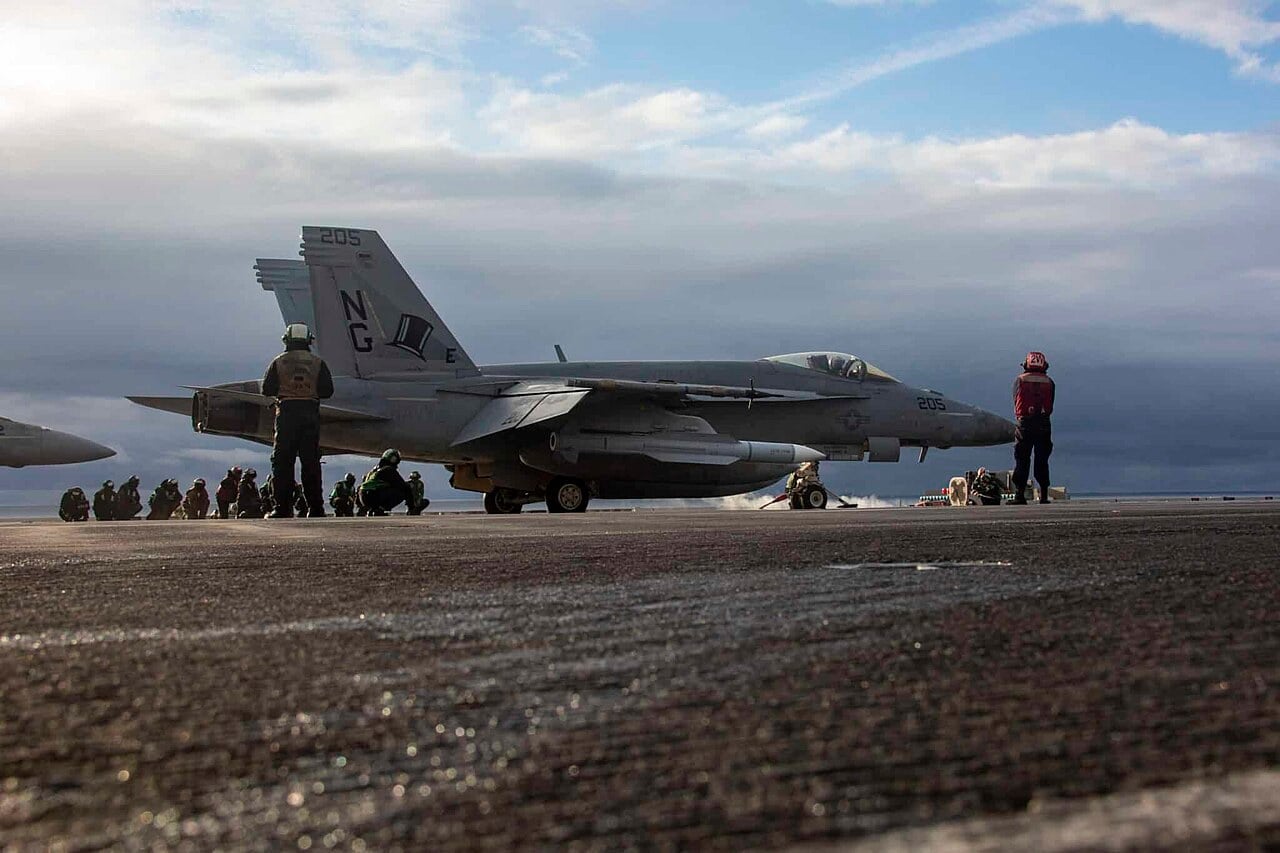
The AIM-174B is the air-launched member of Raytheon’s Standard Missile-6 family. It is essentially an SM-6 without the Mk 72 booster that ships use to get the missile out of a vertical launch cell. The Navy calls it the SM-6 Air Launched Configuration; its official nickname, revealed in the Navy’s 2025 naval aviation playbook, is Gunslinger.
It is a big weapon for a fighter: roughly 860 kg (about 1,900 lb), several times the weight of an AIM-120 AMRAAM. That mass buys range. The Navy has never published a figure, and estimates in open sources vary widely, but all put it well beyond the AIM-120D, in the region of hundreds of kilometres. Its intended targets are high-value aircraft such as tankers, airborne early warning jets and bombers.
The missile broke cover on VFA-2 Super Hornets at RIMPAC in July 2024, when a Navy spokesperson told Naval News that the Air Launched Configuration was operationally deployed. It has since appeared at Gray Flag 2024 with VX-9, at Northern Edge 2025 aboard USS Abraham Lincoln, and with forward-deployed squadrons in Japan. According to the Pentagon’s test office, it entered live fire test and evaluation in 2025.
TWZ on how the AIM-174 changes the Navy’s long-range air-to-air equation.
AIM-260A JATM: the quiet successor
The AIM-260A Joint Advanced Tactical Missile is a very different animal. Developed by Lockheed Martin for the US Air Force and Navy, it is meant to supplement and eventually replace the AIM-120, and it has to fit inside the weapon bays of the F-22 Raptor Und F-35. Its range, speed and seeker are undisclosed, and it is widely described as the answer to China’s PL-15.
The JATM stayed out of sight for years. It was finally photographed in public in May 2026 on another VX-31 F/A-18F leaving Eglin Air Force Base, and later on a Royal Australian Air Force Super Hornet at Gray Flag. In September 2026, Lockheed Martin and the Department of War signed a framework agreement to accelerate production, laying the groundwork for a multiyear procurement contract that still needs Congressional approval.
Why the pairing matters
Put the two together and the logic of the Navy’s Pacific air wing is visible on a single jet. The AIM-174B is the long arm, intended to push enemy tankers and radar aircraft back before a fight starts. The AIM-260 is the workhorse for the fight itself, compact enough for stealth fighters and with more reach than any AMRAAM.
There is a third act waiting: the AIM-424, a long-range air-to-air missile the Navy disclosed in August 2026 and is now testing on Super Hornets. For now, though, the AIM-174B and AIM-260 photographed together over Ridgecrest show where the Super Hornet is heading: a sensor-and-missile truck that hits at ranges its designers in the 1990s never planned for.
Sources: TWZ, Naval News, U.S. Navy, Lockheed Martin, Director, Operational Test and Evaluation, The Aviationist, Naval Aviation 2025 (US Navy)



0 Comments