
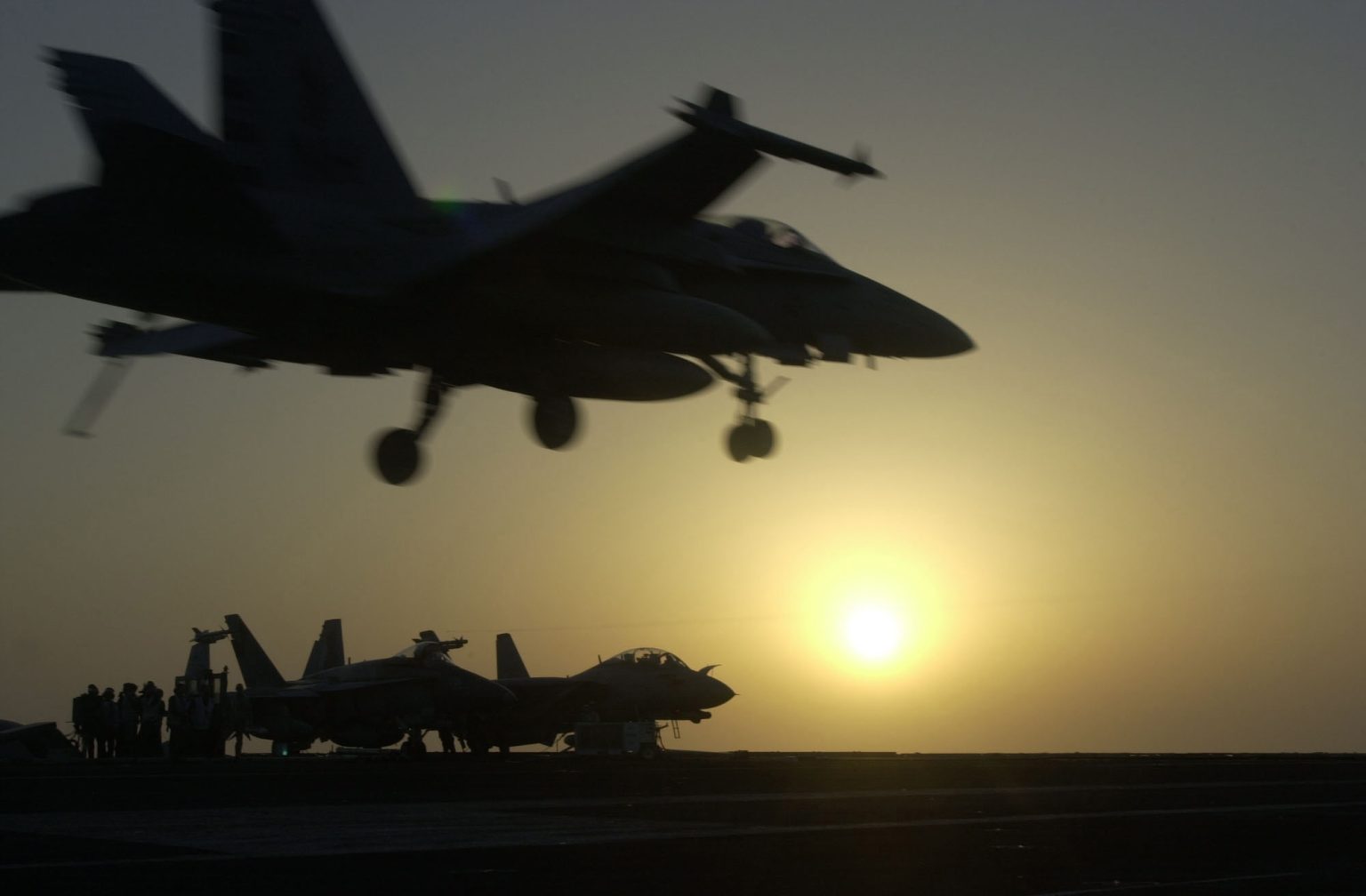
McDonnell Douglas F/A-18
“Hornet”
The world’s first true carrier multirole fighter — born from a jet that lost the contest the F-16 won, it merged fighter and attack into one airframe, proved it in a single 40-second Desert Storm sortie, and armed seven allied air forces. This is the original “legacy” Hornet (A/B/C/D), not the larger Super Hornet.
The winner that lost — and rewrote how navies fly
The Hornet grew out of a loser. Northrop’s YF-17 “Cobra” lost the US Air Force’s Lightweight Fighter fly-off to the General Dynamics YF-16 in 1975 — the design that became the F-16. But the US Navy wanted a twin-engine, carrier-capable multirole jet, and picked the YF-17 as the basis for its Naval Air Combat Fighter. McDonnell Douglas became prime contractor, with Northrop as partner, and heavily navalized the design: a bigger, stronger structure, folding wings, carrier landing gear and an arrestor hook.
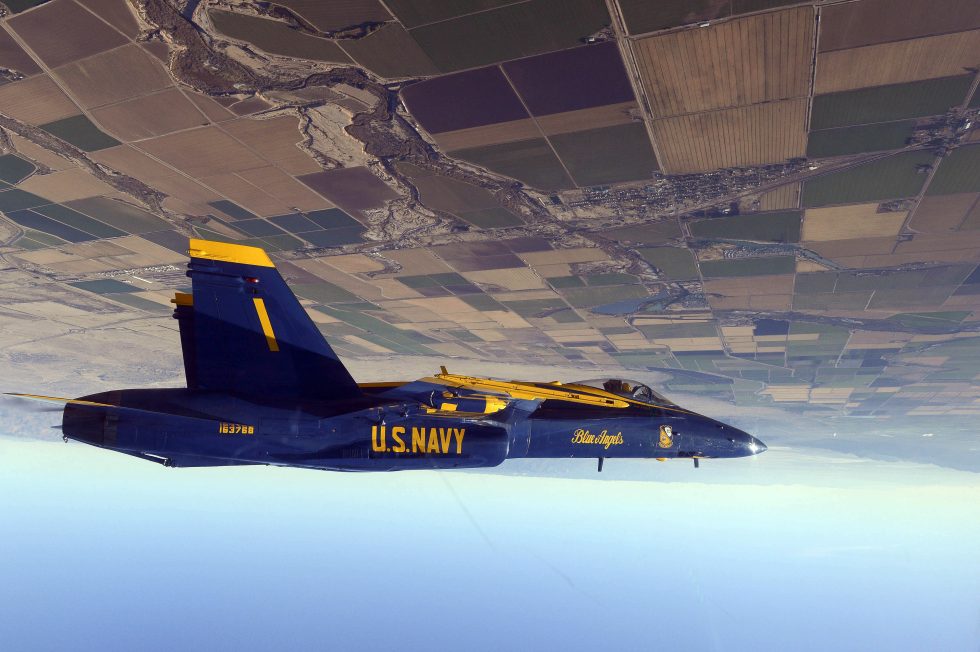
The F/A-18 first flew on 18 November 1978 and entered US Navy and Marine Corps service in 1983 with squadrons VMFA-314 and VFA-113. Its breakthrough was doing two jobs in one airframe — fighter and attack, hence the “F/A” designation — replacing separate F-4s and A-7s. The improved F/A-18C/D arrived from 1987 with new avionics and weapons, and the US Navy’s Blue Angels have flown Hornets since 1986.
Widely exported, the legacy Hornet armed seven allied air forces — Canada, Australia, Spain, Kuwait, Finland, Switzerland and Malaysia — and flew combat for many of them. Today it is an active but retreating aircraft: the US Navy retired the legacy Hornet from its front-line fleet squadrons in early 2019, Australia bowed out in 2021, and Canada, Finland and Switzerland are transitioning to the F-35. This page is the original “legacy” Hornet — not the larger, later Super Hornet.
01The multirole revolution, proven in one 40-second F/A-18 sortie
On the opening morning of Desert Storm, 17 January 1991, four VFA-81 “Sunliners” F/A-18Cs launched from USS Saratoga, each hauling four 2,000-lb Mk 84 bombs toward the H-3 airfield in western Iraq. An E-2C Hawkeye warned of MiG-21s closing head-on. Lt Cdr Mark Fox and Lt Nick Mongillo swung to the threat and killed both MiGs — Fox with an AIM-9 Sidewinder, Mongillo with an AIM-7 Sparrow — then rolled back onto their attack run and dropped their bombs on target.
The whole air-to-air engagement lasted under a minute. No aircraft type had ever so publicly demonstrated the “F/A” promise: win the dogfight and complete the strike on the same mission, without swapping jets or jettisoning ordnance. It became the enduring case study for why one multirole airframe could replace two specialists.
What makes the F/A-18 Hornet special
Twin GE F404 turbofans
Two General Electric F404 turbofans (F404-GE-400/-402), roughly 78–80 kN each in afterburner, gave the reliability, tolerance and quick throttle response the Navy demanded. Two engines meant redundancy for long over-water carrier sorties, and strong spool-up for the exacting carrier approach — a deliberate contrast to the single-engine F-16.
Leading-edge extensions & high-alpha control
The big wing-root leading-edge extensions (LEX), paired with relaxed stability, generate stabilising vortices that keep airflow attached at extreme angles of attack. The result is superb slow-speed, nose-high controllability — the signature air-show and dogfight trait that lets the Hornet point its nose where older jets would simply depart.
Carrier-suitable, digital, and multirole
A beefed-up structure, folding wings, tailhook and rugged gear made it carrier-suitable; a digital fly-by-wire system, APG-65/73 radar, HOTAS controls and glass-cockpit multifunction displays let one pilot switch from fighter to attack in flight. That marriage of a robust airframe and modern avionics is the core “F/A” idea made real.
02The F/A-18’s LEX: vortices that tame high angle of attack
The strakes running forward of the wing roots are not decoration. At high angle of attack they shed powerful vortices that re-energise the airflow over the wing, keeping it attached when the nose is pointed high and older designs would stall and depart. That is why the Hornet stays crisply controllable in the slow, nose-high regime — a decisive advantage in a close-in knife-fight and, just as importantly, on the low-and-slow carrier approach where control authority is everything.
03Why the Hornet is heavier than the F-16 it shared a contest with
The YF-17 and YF-16 were rival lightweight fighters, but navalizing the YF-17 into the F/A-18 meant reinforcing almost everything: a heavier structure to survive catapult shots and arrested landings, catapult-capable nose gear, an arrestor hook and wings that fold to fit crowded decks. All of that added weight over a land-based fighter like the F-16. The payoff was an aircraft that could slam onto a pitching carrier deck day and night, over open ocean, on two engines — exactly what the Navy could not get from the lighter, single-engine design.
Full F/A-18C specifications
Baseline note: the figures below describe the F/A-18C Hornet, the definitive single-seat legacy Hornet and the mark that flew from every American deck between 1987 and 2019 and still equips most export fleets. Deltas for the original F/A-18A, for the two-seat F/A-18B and F/A-18D, and for the night-attack C/D built from 1989 are given in grey. This page covers the legacy Hornet only; the larger F/A-18E/F Super Hornet and EA-18G Growler are a different aeroplane sharing a name, and have their own page.
Dimensions & weights
- Crew
- 1 (2 in the F/A-18B trainer and the F/A-18D, whose back-seater is a weapons and sensors officer, not a second pilot)
- Length
- 17.07 m (56 ft 0 in)
- Wingspan
- 12.31 m (40 ft 5 in) over the wingtip missile rails — 11.43 m (37 ft 6 in) bare wing
- Width, wings folded
- 8.38 m (27 ft 6 in) — the number that decided how many would fit on a carrier deck
- Height
- 4.66 m (15 ft 4 in)
- Wing area
- 37.16 m² (400 sq ft)
- Wing
- Trapezoidal, aspect ratio 3.5, 20° leading-edge sweep and a straight trailing edge; NACA 65A005 mod. at the root, 65A003.5 mod. at the tip. Full-span leading-edge flaps, single-slotted trailing-edge flaps and ailerons across the whole span.
- Empty weight
- 10,433 kg (23,000 lb) — the two-seat B and D run roughly 100–200 kg heavier
- Loaded weight, fighter mission
- 16,769 kg (36,970 lb)
- Max take-off
- 23,541 kg (51,900 lb)
- Internal fuel
- ~4,926 kg (~10,860 lb) — the B and D give up about 6 per cent of it to make room for the second cockpit
- External fuel
- ~3,050 kg (~6,700 lb) in three 330 US gal (1,250 litre) tanks
- Max external stores
- ~6,215 kg (~13,700 lb) — a catalogue figure. No carrier sortie ever combined it with useful fuel, and the recovery weight limit bit first.
- Hardpoints
- 9 (2 wingtip rails, 4 underwing, 2 fuselage cheek stations, 1 centreline)
- Wing loading, fighter mission
- 451 kg/m² (93 lb/sq ft)
Performance
- Max speed, altitude
- Mach 1.8, 1,915 km/h (1,190 mph, 1,034 kt) at 12,190 m (40,000 ft)
- Max speed, sea level
- Mach 1.06, 1,296 km/h (805 mph, 700 kt)
- Cruise speed
- 889 km/h (552 mph, 480 kt)
- Rate of climb, sea level
- 15,240 m/min (50,000 ft/min)
- Service ceiling
- 15,240 m (50,000 ft)
- Combat radius, air-to-air
- ~740 km (~460 miles, ~400 nm) — the single most consequential number on this page. With a strike load it was shorter again, and every published figure depends on a profile the publisher rarely states.
- Range, clean with two AIM-9
- 2,017 km (1,253 miles, 1,089 nm)
- Ferry range
- 3,330 km (2,070 miles, 1,800 nm) with three drop tanks
- Approach speed
- ~248 km/h (~154 mph, ~134 kt) — low and stable, and the reason Hornet pilots consistently rated it the easiest fast jet in the fleet to bring aboard
- Load factor limits
- +7.5 g / −3.0 g
- Angle of attack
- Controllable well beyond 50°, with the nose still pointing where the pilot wanted it. NASA's F-18 High Alpha Research Vehicle pushed a thrust-vectoring Hornet to 65–70°.
- Thrust-to-weight
- 0.96 at fighter loaded weight (1.13 at half internal fuel)
Propulsion & systems
- Engines
- 2 × General Electric F404-GE-402 Enhanced Performance Engine afterburning turbofans — F404-GE-400 in the F/A-18A/B and in C/D airframes built before 1992
- Thrust
- 48.9 kN (11,000 lbf) dry and 78.7 kN (17,700 lbf) with reheat, per engine; 157.4 kN (35,400 lbf) total — the earlier F404-GE-400 gave 47.7 kN (10,700 lbf) dry and 71.2 kN (16,000 lbf) in reheat, so the -402 is worth roughly 10 per cent more
- Intakes
- Fixed pitot type, with no variable ramps or cones. Simpler, lighter and far less maintenance than the F-4, F-14 and F-15 arrangements, at the cost of pressure recovery above about Mach 1.6 — a deliberate trade for an aircraft meant to fight subsonic and transonic.
- Flight control
- Quadruplex digital fly-by-wire, the first fitted to a production fighter, with a mechanical reversion to the stabilators only. Full-span leading-edge flaps, flaperons and oversized stabilators scheduled by the flight control computers, which multiply surface travel at low speed and swing the canted fins inboard rather than simply left and right.
- Radar
- Hughes AN/APG-65 multi-mode pulse-Doppler, the first radar to give one pilot genuinely usable air-to-air and ground-mapping modes on the same scope. Replaced from 1992–94 by the faster AN/APG-73. Selected US Marine Corps C/D and the Canadian CF-188 fleet have since been retrofitted with the Raytheon AN/APG-79(V)4 gallium-nitride AESA — a forty-year-old airframe carrying a radar newer than most of what flies against it.
- Sights and sensors
- Head-up display, HOTAS controls and three multi-function displays — the arrangement that let one pilot swap between fighter and attack work at the push of a button. AN/AAS-38 NITE Hawk targeting FLIR and AN/AAR-50 thermal navigation pod on night-attack aircraft, later AN/ASQ-228 ATFLIR and Litening; JHMCS helmet-mounted sight on upgraded fleets.
- Countermeasures
- AN/ALR-67 radar warning receiver, AN/ALQ-126B deceptive jammer, AN/ALE-39 and later AN/ALE-47 chaff and flare dispensers. The AN/ALQ-165 ASPJ internal jammer was cancelled for the US fleet but bought by Finland, and later reinstated for the Super Hornet.
- Ejection seat
- Martin-Baker SJU-5/6 in the A and B; SJU-17 NACES (Navy Aircrew Common Ejection Seat) in the C and D, zero-zero capable
- First flight
- Northrop YF-17 Cobra, 9 June 1974; F/A-18A prototype, 18 November 1978; first production F/A-18A, 12 April 1980
- Service entry
- January 1983 with VMFA-314 at MCAS El Toro; first carrier deployment February 1985 aboard USS Constellation with VFA-25 and VFA-113
- Number built
- ~1,480 F/A-18A/B/C/D (1978–2000, including 431 built new for export customers, many of them licence-assembled in Australia, Finland and Switzerland). Production of the C and D ended in 2000; the very last F/A-18C was assembled by Patria in Finland.
- Unit cost
- ~US$29 million flyaway (1998 US Navy figure; roughly US$57 million in 2026 money) — cost per flight hour is quoted anywhere between about US$16,000 and US$24,000 depending on whether depot-level work is counted
04The F/A-18 Hornet’s cost: why the numbers are slippery
Published unit costs for the legacy Hornet range roughly from US$29 million to US$57 million depending on the variant, the year and how the accounting is done — flyaway cost, program cost, then-year versus constant dollars all give different answers. Treat any single figure as an approximation. No credible, consistent cost-per-flight-hour number exists in open sources for the legacy A/B/C/D either. What is clear is the value proposition the Navy bought: a single airframe that did the work of two, cutting the number of aircraft types a carrier air wing had to buy, crew, arm and maintain.
Armament & payload
The Hornet was the first American aircraft built from the start to fight and to bomb with one pilot and one set of controls
Everything before it made you choose. The F-4 needed two men; the A-6 needed two men and could not fight; the A-7 could not fight at all; the F-14 could barely bomb until the 1990s. The Hornet put a multi-mode radar, three multi-function displays and a HOTAS grip in front of one pilot and let him change the aeroplane's job in flight with a thumb. On 17 January 1991 two VFA-81 F/A-18Cs, outbound to bomb an Iraqi airfield with four Mk 84s apiece, were vectored onto a pair of MiG-21s, shot both down with Sidewinders inside forty seconds, and then went on and delivered the bombs. No other aircraft in the world could have done that morning's work.
The price was reach. Nine stations and a nominal ~6,215 kg (~13,700 lb) look generous until you notice that two of them are usually drop tanks and that the carrier recovery weight limit bites long before the structural one. Against the A-6 Intruder it replaced, the Hornet gave away most of a tanker's worth of radius, and the fleet spent the 1990s buying that radius back with organic tanking — which is to say, with other Hornets. Clearances vary enormously by mark and operator: Finnish, Swiss and Spanish fits differ substantially from American ones, and several of the weapons below were never carried by every fleet.
Gun
- 1 × General Electric M61A1 Vulcan 20 mm six-barrel rotary cannon in the upper nose, 578 rounds, 6,000 rounds a minute
- Mounted on the centreline above the radar, so the rounds go where the aircraft is pointed with no lateral offset — a better gun installation than the wing-root or fuselage-side fits it replaced
- Firing it kicks gun gas straight into the intakes and blanks the radar picture briefly; pilots learned to accept both
- On the sixty F/A-18D(RC) reconnaissance aircraft the cannon is removed entirely and the ATARS electro-optical sensor package occupies the gun bay
Air-to-air
- AIM-9L/M/X Sidewinder — two on the wingtip rails as standard, up to eight on twin racks; AIM-9X with JHMCS helmet cueing on Finnish, Swiss, Spanish, Canadian and US Marine aircraft
- AIM-7F/M/P Sparrow — two on the fuselage cheek stations, the original medium-range fit and the weapon the APG-65 was built around
- AIM-120A/B/C AMRAAM — from the mid-1990s on the C and on upgraded F/A-18A+ airframes; up to eight with twin racks, a fit a VX-4 test aircraft demonstrated with ten AMRAAM and two Sidewinders aboard
- AIM-132 ASRAAM and IRIS-T on some export fleets — IRIS-T notably on the Spanish EF-18M
- Recorded air-to-air kills are modest: two Iraqi MiG-21s in 1991 by US Navy Hornets, plus a Syrian Su-22 downed by a US Navy F/A-18E in 2017. The Hornet's reputation rests on what it could do, not on a long score sheet.
Air-to-surface guided
- AGM-65E laser-guided and AGM-65F imaging-infrared Maverick, up to four — the Marine Corps close air support round of choice
- AGM-84 Harpoon anti-ship missile, and the derived AGM-84E SLAM and AGM-84H/K SLAM-ER land-attack weapons with man-in-the-loop data link terminal guidance
- AGM-88 HARM anti-radiation missile — the Hornet inherited the defence suppression job from the A-7 and EA-6B, and Spanish squadron 152 was assigned SEAD outright
- AGM-154 JSOW glide weapon and AGM-158 JASSM cruise missile on late US and Finnish aircraft; Finland and Spain also cleared the Taurus KEPD 350
- AGM-62 Walleye electro-optical glide bomb on early aircraft, long since withdrawn
Bombs
- Mk 80 series unguided bombs — Mk 82 227 kg (500 lb), Mk 83 454 kg (1,000 lb), Mk 84 907 kg (2,000 lb), with Snakeye and BSU-49 retarded tails for low-level release
- Paveway II and Paveway III laser-guided bombs (GBU-10, GBU-12, GBU-16, GBU-24) — the precision workhorse from the Gulf War onwards
- JDAM: GBU-31, GBU-32 and GBU-38 GPS-guided kits, and the dual-mode GBU-54 Laser JDAM, which finally let a Hornet hit something that was moving
- Cluster weapons: Mk 20 Rockeye II, CBU-78 Gator mines, CBU-87 Combined Effects Munition, CBU-97 Sensor Fuzed Weapon. Most European operators have given them up under the Convention on Cluster Munitions.
- Mk 77 incendiary bombs; the B61 nuclear bomb was a cleared US Navy and Marine Corps store, quietly dropped from the fact sheets
Rockets
- 2.75 in (70 mm) Hydra 70 rockets in LAU-61 nineteen-round and LAU-68 seven-round pods
- 5 in (127 mm) Zuni rockets in four-round LAU-10 pods — heavy, inaccurate and much liked by Marine forward air controllers for marking
- APKWS laser-guided 2.75 in rockets on late US aircraft, turning the cheapest store on the jet into a precision weapon
- White phosphorus marking rockets for the FAC(A) mission, which the two-seat F/A-18D took over from the OA-4M and OV-10
Pods & other stores
- AN/AAS-38 NITE Hawk targeting FLIR, with a designator and ranger laser from 1993, and the AN/AAR-50 TINS thermal navigation pod — the pair that made the night-attack Hornet
- AN/ASQ-228 ATFLIR on later US and Swiss aircraft, and the Litening pod on Finnish, Spanish and Marine Corps jets
- D-704 buddy refuelling store on the centreline, which let one Hornet tank another — the fleet's standing answer to the type's short legs, and a large slice of the reason the Super Hornet was bought
- ATARS electro-optical and infrared reconnaissance package in the gun bay of the F/A-18D(RC), and the SUU-42A/A dispenser and podded ECM sets
- Up to three 330 US gal (1,250 litre) Sargent Fletcher FPU-8/A drop tanks; ADM-141 TALD decoys, used in numbers to open Iraqi air defences in 1991
Three typical loadouts
- Fleet air defence, combat air patrol
- 2 × AIM-9M Sidewinder on the wingtip rails, 2 × AIM-7M Sparrow or AIM-120 AMRAAM on the fuselage cheeks, 2 × AIM-120 underwing, 2–3 × 330 US gal drop tanks, full 578 rounds of 20 mm. Endurance, not payload, is the limiting quantity.
- Night interdiction, F/A-18D
- 4 × GBU-12 Paveway II, 1 × AN/AAS-38B NITE Hawk targeting FLIR, 1 × AN/AAR-50 navigation pod, 2 × AIM-9M, 2 × AIM-120, 2 × drop tanks. The back-seater works the pod and the radar while the pilot flies low in the dark.
- Defence suppression
- 2–4 × AGM-88 HARM, 2 × AIM-9M, 2 × AIM-120, 1 × AN/ALQ-126B jammer set with a centreline tank. Flown as the first wave into an integrated air defence network, often alongside TALD decoys.
Sources: the US Navy F/A-18 fact file, the F/A-18A/B/C/D NATOPS flight manual performance charts, Naval Air Systems Command programme documents and operator air force publications. Where the same store is quoted at different maximum quantities, the lower and better-attested figure has been used. Nuclear and cluster clearances in particular have been quietly withdrawn from several fleets and should not be read as current.
Variants
The Hornet began as the aeroplane that lost, and the loser turned out to be the one the Navy could actually use
In 1974 the Air Force ran the Lightweight Fighter competition and General Dynamics' single-engined YF-16 beat Northrop's twin-engined YF-17 Cobra. That should have been the end of it. But Congress had told the Navy to find something cheaper than the F-14, and the Navy looked at the YF-16's one engine and narrow undercarriage and declined a naval F-16 outright. On 2 May 1975 it picked the YF-17 instead, and handed Northrop a partner it had not asked for: McDonnell Douglas, who knew how to build a carrier aeroplane and became the prime contractor.
What emerged was barely the same aircraft. The airframe, undercarriage and hook were strengthened, wings folded, a catapult attachment and a second nosewheel appeared, and roughly 2,000 kg of extra fuel went into a fattened dorsal spine and wet wings. Gross weight rose by some 4,500 kg. The gaps between the leading-edge extensions and the fuselage — the boundary layer discharge slots that kept the LEX vortices off the fins — were 80 per cent filled in to cut drag, and the fins duly began cracking. The fleet was briefly grounded in 1984 until the stabilisers were strengthened, and from May 1988 a small vertical fence went on top of each LEX to spread the vortices and steer them clear. It is the most visible scar of the range problem the Hornet never quite solved.
Two separate aircraft, the F-18A fighter and A-18A attack version, were planned and then merged into one when the multi-function displays made the distinction unnecessary. The combined designation F/A-18A became official on 1 April 1984 — and that piece of paperwork is arguably the aircraft's real legacy.
- Northrop YF-17 Cobra (1974, 2 built)
- The land-based lightweight fighter prototype that lost to the YF-16. Twin F404 predecessors, canted fins, leading-edge extensions — the shape survives, almost nothing else does.
- F/A-18A and F/A-18B (1980–87, 380 and 40 built)
- The original single-seater and its two-seat trainer, the latter first designated TF-18A. F404-GE-400 engines, AN/APG-65 radar, no AMRAAM; the second cockpit costs the B about 6 per cent of internal fuel but leaves it fully combat-capable. The airframe was designed for 6,000 flight hours and Marine Corps examples have been stretched past 10,000, by way of the AN/APG-73 and AMRAAM rewiring that made them F/A-18A+ and the later life-extension work that made them F/A-18A++.
- F/A-18C (1987–2000, ~466 for US service)
- The 1987 block upgrade and the baseline of this page: AMRAAM, imaging-infrared Maverick, AGM-84E SLAM, synthetic-aperture ground mapping, a self-protection jammer and the NACES seat. F404-GE-402 engines standard from 1992, AN/APG-73 radar from 1994.
- F/A-18D (~161 built)
- Two-seat C, in US service flown only by the Marine Corps. The rear cockpit is missionised for a naval flight officer rather than a pilot, and the D became the Marines' night attack and airborne forward air control aircraft. Sixty were completed as F/A-18D(RC) with the ATARS reconnaissance package in place of the gun.
- Night attack C/D (from 1989)
- Not a separate designation but a real dividing line: AN/AAR-50 thermal navigation pod, AN/AAS-38A NITE Hawk FLIR, night-vision-compatible cockpit lighting, two full-colour multi-function displays and a colour moving map. Everything before it was a day aeroplane pretending otherwise.
- CF-188A / CF-188B (Canada, 1982–88, 138 built)
- The first export order and still the largest outside the United States: 98 single-seat and 40 two-seat, near-identical to the F/A-18A/B, with a spotlight for night intercept identification and a painted false canopy on the belly. Modernised to C/D avionics standard from 2001, and further extended under the Hornet Extension Project.
- (A)F/A-18A / (A)F/A-18B (Australia, 1984–90, 75 built)
- Assembled in Australia by Government Aircraft Factories from McDonnell Douglas kits, with the catapult attachment deleted and a land arrestor hook. Retired 29 November 2021; 25 airframes went on to Canada.
- EF-18A/B, later EF-18M (Spain, 1985–90, 72 built plus 24 ex-US Navy)
- Spanish designations C.15 and CE.15. Upgraded locally by EADS CASA and Indra rather than under licence, with APG-65(V)3 radar, new mission computers and buses, IRIS-T, GBU-48 and Taurus clearance. A further 24 second-hand US Navy F/A-18As arrived from 1995 for the Canary Islands.
- F-18C/D (Finland 64, Switzerland 34)
- Two neutral air forces that bought the Hornet as an interceptor, hence F rather than F/A. Finland took 57 C and 7 D from 1995, the C-models assembled by Patria at Halli — the last F/A-18C in the world came off that line in August 2000 — and added AIM-9X, JHMCS, Link 16, JDAM, JSOW and JASSM in two mid-life upgrades. Switzerland took 26 C and 8 D, assembled at Emmen, delivered with no ground-attack capability at all as a political condition and retrofitted for it later.
- KAF-18C/D and Malaysian F/A-18D (Kuwait 40, Malaysia 8)
- Kuwait ordered 32 single-seat and 8 two-seat aircraft in 1988 and received them from October 1991 into an air force that had just been overrun and liberated; they remain unusually low-houred, and Malaysia's long attempt to buy them collapsed in early 2026. Malaysia's own eight F/A-18Ds, delivered in 1997, make it the only operator ever to buy the two-seater alone; one was lost at Kuantan in August 2025.
One designation is missing because it was never built: the F-18L, Northrop's land-based export Hornet, some 3,500 kg lighter with no folding wing and no carrier gear. Every customer preferred the real thing, and the sales quarrel that followed put Northrop and McDonnell Douglas in court from 1979 until a settlement in 1985. The F/A-18E/F Super Hornet and EA-18G Growler carry the name and the layout but are a 25 per cent larger, F414-engined redesign with a different wing, different intakes and almost no parts commonality; they are covered on their own page and are deliberately not treated as legacy Hornet variants here. Production figures are the best-attested published totals and differ by a handful of airframes between sources, chiefly over how prototypes, development aircraft and rebuilds are counted — Finland famously rebuilt one damaged F-18C into a D using the forward fuselage of a Canadian CF-188B.
From rejected prototype to retreating veteran
The YF-17 loses
Northrop’s YF-17 loses the USAF Lightweight Fighter fly-off to the YF-16 — the jet that becomes the F-16.
The Navy adopts the loser
The US Navy selects the YF-17 as the basis for its Naval Air Combat Fighter; McDonnell Douglas becomes prime contractor.
First flight
The navalized F/A-18 takes to the air for the first time.
Enters service
The Hornet joins US Navy and Marine Corps squadrons VMFA-314 and VFA-113.
The Blue Angels adopt it
The US Navy flight demonstration squadron re-equips with the Hornet, making its shape iconic.
The improved C/D
The F/A-18C/D enters production with upgraded avionics and expanded weapons.
Two MiGs, then the bombs
VFA-81 Hornets down two MiG-21s in under a minute on the opening morning of Desert Storm, then complete their bombing run.
Kosovo, Iraq, Afghanistan
US and allied Hornets fly combat over the Balkans, Iraq (2003 onward) and Afghanistan.
US Navy retires the legacy Hornet
Front-line fleet squadrons hand over to the Super Hornet; legacy Hornets pass to reserve and training roles.
Australia retires its Classic Hornets
The RAAF withdraws its F/A-18A/B fleet, replaced by the F-35A. Canada, Finland and Switzerland are also transitioning to the F-35.
From the flight line: twelve Hornet stories
Born from a rejected fighter
The winner that lost
Read the full story
Two MiGs killed, then the bombs still fell
Dogfight and strike, one sortie
Read the full story
Why it’s F/A, not just F or A
What the slash means
Read the full story
America’s team flew Hornets for 34 years
The Blue Angels’ mount
Read the full story
How the LEX tame high angle of attack
Vortices that keep flying
Read the full story
MiGFlug’s home country flies the Hornet
Switzerland’s Alpine Hornets
Read the full story
Cold-weather Hornets on the Baltic frontier
The Finnish Ilmavoimat
Read the full story
Folding wings, a hook and a very strong airframe
Built for the boat
Read the full story
The Hornet went to war for many flags
Allied over many skies
Read the full story
The Classic Hornet’s Down Under farewell
Australia says goodbye
Read the full story
Legacy Hornet vs Super Hornet
Don’t confuse the cousins
Read the full story
The workload the Hornet handed its aviator
One pilot, two jobs
Read the full story
The Hornet in pictures
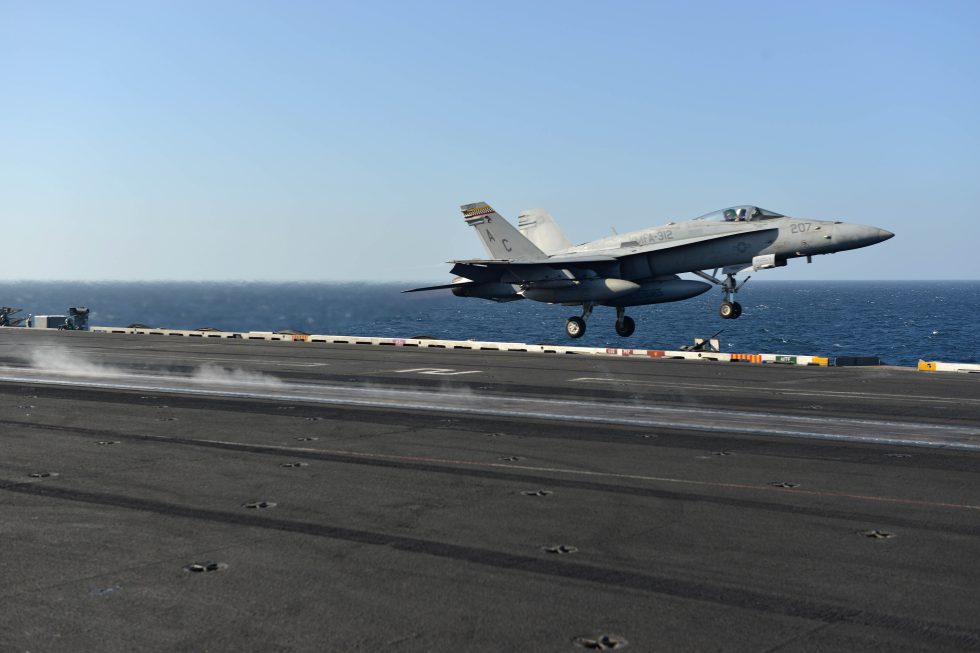
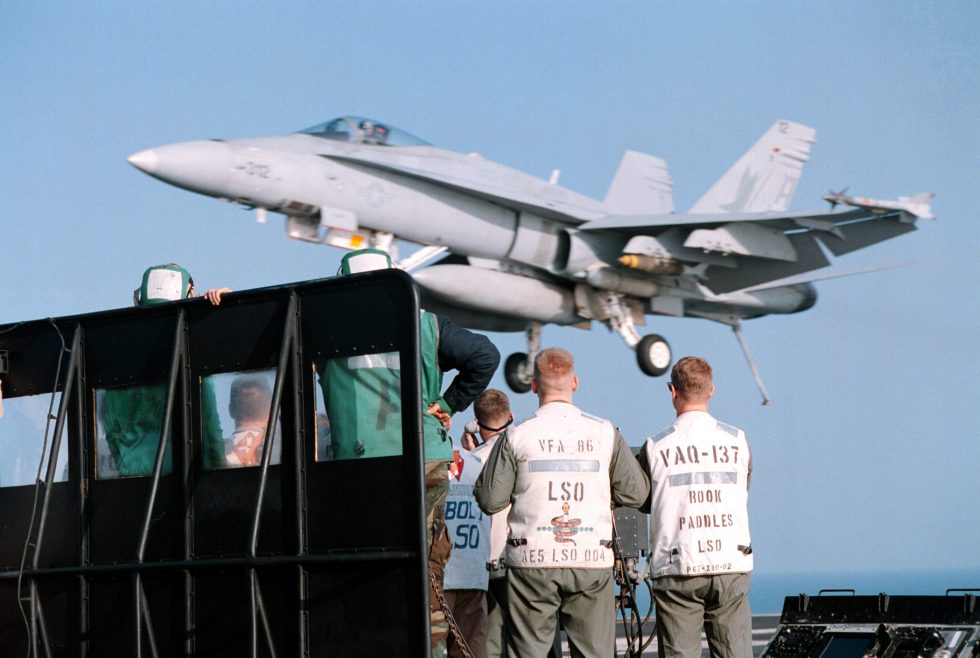
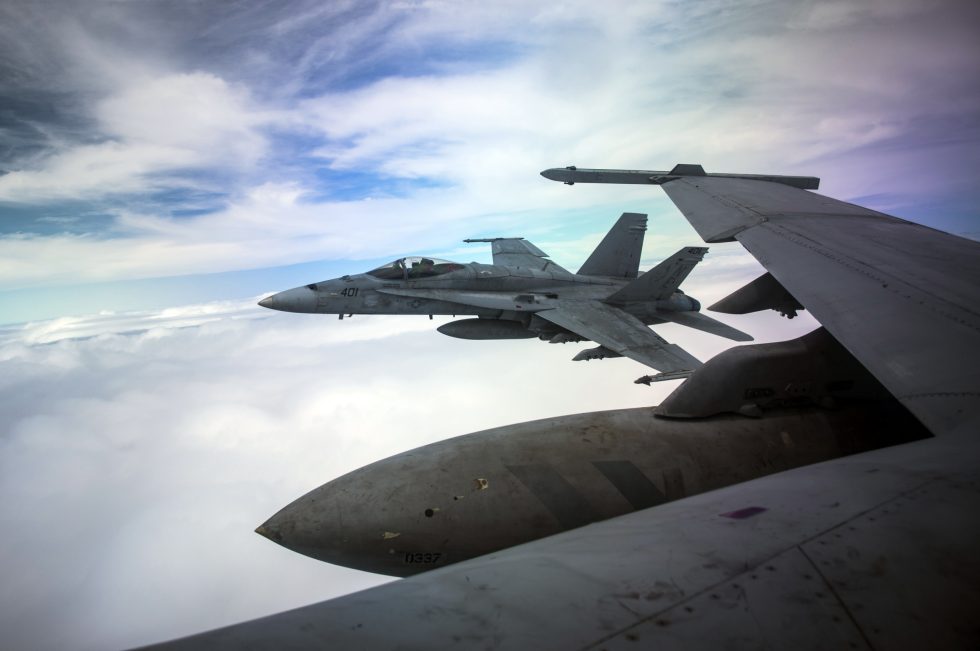
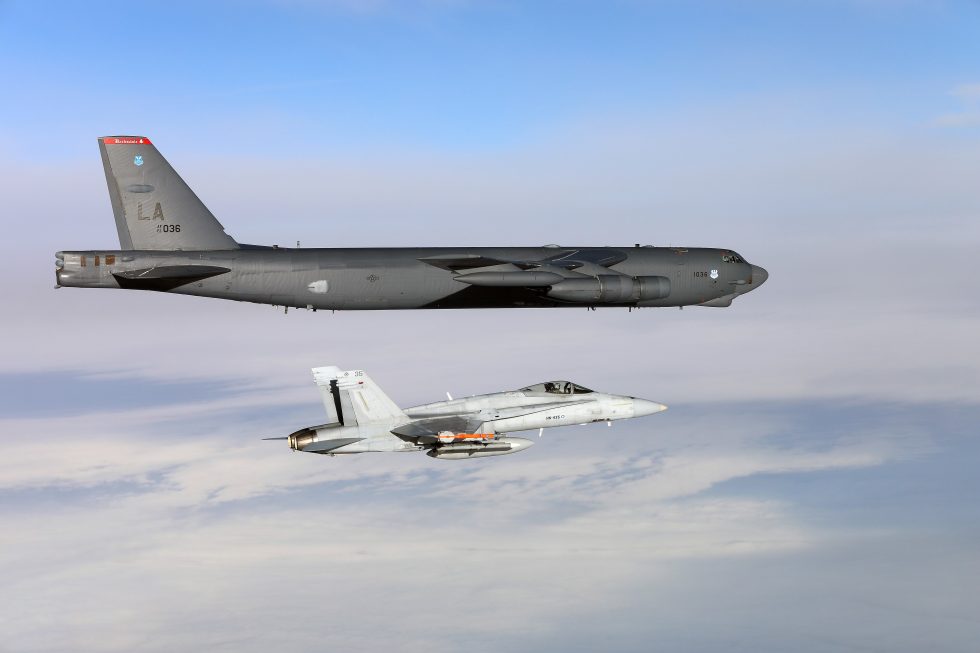
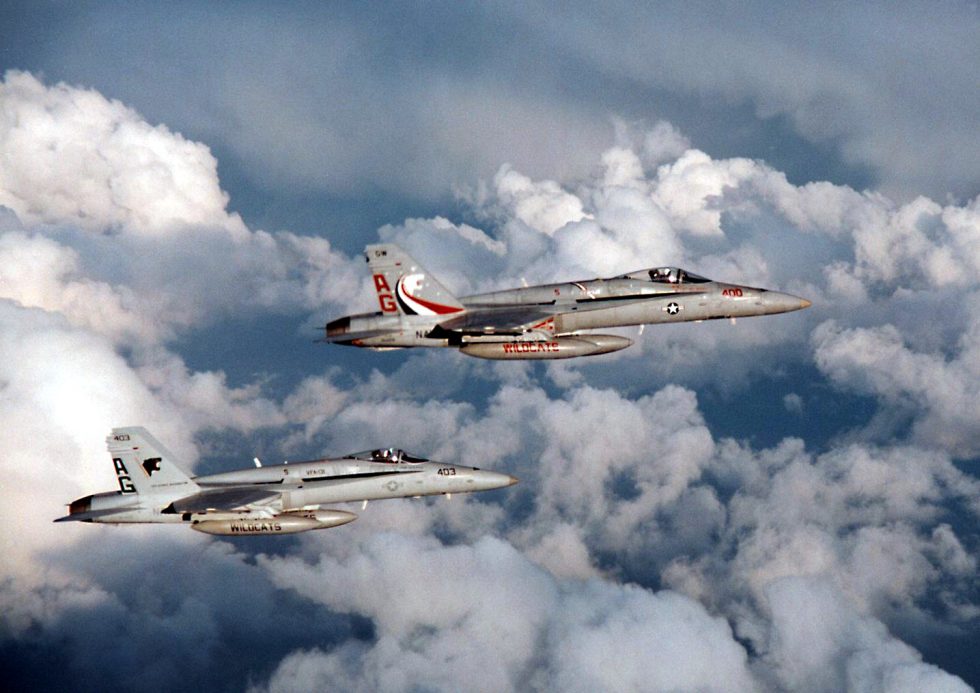
The Hornet in motion
A legacy F/A-18 Hornet video feature is on the way.
The F/A-18 Hornet in motion
DroneScapes — one of the most-watched F/A-18 Hornet films on YouTube.
Where the Hornet flies
Operators
The F/A-18 Hornet became the fighter that small air forces kept flying long after the US Navy had moved on.
Nine services flew the legacy Hornet, but the type’s centre of gravity shifted from the carrier decks it was built for to land-based air forces in Canada, Australia, Spain, Finland, Switzerland, Kuwait and Malaysia, which valued its twin engines, benign handling and ease of upgrade. The US Navy retired its last fleet C-models in 2019 while the Marine Corps, Spain, Canada, Finland and Switzerland still fly the aircraft in the mid-2020s, all of them slowly replacing it with the F-35. Fleet figures mix aircraft delivered, aircraft on strength and airframes actually flying; sources rarely agree to the last airframe.
Current strength, largest fleet first. Where a figure is a range or an estimate the bar is drawn at the middle of it and the number keeps its published form.
In service with
- United States Marine CorpsUnited States · 179 F/A-18C/D on strength in 2024 of roughly 400 A–D delivered; retirement planned by about 2030
- ~180 · 1983–
- Royal Canadian Air ForceCanada · 86 CF-188A/B on strength in 2021 plus 10 ex-RAAF airframes flying by 2025; 138 delivered 1982–88 and 25 ex-Australian aircraft bought from 2019
- ~90 · 1982–
- Spanish Air and Space ForceSpain · 72 EF-18A/B delivered 1986–90 plus 24 ex-US Navy F/A-18A 1995–98
- 85 · 1986–
- Finnish Air ForceFinland · 53 F/A-18C and 7 F/A-18D in 2025 of 64 delivered 1995–2000; withdrawal 2025–30 as the F-35A arrives
- 60 · 1995–
- Kuwait Air ForceKuwait · 27 KAF-18C and 7 KAF-18D in 2021 of 40 delivered 1991–93
- 34 · 1992–
- Swiss Air ForceSwitzerland · 25 F/A-18C and 5 F/A-18D; 34 delivered 1996–99, four lost
- 30 · 1997–
- Royal Malaysian Air ForceMalaysia · 8 F/A-18D delivered 1997; one lost in 2025
- 7 · 1997–
Formerly operated by
- United States NavyUnited States · roughly 1,040 A–D Hornets went to the US Navy and Marine Corps combined; last fleet F/A-18C squadron retired October 2019, the Blue Angels followed in 2020
- ~600 · 1983–2019
- Royal Australian Air ForceAustralia · 57 F/A-18A and 18 F/A-18B delivered 1984–90; formally retired 29 November 2021, 25 airframes sold to Canada
- 75 · 1985–2021
9 operators, 7 current. Dates are first delivery to last retirement, and the basis of the quantity column is stated above. Air forces with a MiGFlug Order of Battle page are linked (8 so far); the rest follow as the database grows.
Combat-proven, under many flags
The legacy Hornet made its combat debut in Operation Desert Storm in 1991 — including the two US Navy MiG-21 kills of 17 January, after which the same Hornets completed their bombing run — and went on to fly thousands of strike sorties. It later served over the Balkans and Kosovo (1999), Iraq (2003 onward) and Afghanistan, flown by US Navy and Marine crews and by allies. Per-nation air-to-air tallies for the legacy jet are small and sometimes contested, so specific claims are best hedged.
Compare the combat record of every military aircraft. Figures as of July 2026.
Everything people ask about the F/A-18 Hornet
Can I fly in an F/A-18 Hornet?
Why is it called “F/A”?
Is the Hornet the same as the Super Hornet?
How fast is the F/A-18 Hornet?
Is it related to the F-16?
Who flies the legacy Hornet now?
Did the F/A-18 Hornet see combat?
Do the Blue Angels fly the Hornet?
You can’t fly the Hornet.
These, you can.
Some legends only live in museums — others are fuelled and waiting. MiGFlug has put civilians in real military jet cockpits since 2004.
 Fly the L-39 AlbatrosThe world’s most-flown jet trainer — aerobatics included
 Fly the F-104 Starfighter“The missile with a man in it”
 Fly the MiG-21The Cold War’s most-produced jet
 Fly the T-33 Shooting StarAmerica’s first jet trainer
 Fly the DH VampireA piece of early jet history
 Fly the S.211Agile Italian jet trainer
 Fly the MB-326The classic Aermacchi jet
 Fly the MiG-15The Soviet legend of the Korean War
Continue the tour
Every fact, checked
- NAVAIR / US NavyOfficial F/A-18 A–D product data and specifications.
- GlobalSecurity.orgF/A-18 specifications and variant history.
- USNA Naval AviationHornet development and service overview.
- The Aviation Geek ClubThe VFA-81 17 January 1991 MiG kills, in detail.
- Vintage Aviation News / Coffee or DieThe Fox & Mongillo dogfight-and-bomb sortie.
- The War Zone (TWZ)Australia’s Classic Hornet retirement, November 2021.
- AeroTime / Australian AviationOperator retirements and F-35 transitions.
- Boeing / McDonnell Douglas heritageOrigins of the YF-17 and F/A-18 program.